Telescope Types & Comparisons
The Best Refractor Telescopes
The shape everybody pictures when they hear the word telescope, and the design that asks the least of its owner. What it costs is light, and the arithmetic says how much.
By Scooter M. · Published · How we pick

A refractor is a lens at the front and an eyepiece at the back, in a sealed tube. There is no mirror to align, nothing open to the air, and nothing that drifts out of adjustment between one session and the next. Point it and it is already as sharp as it is going to be, which is a genuine advantage and the reason this design keeps its following.
It is also the most expensive way to buy aperture, by a wide margin, and this page does not pretend otherwise. What follows is how these are judged, what the trade costs in numbers, and which one to buy for which reason.
How these are judged
- Aperture, first and always. It sets the resolving limit and the light grasp, and no other specification can compensate for it.
- Focal ratio, which in an achromat decides color. A simple two-element lens brings colors to focus at slightly different points, and the error grows as the focal ratio gets faster. A slow refractor shows cleaner bright objects than a fast one of the same aperture.
- The mount, which is usually the weakest part of the package. A refractor sits at the end of a long lever. A tripod that wobbles at 60x makes the aperture irrelevant.
- What is in the box. Supplied eyepieces and diagonals vary enormously here, and a 3x Barlow in a beginner box is usually a magnification claim rather than a useful accessory.
- Honesty about what it cannot do. Every telescope on this page gives up deep sky to a reflector of the same price. A page that hides that is selling, not advising.
What the design actually buys you
- No collimation, ever. The single most common reason a beginner's reflector stops performing is that it drifted out of alignment and nobody noticed. Collimation is not difficult, but it is a thing you have to do, and this design removes it.
- No cool-down and no tube currents. A sealed tube does not churn warm air across the light path the way an open Newtonian does.
- Contrast per millimeter. There is no secondary mirror sitting in the light path, so a refractor gives slightly crisper contrast than a reflector of identical aperture.
- An upright image is available. With an erect-image diagonal these double as daytime instruments, which none of the reflectors here can usefully do. Using a telescope in daylight covers that.
What the design costs, in light
light ratio = (aperture 1 / aperture 2) squared
(203 / 102)squared = 3.96. (102 / 70)squared = 2.12.
The Dobsonian collects nearly four times the light of the largest refractor on this page. Within the page, stepping from 70mm to 102mm doubles the light. Aperture is bought in squares, which is why small increases in millimeters matter more than they look.
That four-to-one ratio is the whole argument against refractors for deep sky, and it is why this site points most first-time buyers at a Dobsonian instead. What it does not settle is the Moon, the planets and double stars, where a modest refractor on a steady mount performs far better than its aperture suggests, and where not having to collimate anything is worth real money.
The published figures, side by side
| Aperture | Focal length | Ratio | Max useful (computed) | Resolving limit | |
|---|---|---|---|---|---|
| AstroMaster 102AZ | 102mm | 660mm | f/6.5 | 204x | 1.14 arcsec |
| NexStar 102SLT | 102mm | 660mm | f/6.47 | 204x | 1.14 arcsec |
| AstroMaster 70AZ | 70mm | 900mm | f/13 | 140x | 1.66 arcsec |
| Travel Scope 70 | 70mm | 400mm | f/5.7 | 140x | 1.66 arcsec |
| NatGeo Sky View 70 | 70mm | 400mm | f/5.7 | 140x | 1.66 arcsec |
Three of these are 70mm and two are 102mm, so the table has only two distinct sets of optical limits in it. What separates the three 70mm telescopes is not what they resolve. It is the focal ratio, the mount and the tripod.
Why two 70mm refractors are not the same telescope
The AstroMaster 70AZ is f/13 and the Travel Scope 70 is f/5.7. Same aperture, same computed limits, and a very different view of a bright object.
The consequence is practical rather than theoretical. If the telescope will mostly look at the Moon and the planets from a garden, the slow one is the better instrument. If it has to fit in a bag, the fast one is the only one of the two that will.
The mount is where beginner refractors are let down
Celestron publishes a 10.8 lb total kit weight for the AstroMaster 70AZ and 3.3 lb for the Travel Scope 70. That second number is the appeal of the travel telescope and also its limitation: 3.3 lb includes a photo-style tripod, and a photo-style tripod at 100x transmits every touch of the focuser into the image.
This is the failure that gets blamed on optics and almost never is. A sharp telescope on a shaking tripod produces a soft, jittery image and the owner concludes the telescope is poor. Why mounts decide everything is the page on that, and it applies more sharply to refractors than to any other design.
How this is funded: the buy buttons below are Amazon Associates links, and a qualifying purchase earns us a commission at no extra cost to you. It cannot move the ranking, because the order here is set by aperture per dollar, and no commission rate changes how much light a mirror collects. Full disclosure.
| # | Telescope | Best for | Aperture | Price |
|---|---|---|---|---|
| 1 | 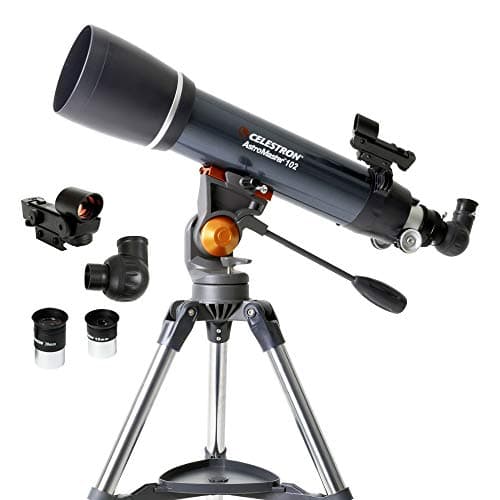 Celestron AstroMaster 102AZTop pick102mm of refractor at f/6.5, which means a short tube and a wide field. A no-maintenance scope with real aperture behind it. | Wide-field refractor views | 102mm (4 in)204x useful | |
| 2 | 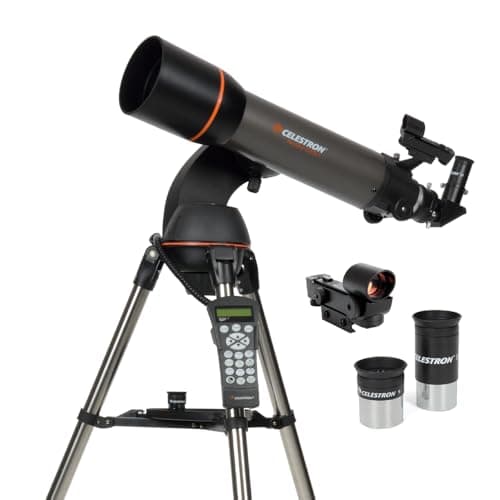 Celestron NexStar 102SLT102mm of refractor at f/6.47 on a computerized fork. Nothing to collimate, nothing to cool down, and it drives itself to the target. | A refractor that finds things for you | 102mm (4.02")204x useful | |
| 3 | 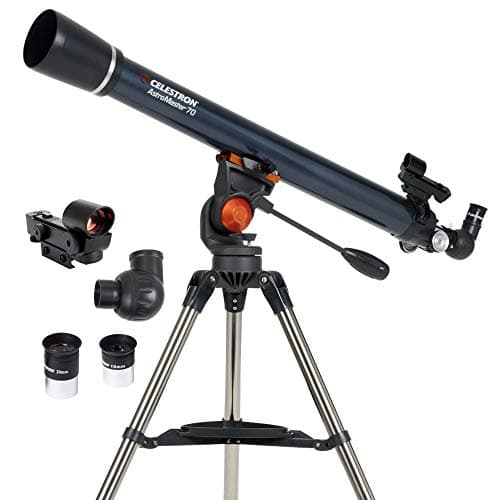 Celestron AstroMaster 70AZ70mm of refractor optics at f/13, on a steel tripod. A long, slow tube that trades field of view and weight for cleaner views of the Moon and planets. | The smallest scope worth owning | 70mm (2.76 in)140x useful | |
| 4 | 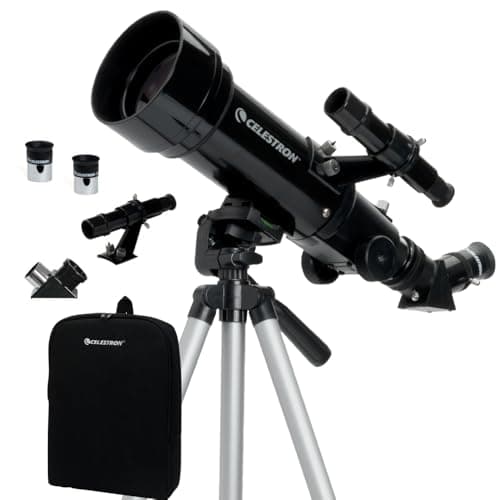 Celestron Travel Scope 7070mm at f/5.7 with a backpack. A daytime spotting scope that moonlights at night, rather than the other way round. | Packing light | 70mm (2.8 in)140x useful | |
| 5 | 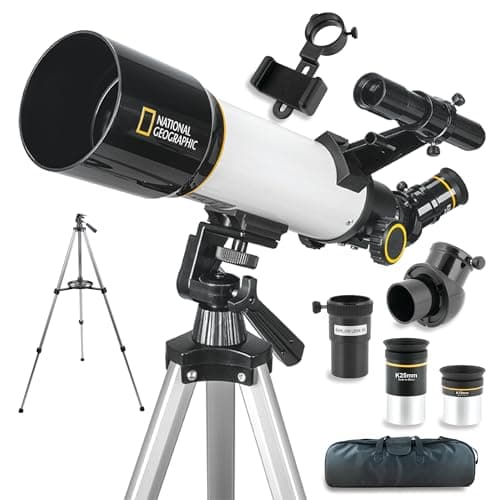 National Geographic Sky View 70mm RefractorA 70mm refractor on a panhandle mount, branded for the shelf it will be bought from. Honest optics inside a gift box. | A gift that looks like a gift | 70mm140x useful |
Top pick · Wide-field refractor views
Celestron AstroMaster 102AZ
102mm of refractor at f/6.5, which means a short tube and a wide field. A no-maintenance scope with real aperture behind it.
What the aperture allows
- Maximum useful magnification
- 204x
- 2 × 102mm of aperture
- Resolving limit (Dawes)
- 1.14 arcseconds
- 116 ÷ 102mm
- Cassini division (0.7″)
- Out of reach
- this aperture cannot resolve it
Celestron publishes 241x as this telescope’s highest useful magnification. Our figure is 204x, from two times the aperture in millimeters. The gap of 37x comes from the slightly more generous per-inch constant makers use. Neither number describes a typical night: the atmosphere usually settles the question well below both.
Worked example: a 25mm eyepiece in this telescope gives 660mm ÷ 25mm = 26x.
102mm collects 2.1 times the light of a 70mm refractor, which is the ratio 102 over 70, squared. That is the difference between the Orion Nebula as a smudge and the Orion Nebula as a shape.
Two times 102mm gives 204x of useful magnification; Celestron publishes 241x. Its published Dawes limit of 1.14 arcseconds is short of the Cassini division, so expect the rings as a clean separated ring rather than a ring with a gap in it.
The short f/6.5 tube is the interesting part. It gives a wide true field for a refractor, which makes large open clusters and Milky Way star fields genuinely rewarding, and it keeps the tube short enough to be easy to handle.
Refractor maintenance is the real selling point for a household that will not enjoy collimating anything. There is nothing to align and nothing to clean.
What it does well
- Real aperture with zero maintenance
- Wide field for a refractor: good on clusters as well as planets
- Short tube balances easily on a simple mount
What it costs you
- A fast achromat shows more color fringing on bright objects than an f/10 tube
- The AZ mount is basic; expect to nudge rather than glide
- Still 102mm, so faint galaxies remain out of reach
Skip this one if: Skip it if the planets are the whole point. A long f/10 refractor or a Dobsonian will show them with less false color.
$359.95 · 11% off
#ad · how this is funded · price as of September 21, 2026
Pick 2 · A refractor that finds things for you
Celestron NexStar 102SLT
102mm of refractor at f/6.47 on a computerized fork. Nothing to collimate, nothing to cool down, and it drives itself to the target.
What the aperture allows
- Maximum useful magnification
- 204x
- 2 × 102mm of aperture
- Resolving limit (Dawes)
- 1.14 arcseconds
- 116 ÷ 102mm
- Cassini division (0.7″)
- Out of reach
- this aperture cannot resolve it
Celestron publishes 241x as this telescope’s highest useful magnification. Our figure is 204x, from two times the aperture in millimeters. The gap of 37x comes from the slightly more generous per-inch constant makers use. Neither number describes a typical night: the atmosphere usually settles the question well below both.
Worked example: a 25mm eyepiece in this telescope gives 660mm ÷ 25mm = 26x.
Two times 102mm gives 204x. Celestron publishes 241x, and Dawes' limit is 1.14 arcseconds, which the maker's own figure matches exactly. At 1.14 arcseconds the Cassini division, at about 0.7, is out of reach: this telescope shows Saturn's rings as rings, not as rings with a gap in them.
The refractor advantage is that none of this needs maintenance. There is no mirror to collimate, no open tube for the air to churn inside, and the optics are sealed. Point it at something and it is already as sharp as it is going to be.
At 660mm the supplied 25mm eyepiece gives 26x and the 9mm gives 73x. Exit pupil at 26x is 102 / 26 = 3.9mm, which is bright and comfortable, and the widest field here is genuinely wide for a computerized telescope.
The 15.5 lb kit weight is the real argument for this one. It is the only telescope on this site that both finds objects by itself and can be carried outside in one trip without thinking about it.
What it does well
- Nothing to collimate and no cool-down, ever
- 15.5 lb total, so the GoTo convenience does not cost you portability
- A genuinely wide lowest power at 26x for a computerized telescope
What it costs you
- 102mm cannot resolve the Cassini division at 1.14 arcseconds
- An achromatic refractor shows some color fringing on the Moon and bright planets
- Needs batteries or mains power, and an alignment on named stars each session
Skip this one if: Skip it if deep sky is the point. 102mm and a limiting magnitude of 12.5 is a modest light bucket, and a 200mm Dobsonian collects 3.8 times more light than it does.
#ad · how this is funded · price as of September 21, 2026
Pick 3 · The smallest scope worth owning
Celestron AstroMaster 70AZ
70mm of refractor optics at f/13, on a steel tripod. A long, slow tube that trades field of view and weight for cleaner views of the Moon and planets.
What the aperture allows
- Maximum useful magnification
- 140x
- 2 × 70mm of aperture
- Resolving limit (Dawes)
- 1.66 arcseconds
- 116 ÷ 70mm
- Cassini division (0.7″)
- Out of reach
- this aperture cannot resolve it
Celestron publishes 165x as this telescope’s highest useful magnification. Our figure is 140x, from two times the aperture in millimeters. The gap of 25x comes from the slightly more generous per-inch constant makers use. Neither number describes a typical night: the atmosphere usually settles the question well below both.
Worked example: a 25mm eyepiece in this telescope gives 900mm ÷ 25mm = 36x.
70mm is the floor. Below it a telescope struggles to beat a decent pair of binoculars, and that is a real comparison rather than a rhetorical one. Two times 70mm gives 140x of useful magnification; Celestron publishes 165x.
The defining number is the focal length. Celestron publishes 900mm, which at 70mm is f/13, an unusually slow ratio for a beginner refractor. A slow achromat brings the colors closer to a common focus, so the violet fringe on the Moon and on Jupiter is smaller than on a faster tube of the same aperture.
The same slow ratio narrows the field. At 45x with the supplied 20mm eyepiece, large star clusters that fit comfortably in a short refractor will not fit here, and finding things takes a steadier hand on the red dot finder.
It is also a large, heavy package for 70mm of aperture: a 685mm tube and a published 10.8 lb kit. That buys a steadier steel tripod than the lightest travel telescopes carry, and it costs portability.
What it does well
- Sealed tube: no collimation, no mirror cleaning, essentially no maintenance
- At f/13, less false color on the Moon and bright planets than a faster 70mm tube
- A steel tripod that is steadier than the lightweight tripods on travel telescopes
- The supplied eyepieces give 45x and 90x, a useful planetary range with no extra purchase
What it costs you
- 70mm collects too little light for galaxies and most nebulae
- The f/13 focal ratio narrows the field, so large clusters and finding things are harder
- A published 10.8 lb and a 685mm tube is a lot to carry for 70mm of aperture
- Chromatic aberration is reduced at f/13, not eliminated
Skip this one if: Skip it if what you actually want is deep sky, or a telescope you can carry easily. No eyepiece will make 70mm show you a spiral arm, and a travel refractor does the carrying better.
$199.95 · 15% off
#ad · how this is funded · price as of September 21, 2026
Pick 4 · Packing light
Celestron Travel Scope 70
70mm at f/5.7 with a backpack. A daytime spotting scope that moonlights at night, rather than the other way round.
What the aperture allows
- Maximum useful magnification
- 140x
- 2 × 70mm of aperture
- Resolving limit (Dawes)
- 1.66 arcseconds
- 116 ÷ 70mm
- Cassini division (0.7″)
- Out of reach
- this aperture cannot resolve it
Celestron publishes 168x as this telescope’s highest useful magnification. Our figure is 140x, from two times the aperture in millimeters. The gap of 28x comes from the slightly more generous per-inch constant makers use. Neither number describes a typical night: the atmosphere usually settles the question well below both.
Worked example: a 25mm eyepiece in this telescope gives 400mm ÷ 25mm = 16x.
3.3 pounds for the whole kit including the tripod is the entire pitch. Nothing else here goes in hand luggage.
The optics are the same 70mm as the AstroMaster LT but at f/5.7 rather than f/10, so the tube is much shorter and the widest field is much wider. That is good for landscapes and star fields and less good for the planets, where the shorter focal length shows more false color.
Two times 70mm gives 140x of useful magnification and Celestron publishes 168x. The published Dawes limit of 1.66 arcseconds means no Cassini division and no tight doubles.
The tripod is the weak link and everybody who owns one says so. It is a photo tripod carrying a telescope, and above about 60x it shakes. If you already own a decent tripod, use that instead.
What it does well
- Genuinely packable: 3.3 lb with the tripod, in a supplied backpack
- Doubles as a daytime spotting scope, which is where a lot of its use will come from
- A wide field at f/5.7 makes finding things easy
What it costs you
- The included tripod is not steady enough above modest magnification
- A short-focus achromat shows visible color fringing on the Moon and Jupiter
- 70mm is the aperture floor, and this one is optimized for portability over performance
Skip this one if: Skip it if it never actually leaves the house. At home, the same money buys a tabletop Dobsonian with twice the aperture and a mount that does not shake.
$119.95 · 25% off
#ad · how this is funded · price as of September 21, 2026
Pick 5 · A gift that looks like a gift
National Geographic Sky View 70mm Refractor
A 70mm refractor on a panhandle mount, branded for the shelf it will be bought from. Honest optics inside a gift box.
What the aperture allows
- Maximum useful magnification
- 140x
- 2 × 70mm of aperture
- Resolving limit (Dawes)
- 1.66 arcseconds
- 116 ÷ 70mm
- Cassini division (0.7″)
- Out of reach
- this aperture cannot resolve it
National Geographic publishes 120x as this telescope’s highest useful magnification. Our figure is 140x, from two times the aperture in millimeters. The two figures agree closely, which is the case whenever a maker states its ceiling honestly.
Worked example: a 25mm eyepiece in this telescope gives 400mm ÷ 25mm = 16x.
70mm of refractor aperture puts this at the floor of what is worth owning, and the same arithmetic applies as to every other 70mm on this site: 140x of useful magnification at the 2x rule, and a Dawes limit of 1.66 arcseconds.
The panhandle mount is the differentiator. A single handle that moves in both axes is far more intuitive for a child, or for an adult who has never used a telescope, than either a slow-motion alt-azimuth head or an equatorial one.
National Geographic publishes a 400mm focal length, which at 70mm gives f/5.7, and advertises 16x, 40x, 48x and 120x. Those four figures check out exactly against 25mm and 10mm eyepieces with the supplied 3x Barlow, and the top one sits under the 140x this aperture supports — which is not what the bottom of this market usually does.
As a gift this earns its place on presentation and on the mount. As an instrument it is a 70mm refractor, which means the Moon, the bright planets and not much else.
What it does well
- The panhandle mount is genuinely the easiest way for a beginner to aim a telescope
- 70mm of real refractor aperture rather than a 50mm toy
- Presents well as a gift, which matters more than enthusiasts like to admit
What it costs you
- A fast f/5.7 achromat shows false color on the Moon and the bright planets
- 70mm limits it to the Moon and the bright planets
- Branded packaging is part of what you are paying for
Skip this one if: Skip it if the recipient is already interested in astronomy rather than being introduced to it. They will want aperture, not a panhandle.
$49.99 · 20% off
#ad · how this is funded · price as of September 21, 2026
What none of these will do
- Resolve the Cassini division. The best of them computes to 1.14 arcseconds and the gap needs about 0.7. Saturn's rings will look like rings, with no gap in them, in every telescope on this page.
- Show galaxies with structure. 102mm collects a quarter of what an 8-inch Dobsonian does. The brighter Messier objects are visible; detail inside them mostly is not. What you can see is specific about the thresholds.
- Reach their own maximum magnification most nights. The atmosphere usually settles that argument long before the aperture does, which is the magnification myth in practice.
Which to buy
- The AstroMaster 102AZ if you want the most refractor here and a simple mount you can point without thinking. It is the top pick because 102mm is where this design starts to show planetary detail worth the price. The full review.
- The NexStar 102SLT if you want that same 102mm lens to find objects by itself. Celestron publishes 15.5 lb for the whole kit, which makes it the only telescope on this site that both drives itself and is genuinely easy to carry. How GoTo telescopes compare.
- The AstroMaster 70AZ if the budget is firm and the target is the Moon. At f/13 it is the best-corrected achromat here. The full review.
- The Travel Scope 70 if it has to travel. 3.3 lb and a 400mm tube go in hand luggage, and it doubles as a spotting scope. The full review.
- The NatGeo Sky View 70 as a first telescope for a child, with the 3x Barlow in the box treated as packaging rather than equipment. The full review.
And if none of those reasons apply to you, buy a reflector. The honest summary of this page is that a refractor is the right answer when maintenance, weight or daylight use matters more than faint objects, and the wrong answer when it does not. Refractor against reflector works that decision through from the beginning.
Questions people actually ask
What is the best refractor telescope for beginners?
The Celestron AstroMaster 102AZ, if the budget reaches it. 102mm computes to 204x of useful magnification and a 1.14-arcsecond resolving limit, which is the point where a refractor starts showing planetary detail worth paying for, and its alt-azimuth mount is simple to aim. Below that, the AstroMaster 70AZ at f/13 is the better-corrected of the 70mm options.
Are refractor telescopes better than reflectors?
They are better at requiring nothing of you: no collimation, no cool-down, no open tube. They are much worse at collecting light for the money. An 8-inch reflector collects nearly four times what a 102mm refractor does, so for faint objects the reflector wins decisively and for convenience and bright targets the refractor holds its own.
Why do cheap refractors show colored fringes?
A simple two-element achromatic lens does not bring every wavelength to focus at the same point, and the error grows as the focal ratio gets faster. A 70mm at f/5.7 shows a visible violet fringe on the Moon and Venus; the same aperture at f/13 shows much less, because the slower cone of light reduces the error.
What can you see with a 70mm refractor?
Lunar craters and mountains in real detail, the phases of Venus, Jupiter's four bright moons and its two main belts, Saturn's rings as rings with no gap visible, and the brighter open clusters. At 1.66 arcseconds of resolving limit and 140x of useful magnification it is a Moon and planets telescope, not a deep-sky one.
Do refractor telescopes need collimation?
No. The lens is fixed in its cell at the factory and there is no user alignment to perform, which is the single biggest practical advantage of the design for someone who does not want to maintain equipment.
Read next
Refractor vs Reflector: Which Should You Buy?
Aperture against maintenance, with the light-gathering arithmetic worked out and a stated verdict.
Top pick: Sky-Watcher Heritage 130 Tabletop Dobsonian
#ad · how this is funded · price as of September 21, 2026
Celestron AstroMaster 102AZ
102mm of refractor at f/6.5 on a simple mount. Wide fields and zero maintenance, paid for in false color on bright targets.
Top pick: Celestron AstroMaster 102AZ
$359.95 · 11% off
#ad · how this is funded · price as of September 21, 2026
Best GoTo
The Best GoTo Telescopes
Computerized telescopes ranked on what the motors cost in aperture, whether they track as well as find, and what they need to run.
Top pick: Sky-Watcher Virtuoso GTi 130P
#ad · how this is funded · price as of September 21, 2026
Found something wrong here? Tell us and we will correct it and date the correction, per our editorial policy.