Aperture, Magnification & First Light
The Magnification Myth: Why 525x Means Nothing
Magnification is set by the eyepiece, not by the telescope, so any telescope can reach any magnification. What it cannot do is show detail it never collected in the first place.
By Scooter M. · Published · How we pick
A box advertising 525x is telling you it ships a very short eyepiece. It is telling you nothing at all about the telescope. Magnification is set by which eyepiece you fit, so any telescope can technically reach any magnification, including magnifications at which the image is a dim wobbling smear.
Where magnification actually comes from
magnification = telescope focal length / eyepiece focal length
A 650mm telescope with a 25mm eyepiece: 650 / 25 = 26x. With a 10mm eyepiece: 650 / 10 = 65x.
Both numbers are printed on the equipment: the focal length on the telescope tube, the eyepiece's on its side. Celestron publishes exactly these two figures for its StarSense Explorer DX 130AZ, and 26x and 65x are its own stated values.
Notice what is not in that formula: aperture. The telescope's mirror or lens has no role in setting magnification at all, which is precisely why magnification tells you nothing about the telescope's capability.
The ceiling, and where it comes from
What aperture does set is the point past which extra magnification adds nothing. Beyond it the image gets bigger and dimmer while the detail stays exactly where it was, because the detail was never collected.
maximum useful magnification = 2 x aperture in millimeters
60mm: 120x. 70mm: 140x. 130mm: 260x. 200mm: 400x.
Roughly 50x per inch of aperture, which is the same rule in imperial units. This is the number the box claim should be measured against, and it is published by manufacturers as well: Celestron's own figures for its telescopes appear in the table below.
What magnification are you actually getting?
Magnification is the telescope’s focal length divided by the eyepiece’s focal length. Both numbers are printed on the equipment. The box is not part of the calculation.
On the tube or in the manual
The diameter of the lens or mirror
Printed on the side of the eyepiece
Halves the eyepiece focal length
- You get
- 65x
- 650 ÷ 10mm
- This aperture supports
- 260x
- 2 × 130mm
- Exit pupil
- 2.0mm
- 130 ÷ 65x
That is inside the useful range. The exit pupil of 2.0mm fits comfortably inside a dark-adapted pupil, so you are using all the light the telescope collects.
What the manufacturers themselves publish
This is worth showing, because it is one place where the makers are more honest than the retail listings. Celestron publishes a maximum useful magnification for almost every telescope it sells, and those figures sit far below the numbers that appear on some third-party listings for the same products.
| Telescope | Aperture | 2x aperture | Maker's published figure |
|---|---|---|---|
| Celestron AstroMaster 70AZ | 70mm | 140x | 165x |
| Celestron FirstScope 76 | 76mm | 152x | 180x |
| Celestron AstroMaster 102AZ | 102mm | 204x | 241x |
| Celestron StarSense LT 114AZ | 114mm | 228x | 269x |
| Celestron PowerSeeker 127EQ | 127mm | 254x | 300x |
| Celestron StarSense DX 130AZ | 130mm | 260x | 307x |
| Celestron NexStar 6SE | 150mm | 300x | 354x |
The makers' figures run consistently above the 2x rule, because they compute per inch of aperture with a slightly more generous constant. Neither column describes a typical night: the atmosphere usually settles the question well below both.
The magnification you will actually use
- Finding anything: 20x to 40x. The widest field is the finding field, and this is where most of a session is spent.
- Deep-sky objects: 30x to 80x. These are large and faint, and low power gives a brighter, wider view. Why.
- The Moon: 50x to 150x. More than enough for craters, central peaks and terminator shadows.
- Planets: one to one-and-a-half times the aperture in millimeters. So 130x to 200x on a 130mm telescope, on a good night.
- Above two times the aperture: never usefully. The image is bigger, dimmer and no more detailed.
Why the atmosphere usually decides it anyway
Astronomical seeing is the blurring caused by turbulence in Earth's atmosphere. On an average night it limits detail to 2 or 3 arcseconds regardless of the telescope, which is coarser than the resolving limit of every aperture on this site.
In practice the useful magnification on a given night is usually well below the theoretical ceiling. Work up in steps and stop when the image softens; that point, not the number on the box, is your telescope's real maximum tonight. A Barlow multiplies whatever eyepiece is in it and will sail past that ceiling without complaining, so work the arithmetic first.
The companion myth is distance. A box that promises to show you objects millions of light-years away is telling the truth and saying nothing, because distance is not what limits a telescope — brightness is. There is one pair of targets where pushing magnification hard really is correct, and the ice giants explains why they are the exception.
How this is funded: the buy buttons below are Amazon Associates links, and a qualifying purchase earns us a commission at no extra cost to you. It cannot move the ranking, because the order here is set by aperture per dollar, and no commission rate changes how much light a mirror collects. Full disclosure.
| # | Telescope | Best for | Aperture | Price |
|---|---|---|---|---|
| 1 | 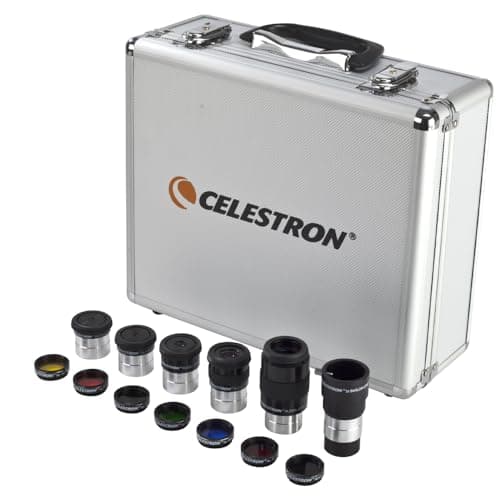 Celestron Eyepiece, Barlow and Filter Kit (1.25")Top pickFive Plossl eyepieces from 32mm down to 6mm plus a 2x Barlow. This is the accessory that actually changes what you see. | The upgrade that changes the most | 1.25" barrel64x useful | |
| 2 | 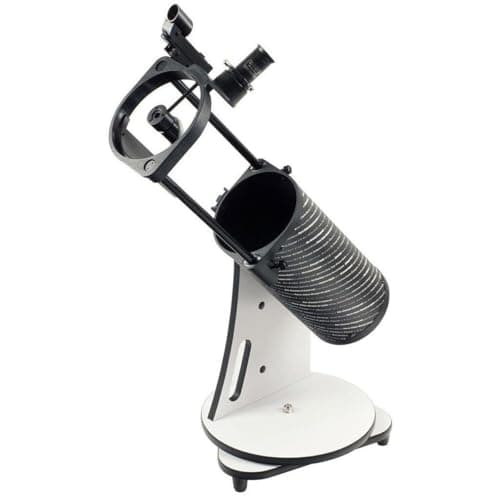 Sky-Watcher Heritage 130 Tabletop DobsonianThe same 130mm parabolic mirror as scopes costing far more, on a base with no tripod to wobble and nothing to set up. | Most aperture per dollar | 130mm260x useful | |
| 3 | 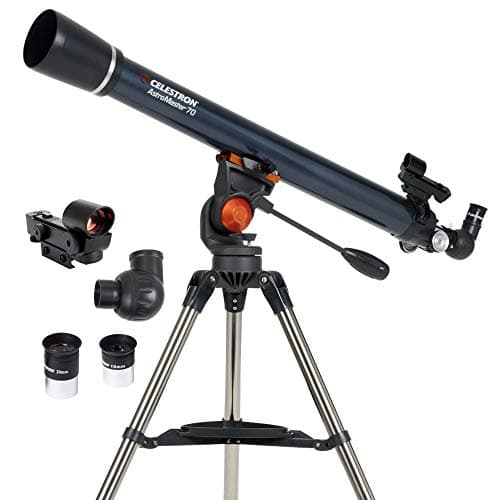 Celestron AstroMaster 70AZ70mm of refractor optics at f/13, on a steel tripod. A long, slow tube that trades field of view and weight for cleaner views of the Moon and planets. | The smallest scope worth owning | 70mm (2.76 in)140x useful |
Top pick · The upgrade that changes the most
Celestron Eyepiece, Barlow and Filter Kit (1.25")
Five Plossl eyepieces from 32mm down to 6mm plus a 2x Barlow. This is the accessory that actually changes what you see.
What the aperture allows
- Maximum useful magnification
- 64x
- 2 × 31.75mm of aperture
- Resolving limit (Dawes)
- 3.65 arcseconds
- 116 ÷ 31.75mm
- Cassini division (0.7″)
- Out of reach
- this aperture cannot resolve it
Magnification is telescope focal length divided by eyepiece focal length, so this kit is the variable in that equation. On a 650mm f/5 telescope the 32mm gives 20x, the 13mm gives 50x and the 6mm gives 108x. On a 1200mm Dobsonian the same three give 38x, 92x and 200x.
The 2x Barlow halves every eyepiece's effective focal length, which is where the ten-eyepieces-in-one claim comes from. It is true arithmetic, but a Barlow on a 6mm eyepiece produces 3mm, and on most beginner telescopes 3mm is beyond the useful magnification the aperture supports.
The useful lesson is that the two eyepieces in the telescope's box are usually the two least considered items in it. A 32mm Plossl in a fast Dobsonian gives a genuinely wide, bright field that no bundled eyepiece will match.
A moon filter is not optional at full Moon in anything over about 100mm. The Moon at 130mm is uncomfortably bright, and that is not a figure of speech.
What it does well
- Covers the whole useful magnification range in one purchase rather than five
- Plossl is a well-corrected classic design at a price where the alternatives are not
- The moon filter alone earns its place in anything over 100mm
What it costs you
- The shortest eyepieces exceed the useful magnification of a small telescope
- Plossl eye relief at 6mm is tight, which is awkward for spectacle wearers
- Several of the colored planetary filters see very little use
Skip this one if: Skip it if your telescope has a 2-inch focuser and you would rather put the money toward one good wide-field 2-inch eyepiece.
| Optical design | Five 1.25-inch four-element Plossl eyepieces, a 2x Barlow and seven filtersSource: Celestron Eyepiece, Barlow and Filter Kit — the brand's own listing on Amazon.com (retrieved September 1, 2026) |
|---|---|
| Aperture | 1.25" barrelThe fitting size, not a light-collecting aperture. Check your focuser takes 1.25-inch eyepieces.Source: Celestron Eyepiece, Barlow and Filter Kit — the brand's own listing on Amazon.com (retrieved September 1, 2026) |
| Eyepieces supplied | 32mm, 17mm, 13mm, 8mm and 6mm Plossl, each with a 52-degree apparent fieldSource: Celestron Eyepiece, Barlow and Filter Kit — the brand's own listing on Amazon.com (retrieved September 1, 2026) |
| Barlow | 2x, which doubles the magnification of every eyepiece in the caseSource: Celestron Eyepiece, Barlow and Filter Kit — the brand's own listing on Amazon.com (retrieved September 1, 2026) |
| Filters | A moon filter plus the common colored planetary filtersSource: Celestron Eyepiece, Barlow and Filter Kit — the brand's own listing on Amazon.com (retrieved September 1, 2026) |
$239.95 · 8% off
#ad · how this is funded · price as of October 19, 2026
Pick 2 · Most aperture per dollar
Sky-Watcher Heritage 130 Tabletop Dobsonian
The same 130mm parabolic mirror as scopes costing far more, on a base with no tripod to wobble and nothing to set up.
What the aperture allows
- Maximum useful magnification
- 260x
- 2 × 130mm of aperture
- Resolving limit (Dawes)
- 0.89 arcseconds
- 116 ÷ 130mm
- Cassini division (0.7″)
- Out of reach
- this aperture cannot resolve it
Worked example: a 25mm eyepiece in this telescope gives 650mm ÷ 25mm = 26x.
This is the aperture-per-dollar champion of the beginner shelf and it is not close. You get the same 130mm parabolic mirror found in telescopes at twice the price, and you get it without paying for a tripod, a slow-motion assembly or a hand controller.
Two times 130mm is 260x of useful magnification. Dawes' limit at 130mm works out to 116 divided by 130, which is 0.89 arcseconds. The Cassini division in Saturn's rings spans roughly 0.7 arcseconds at its widest, so this telescope sits right at the edge of showing it on a still night and will show the rings themselves easily.
The catch is the word tabletop. It needs a surface at roughly chest height when you are seated. A garden table works, a plastic patio chair does not, and buying one without thinking about where it will stand is the single most common regret with this design.
The tube collapses, which is what makes it live in a cupboard rather than a garage. That matters more than it sounds: the telescope you can carry outside in one trip is the telescope you use.
What it does well
- The most aperture you can buy at this price, by a clear margin
- Nothing to assemble, no tripod to wobble, ready in the time it takes to carry it outside
- Collapsible tube stores in a cupboard and keeps its collimation
- The Dobsonian motion is intuitive: you push the tube where you want to look
What it costs you
- Needs a solid table or stool at the right height, which is a real constraint
- The helical focuser is coarser than a rack-and-pinion or a Crayford
- Open tube design collects dust and needs the odd mirror clean
Skip this one if: Skip it if you have nowhere to stand it. On the ground it points at treetops, and on a wobbly plastic table every view shakes.
$305.00 · 12% off
#ad · how this is funded · price as of October 19, 2026
Pick 3 · The smallest scope worth owning
Celestron AstroMaster 70AZ
70mm of refractor optics at f/13, on a steel tripod. A long, slow tube that trades field of view and weight for cleaner views of the Moon and planets.
What the aperture allows
- Maximum useful magnification
- 140x
- 2 × 70mm of aperture
- Resolving limit (Dawes)
- 1.66 arcseconds
- 116 ÷ 70mm
- Cassini division (0.7″)
- Out of reach
- this aperture cannot resolve it
Celestron publishes 165x as this telescope’s highest useful magnification. Our figure is 140x, from two times the aperture in millimeters. The gap of 25x comes from the slightly more generous per-inch constant makers use. Neither number describes a typical night: the atmosphere usually settles the question well below both.
Worked example: a 25mm eyepiece in this telescope gives 900mm ÷ 25mm = 36x.
70mm is the floor. Below it a telescope struggles to beat a decent pair of binoculars, and that is a real comparison rather than a rhetorical one. Two times 70mm gives 140x of useful magnification; Celestron publishes 165x.
The defining number is the focal length. Celestron publishes 900mm, which at 70mm is f/13, an unusually slow ratio for a beginner refractor. A slow achromat brings the colors closer to a common focus, so the violet fringe on the Moon and on Jupiter is smaller than on a faster tube of the same aperture.
The same slow ratio narrows the field. At 45x with the supplied 20mm eyepiece, large star clusters that fit comfortably in a short refractor will not fit here, and finding things takes a steadier hand on the red dot finder.
It is also a large, heavy package for 70mm of aperture: a 685mm tube and a published 10.8 lb kit. That buys a steadier steel tripod than the lightest travel telescopes carry, and it costs portability.
What it does well
- Sealed tube: no collimation, no mirror cleaning, essentially no maintenance
- At f/13, less false color on the Moon and bright planets than a faster 70mm tube
- A steel tripod that is steadier than the lightweight tripods on travel telescopes
- The supplied eyepieces give 45x and 90x, a useful planetary range with no extra purchase
What it costs you
- 70mm collects too little light for galaxies and most nebulae
- The f/13 focal ratio narrows the field, so large clusters and finding things are harder
- A published 10.8 lb and a 685mm tube is a lot to carry for 70mm of aperture
- Chromatic aberration is reduced at f/13, not eliminated
Skip this one if: Skip it if what you actually want is deep sky, or a telescope you can carry easily. No eyepiece will make 70mm show you a spiral arm, and a travel refractor does the carrying better.
$199.95 · 10% off
#ad · how this is funded · price as of October 19, 2026
Questions people actually ask
How do you calculate telescope magnification?
Divide the telescope's focal length by the eyepiece's focal length. A 650mm telescope with a 25mm eyepiece gives 26x. Both numbers are printed on the equipment, and the telescope's aperture plays no part in the calculation.
What is the maximum useful magnification of a telescope?
About two times the aperture in millimeters, or 50x per inch. A 70mm telescope tops out near 140x and a 200mm near 400x. Past that the image gets larger and dimmer without gaining detail, because the detail was never collected.
Why do telescope boxes advertise 525x?
Because it is technically achievable by supplying a very short eyepiece, and because it is the number that sells on a shelf. It says nothing about the optics. On a 60mm telescope 525x produces a dim, blurred, wobbling image.
What magnification do I need to see Saturn's rings?
About 70x. Below roughly 40x Saturn looks like a small oval; at 70x the ring separation is unmistakable. A 700mm telescope with a 10mm eyepiece gives exactly 70x. More on Saturn.
Does a Barlow lens increase magnification?
Yes, a 2x Barlow doubles the magnification of any eyepiece it is used with. That is genuinely useful in the middle of the range and pointless at the short end, where the result exceeds what the aperture can support.
Why does higher magnification make the image dimmer?
Because the same collected light is spread over a larger apparent image. The telescope gathers a fixed amount of light, and magnifying further dilutes it across more of your field of view.
Read next
Telescope Aperture: What It Is and What It Buys
What aperture is, what each size can resolve, and a calculator that runs the numbers on your own telescope.
Top pick: Sky-Watcher Heritage 130 Tabletop Dobsonian
$305.00 · 12% off
#ad · how this is funded · price as of October 19, 2026
Best accessory upgrade
Telescope Eyepieces: Which Ones You Actually Need
Which eyepiece focal lengths suit your telescope, what exit pupil means, and the cheapest real upgrade available.
Top pick: Celestron Eyepiece, Barlow and Filter Kit (1.25")
$239.95 · 8% off
#ad · how this is funded · price as of October 19, 2026
What to Avoid When Buying a First Telescope
The six traps that produce a disappointing first telescope, each one checkable from the product listing before you buy.
Top pick: Celestron FirstScope 76
#ad · how this is funded · price as of October 19, 2026
Found something wrong here? Tell us and we will correct it and date the correction, per our editorial policy.