What You Can Actually See
Telescopes for Deep Space, and What Deep Sky Really Looks Like
Deep-sky objects are the ones photographs prepare you for least. They are gray, they are faint, and finding one yourself is one of the better experiences the hobby offers.
By Scooter M. · Published · How we pick
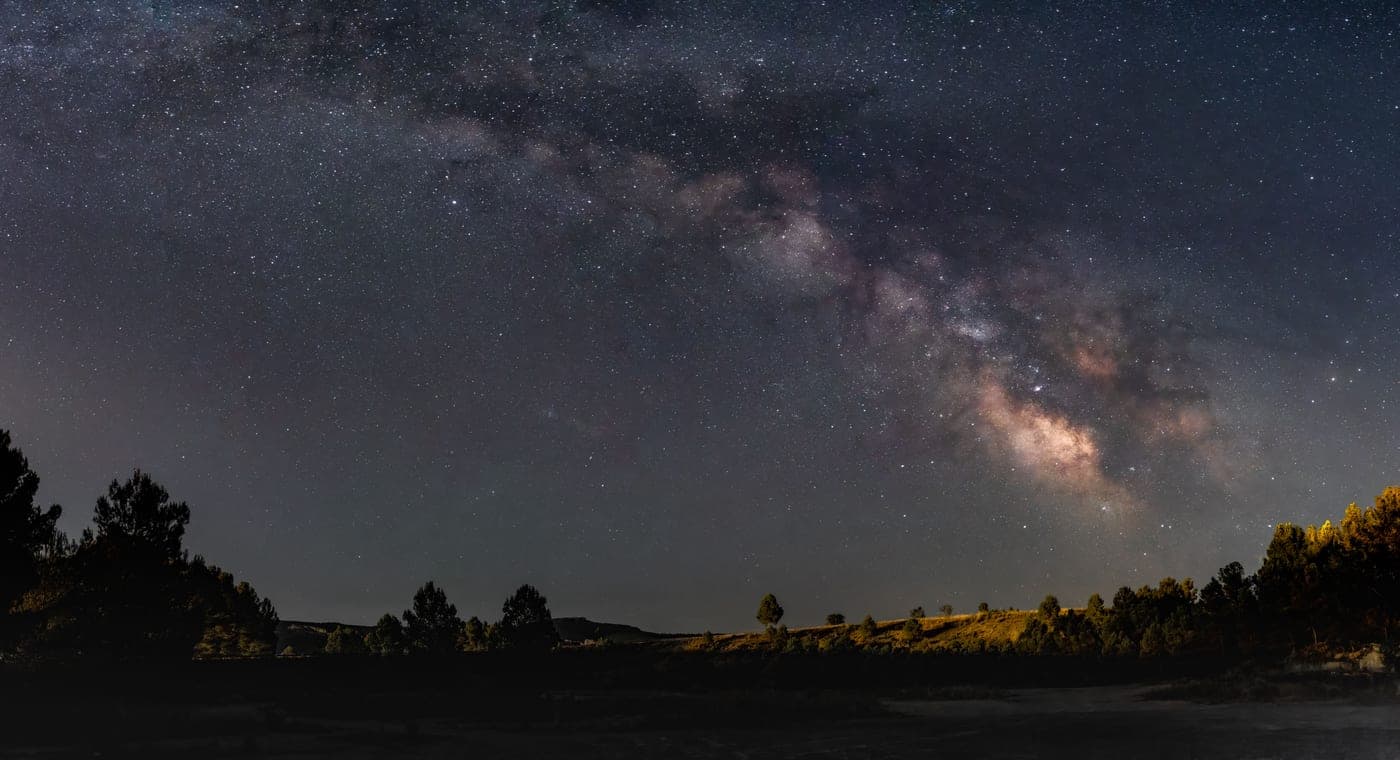
Deep-sky objects look gray. Not because your telescope is inadequate, but because human color vision needs more light than a galaxy delivers. Every color photograph of a nebula is a long exposure, and the eye cannot do long exposures.
Once you know that, deep sky becomes rewarding on its own terms. The Orion Nebula through a 150mm telescope is a genuinely beautiful structure of gray light with four stars embedded in it, and knowing you are looking at a stellar nursery 1,300 light years away does the rest.
Two things matter, and one of them is free
Aperture collects light, so more of it means fainter objects. Sky darkness sets how much of that light you can actually distinguish from the background. Under a bright suburban sky a 200mm telescope may show fewer galaxies than a 130mm does from a genuinely dark site. If a bright sky is what you have, the city-sky picks are chosen around that constraint.
Celestron publishes three limiting magnitudes for the same pair of binoculars, spanning two full magnitudes from ideal to poor skies. That is roughly a factor of six in brightness, from the sky alone. Light pollution is the page that follows from this.
| Object class | 70mm | 130mm | 200mm |
|---|---|---|---|
| Open clusters | Excellent | Excellent | Excellent |
| Orion Nebula (M42) | Gray smudge with stars | Structure and wings | Extended structure |
| Globular clusters | Fuzzy ball | Granular at the edge | Resolved into stars |
| Andromeda (M31) | Bright core only | Core and some disc | Disc, and the dust lane |
| Ring Nebula (M57) | Tiny gray ring | Clear ring shape | Ring with a darker center |
| Fainter galaxies | No | Faint smudges | Shape, some structure |
Why a wide field matters more than magnification
Deep-sky objects are usually large and faint rather than small and faint. The Andromeda galaxy spans several times the width of the full Moon, and a high-magnification eyepiece shows you a piece of its core with no context at all.
exit pupil in millimeters = aperture / magnification
200mm at 40x: 200 / 40 = 5mm. 200mm at 200x: 200 / 200 = 1mm.
The dark-adapted human pupil opens to about 7mm. A 5mm exit pupil delivers a bright, wide view; a 1mm exit pupil delivers a dim one. This is why a long-focal-length eyepiece is the deep-sky eyepiece. Full explanation.
Averted vision, which genuinely works
Look slightly to one side of a faint object rather than directly at it. The center of your retina is dense with cone cells that need bright light; the sensitive rod cells sit off-center. Looking a little away from a faint galaxy puts its light onto the part of your retina that can actually detect it.
This is not a trick. It is a real and substantial gain, worth roughly a magnitude in practice, and every experienced observer uses it constantly.
How this is funded: the buy buttons below are Amazon Associates links, and a qualifying purchase earns us a commission at no extra cost to you. It cannot move the ranking, because the order here is set by aperture per dollar, and no commission rate changes how much light a mirror collects. Full disclosure.
| # | Telescope | Best for | Aperture | Price |
|---|---|---|---|---|
| 1 | 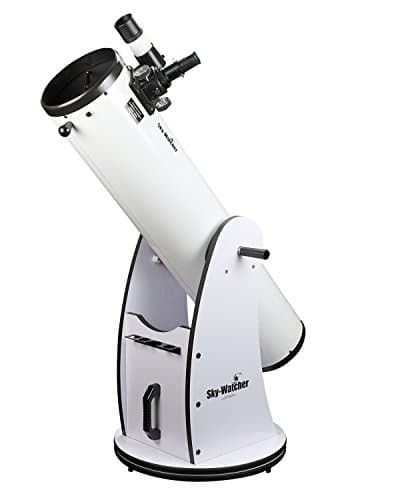 Sky-Watcher Classic 200P Dobsonian (8-inch)Top pickEight inches of aperture on the simplest mount ever designed. This is the telescope experienced observers tell beginners to buy. | The one you will not outgrow | 200mm (8 in)400x useful | Unavailable |
| 2 | 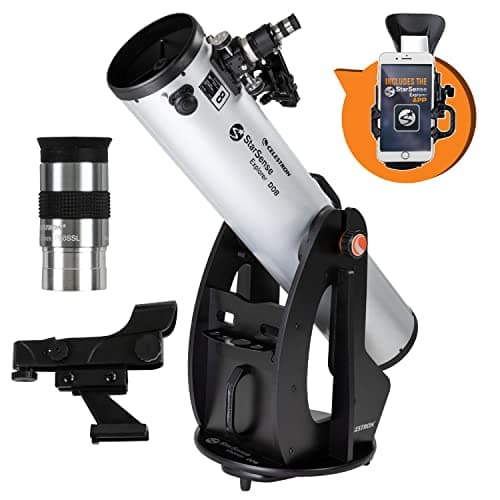 Celestron StarSense Explorer 8-inch Dobsonian203mm of Dobsonian aperture with the phone finder bolted on. The largest telescope here that a beginner can genuinely operate on night one. | Big aperture, no star-hopping | 203mm (8 in)406x useful | |
| 3 | 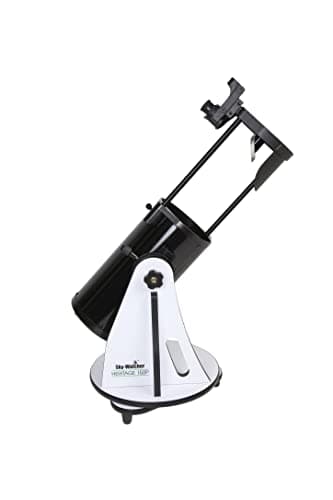 Sky-Watcher Heritage 150 Tabletop Dobsonian150mm at f/5 in a collapsible tube on a tabletop base. Deep-sky aperture that still stores next to the vacuum cleaner. | Maximum aperture in a cupboard | 150mm300x useful | |
| 4 | 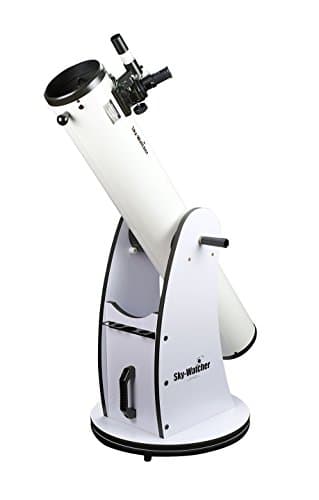 Sky-Watcher Classic 150P Dobsonian (6-inch)Six inches of parabolic mirror on a floor-standing Dobsonian base. The compromise between the 8-inch and a life with less lifting. | Serious aperture that still fits in a car | 150mm (6 in)300x useful | |
| 5 | 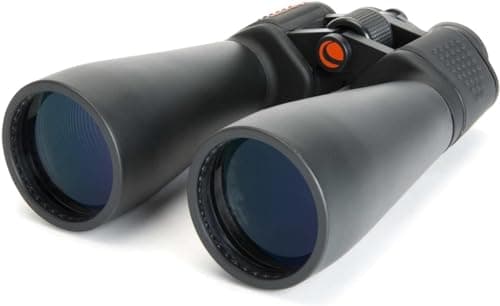 Celestron SkyMaster 15x70 Binoculars70mm of aperture in each barrel at a fixed 15x. For the money spent on a toy telescope, these show more and get used more. | The honest alternative to a cheap telescope | 70mm objective lenses (2.75 in)140x useful |
Top pick · The one you will not outgrow
Sky-Watcher Classic 200P Dobsonian (8-inch)
Eight inches of aperture on the simplest mount ever designed. This is the telescope experienced observers tell beginners to buy.
What the aperture allows
- Maximum useful magnification
- 400x
- 2 × 200mm of aperture
- Resolving limit (Dawes)
- 0.58 arcseconds
- 116 ÷ 200mm
- Cassini division (0.7″)
- Within reach
- on a steady night, at high magnification
200mm is a different category of instrument, not an incremental upgrade. Against the 70mm refractor at the other end of this list the light-gathering ratio is 200 divided by 70, squared: 8.2 times more light reaching your eye.
Two times 200mm gives 400x of useful magnification, which is more than the atmosphere delivers on all but a handful of nights a year. In practice this telescope is limited by the sky rather than by its optics, which is exactly the position you want to be in.
Dawes' limit at 200mm is 116 divided by 200, which is 0.58 arcseconds. The Cassini division, at roughly 0.7 arcseconds, is comfortably inside that. So is the Great Red Spot, and so are hundreds of Messier objects a 70mm scope simply cannot reach.
The honest cost is bulk. The tube is long and the base is wide, and this is a telescope you carry outside in two trips. Everyone who owns one tells the same story: they used it far more once they stopped storing it somewhere awkward.
What it does well
- The aperture-per-dollar figure that no other design at this price approaches
- A mount that cannot be wobbly, because there is almost nothing to it
- The 2-inch focuser takes wide-field eyepieces the cheaper models cannot
- Genuinely a lifetime telescope; nobody outgrows eight inches of aperture in a hurry
What it costs you
- Big and heavy: two trips outside, and it needs real storage space
- No tracking, so at 200x objects drift out of view in well under a minute
- Needs collimation checks, and the mirror takes 30 to 45 minutes to reach outside temperature
Skip this one if: Skip it if you live upstairs with no lift, or if the observing spot is a fire escape. The best telescope in this list is the wrong one if carrying it is a chore.
| Optical design | Newtonian reflector, borosilicate parabolic primary with 94 percent reflective coatingsSource: Classic 200P Dobsonian — manufacturer specifications (retrieved September 1, 2026) |
|---|---|
| Aperture | 200mm (8 in)Source: Classic 200P Dobsonian — manufacturer specifications (retrieved September 1, 2026) |
| Mount | Dobsonian rocker box with Teflon bearings and a patented tension control handleSource: Classic 200P Dobsonian — manufacturer specifications (retrieved September 1, 2026) |
| Light gathering vs the eye | 816xSky-Watcher's own published figure.Source: Classic 200P Dobsonian — manufacturer specifications (retrieved September 1, 2026) |
| Focuser | 2-inch Crayford with a 1.25-inch adapterSource: Classic 200P Dobsonian — manufacturer specifications (retrieved September 1, 2026) |
| Versus the 6-inch model | 78 percent brighter than the 150mm versionSky-Watcher's own published comparison.Source: Classic 200P Dobsonian — manufacturer specifications (retrieved September 1, 2026) |
Currently unavailable at Amazon
Checked October 18, 2026. We are not linking to it while there is nothing to buy.
Pick 2 · Big aperture, no star-hopping
Celestron StarSense Explorer 8-inch Dobsonian
203mm of Dobsonian aperture with the phone finder bolted on. The largest telescope here that a beginner can genuinely operate on night one.
What the aperture allows
- Maximum useful magnification
- 406x
- 2 × 203mm of aperture
- Resolving limit (Dawes)
- 0.57 arcseconds
- 116 ÷ 203mm
- Cassini division (0.7″)
- Within reach
- on a steady night, at high magnification
Celestron publishes 480x as this telescope’s highest useful magnification. Our figure is 406x, from two times the aperture in millimeters. The gap of 74x comes from the slightly more generous per-inch constant makers use. Neither number describes a typical night: the atmosphere usually settles the question well below both.
Worked example: a 25mm eyepiece in this telescope gives 1200mm ÷ 25mm = 48x.
203mm gathers 841 times the light of the naked eye, which is Celestron's own published figure. Against the 130mm scopes further up this list it is 2.4 times the light, from the ratio 203 over 130, squared.
Two times 203mm gives 406x of useful magnification; Celestron publishes 480x. Dawes' limit is 0.57 arcseconds, so the Cassini division, the Great Red Spot and hundreds of Messier objects are all inside its reach.
The published limiting stellar magnitude of 14.2 is the number that explains what deep sky means. It is roughly 4,000 times fainter than the faintest star a good naked eye sees from a dark site.
The reason to choose this over a plain 8-inch Dobsonian is the phone finder. An 8-inch tube with a 0.57-arcsecond resolution limit is wasted on somebody who cannot locate anything to point it at.
What it does well
- The largest aperture here that a beginner can realistically use on the first night
- The phone finder removes the learning curve that stops most people using this much telescope
- A Dobsonian base is rock steady under a big tube
What it costs you
- Heavy and bulky; two trips outside and real storage space
- No tracking, so at 200x objects leave the field quickly
- Collimation and a long cool-down are part of owning it
Skip this one if: Skip it if storage or stairs are a problem. That is the single most common reason a large Dobsonian stops getting used.
#ad · how this is funded · price as of October 18, 2026
Pick 3 · Maximum aperture in a cupboard
Sky-Watcher Heritage 150 Tabletop Dobsonian
150mm at f/5 in a collapsible tube on a tabletop base. Deep-sky aperture that still stores next to the vacuum cleaner.
What the aperture allows
- Maximum useful magnification
- 300x
- 2 × 150mm of aperture
- Resolving limit (Dawes)
- 0.77 arcseconds
- 116 ÷ 150mm
- Cassini division (0.7″)
- Out of reach
- this aperture cannot resolve it
Worked example: a 25mm eyepiece in this telescope gives 750mm ÷ 25mm = 30x.
This is the Heritage 130's argument with 33 percent more mirror. Light gathering scales as the square of the aperture ratio, so 150 over 130, squared, is 1.33 times the light of its smaller sibling.
Two times 150mm is 300x of useful magnification and Dawes' limit is 0.77 arcseconds, which puts the Cassini division inside its reach on a good night.
At f/5 the 750mm focal length keeps the tube short enough to collapse, which is the entire reason this design exists. A conventional 150mm Newtonian tube is over a meter long and lives in a garage.
The same tabletop caveat applies as with the 130: it needs a stable surface at seated chest height. Check you have one before you buy, not after.
What it does well
- Deep-sky aperture in a package that genuinely stores in a cupboard
- Collapsible tube holds collimation between setups
- No tripod means no tripod wobble, the most common cause of a shaky first view
What it costs you
- The tabletop requirement is a real constraint, not a footnote
- The helical focuser is the weakest component
- An open tube collects dust and needs the occasional clean
Skip this one if: Skip it if you have the floor space for the Classic 150P. The floor-standing version has a better focuser and needs no furniture.
$355.00 · 13% off
#ad · how this is funded · price as of October 18, 2026
Pick 4 · Serious aperture that still fits in a car
Sky-Watcher Classic 150P Dobsonian (6-inch)
Six inches of parabolic mirror on a floor-standing Dobsonian base. The compromise between the 8-inch and a life with less lifting.
What the aperture allows
- Maximum useful magnification
- 300x
- 2 × 150mm of aperture
- Resolving limit (Dawes)
- 0.77 arcseconds
- 116 ÷ 150mm
- Cassini division (0.7″)
- Out of reach
- this aperture cannot resolve it
150mm sits in a genuinely useful place. Two times the aperture gives 300x of useful magnification and Dawes' limit works out to 0.77 arcseconds, so the Cassini division is within reach on a steady night.
Against the 8-inch it collects about 56 percent of the light. Sky-Watcher publishes the 8-inch as 78 percent brighter, which is the same comparison seen from the other side. Against a 100mm refractor it gains 232 percent, also their figure. Those two numbers together are the whole argument for buying by aperture.
The practical case for the 6-inch over the 8-inch is transport. It fits across a back seat, one person can move it in a single trip, and a telescope that gets used beats one that is technically better and stays in the garage.
This is a floor-standing Dobsonian, so unlike the tabletop models it needs no furniture. You sit on a low stool beside it, which is the most comfortable way to observe there is.
What it does well
- Real aperture without the 8-inch's transport problem
- Floor-standing, so no table required
- The 2-inch focuser is a genuine upgrade path rather than a dead end
- Simple enough that nothing about it can fail on a cold night
What it costs you
- Still a long tube; it is not a cupboard telescope
- No tracking or GoTo, so you find things yourself
- Collimation and cool-down apply to every Newtonian, this one included
Skip this one if: Skip it if you were choosing between this and the 8-inch and storage is not actually a problem. In that case the extra aperture is worth having.
| Optical design | Newtonian reflector, parabolic primary with Radiant Aluminum Quartz coatingsSource: Classic 150P Dobsonian — manufacturer specifications (retrieved September 1, 2026) |
|---|---|
| Aperture | 150mm (6 in)Source: Classic 150P Dobsonian — manufacturer specifications (retrieved September 1, 2026) |
| Mount | Dobsonian rocker box with Teflon bearings and a tension control handleSource: Classic 150P Dobsonian — manufacturer specifications (retrieved September 1, 2026) |
| Versus a 100mm refractor | 232 percent brighterSky-Watcher's own published comparison.Source: Classic 150P Dobsonian — manufacturer specifications (retrieved September 1, 2026) |
| Focuser | 2-inch rack-and-pinion with a 1.25-inch adapterSource: Classic 150P Dobsonian — manufacturer specifications (retrieved September 1, 2026) |
$515.00 · 13% off
#ad · how this is funded · price as of October 18, 2026
Pick 5 · The honest alternative to a cheap telescope
Celestron SkyMaster 15x70 Binoculars
70mm of aperture in each barrel at a fixed 15x. For the money spent on a toy telescope, these show more and get used more.
What the aperture allows
- Maximum useful magnification
- 140x
- 2 × 70mm of aperture
- Resolving limit (Dawes)
- 1.66 arcseconds
- 116 ÷ 70mm
- Cassini division (0.7″)
- Out of reach
- this aperture cannot resolve it
Worked example: a 25mm eyepiece in this telescope gives 279.63mm ÷ 25mm = 11x.
Each barrel has the same 70mm aperture as the entry-level refractors on this site, and because you use both eyes the perceived brightness is higher than a single 70mm tube.
The fixed 15x is well below the 140x that 70mm could support, and that is deliberate. Binoculars are a wide-field instrument: the Pleiades, the Andromeda galaxy, the Milky Way star clouds and the whole Moon at once.
Celestron publishing three limiting magnitudes, 11.73 for ideal skies down to 9.73 for poor ones, is the single most useful number on this page. It says out loud what most listings hide: your sky matters as much as your optics.
At 15x these are heavy to hold steady. The included tripod adapter is not an accessory, it is a requirement for any sustained looking.
What it does well
- 70mm per barrel is real aperture, not a novelty
- Instantly usable: no assembly, no alignment, no learning curve
- Wide field shows large objects a telescope cannot fit in view
- Doubles as daytime and wildlife optics, so it gets used year-round
What it costs you
- Too heavy to hold steady at 15x for long; a tripod is effectively required
- Fixed magnification, so the planets stay small
- No detail on Saturn: at 15x the rings are a suggestion, not a shape
Skip this one if: Skip them if the goal is specifically to see Saturn's rings as rings. 15x will not do it; a 70mm telescope at 70x will.
$129.95 · 32% off
#ad · how this is funded · price as of October 18, 2026
If the faint end of this list is what you are chasing, aperture is the only thing that moves it. Your second telescope computes what each step up actually buys.
Large mounted binoculars are an underrated route to this list, since two eyes on a rich star field is a view no telescope reproduces. The SkyMaster 20x80 reaches deepest of the pairs here, and the 25x70 trades some of that light for magnification.
The two objects to start with
The table above treats deep sky as classes of object, and the two that most reward a first attempt have their own pages. The Orion Nebula is the one deep-sky target bright enough to survive a suburban sky, which makes it the right place to begin. The Andromeda Galaxy is the opposite problem: it is so large that a telescope cannot fit it in one field, and binoculars genuinely beat a telescope on it.
Questions people actually ask
What is the best telescope for deep space?
The largest aperture you will actually carry outside, which for most people is a 200mm Dobsonian. Deep sky is limited by collected light, and light gathering goes as the square of aperture, so a 200mm collects 2.4 times what a 130mm does.
Why do galaxies look gray and not colorful?
Because color vision comes from cone cells that need far more light than a galaxy delivers to the eye. At low light levels you see with rod cells, which have no color response. Photographs are long exposures and cameras have no such limit.
Can I see deep-sky objects from a city?
Some. Bright open clusters, the Orion Nebula and the brighter globular clusters survive moderate light pollution. Faint galaxies mostly do not, because it is the contrast against the sky background rather than the object's own brightness that is destroyed.
What magnification for deep-sky objects?
Low, usually 30x to 80x. Most deep-sky objects are large and faint rather than small and faint, and a longer eyepiece gives a wider, brighter view. Only small planetary nebulae and tight globular clusters reward high power.
What is averted vision?
Looking slightly to one side of a faint object so its light falls on the more light-sensitive off-center part of your retina. It is worth roughly a magnitude in practice and every experienced observer uses it.
Read next

What a City Sky Actually Allows
What survives a bright sky, what does not, and why light pollution changes what you should spend a telescope budget on.
Top pick: Celestron NexStar 6SE
#ad · how this is funded · price as of October 18, 2026
Best aperture per dollar
Dobsonian Telescopes, and Why Experienced Observers Recommend Them
Why a Dobsonian gives the most aperture per dollar, what the design costs you, and which size to buy.
Top pick: Sky-Watcher Heritage 130 Tabletop Dobsonian
$305.00 · 12% off
#ad · how this is funded · price as of October 18, 2026
Best accessory upgrade
Telescope Eyepieces: Which Ones You Actually Need
Which eyepiece focal lengths suit your telescope, what exit pupil means, and the cheapest real upgrade available.
Top pick: Celestron Eyepiece, Barlow and Filter Kit (1.25")
$239.95 · 8% off
#ad · how this is funded · price as of October 18, 2026
Found something wrong here? Tell us and we will correct it and date the correction, per our editorial policy.