Reviews
Celestron SkyMaster 20x80
The deepest-reaching optic on this site that is not a telescope, and the one most likely to sit in a closet. Both facts come from the same specification.
By Scooter M. · Published · How we pick
These are the largest binoculars this site covers and they reach deeper than anything else here short of a telescope. They are also 75 oz, which is 4.7 lb, and that number decides whether they were a good purchase far more often than the optics do. This review puts the weight first because the specification sheet puts it last.
What 80mm actually reaches
light vs the eye = (objective / 7)squared. Dawes limit = 116 / objective.
(80 / 7)squared = 131. 116 / 80 = 1.45 arcseconds.
About 131 times the light of a dark-adapted eye pupil. Celestron publishes a limiting stellar magnitude of 12.02 under ideal skies, 11.02 moderate and 10.02 poor — the deepest figures of any binocular on this site.
Against the 50mm pairs here the gain is real and computable: (80 / 50) squared is 2.56, so these collect more than two and a half times the light of a 10x50. Celestron's own published limiting magnitudes agree with that — 12.02 against 10.99 is 1.03 magnitudes, and a 2.56 light ratio works out to 1.02 magnitudes. The maker's figures and the arithmetic land in the same place.
In practice that is the difference between suspecting a galaxy is present and seeing its shape, and it is what makes these a genuine deep-sky instrument rather than a wide-field one.
The exit pupil is still generous
exit pupil = objective / magnification
80 / 20 = 4mm.
Celestron publishes 4mm. That is comfortably within what any adult eye can use, so unlike the higher-power pair on this site these do not throw away brightness to get their magnification.
This is the quiet reason the 20x80 beats the 25x70 for faint objects despite having less magnification: it has more aperture *and* a larger exit pupil. More power is not more. The 25x70 review works through the other side of that comparison.
The tripod is not optional
Celestron publishes these as tripod adaptable and supplies no tripod, so the real cost of ownership is the pair plus a mount sturdy enough for 4.7 lb held overhead. A photo tripod that handles a camera will often not handle this comfortably pointed up. Why mounts decide everything applies to binoculars as much as to telescopes.
There is a second consequence nobody mentions: pointing a tripod-mounted binocular at anything near the zenith is awkward, because your head has to go under the eyepieces. Observers who use large binoculars seriously often end up in a reclining chair, which is a genuinely comfortable way to observe and worth knowing about in advance.
How this is funded: the buy buttons below are Amazon Associates links, and a qualifying purchase earns us a commission at no extra cost to you. It cannot move the ranking, because the order here is set by aperture per dollar, and no commission rate changes how much light a mirror collects. Full disclosure.
| # | Telescope | Best for | Aperture | Price |
|---|---|---|---|---|
| 1 | 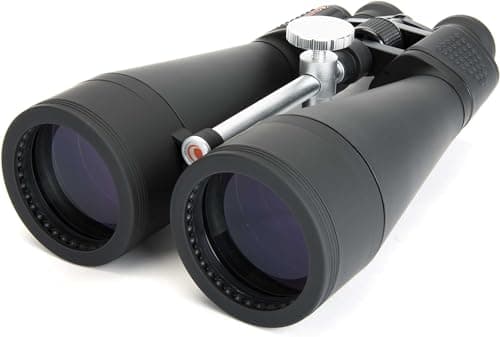 Celestron SkyMaster 20x80 BinocularsTop pick80mm objectives and BaK-4 prisms reach the faintest stars of anything here, and at 75 oz and 20x they are a tripod instrument, not a handheld one. | The most light, if you will mount them | 80mm objective lenses (3.15 in)160x useful |
Top pick · The most light, if you will mount them
Celestron SkyMaster 20x80 Binoculars
80mm objectives and BaK-4 prisms reach the faintest stars of anything here, and at 75 oz and 20x they are a tripod instrument, not a handheld one.
What the aperture allows
- Maximum useful magnification
- 160x
- 2 × 80mm of aperture
- Resolving limit (Dawes)
- 1.45 arcseconds
- 116 ÷ 80mm
- Cassini division (0.7″)
- Out of reach
- this aperture cannot resolve it
80mm per barrel is more aperture than most beginner refractors carry, and Celestron publishes the deepest limiting magnitude in this roundup for it: 12.02 under ideal skies. That is the practical meaning of the extra 10mm over a 70mm pair.
The cost is weight and magnification together. Celestron publishes 75 oz, which is nearly three times the weight of a 10x50, and at 20x every tremor is magnified twenty times. These are not binoculars you hold up to the sky; they are binoculars you mount and then look through.
Two quieter strengths: BaK-4 prisms, the better glass, and a published 18mm of eye relief, the most here and genuinely comfortable for glasses wearers.
What it does well
- The deepest published limiting magnitude here, 12.02 under ideal skies
- BaK-4 prisms
- A published 18mm of eye relief, comfortable with glasses
- Enough aperture to start resolving the brighter globular clusters
What it costs you
- A published 75 oz: a tripod and a proper binocular mount are not optional
- At 20x the field narrows to 3.7 degrees, too tight for the largest star fields
- Large Porro binoculars can be knocked out of collimation by a hard knock, and a misaligned pair gives double images
- The heaviest thing here to carry anywhere
Skip this one if: Skip them if you are not going to buy a tripod and a binocular mount alongside. Handheld, a 10x50 will show you more because you will actually be able to keep it still.
#ad · how this is funded · price as of September 27, 2026
What the specification sheet gets right
- BaK-4 prisms. A higher refractive index than the BK7 in the cheaper pairs here, which keeps the exit pupil round and evenly bright to its edge.
- 18mm of eye relief, the most generous figure of the four pairs this site covers and the only one that is genuinely comfortable with glasses on.
- A 3.7-degree field, quoted as 195 ft at 1,000 yards. Multiplied by 20x that is a 74-degree apparent field, which is wide, and narrow in true sky coverage at the same time — about seven full Moons across.
- Water resistant, though not nitrogen purged.
The honest drawbacks
- 75 oz, and a tripod purchase on top. This is the whole case against them, and it is decisive for a lot of buyers.
- 3.7 degrees is a narrow field for binoculars. The sweeping and framing that make a 7x50 delightful are largely gone; the Pleiades fill the view rather than sitting in it.
- Collimation on large budget binoculars is a real risk. A pair this size is more prone to arriving or becoming slightly misaligned between the two barrels, which shows up as eye strain rather than as an obvious double image. Check a bright star at first light and return them if each eye sees it in a different place.
- Still no planetary detail. 20x on Saturn will not separate the rings, and 1.45 arcseconds of resolving limit rules out the Cassini division regardless.
- Awkward at the zenith unless you observe reclined.
What kind of tripod actually works
Since the mount is a required purchase, it is worth being specific about what to look for, because the obvious choice is the wrong one. A ball head, which is what most photo tripods carry, is poor for this job: it moves in all directions at once, so nudging a target back into a 3.7-degree field means fighting two axes you did not want to move.
- A fluid video head is the right answer at this weight. It pans and tilts on separate axes with damped movement, which is exactly what following an object at 20x needs.
- Check the rated load, not the leg diameter. 4.7 lb held high and pointed upward puts far more leverage on a head than the same weight sitting flat, and a head rated for a small camera will sag.
- You need a binocular tripod adapter, a small L-shaped bracket that screws into the socket between the barrels. Celestron publishes these as tripod adaptable; the adapter itself is a separate item.
- Height matters more than you expect. Seated observing is far more comfortable than standing for anything above about 45 degrees, so a tripod that goes low is more useful here than one that goes high.
For observers who use large binoculars seriously there is also the parallelogram mount, a hinged arm that holds the pair at eye level and lets you move it freely while the weight stays supported. It costs more than the binoculars and it is the only arrangement that makes 4.7 lb genuinely pleasant for a long session.
Who should buy these, and who should not
Buy them if you specifically want a deep-sky sweeper and you already own, or will happily buy, a solid tripod. Mounted under a dark sky these are a superb instrument for star clusters, large nebulae and the brighter galaxies, and the two-eyed view of a rich star field is something no telescope on this site reproduces.
Buy them also if you wear glasses at the eyepiece, because 18mm of eye relief is the best figure here by a clear margin.
Do not buy them as a first optic. A pair that needs a mount assembled will lose every contest with a pair you can pick up, and the 7x50 or the 15x70 is the better starting point. Do not buy them for planets. And do not buy them if the money would be better spent on a Dobsonian, which at this aperture class collects similar light and resolves far finer detail for a comparable outlay.
Questions people actually ask
Are the Celestron SkyMaster 20x80 worth it?
They are worth it if you will mount them. Celestron publishes a limiting stellar magnitude of 12.02 under ideal skies, the deepest of any binocular on this site, with BaK-4 prisms and 18mm of eye relief. At 75 oz and 20x they cannot be handheld, so the real purchase is the pair plus a sturdy tripod.
Can you hold 20x80 binoculars by hand?
No, not usefully. The conventional limit for handheld viewing is about 10x and these are 20x on a 4.7 lb body. Handheld you will see a shaking field. A tripod and a binocular adapter are required equipment rather than accessories.
SkyMaster 20x80 or 25x70 for astronomy?
The 20x80, for faint objects. It has more aperture and a larger exit pupil at once: 4mm against 2.8mm, and Celestron publishes 12.02 limiting magnitude against 11.73. The 25x70 offers more magnification, but it collects less light and delivers a dimmer view, so higher power does not mean seeing more here.
What can you see with 20x80 binoculars?
Star clusters in quantity and resolved into individual stars, large nebulae, the brighter galaxies with visible elongation and some shape, lunar detail, and Jupiter's moons. Celestron publishes a limiting stellar magnitude of 12.02 under ideal skies. Planetary surface detail and Saturn's rings are out of reach at 20x and 1.45 arcseconds.
Do the SkyMaster 20x80 come with a tripod?
No. Celestron publishes them as tripod adaptable but supplies no tripod or adapter, so budget for a mount rated to hold 4.7 lb steadily while pointed upward. A light photo tripod will usually not be enough.
Read next
Best for astronomy
The Best Binoculars for Astronomy
Astronomy binoculars ranked on aperture, holdability and exit pupil, with the maker's limiting magnitudes for every pair.
Top pick: Celestron SkyMaster 15x70 Binoculars
$129.95 · 32% off
#ad · how this is funded · price as of September 27, 2026

Celestron SkyMaster 25x70
25x70 Porro binoculars with BaK-4 prisms and a 2.8mm exit pupil. The most magnification here, tripod required, and dimmer than the 20x80.
Top pick: Celestron SkyMaster 25x70 Binoculars
$139.95 · 14% off
#ad · how this is funded · price as of September 27, 2026
Telescope Mounts, and Why They Decide Everything
The four mount types compared, why the mount matters as much as the optics, and whether they are interchangeable.
Top pick: Sky-Watcher Classic 200P Dobsonian (8-inch)
#ad · how this is funded · price as of September 27, 2026
Found something wrong here? Tell us and we will correct it and date the correction, per our editorial policy.