Reviews
Celestron Cometron 7x50
The cheapest genuinely useful optic on this site, and the only one here whose exit pupil matches a dark-adapted human eye. That is not a coincidence, and it is the whole design.
By Scooter M. · Published · How we pick

A 7x50 is the oldest specification in amateur astronomy that is still exactly right. It was the standard naval night glass for the same reason it works now: 7x is slow enough to hold steady, and 50mm divided by 7 gives an exit pupil that matches a dark-adapted human pupil almost precisely. Everything else about this pair is a budget decision. That one number is not.
Why 7x50 and not something bigger
exit pupil = objective diameter / magnification
50 / 7 = 7.1mm.
Celestron publishes 7.1mm, which agrees. A dark-adapted young eye opens to roughly 7mm, so this is as bright a view as a human eye can physically accept. Nothing on this site delivers a brighter image per unit of aperture.
That has a practical consequence and an honest caveat. The practical consequence is that the sky looks bright through these in a way that a higher-power instrument of the same aperture does not, because the light is spread across the widest pupil your eye can use. The caveat is that pupil size shrinks with age: a 7.1mm exit pupil is fully used by a young eye and partly wasted by one that opens to 5mm, which is common past middle age. For that observer a 10x50 puts the same light through a smaller, fully-used cone.
light vs the eye = (objective / 7)squared. Dawes limit = 116 / objective.
(50 / 7)squared = 51. 116 / 50 = 2.32 arcseconds.
About 51 times the light of a 7mm eye pupil. Celestron publishes a limiting stellar magnitude of 10.99 under ideal skies, 9.99 in moderate conditions and 8.99 in poor ones, which is an unusually honest three-figure statement.
At 2.32 arcseconds of resolving limit and only 7x of magnification, detail is not what these are for. Resolution never becomes the constraint, because 7x is nowhere near what 50mm could support: two times the aperture gives 100x as a useful ceiling and this pair uses seven of it. These are a light bucket and a wide window, not a detail instrument.
The field, which is the real luxury
Celestron publishes a 6.6-degree field of view, quoted as 344 ft at 1,000 yards. Six and a half degrees is about thirteen full Moons laid side by side.
- The Pleiades sit in the middle with room around them, which is how that cluster is meant to be seen and which no telescope on this site can manage.
- Sweeping works. You can pan along the Milky Way and run over clusters and star fields continuously rather than hopping between framed views.
- Comets are the use case in the name. A bright comet's tail is large and faint, which is exactly the combination a wide, bright, low-power optic handles better than a telescope.
- Finding is easier. Many people use a pair like this beside a telescope to locate a target first. Binoculars against a telescope sets the two side by side.
You can actually hold these
This is where 7x earns its place against every higher-power pair here. Hand shake is magnified along with the image, and the conventional limit for comfortable handheld viewing sits around 10x. At 7x the wobble is small enough that a standing observer sees a steady field, and Celestron publishes 27.3 oz, so your arms last.
Compare that with the 20x80 pair on this site at 75 oz, which cannot be handheld at all and requires a tripod before it shows you anything. A cheaper optic you can lift to your eyes on an impulse gets used far more than an expensive one that needs a mount assembled first.
How this is funded: the buy buttons below are Amazon Associates links, and a qualifying purchase earns us a commission at no extra cost to you. It cannot move the ranking, because the order here is set by aperture per dollar, and no commission rate changes how much light a mirror collects. Full disclosure.
| # | Telescope | Best for | Aperture | Price |
|---|---|---|---|---|
| 1 | 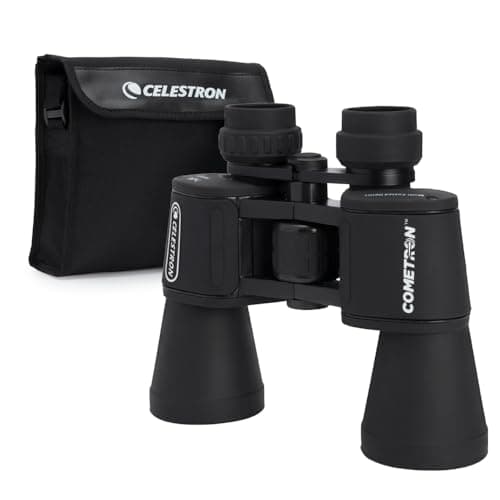 Celestron Cometron 7x50 BinocularsTop pick7x on 50mm objectives gives the widest field and the steadiest handheld view of anything here, at the price of the least light. | Handheld sweeping, on the smallest budget | 50mm objective lenses (1.97 in)100x useful |
Top pick · Handheld sweeping, on the smallest budget
Celestron Cometron 7x50 Binoculars
7x on 50mm objectives gives the widest field and the steadiest handheld view of anything here, at the price of the least light.
What the aperture allows
- Maximum useful magnification
- 100x
- 2 × 50mm of aperture
- Resolving limit (Dawes)
- 2.32 arcseconds
- 116 ÷ 50mm
- Cassini division (0.7″)
- Out of reach
- this aperture cannot resolve it
At 7x the image moves seven times as much as your hands do, which is slow enough to hold steady for as long as you like. That is the entire case for this magnification, and for a first astronomy instrument it is a strong one.
Celestron publishes a 6.6-degree field, wide enough to take in the whole of the Pleiades with room around it, and a 7.1mm exit pupil. That exit pupil is larger than most adult eyes open to, so some of the collected light is simply not used — the trade-off of a wide, bright, forgiving view.
The prisms are BK7 rather than BaK-4, which Celestron states plainly. BK7 is the cheaper glass and tends to vignette the edge of the exit pupil slightly; for a sweeping instrument at this price it is a reasonable compromise rather than a flaw.
What it does well
- The steadiest handheld magnification in this roundup
- A 6.6-degree field frames large clusters and the Milky Way whole
- The lightest pair here at a published 27.3 oz
- Tripod adaptable if you later want to mount them
What it costs you
- The smallest objectives here, so the faintest limiting magnitude Celestron publishes: 10.99 under ideal skies
- BK7 prisms rather than the better BaK-4
- A 7.1mm exit pupil wastes light on eyes that no longer dilate that far, which becomes more common with age
- Water resistant but not nitrogen filled, so they can fog internally
Skip this one if: Skip them if you will always use a tripod. Once they are mounted, more magnification and more aperture both become usable, and the reasons to choose 7x disappear.
$47.95 · 17% off
#ad · how this is funded · price as of September 27, 2026
Where the budget shows
- BK7 prisms rather than BaK-4. Celestron publishes BK7 for this pair and BaK-4 for the SkyMasters. BK7 has a lower refractive index, and the visible consequence is that the round exit pupil can appear slightly squared-off at the edges, dimming the outer field a little. At this price it is a reasonable trade and it is a real difference.
- 13mm of eye relief. Workable, but tight if you observe with glasses on, where about 15mm is the comfortable threshold.
- Water resistant, not nitrogen filled. These will survive dew and drizzle. They are not sealed against internal fogging in the way a nitrogen-purged pair is.
- 7x is genuinely low power. Saturn will not show rings. Jupiter's moons appear as points beside the planet, which is a real sight, but planetary detail is out of the question.
- No tripod adapter is included, although the barrel is tripod adaptable if you later want one.
What these honestly show
Craters along the lunar terminator, and the Moon as a three-dimensional object rather than a disc. The four bright moons of Jupiter as a line of points. Open clusters in quantity, including the Pleiades, the Hyades and the Beehive. The Andromeda galaxy as an elongated smudge from a decent sky. The Orion nebula as a patch of haze around the trapezium stars. Comets, when there is one. What you can see sets the thresholds out object by object.
What they do not show is any planetary surface detail, the rings of Saturn, or structure inside a galaxy. For those you need aperture and magnification, which means a telescope, and the cheapest honest route to that is a tabletop Dobsonian.
Who should buy these, and who should not
Buy them as a first optic for somebody who is not sure they are interested yet. That is the strongest argument for this pair and it is a financial one: they cost a fraction of any telescope here, they need no setup, no collimation and no power, and they will still be useful in ten years as a finder beside a larger instrument. Nothing is wasted if the hobby does not stick.
Buy them also as a deliberate wide-field companion to a telescope you already own, and buy them for a child old enough to handle glass, since there is nothing to knock out of alignment.
Do not buy them expecting planets. Do not buy them if your eyes no longer dark-adapt to 7mm, because a 10x50 will suit you better for the same money. And do not buy them if you already own a 10x50, because the overlap is nearly total and the step is not worth it.
Questions people actually ask
Are the Celestron Cometron 7x50 binoculars good for astronomy?
Yes, for wide-field astronomy specifically. The 7.1mm exit pupil Celestron publishes matches a dark-adapted eye, so the view is as bright as an eye can accept, and the 6.6-degree field is about thirteen full Moons wide. They will not show planetary detail, because 7x of magnification is far below what any planet needs.
What can you see with 7x50 binoculars?
Lunar craters along the terminator, Jupiter's four bright moons as points, many open clusters including the Pleiades with room to spare, the Andromeda galaxy as an elongated smudge from a reasonable sky, the Orion nebula as haze, and comets. Celestron publishes a limiting stellar magnitude of 10.99 under ideal skies and 8.99 under poor ones.
Is 7x50 or 10x50 better for stargazing?
It depends on your eyes. 7x50 gives a 7.1mm exit pupil and is the steadiest to hold; 10x50 gives 5mm and more detail. If your dark-adapted pupil opens to around 7mm, the 7x50 uses all of that light. If it opens to about 5mm, which is common past middle age, the 10x50 wastes none of it and shows more.
Do the Cometron 7x50 need a tripod?
No. At 7x and 27.3 oz they are comfortable to hold, and 7x is well below the roughly 10x point where hand shake starts to spoil the view. The barrel is tripod adaptable if you want one later, but a tripod is not part of the purchase.
What is the difference between BK7 and BaK-4 prisms?
BaK-4 glass has a higher refractive index, which keeps the exit pupil fully round and evenly bright to its edge. BK7, which Celestron publishes for this pair, can show a slightly squared-off exit pupil and a little dimming at the outer field. It is a visible difference and an accepted one at this price.
Read next

Best for astronomy
The Best Binoculars for Astronomy
Astronomy binoculars ranked on aperture, holdability and exit pupil, with the maker's limiting magnitudes for every pair.
Top pick: Celestron SkyMaster 15x70 Binoculars
$129.95 · 32% off
#ad · how this is funded · price as of September 27, 2026

Binoculars vs a Telescope: Which Should You Buy First?
Where astronomy binoculars beat a first telescope, where they do not, and the one view only a telescope delivers.
Top pick: Celestron SkyMaster 15x70 Binoculars
$129.95 · 32% off
#ad · how this is funded · price as of September 27, 2026

Celestron SkyMaster 15x70 Binoculars
70mm objectives at 15x, both eyes, with published limiting magnitudes for three sky qualities. The honest first instrument.
Top pick: Celestron SkyMaster 15x70 Binoculars
$129.95 · 32% off
#ad · how this is funded · price as of September 27, 2026
Found something wrong here? Tell us and we will correct it and date the correction, per our editorial policy.