Telescope Gifts
Telescope Gifts, and How to Buy One That Gets Used
The risk with a telescope as a gift is not spending too much. It is a beautiful box, one frustrating evening, and a cupboard by February. Almost all of that is avoidable at the point of purchase.
By Scooter M. · Published · How we pick

A telescope is a wonderful gift and a risky one. The risk is specific and it is not the price: it is that the first evening goes badly, and a telescope that disappoints once tends not to get a second chance.
Nearly every version of that failure is decided at the point of purchase, and none of it is about the recipient's enthusiasm.
The four ways a gift telescope fails
- The box promised 525x. The recipient fits the shortest eyepiece, sees a dim wobbling blur, and concludes the telescope is broken. It is not: the optics topped out around 140x. The magnification myth is the fix, and it is worth reading before you buy rather than after.
- The mount was an equatorial. Two tilted axes that make no sense until the thing is polar aligned. A recipient who has never seen one assumes it is faulty. What to avoid covers it.
- Nothing could be found. Without a finder that is aligned, or an app, the first evening ends without locating anything at all. This is the single most common failure and the most fixable one.
- Nobody set it up on the night. A telescope unwrapped at 4pm on a cloudy December afternoon and then put down is a telescope with a real chance of staying down.
Choose by who it is for

Best for kids
The Best Telescopes for Kids
Telescopes chosen for how easily a child can aim and carry them, which matters more at this age than aperture does.
Top pick: Celestron FirstScope 76
#ad · how this is funded · price as of October 19, 2026
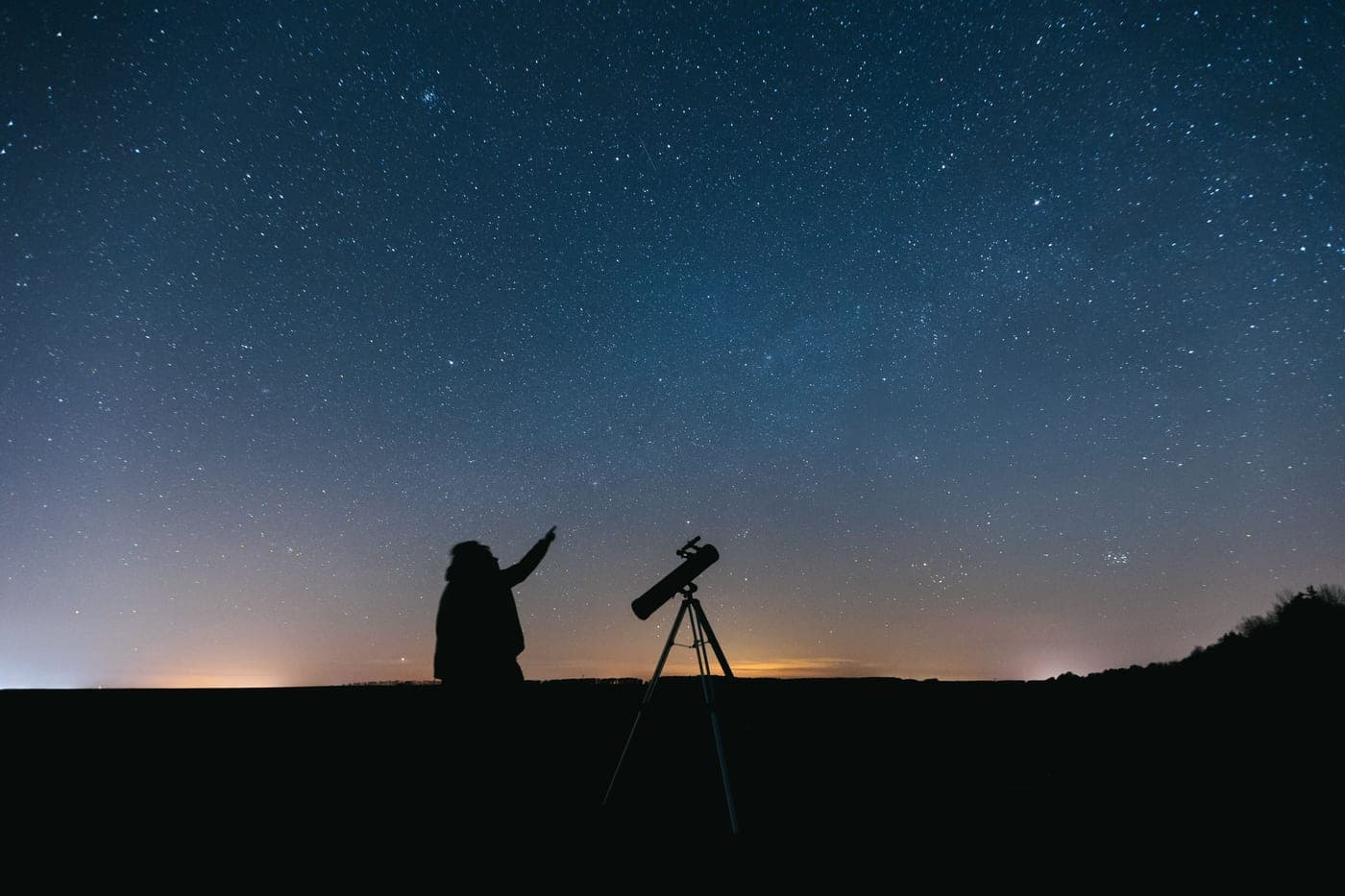
Best gift for an adult
The Best Telescopes to Give an Adult
Telescopes for an adult recipient, where the only real constraints are storage and whether they can find things.
Top pick: Celestron StarSense Explorer DX 130AZ
#ad · how this is funded · price as of October 19, 2026

Telescopes by Age: What a Child Can Actually Do
What a child can genuinely do with a telescope at each age, and what to buy from four years upward.
Top pick: Celestron SkyMaster 15x70 Binoculars
$129.95 · 32% off
#ad · how this is funded · price as of October 19, 2026
The questions gift buyers actually ask

Buying a Telescope for Somebody Else
What to work out without asking, what to default to when you cannot, and how to keep the gift adjustable afterwards.
Top pick: Celestron StarSense Explorer DX 130AZ
#ad · how this is funded · price as of October 19, 2026
Will They Actually Use It?
Why telescopes get abandoned, why it is almost always the first evening rather than the instrument, and what fixes it.
Top pick: Celestron StarSense Explorer DX 130AZ
#ad · how this is funded · price as of October 19, 2026
Best under $50
Telescope Gifts Under $50
No telescope under $50 is worth giving. These accessories genuinely improve one somebody already owns.
Top pick: Celestron Eyepiece, Barlow and Filter Kit (1.25")
$239.95 · 8% off
#ad · how this is funded · price as of October 19, 2026
Best for a telescope owner
Gifts for Someone Who Already Has a Telescope
What to give a stargazer who already owns a telescope, ranked by how much each item changes an actual observing session.
Top pick: Celestron Omni 32mm Eyepiece (1.25")
$52.95 · 6% off
#ad · how this is funded · price as of October 19, 2026
That last page is for the harder version of this problem: they already own a telescope, you do not know which one, and buying a second is the wrong move. Gifts for someone who already has a telescope works through what fits almost anything, which is most of this category.
What to give alongside the telescope
- A red flashlight. Twenty to thirty minutes to build dark adaptation, one glance at a phone to destroy it. Cheap, and it changes a session.
- A moon filter, if the telescope is over about 100mm. The full Moon through it is genuinely uncomfortable without one.
- A planisphere or a free sky app. Something that answers "what is that bright one?" on the first evening.
- A stool. Nobody thinks of this and it transforms an hour at a Dobsonian.
- A note about the first clear night. Wrap the promise of an evening with the recipient, not just the box. It is the highest-value thing in this list and it costs nothing.
How this is funded: the buy buttons below are Amazon Associates links, and a qualifying purchase earns us a commission at no extra cost to you. It cannot move the ranking, because the order here is set by aperture per dollar, and no commission rate changes how much light a mirror collects. Full disclosure.
| # | Telescope | Best for | Aperture | Price |
|---|---|---|---|---|
| 1 | 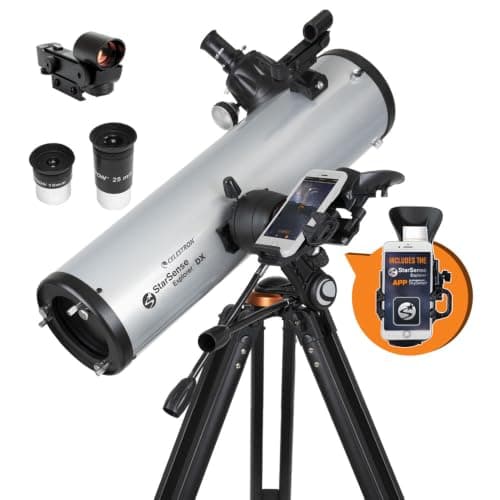 Celestron StarSense Explorer DX 130AZTop pick130mm of parabolic aperture on a mount that stays still, plus the one piece of software that genuinely solves the find-it problem. | Most first buyers | 130mm (5.11 in)260x useful | |
| 2 | 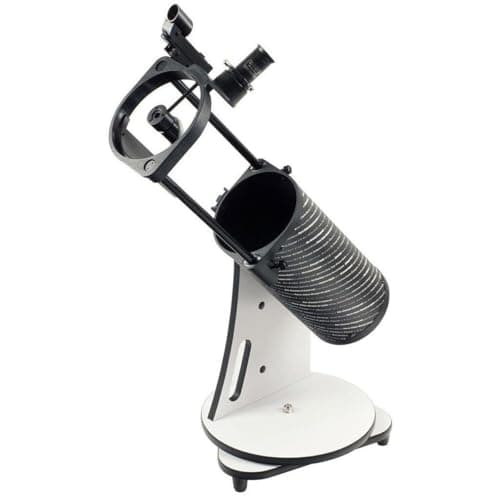 Sky-Watcher Heritage 130 Tabletop DobsonianThe same 130mm parabolic mirror as scopes costing far more, on a base with no tripod to wobble and nothing to set up. | Most aperture per dollar | 130mm260x useful | |
| 3 | 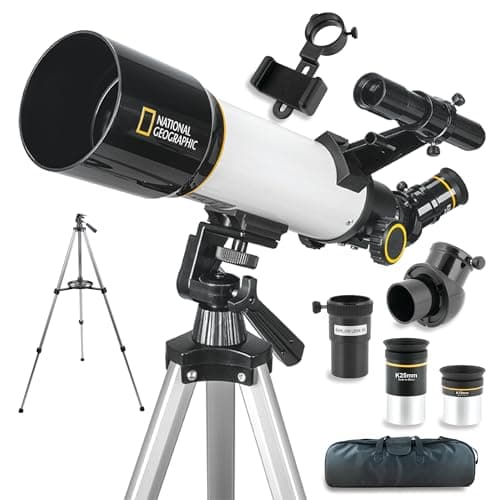 National Geographic Sky View 70mm RefractorA 70mm refractor on a panhandle mount, branded for the shelf it will be bought from. Honest optics inside a gift box. | A gift that looks like a gift | 70mm140x useful | |
| 4 | 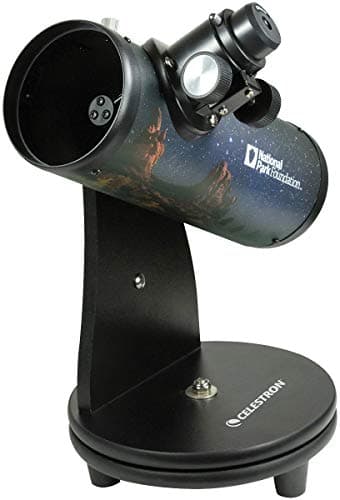 Celestron FirstScope 7676mm on a tiny Dobsonian base. The cheapest thing on this site that is a telescope rather than a toy shaped like one. | A real telescope under a hundred dollars | 76mm (2.99 in)152x useful | |
| 5 | 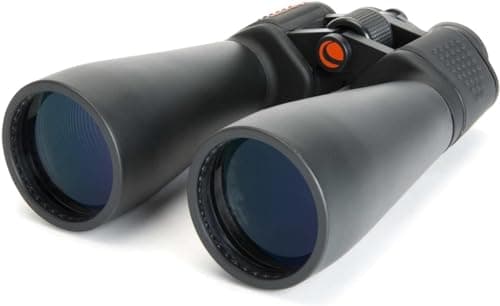 Celestron SkyMaster 15x70 Binoculars70mm of aperture in each barrel at a fixed 15x. For the money spent on a toy telescope, these show more and get used more. | The honest alternative to a cheap telescope | 70mm objective lenses (2.75 in)140x useful |
Top pick · Most first buyers
Celestron StarSense Explorer DX 130AZ
130mm of parabolic aperture on a mount that stays still, plus the one piece of software that genuinely solves the find-it problem.
What the aperture allows
- Maximum useful magnification
- 260x
- 2 × 130mm of aperture
- Resolving limit (Dawes)
- 0.89 arcseconds
- 116 ÷ 130mm
- Cassini division (0.7″)
- Out of reach
- this aperture cannot resolve it
Celestron publishes 307x as this telescope’s highest useful magnification. Our figure is 260x, from two times the aperture in millimeters. The gap of 47x comes from the slightly more generous per-inch constant makers use. Neither number describes a typical night: the atmosphere usually settles the question well below both.
Worked example: a 25mm eyepiece in this telescope gives 650mm ÷ 25mm = 26x.
130mm is the aperture where the sky stops being a list of bright dots. Two times that aperture is 260x of useful magnification, which is more than the atmosphere will usually give you on any given night, so nothing in this telescope's optical budget is wasted on a number you cannot use.
Celestron's own published ceiling for it is 307x, which sits above the 2x-aperture rule of thumb. The gap is worth knowing about: manufacturers compute that figure per inch of aperture with a slightly more generous constant. Neither number describes a night you will actually have. Plan around 130x to 180x and treat anything higher as a rare-night bonus.
At f/5 the focal length is short, so the supplied 25mm eyepiece gives a wide, forgiving 26x that makes finding things possible in the first place. That is not a compromise; it is the eyepiece you will use most.
The StarSense part is the honest reason this sits at the top. It uses your phone's camera to plate-solve the actual sky and then walks you to a target with an on-screen arrow. It is not a motor and it does not track. It solves the problem that really kills first telescopes, which is not being able to find anything.
What it does well
- 130mm parabolic mirror rather than the cheaper spherical mirror used at this price by several competitors
- The phone-based finder works and needs no alignment stars, no power and no hand controller
- Full-height tripod, so an adult uses it standing up rather than kneeling on wet grass
- Manual mount means nothing to charge, nothing to fail and nothing to re-align next time
What it costs you
- The bundled 10mm eyepiece is the weakest part of the package
- A Newtonian needs collimation checks; not hard, but it is a task a refractor does not have
- No tracking, so at high magnification you are nudging the tube every 30 seconds
Skip this one if: Skip it if the person receiving it is under about ten and will be using it alone. The tripod is full height and the finding workflow assumes a phone.
#ad · how this is funded · price as of October 19, 2026
Pick 2 · Most aperture per dollar
Sky-Watcher Heritage 130 Tabletop Dobsonian
The same 130mm parabolic mirror as scopes costing far more, on a base with no tripod to wobble and nothing to set up.
What the aperture allows
- Maximum useful magnification
- 260x
- 2 × 130mm of aperture
- Resolving limit (Dawes)
- 0.89 arcseconds
- 116 ÷ 130mm
- Cassini division (0.7″)
- Out of reach
- this aperture cannot resolve it
Worked example: a 25mm eyepiece in this telescope gives 650mm ÷ 25mm = 26x.
This is the aperture-per-dollar champion of the beginner shelf and it is not close. You get the same 130mm parabolic mirror found in telescopes at twice the price, and you get it without paying for a tripod, a slow-motion assembly or a hand controller.
Two times 130mm is 260x of useful magnification. Dawes' limit at 130mm works out to 116 divided by 130, which is 0.89 arcseconds. The Cassini division in Saturn's rings spans roughly 0.7 arcseconds at its widest, so this telescope sits right at the edge of showing it on a still night and will show the rings themselves easily.
The catch is the word tabletop. It needs a surface at roughly chest height when you are seated. A garden table works, a plastic patio chair does not, and buying one without thinking about where it will stand is the single most common regret with this design.
The tube collapses, which is what makes it live in a cupboard rather than a garage. That matters more than it sounds: the telescope you can carry outside in one trip is the telescope you use.
What it does well
- The most aperture you can buy at this price, by a clear margin
- Nothing to assemble, no tripod to wobble, ready in the time it takes to carry it outside
- Collapsible tube stores in a cupboard and keeps its collimation
- The Dobsonian motion is intuitive: you push the tube where you want to look
What it costs you
- Needs a solid table or stool at the right height, which is a real constraint
- The helical focuser is coarser than a rack-and-pinion or a Crayford
- Open tube design collects dust and needs the odd mirror clean
Skip this one if: Skip it if you have nowhere to stand it. On the ground it points at treetops, and on a wobbly plastic table every view shakes.
$305.00 · 12% off
#ad · how this is funded · price as of October 19, 2026
Pick 3 · A gift that looks like a gift
National Geographic Sky View 70mm Refractor
A 70mm refractor on a panhandle mount, branded for the shelf it will be bought from. Honest optics inside a gift box.
What the aperture allows
- Maximum useful magnification
- 140x
- 2 × 70mm of aperture
- Resolving limit (Dawes)
- 1.66 arcseconds
- 116 ÷ 70mm
- Cassini division (0.7″)
- Out of reach
- this aperture cannot resolve it
National Geographic publishes 120x as this telescope’s highest useful magnification. Our figure is 140x, from two times the aperture in millimeters. The two figures agree closely, which is the case whenever a maker states its ceiling honestly.
Worked example: a 25mm eyepiece in this telescope gives 400mm ÷ 25mm = 16x.
70mm of refractor aperture puts this at the floor of what is worth owning, and the same arithmetic applies as to every other 70mm on this site: 140x of useful magnification at the 2x rule, and a Dawes limit of 1.66 arcseconds.
The panhandle mount is the differentiator. A single handle that moves in both axes is far more intuitive for a child, or for an adult who has never used a telescope, than either a slow-motion alt-azimuth head or an equatorial one.
National Geographic publishes a 400mm focal length, which at 70mm gives f/5.7, and advertises 16x, 40x, 48x and 120x. Those four figures check out exactly against 25mm and 10mm eyepieces with the supplied 3x Barlow, and the top one sits under the 140x this aperture supports — which is not what the bottom of this market usually does.
As a gift this earns its place on presentation and on the mount. As an instrument it is a 70mm refractor, which means the Moon, the bright planets and not much else.
What it does well
- The panhandle mount is genuinely the easiest way for a beginner to aim a telescope
- 70mm of real refractor aperture rather than a 50mm toy
- Presents well as a gift, which matters more than enthusiasts like to admit
What it costs you
- A fast f/5.7 achromat shows false color on the Moon and the bright planets
- 70mm limits it to the Moon and the bright planets
- Branded packaging is part of what you are paying for
Skip this one if: Skip it if the recipient is already interested in astronomy rather than being introduced to it. They will want aperture, not a panhandle.
#ad · how this is funded · price as of October 19, 2026
Pick 4 · A real telescope under a hundred dollars
Celestron FirstScope 76
76mm on a tiny Dobsonian base. The cheapest thing on this site that is a telescope rather than a toy shaped like one.
What the aperture allows
- Maximum useful magnification
- 152x
- 2 × 76mm of aperture
- Resolving limit (Dawes)
- 1.53 arcseconds
- 116 ÷ 76mm
- Cassini division (0.7″)
- Out of reach
- this aperture cannot resolve it
Celestron publishes 180x as this telescope’s highest useful magnification. Our figure is 152x, from two times the aperture in millimeters. The gap of 28x comes from the slightly more generous per-inch constant makers use. Neither number describes a typical night: the atmosphere usually settles the question well below both.
Worked example: a 25mm eyepiece in this telescope gives 300mm ÷ 25mm = 12x.
76mm is small, and this page is not going to pretend otherwise. What it is not is a toy: the mirror is real, the mount is a proper Dobsonian, and it will show the Moon's craters and Jupiter's moons.
Two times 76mm gives 152x of useful magnification. Celestron publishes 180x. Either figure demolishes the 525x printed on the box of the department-store scope sitting beside it at the same price.
The f/3.95 focal ratio is very fast, which is hard on a spherical mirror and hard on cheap eyepieces. Expect softness at the edge of the field and do not expect much above about 60x to 75x in practice.
The right way to think about it: this is a lot better than nothing, it is enormously better than a 60mm toy scope on a plastic tripod, and it is meaningfully worse than the 130mm tabletop Dobsonian that costs roughly three times as much.
What it does well
- A genuine telescope at a price where most of the shelf is not
- Nothing to assemble, nothing to align, nothing to charge
- Small enough that a child can carry and aim it without help
What it costs you
- A fast spherical mirror at f/3.95 is soft away from the field center
- The bundled eyepieces are the cheapest part of a cheap package
- Very small; it needs a table and it is easy to knock over
Skip this one if: Skip it if the budget can stretch to a 130mm tabletop. The aperture difference is 2.9 times the light, and it is obvious at the eyepiece.
#ad · how this is funded · price as of October 19, 2026
Pick 5 · The honest alternative to a cheap telescope
Celestron SkyMaster 15x70 Binoculars
70mm of aperture in each barrel at a fixed 15x. For the money spent on a toy telescope, these show more and get used more.
What the aperture allows
- Maximum useful magnification
- 140x
- 2 × 70mm of aperture
- Resolving limit (Dawes)
- 1.66 arcseconds
- 116 ÷ 70mm
- Cassini division (0.7″)
- Out of reach
- this aperture cannot resolve it
Worked example: a 25mm eyepiece in this telescope gives 279.63mm ÷ 25mm = 11x.
Each barrel has the same 70mm aperture as the entry-level refractors on this site, and because you use both eyes the perceived brightness is higher than a single 70mm tube.
The fixed 15x is well below the 140x that 70mm could support, and that is deliberate. Binoculars are a wide-field instrument: the Pleiades, the Andromeda galaxy, the Milky Way star clouds and the whole Moon at once.
Celestron publishing three limiting magnitudes, 11.73 for ideal skies down to 9.73 for poor ones, is the single most useful number on this page. It says out loud what most listings hide: your sky matters as much as your optics.
At 15x these are heavy to hold steady. The included tripod adapter is not an accessory, it is a requirement for any sustained looking.
What it does well
- 70mm per barrel is real aperture, not a novelty
- Instantly usable: no assembly, no alignment, no learning curve
- Wide field shows large objects a telescope cannot fit in view
- Doubles as daytime and wildlife optics, so it gets used year-round
What it costs you
- Too heavy to hold steady at 15x for long; a tripod is effectively required
- Fixed magnification, so the planets stay small
- No detail on Saturn: at 15x the rings are a suggestion, not a shape
Skip this one if: Skip them if the goal is specifically to see Saturn's rings as rings. 15x will not do it; a 70mm telescope at 70x will.
$129.95 · 32% off
#ad · how this is funded · price as of October 19, 2026
If in doubt, buy binoculars
This is not a fallback. A pair of 15x70 astronomy binoculars has as much aperture per barrel as an entry-level refractor, works the moment it comes out of the box, is useful in daylight, and shows the Pleiades and the Milky Way in a way a small telescope cannot.
The one thing they cannot do is show Saturn's rings as rings, which needs magnification only interchangeable eyepieces provide. If that specific view is the point of the gift, buy the telescope. The full comparison is here.
Questions people actually ask
Is a telescope a good gift?
Yes, if you buy one that can be used on the first clear night. The common failures are a magnification claim the optics cannot meet, a mount nobody can operate, and no way to find anything. All three are visible in the listing before you buy.
What is the best telescope to give as a gift?
For most recipients, one with phone-based finding, because being unable to locate anything is what ends most first evenings. For the best value, a 130mm tabletop Dobsonian, provided the recipient has a suitable table.
How much should I spend on a telescope gift?
Enough to clear 70mm of aperture on a mount that does not shake. Below that a pair of astronomy binoculars is genuinely the better gift and costs the same.
What should I give with a telescope?
A red flashlight, a moon filter if the telescope is over 100mm, something that identifies what is in the sky, and a promise to be there on the first clear night. The last one matters more than any of the accessories.
Should I buy a telescope for someone who has not asked for one?
It can work very well, but pick for the situation rather than the specification. Somebody with no stated interest needs a telescope that works in five minutes far more than they need the largest mirror your budget allows.
Read next
Best for kids
The Best Telescopes for Kids
Telescopes chosen for how easily a child can aim and carry them, which matters more at this age than aperture does.
Top pick: Celestron FirstScope 76
#ad · how this is funded · price as of October 19, 2026
Will They Actually Use It?
Why telescopes get abandoned, why it is almost always the first evening rather than the instrument, and what fixes it.
Top pick: Celestron StarSense Explorer DX 130AZ
#ad · how this is funded · price as of October 19, 2026
What to Avoid When Buying a First Telescope
The six traps that produce a disappointing first telescope, each one checkable from the product listing before you buy.
Top pick: Celestron FirstScope 76
#ad · how this is funded · price as of October 19, 2026
Found something wrong here? Tell us and we will correct it and date the correction, per our editorial policy.