What You Can Actually See
The Best Telescopes for a City Sky
A bright sky does not dim everything equally. Once you know which half of the sky it takes and which half it leaves alone, choosing a telescope for a city gets much easier.
By Scooter M. · Published · How we pick
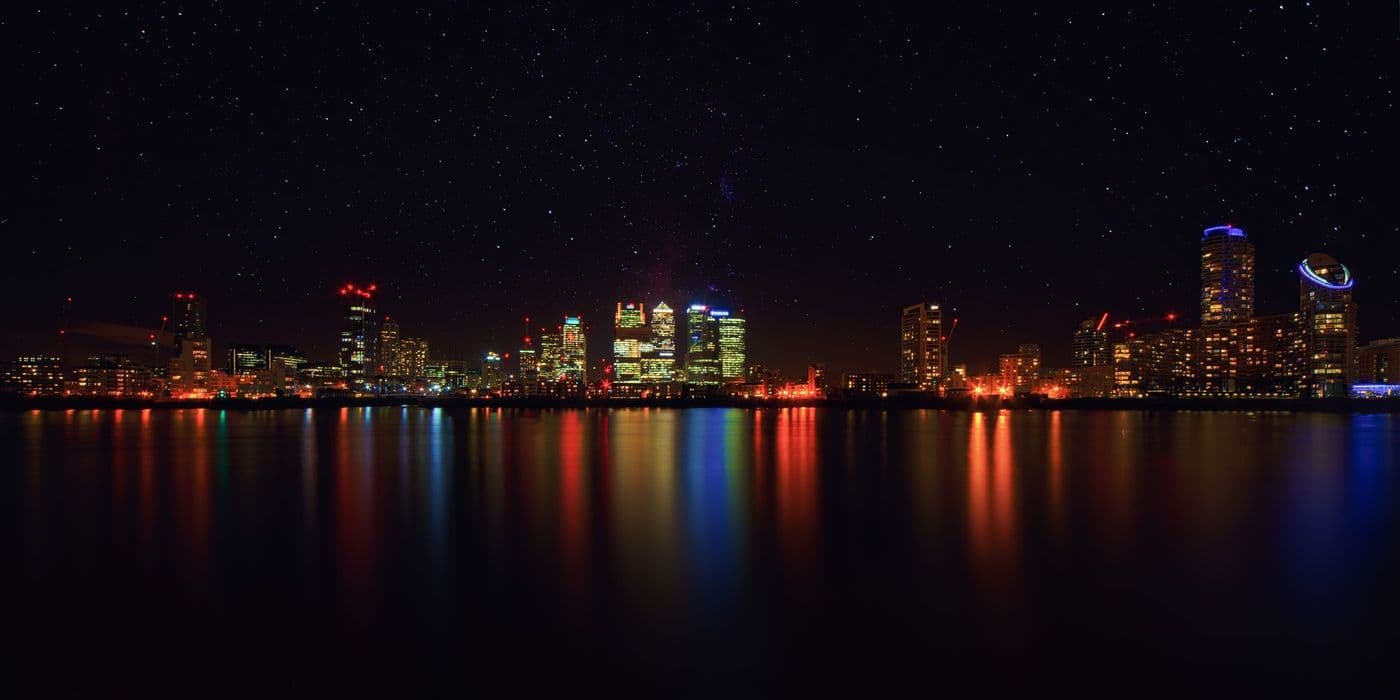
Most advice about city astronomy is some version of give up and drive somewhere dark. That is good advice for one half of the sky and useless for the other, because light pollution does not dim everything by the same amount. Understanding which half is which is the whole of choosing a telescope for a city.
The criteria, before any picks
Every recommendation below is judged on four things, in this order. Nothing here is ranked on brand, on how a telescope looks, or on what it costs.
- Does it perform on targets a bright sky cannot touch? The Moon, the planets and double stars are essentially immune to light pollution. They are bright compact sources, and washing the background gray barely changes them.
- Does it have the aperture and magnification headroom for those targets? City observing lives at higher magnification than dark-sky observing, because you are working on small bright things rather than large faint ones.
- Does it suit a hard stand? A city garden, a balcony or a roof is usually a hard flat surface with a restricted view of the sky, often with a wall or building blocking half of it.
- Can you find things when half the guide stars are invisible? Star-hopping gets genuinely harder under a bright sky, because the faint stars you hop between are the first things a city sky removes.
What a city sky takes, and what it leaves
| Target | From a city | Why |
|---|---|---|
| The Moon | No loss at all | Far brighter than any skyglow |
| Jupiter, Saturn, Venus, Mars | No meaningful loss | Bright compact sources |
| Double stars | No meaningful loss | Point sources, unaffected by background |
| Bright open clusters | Most survive | Individual stars stay visible |
| Globular clusters | Dimmer, still worthwhile | Bright core carries through |
| Emission nebulae | Badly hit, filter helps | Large and faint, but narrow-band |
| Galaxies | Mostly gone | Large, faint and broad-spectrum |
Read down that column and the buying advice writes itself. A city telescope is a planetary telescope, and the qualities that make a good planetary telescope are aperture, focal length and a mount steady enough to use at high magnification. The planetary roundup ranks on the same logic from a different starting point.
Why finding things is the real city problem
This is the part most guides skip. Under a rural sky you star-hop from a bright star through a chain of fainter ones to your target. A city sky deletes the chain. You can still see the bright anchors, and everything between them is gone, which makes the standard finding technique much harder to learn.
That pushes a city buyer toward one of two answers: a telescope that finds things for you, or one that tracks so you do not lose what you found. Both cost aperture, and in a city that trade is more defensible than it is anywhere else, because aperture was buying you less here to begin with. StarSense against manual finding and GoTo against manual both work the trade through.
How this is funded: the buy buttons below are Amazon Associates links, and a qualifying purchase earns us a commission at no extra cost to you. It cannot move the ranking, because the order here is set by aperture per dollar, and no commission rate changes how much light a mirror collects. Full disclosure.
| # | Telescope | Best for | Aperture | Price |
|---|---|---|---|---|
| 1 | 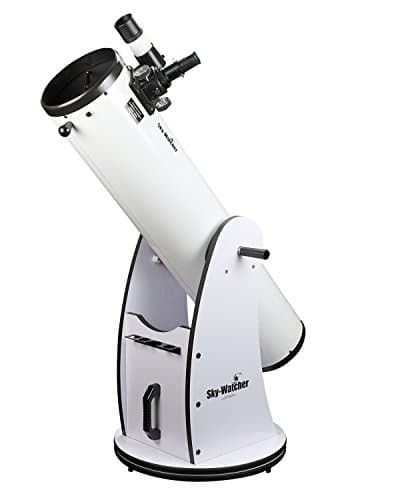 Sky-Watcher Classic 200P Dobsonian (8-inch)Top pickEight inches of aperture on the simplest mount ever designed. This is the telescope experienced observers tell beginners to buy. | The one you will not outgrow | 200mm (8 in)400x useful | |
| 2 | 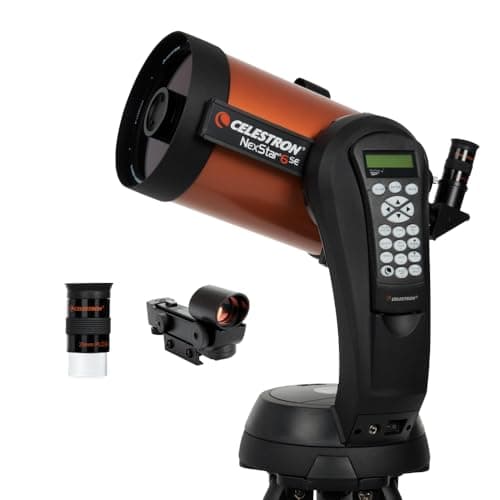 Celestron NexStar 6SE150mm of Schmidt-Cassegrain at f/10 on a computerized fork. Long focal length in a short tube, and the planetary views to match. | The serious step up | 150mm (5.91 in)300x useful | |
| 3 | 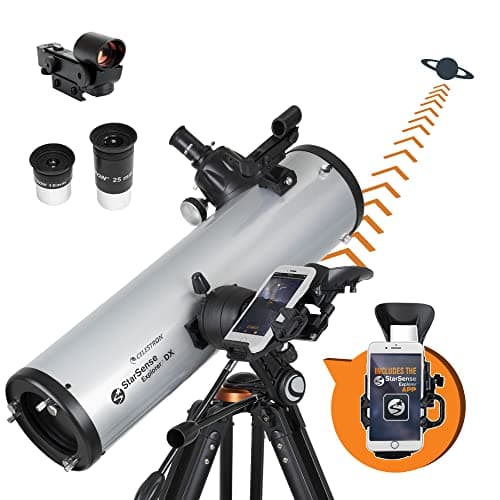 Celestron StarSense Explorer DX 130AZ130mm of parabolic aperture on a mount that stays still, plus the one piece of software that genuinely solves the find-it problem. | Most first buyers | 130mm (5.11 in)260x useful | |
| 4 | 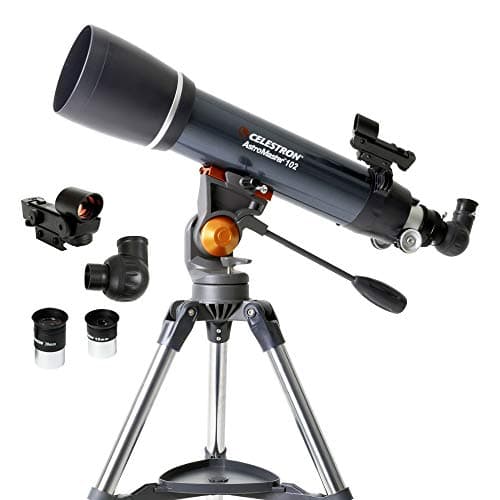 Celestron AstroMaster 102AZ102mm of refractor at f/6.5, which means a short tube and a wide field. A no-maintenance scope with real aperture behind it. | Wide-field refractor views | 102mm (4 in)204x useful | |
| 5 | 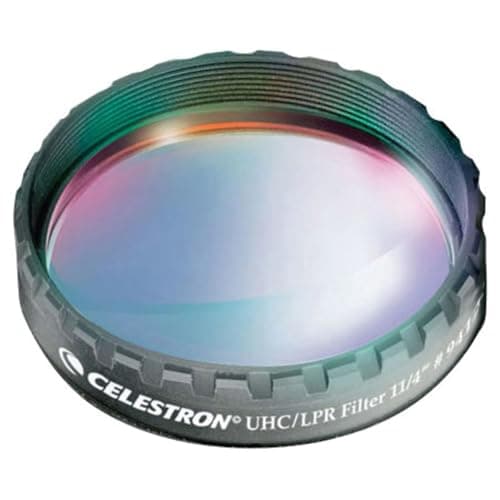 Celestron UHC/LPR Light Pollution Reduction Filter (1.25")A filter that selectively cuts the wavelengths streetlights emit. It helps on emission nebulae and does nothing for stars, galaxies or planets. | A suburban sky, on nebulae only | 1.25" thread64x useful | |
| 6 | 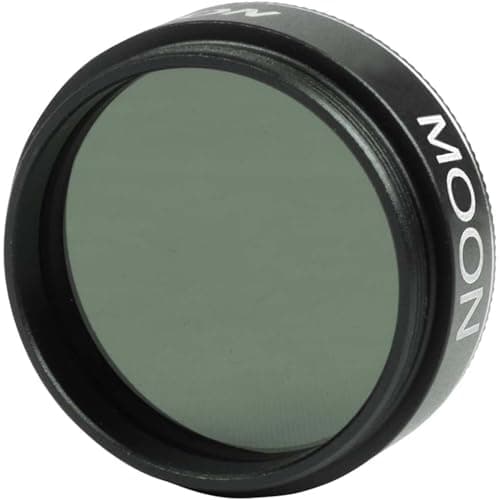 Celestron Moon Filter (1.25")A neutral-density filter that screws into an eyepiece and makes the full Moon comfortable to look at. | The cheapest real upgrade | 1.25" thread64x useful |
Top pick · The one you will not outgrow
Sky-Watcher Classic 200P Dobsonian (8-inch)
Eight inches of aperture on the simplest mount ever designed. This is the telescope experienced observers tell beginners to buy.
What the aperture allows
- Maximum useful magnification
- 400x
- 2 × 200mm of aperture
- Resolving limit (Dawes)
- 0.58 arcseconds
- 116 ÷ 200mm
- Cassini division (0.7″)
- Within reach
- on a steady night, at high magnification
200mm is a different category of instrument, not an incremental upgrade. Against the 70mm refractor at the other end of this list the light-gathering ratio is 200 divided by 70, squared: 8.2 times more light reaching your eye.
Two times 200mm gives 400x of useful magnification, which is more than the atmosphere delivers on all but a handful of nights a year. In practice this telescope is limited by the sky rather than by its optics, which is exactly the position you want to be in.
Dawes' limit at 200mm is 116 divided by 200, which is 0.58 arcseconds. The Cassini division, at roughly 0.7 arcseconds, is comfortably inside that. So is the Great Red Spot, and so are hundreds of Messier objects a 70mm scope simply cannot reach.
The honest cost is bulk. The tube is long and the base is wide, and this is a telescope you carry outside in two trips. Everyone who owns one tells the same story: they used it far more once they stopped storing it somewhere awkward.
What it does well
- The aperture-per-dollar figure that no other design at this price approaches
- A mount that cannot be wobbly, because there is almost nothing to it
- The 2-inch focuser takes wide-field eyepieces the cheaper models cannot
- Genuinely a lifetime telescope; nobody outgrows eight inches of aperture in a hurry
What it costs you
- Big and heavy: two trips outside, and it needs real storage space
- No tracking, so at 200x objects drift out of view in well under a minute
- Needs collimation checks, and the mirror takes 30 to 45 minutes to reach outside temperature
Skip this one if: Skip it if you live upstairs with no lift, or if the observing spot is a fire escape. The best telescope in this list is the wrong one if carrying it is a chore.
| Optical design | Newtonian reflector, borosilicate parabolic primary with 94 percent reflective coatingsSource: Classic 200P Dobsonian — manufacturer specifications (retrieved September 1, 2026) |
|---|---|
| Aperture | 200mm (8 in)Source: Classic 200P Dobsonian — manufacturer specifications (retrieved September 1, 2026) |
| Mount | Dobsonian rocker box with Teflon bearings and a patented tension control handleSource: Classic 200P Dobsonian — manufacturer specifications (retrieved September 1, 2026) |
| Light gathering vs the eye | 816xSky-Watcher's own published figure.Source: Classic 200P Dobsonian — manufacturer specifications (retrieved September 1, 2026) |
| Focuser | 2-inch Crayford with a 1.25-inch adapterSource: Classic 200P Dobsonian — manufacturer specifications (retrieved September 1, 2026) |
| Versus the 6-inch model | 78 percent brighter than the 150mm versionSky-Watcher's own published comparison.Source: Classic 200P Dobsonian — manufacturer specifications (retrieved September 1, 2026) |
#ad · how this is funded · price as of September 13, 2026
Pick 2 · The serious step up
Celestron NexStar 6SE
150mm of Schmidt-Cassegrain at f/10 on a computerized fork. Long focal length in a short tube, and the planetary views to match.
What the aperture allows
- Maximum useful magnification
- 300x
- 2 × 150mm of aperture
- Resolving limit (Dawes)
- 0.77 arcseconds
- 116 ÷ 150mm
- Cassini division (0.7″)
- Out of reach
- this aperture cannot resolve it
Celestron publishes 354x as this telescope’s highest useful magnification. Our figure is 300x, from two times the aperture in millimeters. The gap of 54x comes from the slightly more generous per-inch constant makers use. Neither number describes a typical night: the atmosphere usually settles the question well below both.
Worked example: a 25mm eyepiece in this telescope gives 1500mm ÷ 25mm = 60x.
The Schmidt-Cassegrain folds a 1500mm light path into a tube about a foot long. That is what you are paying for: 150mm of aperture and a long focal length in something you can pick up with one hand.
Two times 150mm gives 300x of useful magnification. Celestron publishes 354x. Dawes' limit is 0.77 arcseconds, so the Cassini division and the Great Red Spot are both genuinely within reach.
At f/10 a 25mm eyepiece gives 60x rather than the 26x it would give on an f/5 Newtonian, so the widest view this telescope offers is narrower than a Dobsonian's. It is a planetary and double-star instrument first and a deep-sky one second.
This is the point on the list where the price stops being a beginner price. It earns that if the buyer already knows they are staying with the hobby; it is a lot of telescope to gamble on somebody who has never looked through one.
What it does well
- 150mm of aperture in a genuinely portable tube
- Long focal length suits the Moon, the planets and double stars extremely well
- Full GoTo and tracking on a mount that is properly steady for the tube
What it costs you
- Narrow widest field: large open clusters do not fit
- The corrector plate dews up and needs a dew shield or a heater
- Long cool-down before the optics settle
Skip this one if: Skip it if this would be the first telescope in the house. Buy a Dobsonian, find out whether the hobby sticks, and spend this money in a year with much better information.
$1,199.00 · 13% off
#ad · how this is funded · price as of September 13, 2026
Pick 3 · Most first buyers
Celestron StarSense Explorer DX 130AZ
130mm of parabolic aperture on a mount that stays still, plus the one piece of software that genuinely solves the find-it problem.
What the aperture allows
- Maximum useful magnification
- 260x
- 2 × 130mm of aperture
- Resolving limit (Dawes)
- 0.89 arcseconds
- 116 ÷ 130mm
- Cassini division (0.7″)
- Out of reach
- this aperture cannot resolve it
Celestron publishes 307x as this telescope’s highest useful magnification. Our figure is 260x, from two times the aperture in millimeters. The gap of 47x comes from the slightly more generous per-inch constant makers use. Neither number describes a typical night: the atmosphere usually settles the question well below both.
Worked example: a 25mm eyepiece in this telescope gives 650mm ÷ 25mm = 26x.
130mm is the aperture where the sky stops being a list of bright dots. Two times that aperture is 260x of useful magnification, which is more than the atmosphere will usually give you on any given night, so nothing in this telescope's optical budget is wasted on a number you cannot use.
Celestron's own published ceiling for it is 307x, which sits above the 2x-aperture rule of thumb. The gap is worth knowing about: manufacturers compute that figure per inch of aperture with a slightly more generous constant. Neither number describes a night you will actually have. Plan around 130x to 180x and treat anything higher as a rare-night bonus.
At f/5 the focal length is short, so the supplied 25mm eyepiece gives a wide, forgiving 26x that makes finding things possible in the first place. That is not a compromise; it is the eyepiece you will use most.
The StarSense part is the honest reason this sits at the top. It uses your phone's camera to plate-solve the actual sky and then walks you to a target with an on-screen arrow. It is not a motor and it does not track. It solves the problem that really kills first telescopes, which is not being able to find anything.
What it does well
- 130mm parabolic mirror rather than the cheaper spherical mirror used at this price by several competitors
- The phone-based finder works and needs no alignment stars, no power and no hand controller
- Full-height tripod, so an adult uses it standing up rather than kneeling on wet grass
- Manual mount means nothing to charge, nothing to fail and nothing to re-align next time
What it costs you
- The bundled 10mm eyepiece is the weakest part of the package
- A Newtonian needs collimation checks; not hard, but it is a task a refractor does not have
- No tracking, so at high magnification you are nudging the tube every 30 seconds
Skip this one if: Skip it if the person receiving it is under about ten and will be using it alone. The tripod is full height and the finding workflow assumes a phone.
$499.95 · 17% off
#ad · how this is funded · price as of September 13, 2026
Pick 4 · Wide-field refractor views
Celestron AstroMaster 102AZ
102mm of refractor at f/6.5, which means a short tube and a wide field. A no-maintenance scope with real aperture behind it.
What the aperture allows
- Maximum useful magnification
- 204x
- 2 × 102mm of aperture
- Resolving limit (Dawes)
- 1.14 arcseconds
- 116 ÷ 102mm
- Cassini division (0.7″)
- Out of reach
- this aperture cannot resolve it
Celestron publishes 241x as this telescope’s highest useful magnification. Our figure is 204x, from two times the aperture in millimeters. The gap of 37x comes from the slightly more generous per-inch constant makers use. Neither number describes a typical night: the atmosphere usually settles the question well below both.
Worked example: a 25mm eyepiece in this telescope gives 660mm ÷ 25mm = 26x.
102mm collects 2.1 times the light of a 70mm refractor, which is the ratio 102 over 70, squared. That is the difference between the Orion Nebula as a smudge and the Orion Nebula as a shape.
Two times 102mm gives 204x of useful magnification; Celestron publishes 241x. Its published Dawes limit of 1.14 arcseconds is short of the Cassini division, so expect the rings as a clean separated ring rather than a ring with a gap in it.
The short f/6.5 tube is the interesting part. It gives a wide true field for a refractor, which makes large open clusters and Milky Way star fields genuinely rewarding, and it keeps the tube short enough to be easy to handle.
Refractor maintenance is the real selling point for a household that will not enjoy collimating anything. There is nothing to align and nothing to clean.
What it does well
- Real aperture with zero maintenance
- Wide field for a refractor: good on clusters as well as planets
- Short tube balances easily on a simple mount
What it costs you
- A fast achromat shows more color fringing on bright objects than an f/10 tube
- The AZ mount is basic; expect to nudge rather than glide
- Still 102mm, so faint galaxies remain out of reach
Skip this one if: Skip it if the planets are the whole point. A long f/10 refractor or a Dobsonian will show them with less false color.
$359.95 · 11% off
#ad · how this is funded · price as of September 13, 2026
Pick 5 · A suburban sky, on nebulae only
Celestron UHC/LPR Light Pollution Reduction Filter (1.25")
A filter that selectively cuts the wavelengths streetlights emit. It helps on emission nebulae and does nothing for stars, galaxies or planets.
What the aperture allows
- Maximum useful magnification
- 64x
- 2 × 31.75mm of aperture
- Resolving limit (Dawes)
- 3.65 arcseconds
- 116 ÷ 31.75mm
- Cassini division (0.7″)
- Out of reach
- this aperture cannot resolve it
A light-pollution filter is not a contrast knob for the whole sky. It works by blocking the narrow bands that streetlights emit while passing the narrow bands that glowing gas emits, so it only helps on targets that are themselves glowing gas.
That means emission nebulae, and essentially nothing else. Stars, galaxies and planets shine across the whole spectrum, so a filter that removes part of the spectrum removes part of them too and the view gets dimmer rather than better.
It also cannot give you back a dark sky. A filter improves contrast on a specific class of target under a specific kind of light pollution; it does not turn a city garden into a rural one, and any product that claims otherwise is overselling.
Worth buying second or third, after a decent eyepiece, and only if emission nebulae are something you actually want to chase from where you live.
What it does well
- Genuinely raises contrast on emission nebulae under artificial skylight
- Threads into any standard 1.25-inch eyepiece, so it moves between telescopes
- Celestron states plainly what it targets rather than promising a darker sky
What it costs you
- Does nothing useful on stars, galaxies or planets, which is most of what a beginner looks at
- Dims the view, so it wants aperture behind it — below about 130mm the trade is rarely worth it
- Celestron publishes no transmission curve on the listing, so you cannot check the passband before buying
- Costs several times what a moon filter costs and helps on far fewer targets
Skip this one if: Skip it if you are still on your first eyepiece, or if your sky is genuinely dark. A dark site beats any filter, and a better eyepiece changes more nights than this will.
| Optical design | Threaded filter for 1.25-inch eyepiecesSource: Celestron UHC/LPR Light Pollution Reduction Filter — the brand's own listing on Amazon.com (retrieved September 13, 2026) |
|---|---|
| Aperture | 1.25" threadThe fitting size. It threads into the eyepiece, not into the telescope.Source: Celestron UHC/LPR Light Pollution Reduction Filter — the brand's own listing on Amazon.com (retrieved September 13, 2026) |
| What Celestron says it does | Designed to selectively reduce the transmission of certain wavelengths of light, specifically those produced by artificial lightQuoted from the brand's own published description. Celestron does not publish a transmission curve or a named passband on that listing, so this page does not state one.Source: Celestron UHC/LPR Light Pollution Reduction Filter — the brand's own listing on Amazon.com (retrieved September 13, 2026) |
$94.95 · 25% off
#ad · how this is funded · price as of September 13, 2026
Pick 6 · The cheapest real upgrade
Celestron Moon Filter (1.25")
A neutral-density filter that screws into an eyepiece and makes the full Moon comfortable to look at.
What the aperture allows
- Maximum useful magnification
- 64x
- 2 × 31.75mm of aperture
- Resolving limit (Dawes)
- 3.65 arcseconds
- 116 ÷ 31.75mm
- Cassini division (0.7″)
- Out of reach
- this aperture cannot resolve it
The full Moon through a 130mm telescope is genuinely too bright to look at comfortably, and the discomfort costs you detail: a dazzled eye resolves less.
The filter is neutral density, meaning it cuts the light without shifting the color. Contrast goes up, the glare goes away, and the terminator, the line between lunar day and night where the shadows are longest, becomes the best thing in the sky.
It is the single cheapest item that changes an observing session, and it is the one accessory almost every beginner buys second rather than first.
What it does well
- Turns the full Moon from uncomfortable into detailed
- Threads into any standard 1.25-inch eyepiece
- Costs less than almost anything else that improves a view
What it costs you
- Only useful on the Moon and on Venus
- Redundant if you buy an accessory kit, which usually includes one
Skip this one if: Skip it if you are already buying an eyepiece and filter kit. There is one in the case.
| Optical design | Neutral-density filter that threads into a 1.25-inch eyepiece barrelSource: Celestron Moon Filter — the brand's own listing on Amazon.com (retrieved September 1, 2026) |
|---|---|
| Aperture | 1.25" threadThe fitting size. It threads into the eyepiece, not into the telescope.Source: Celestron Moon Filter — the brand's own listing on Amazon.com (retrieved September 1, 2026) |
| Effect | Reduces lunar glare, improves contrast and reveals surface detailCelestron's own description of what the filter does.Source: Celestron Moon Filter — the brand's own listing on Amazon.com (retrieved September 1, 2026) |
$12.95 · 12% off
#ad · how this is funded · price as of September 13, 2026
A balcony is a different problem again
If your only observing spot is a balcony, two things change. The sky available to you is a narrow wedge rather than a dome, so a telescope that tracks is worth more because objects cross that wedge quickly. And the floor is often a concrete slab beside a building that radiates stored heat all evening, which creates rising air that blurs high magnification exactly when you want it.
The practical answer to the heat is to observe away from the wall where you can, accept that seeing will be worse than a garden, and work at the magnification the night actually supports rather than the one the aperture allows. Astronomical seeing is the limit far more often than the telescope is.
What about a light-pollution filter?
A light-pollution filter blocks the narrow wavelengths streetlights emit and passes the narrow wavelengths glowing gas emits. That makes it genuinely useful on emission nebulae and useless on everything else, because stars, galaxies and planets shine across the whole spectrum and a filter that removes part of the spectrum removes part of them too.
Three habits that beat any purchase
- Put a wall or a hedge between you and the nearest streetlight. Direct glare into your eye costs more contrast than the skyglow does. Standing in a shadow is free and it works immediately.
- Protect your dark adaptation. Twenty minutes to build, one glance at a phone to destroy. A red flashlight preserves it, a white one does not.
- Observe when the air is still, not when the sky is clearest. A steady night at 180x beats a transparent night at 90x for everything a city sky lets you see, because you are working on small bright targets where resolution matters more than depth.
And the honest note to end on: if galaxies are what you want, no telescope and no filter will deliver them from a city center. That needs a drive to a darker site, and the Bortle scale will tell you how far you have to go.
Questions people actually ask
What is the best telescope for a city or apartment?
One with aperture and magnification headroom for the planets, on a mount steady enough to use at 150x or more, because a bright sky leaves bright compact targets untouched and takes away the faint extended ones. A phone-guided or tracking telescope helps more in a city than anywhere else, because star-hopping is harder when the faint guide stars are washed out.
Can you see anything with a telescope in a city?
Yes, and more than most people expect. The Moon shows full detail, Jupiter's belts and moons, Saturn's rings, the phases of Venus, and hundreds of double stars are all effectively unaffected by light pollution. Galaxies and large faint nebulae are the losses.
Do light pollution filters actually work?
On emission nebulae, yes, because those glow at narrow wavelengths a filter can isolate. On stars, galaxies and planets, no: they shine across the whole spectrum, so a filter dims them without improving contrast. It is a targeted tool, not a general fix.
Is a bigger telescope better in a city?
For planets and the Moon, yes. For faint extended objects, much less than you would hope, because extra aperture collects more skyglow along with more object light and the contrast ratio barely changes. Aperture buys resolution in a city more than it buys depth.
Can you use a telescope on a balcony?
Yes, with two caveats. Your sky is a narrow wedge, so objects cross it quickly and a tracking mount is worth more than usual. And concrete and walls radiate stored heat for hours after sunset, which blurs high magnification, so expect worse seeing than an open garden.
What magnification should you use in a city?
Usually higher than in the country, because you are observing small bright targets rather than large faint ones. The practical limit is the atmosphere rather than the telescope: work up in steps and stop when the image softens.
Read next

What a City Sky Actually Allows
What survives a bright sky, what does not, and why light pollution changes what you should spend a telescope budget on.
Top pick: Sky-Watcher Classic 200P Dobsonian (8-inch)
#ad · how this is funded · price as of September 13, 2026
Best for the planets
The Best Telescopes for Seeing the Planets
Telescopes ranked for planetary detail, where resolving limit and mount steadiness matter more than raw light-gathering.
Top pick: Celestron NexStar 6SE
$1,199.00 · 13% off
#ad · how this is funded · price as of September 13, 2026

GoTo vs Manual: What the Motors Actually Cost You
What a GoTo mount costs in aperture, when it earns that back, and the phone-guided middle option most buyers miss.
Top pick: Celestron NexStar 130SLT
Currently unavailable at Amazon
Checked September 13, 2026. We are not linking to it while there is nothing to buy.
Found something wrong here? Tell us and we will correct it and date the correction, per our editorial policy.