Beginner Telescopes
StarSense Phone Finding vs Finding Things Yourself
The StarSense app plate-solves the real sky through your phone's camera and walks you to a target. The question is what that convenience costs, and the answer is aperture.
By Scooter M. · Published · How we pick
Buy the StarSense version if not being able to find anything is what would stop the telescope being used. Buy the manual version if you would enjoy learning the sky, because the same money buys about 30 percent more light. That is the whole decision, and everything below is the working.
What StarSense actually does
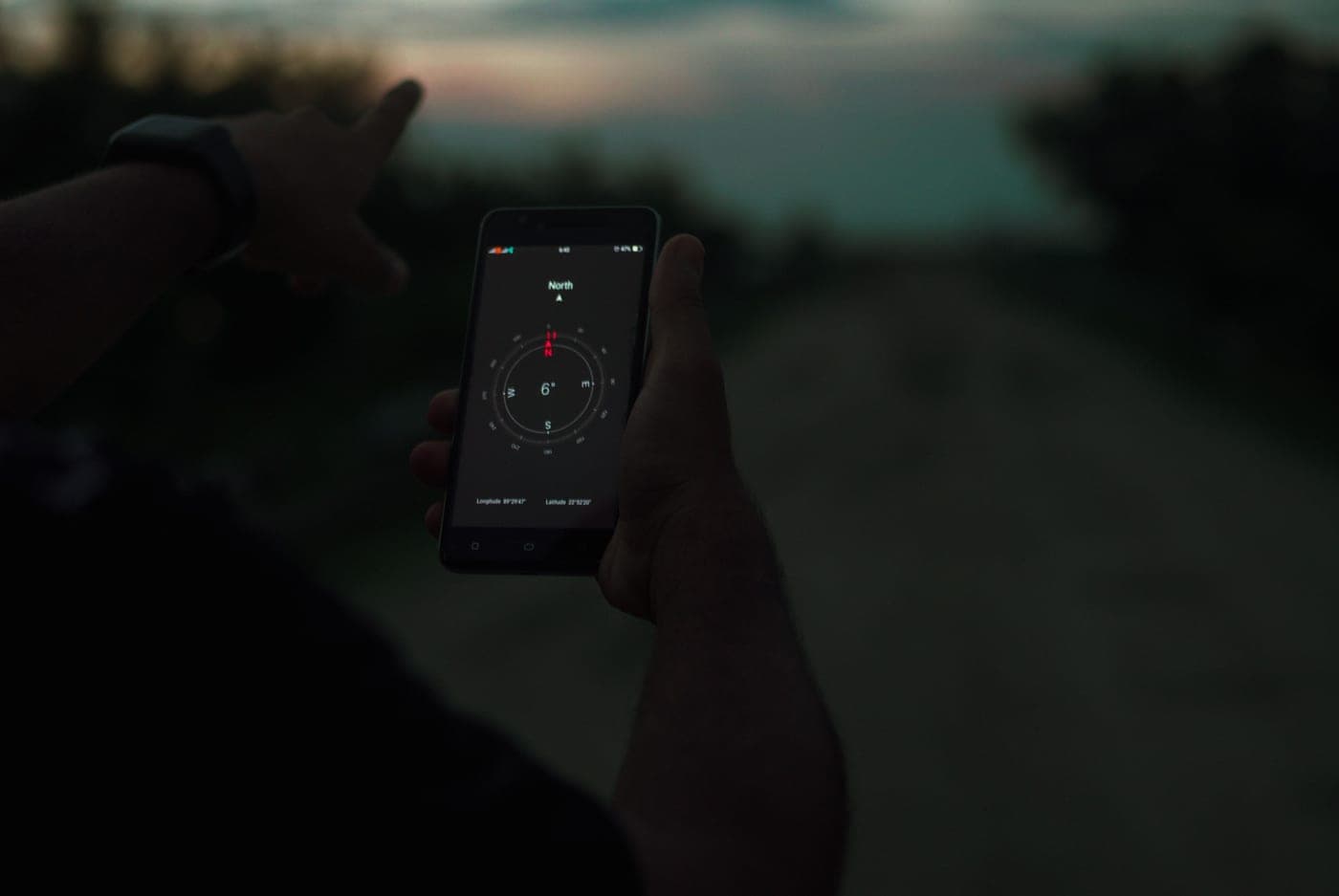
Your phone sits in a dock over a mirror pointed at the sky. The app takes a picture, matches the star pattern against a catalog, and works out precisely where the telescope is aimed. That is plate solving, and it is the same technique used by research telescopes.
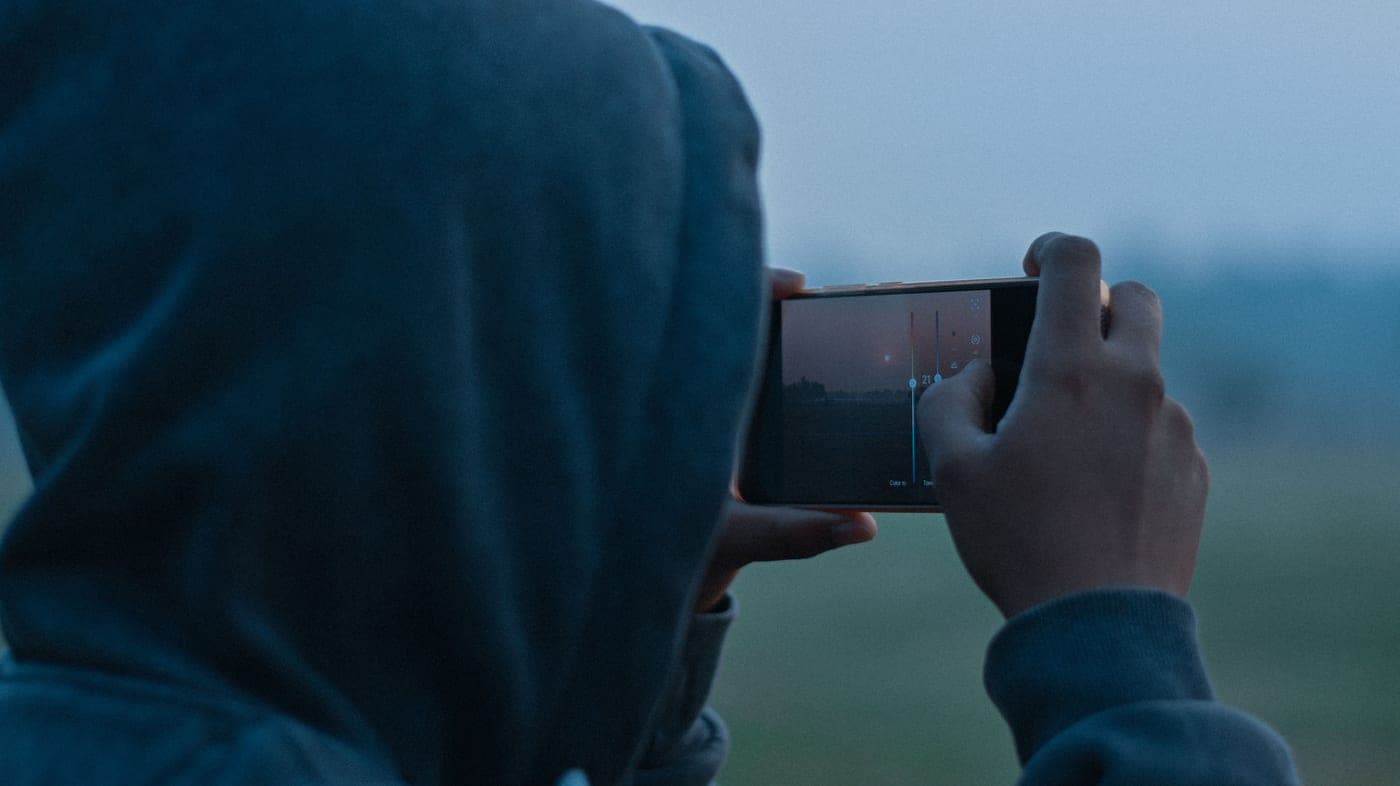
It then shows an on-screen arrow: push the tube this way. When you arrive, a bullseye. There is no alignment routine, no named stars to identify, no power supply and no hand controller. That is a different job from holding a phone over the eyepiece to take a picture, and the two are easy to confuse when shopping.
What it costs, in aperture
The comparison worth making is between two telescopes at a similar price: the Celestron StarSense Explorer LT 114AZ with the app, and the Sky-Watcher Heritage 130 without it.
light ratio = (aperture 1 / aperture 2) squared
(130 / 114)squared = 1.30, so 30 percent more light
The Heritage also has a parabolic mirror where the LT 114AZ has a spherical one, per Celestron's own published optical design line. Check any pair of apertures yourself with the aperture calculator.
Thirty percent more light is a real difference on faint objects and an invisible one on the Moon. So the question becomes: which failure is more likely for this particular buyer, a slightly dimmer view or an evening that ends without finding anything? There is also a telescope that refuses the question: the phone-guided 130mm tabletop, which costs more than either.
Learning to star-hop, and why people still do it
Star-hopping means starting from a bright star you can recognize and stepping through the field with a low-power eyepiece to your target, using a chart. It is a skill, it takes a few sessions to click, and the people who have it tend to be evangelical about it.
Their argument is not nostalgia. Learning to star-hop means learning the sky, and after a season you know where things are, which constellations are up in which month, and what is worth looking at tonight. The app-guided route gives you the object without the map. If you have already decided on the app, the LT against the DX is the next question.
| StarSense phone finding | Manual star-hopping | |
|---|---|---|
| Aperture per dollar | Lower: you pay for the dock and app | Higher: all of it goes into the mirror |
| First night | Finds targets in minutes | Moon and bright planets only, most likely |
| Needs | A supported phone, charged | A chart or a free app, and a red light |
| What you learn | Where things are tonight | The sky, over a season |
| Works when | Enough stars are visible to plate-solve | You can see enough to star-hop from |
| Long term | Still convenient | You stop needing anything |
The recommendation, split by buyer
- A gift for somebody who has shown no prior interest: StarSense. The first session decides whether there is a second one, and it removes the most common way that first session fails.
- Somebody who asked for a telescope: manual, and spend the difference on aperture. Motivated buyers get through the star-hopping learning curve.
- A family with children: StarSense. Handing a child the phone and letting them lead the way to Jupiter is genuinely the best use of it.
- A city sky: StarSense struggles when too few stars are visible to plate-solve, and so does star-hopping. Both approaches suffer, and light pollution is the page to read.
There is one pair of targets where this choice stops being a convenience and becomes the whole observation. Uranus and Neptune are bright enough for a 70mm and look exactly like field stars, so without something that tells you which point is the planet you can have one centered and never know.
How this is funded: the buy buttons below are Amazon Associates links, and a qualifying purchase earns us a commission at no extra cost to you. It cannot move the ranking, because the order here is set by aperture per dollar, and no commission rate changes how much light a mirror collects. Full disclosure.
| # | Telescope | Best for | Aperture | Price |
|---|---|---|---|---|
| 1 | 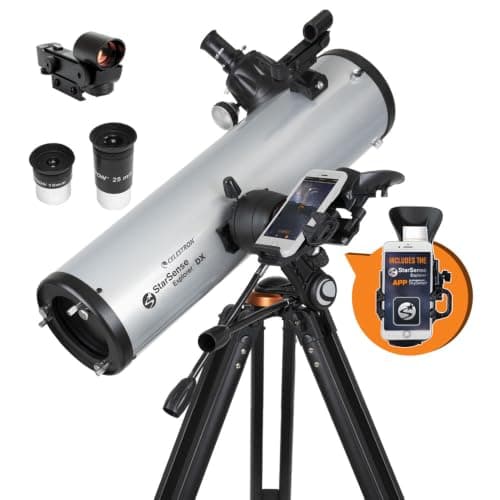 Celestron StarSense Explorer DX 130AZTop pick130mm of parabolic aperture on a mount that stays still, plus the one piece of software that genuinely solves the find-it problem. | Most first buyers | 130mm (5.11 in)260x useful | |
| 2 | 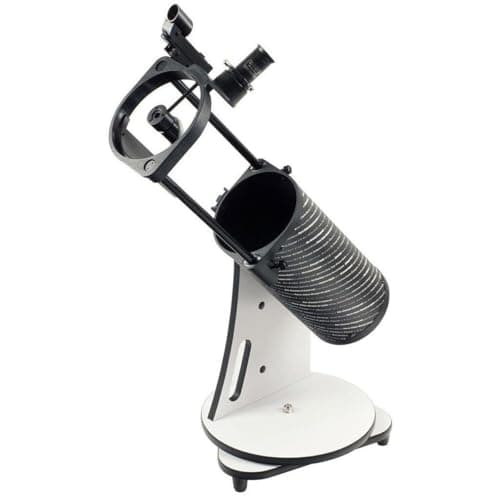 Sky-Watcher Heritage 130 Tabletop DobsonianThe same 130mm parabolic mirror as scopes costing far more, on a base with no tripod to wobble and nothing to set up. | Most aperture per dollar | 130mm260x useful | |
| 3 | 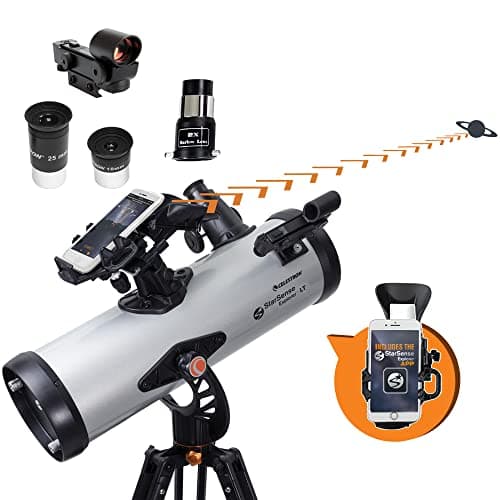 Celestron StarSense Explorer LT 114AZThe StarSense phone finder at a lower price, paid for with a spherical mirror instead of a parabolic one. | Phone finding on a budget | 114mm (4.5 in)228x useful |
Top pick · Most first buyers
Celestron StarSense Explorer DX 130AZ
130mm of parabolic aperture on a mount that stays still, plus the one piece of software that genuinely solves the find-it problem.
What the aperture allows
- Maximum useful magnification
- 260x
- 2 × 130mm of aperture
- Resolving limit (Dawes)
- 0.89 arcseconds
- 116 ÷ 130mm
- Cassini division (0.7″)
- Out of reach
- this aperture cannot resolve it
Celestron publishes 307x as this telescope’s highest useful magnification. Our figure is 260x, from two times the aperture in millimeters. The gap of 47x comes from the slightly more generous per-inch constant makers use. Neither number describes a typical night: the atmosphere usually settles the question well below both.
Worked example: a 25mm eyepiece in this telescope gives 650mm ÷ 25mm = 26x.
130mm is the aperture where the sky stops being a list of bright dots. Two times that aperture is 260x of useful magnification, which is more than the atmosphere will usually give you on any given night, so nothing in this telescope's optical budget is wasted on a number you cannot use.
Celestron's own published ceiling for it is 307x, which sits above the 2x-aperture rule of thumb. The gap is worth knowing about: manufacturers compute that figure per inch of aperture with a slightly more generous constant. Neither number describes a night you will actually have. Plan around 130x to 180x and treat anything higher as a rare-night bonus.
At f/5 the focal length is short, so the supplied 25mm eyepiece gives a wide, forgiving 26x that makes finding things possible in the first place. That is not a compromise; it is the eyepiece you will use most.
The StarSense part is the honest reason this sits at the top. It uses your phone's camera to plate-solve the actual sky and then walks you to a target with an on-screen arrow. It is not a motor and it does not track. It solves the problem that really kills first telescopes, which is not being able to find anything.
What it does well
- 130mm parabolic mirror rather than the cheaper spherical mirror used at this price by several competitors
- The phone-based finder works and needs no alignment stars, no power and no hand controller
- Full-height tripod, so an adult uses it standing up rather than kneeling on wet grass
- Manual mount means nothing to charge, nothing to fail and nothing to re-align next time
What it costs you
- The bundled 10mm eyepiece is the weakest part of the package
- A Newtonian needs collimation checks; not hard, but it is a task a refractor does not have
- No tracking, so at high magnification you are nudging the tube every 30 seconds
Skip this one if: Skip it if the person receiving it is under about ten and will be using it alone. The tripod is full height and the finding workflow assumes a phone.
#ad · how this is funded · price as of October 18, 2026
Pick 2 · Most aperture per dollar
Sky-Watcher Heritage 130 Tabletop Dobsonian
The same 130mm parabolic mirror as scopes costing far more, on a base with no tripod to wobble and nothing to set up.
What the aperture allows
- Maximum useful magnification
- 260x
- 2 × 130mm of aperture
- Resolving limit (Dawes)
- 0.89 arcseconds
- 116 ÷ 130mm
- Cassini division (0.7″)
- Out of reach
- this aperture cannot resolve it
Worked example: a 25mm eyepiece in this telescope gives 650mm ÷ 25mm = 26x.
This is the aperture-per-dollar champion of the beginner shelf and it is not close. You get the same 130mm parabolic mirror found in telescopes at twice the price, and you get it without paying for a tripod, a slow-motion assembly or a hand controller.
Two times 130mm is 260x of useful magnification. Dawes' limit at 130mm works out to 116 divided by 130, which is 0.89 arcseconds. The Cassini division in Saturn's rings spans roughly 0.7 arcseconds at its widest, so this telescope sits right at the edge of showing it on a still night and will show the rings themselves easily.
The catch is the word tabletop. It needs a surface at roughly chest height when you are seated. A garden table works, a plastic patio chair does not, and buying one without thinking about where it will stand is the single most common regret with this design.
The tube collapses, which is what makes it live in a cupboard rather than a garage. That matters more than it sounds: the telescope you can carry outside in one trip is the telescope you use.
What it does well
- The most aperture you can buy at this price, by a clear margin
- Nothing to assemble, no tripod to wobble, ready in the time it takes to carry it outside
- Collapsible tube stores in a cupboard and keeps its collimation
- The Dobsonian motion is intuitive: you push the tube where you want to look
What it costs you
- Needs a solid table or stool at the right height, which is a real constraint
- The helical focuser is coarser than a rack-and-pinion or a Crayford
- Open tube design collects dust and needs the odd mirror clean
Skip this one if: Skip it if you have nowhere to stand it. On the ground it points at treetops, and on a wobbly plastic table every view shakes.
$305.00 · 12% off
#ad · how this is funded · price as of October 18, 2026
Pick 3 · Phone finding on a budget
Celestron StarSense Explorer LT 114AZ
The StarSense phone finder at a lower price, paid for with a spherical mirror instead of a parabolic one.
What the aperture allows
- Maximum useful magnification
- 228x
- 2 × 114mm of aperture
- Resolving limit (Dawes)
- 1.02 arcseconds
- 116 ÷ 114mm
- Cassini division (0.7″)
- Out of reach
- this aperture cannot resolve it
Celestron publishes 269x as this telescope’s highest useful magnification. Our figure is 228x, from two times the aperture in millimeters. The gap of 41x comes from the slightly more generous per-inch constant makers use. Neither number describes a typical night: the atmosphere usually settles the question well below both.
Worked example: a 25mm eyepiece in this telescope gives 1000mm ÷ 25mm = 40x.
The StarSense phone finder is the same one on the DX 130AZ and it works just as well here. What is different is the mirror: Celestron's own optical design line says spherical rather than parabolic.
That matters at this focal ratio less than it would at f/5. A spherical mirror's error falls off sharply as the focal ratio gets longer, and at f/9 a 114mm sphere is close enough to a paraboloid that most observers will not see the difference.
Two times 114mm is 228x of useful magnification; Celestron publishes 269x. Its published Dawes limit of 1.02 arcseconds is a fraction short of the Cassini division.
The honest comparison is with the Heritage 130 tabletop, which has 30 percent more light-gathering area and a parabolic mirror but no phone finder. If finding things is the barrier, this wins. If light is the barrier, it does not.
What it does well
- The phone-based finder, which is the feature that keeps first telescopes in use
- f/9 is forgiving of both cheap eyepieces and the spherical mirror
- Light enough to carry out in one hand
What it costs you
- Spherical rather than parabolic primary, which is a real optical compromise
- A 1000mm focal length in a light tube on a light mount vibrates easily
- 114mm is a modest aperture for the price once you compare it with tabletop Dobsonians
Skip this one if: Skip it if you would happily learn to star-hop. The same money buys noticeably more aperture without the app.
$259.95 · 8% off
#ad · how this is funded · price as of October 18, 2026
Questions people actually ask
Is StarSense worth it for a beginner?
Usually yes, if the alternative is a telescope that stops being used because nothing can be found. It costs roughly 30 percent of the light-gathering you could have had at the same price, which is a real cost, but a dimmer view beats no view.
Does StarSense move the telescope for you?
No. It shows you which way to push the tube and tells you when you have arrived. Nothing is motorized and nothing tracks, so objects still drift out of the field as the Earth turns.
Does StarSense work under city skies?
Less reliably. It needs to see enough stars to match a pattern, and a heavily light-polluted sky can leave it without enough to work with. It generally still functions, but expect it to be slower.
Do I need a specific phone for StarSense?
It needs a reasonably modern phone with a decent camera, and Celestron publishes a compatibility list. Check your handset against the maker's list before buying, not after.
Read next
GoTo vs Manual: What the Motors Actually Cost You
What a GoTo mount costs in aperture, when it earns that back, and the phone-guided middle option most buyers miss.
Top pick: Celestron NexStar 130SLT
#ad · how this is funded · price as of October 18, 2026
Celestron StarSense Explorer LT 114AZ
The StarSense phone finder at the low end of the range, bought with a spherical mirror that f/9 largely forgives.
Top pick: Celestron StarSense Explorer LT 114AZ
$259.95 · 8% off
#ad · how this is funded · price as of October 18, 2026
How to Use a Telescope: Your First Night, Step by Step
The first evening with a telescope, in the order things actually happen, with the daylight steps that decide it.
Top pick: Celestron Night Vision Red LED Flashlight
$20.95 · 19% off
#ad · how this is funded · price as of October 18, 2026
Found something wrong here? Tell us and we will correct it and date the correction, per our editorial policy.