Reviews
Celestron StarSense Explorer 130mm Tabletop Dobsonian
The two things that most reliably keep a first telescope in use are a mount with nothing to wobble and a finder that removes the where-is-it problem. This is both, in one box.
By Scooter M. · Published · How we pick
Two things end first telescopes. The image shakes, or nothing can be found. A Dobsonian base solves the first by having almost nothing in it that can flex, and phone-based plate solving solves the second without alignment stars. This telescope is the combination.
The optics are the good ones
Celestron publishes a parabolic primary mirror here, not the spherical one it uses in the cheaper StarSense LT models. At f/5 that distinction matters: a fast spherical mirror shows its error clearly, and a fast paraboloid does not.
max useful magnification = 2 x aperture. Dawes limit = 116 / aperture.
130 x 2 = 260x. 116 / 130 = 0.89 arcseconds.
Celestron publishes 307x and 345 times the light-gathering of the naked eye. The 307x sits above the 2x-aperture rule because makers compute per inch with a more generous constant; neither figure describes a typical night's seeing.
At 0.89 arcseconds the Cassini division, which spans roughly 0.7 arcseconds at its widest, sits just at the edge of reach on the steadiest nights. Everything easier than that — the rings themselves, Jupiter's belts and moons, the Orion Nebula with structure — is comfortable.
Why the tabletop base is the right mount for this optic
A 650mm tube is short, light and awkward on a light tripod: there is not enough mass to damp a touch, so the image rings after every adjustment. On a Dobsonian base the tube sits in bearings with nothing to flex, and a nudge settles almost immediately.
The trade is height. This needs a stable surface at roughly chest height while you are seated, and that is a genuine requirement rather than a footnote. A wooden garden table works; a plastic folding table transmits every touch. Check before buying, not after. The tabletop page sets the condition out in full.
How it compares to its two obvious rivals
| StarSense 130 Tabletop | StarSense DX 130AZ | Sky-Watcher Heritage 130 | |
|---|---|---|---|
| Aperture and mirror | 130mm parabolic | 130mm parabolic | 130mm parabolic |
| Max useful magnification | 260x | 260x | 260x |
| Resolving limit | 0.89 arcsec | 0.89 arcsec | 0.89 arcsec |
| Mount | Tabletop Dobsonian | Alt-azimuth tripod | Tabletop Dobsonian |
| Phone finding | Yes | Yes | No |
| Needs a table | Yes | No | Yes |
| Stand-up height | No | Yes | No |
| Relative price | Middle | Highest | Lowest |
Against the DX 130AZ you trade standing height for a steadier mount and a smaller footprint. Against the Sky-Watcher Heritage 130 you pay more and get the phone dock. All three see exactly the same amount of sky, because they carry the same mirror.
How this is funded: the buy buttons below are Amazon Associates links, and a qualifying purchase earns us a commission at no extra cost to you. It cannot move the ranking, because the order here is set by aperture per dollar, and no commission rate changes how much light a mirror collects. Full disclosure.
| # | Telescope | Best for | Aperture | Price |
|---|---|---|---|---|
| 1 | 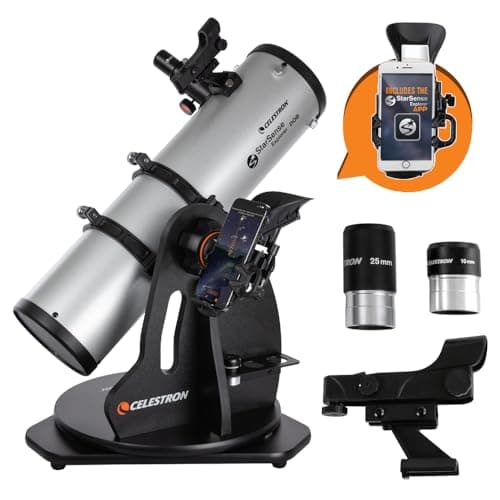 Celestron StarSense Explorer 130mm Tabletop DobsonianTop pick130mm parabolic optics on a tabletop Dobsonian base with the StarSense phone dock. The two best beginner ideas in one box. | Phone finding plus tabletop simplicity | 130mm (5.12 in)260x useful |
Top pick · Phone finding plus tabletop simplicity
Celestron StarSense Explorer 130mm Tabletop Dobsonian
130mm parabolic optics on a tabletop Dobsonian base with the StarSense phone dock. The two best beginner ideas in one box.
What the aperture allows
- Maximum useful magnification
- 260x
- 2 × 130mm of aperture
- Resolving limit (Dawes)
- 0.89 arcseconds
- 116 ÷ 130mm
- Cassini division (0.7″)
- Out of reach
- this aperture cannot resolve it
Celestron publishes 307x as this telescope’s highest useful magnification. Our figure is 260x, from two times the aperture in millimeters. The gap of 47x comes from the slightly more generous per-inch constant makers use. Neither number describes a typical night: the atmosphere usually settles the question well below both.
Worked example: a 25mm eyepiece in this telescope gives 650mm ÷ 25mm = 26x.
This combines the two things that actually keep a first telescope in use: a mount with nothing to wobble, and a finder that removes the where-is-it problem.
Optically it is the same 130mm f/5 parabolic mirror as the DX 130AZ, and Celestron publishes the same figures: 307x maximum useful magnification, 345 times the light of the eye. Two times the aperture gives 260x and Dawes' limit is 0.89 arcseconds.
Against the tripod-mounted DX version you trade standing height for stability and a smaller footprint. Against the Sky-Watcher Heritage 130 you pay more and get the phone dock.
The tabletop condition applies here as much as anywhere: a stable surface at seated chest height, checked before purchase.
What it does well
- Parabolic 130mm mirror, not a spherical compromise
- A Dobsonian base cannot wobble the way a light tripod does
- The StarSense app removes the biggest cause of first-telescope abandonment
What it costs you
- Needs a table, which not every buyer has thought about
- Costs more than the equivalent manual tabletop Dobsonian
- The app needs a phone the whole time it is in use
Skip this one if: Skip it if the recipient wants to learn the constellations. Being walked to a target teaches you less than finding it.
$479.95 · 10% off
#ad · how this is funded · price as of October 21, 2026
What the phone dock does and does not do
The app photographs the sky through your phone's camera, matches the star pattern against a catalog, and works out precisely where the tube is aimed. Then it shows an arrow and a bullseye. There is no alignment routine, no named stars to identify, no power supply and no hand controller.
What it is not is GoTo. Nothing moves the telescope and nothing tracks, so at 150x an object still drifts out of the field in well under a minute. If you want the telescope to follow as well as find, that is a different purchase and it costs aperture.
Who should not buy it
Anybody without a suitable surface, in which case the tripod-mounted DX version is the same optic at standing height. Anybody who wants to learn the constellations, because being walked to a target teaches you less than finding it. And anybody on a tight budget, because the Sky-Watcher Heritage 130 has the same mirror for less and star-hopping is a skill worth having.
Questions people actually ask
Is the StarSense Explorer 130mm Tabletop a good first telescope?
It is one of the strongest options available, because it combines the two things that keep first telescopes in use: a Dobsonian base with nothing that can wobble, and phone-based finding that needs no alignment stars. The condition is that you need a stable table.
Is the mirror parabolic or spherical?
Parabolic. Celestron states it in its own optical design line for this model, which is a real distinction from the spherical mirrors in the cheaper StarSense LT telescopes and matters at this telescope's f/5 focal ratio.
StarSense 130 tabletop or the DX 130AZ?
Identical optics, so identical views. The tabletop is steadier and smaller but needs a table; the DX sits on a full-height tripod and works anywhere. If you have a suitable surface, the tabletop is the better mount.
Does it track objects?
No. StarSense finds things and nothing more. At 150x an object leaves the field in under a minute and you nudge the tube back, which is normal for any undriven telescope.
Can it show the Cassini division?
Right at the edge. Its computed resolving limit is 0.89 arcseconds and the division spans roughly 0.7 at its widest, so it appears on genuinely steady nights and not on average ones.
Read next
Best tabletop
Tabletop Telescopes, and the One Thing to Check First
The best value design in beginner astronomy, and the surface requirement that decides whether it works for you.
Top pick: Sky-Watcher Heritage 130 Tabletop Dobsonian
$305.00 · 12% off
#ad · how this is funded · price as of October 21, 2026

Sky-Watcher Heritage 130 Tabletop Dobsonian
The aperture-per-dollar champion: 130mm parabolic in a collapsible tube, with one condition to check first.
Top pick: Sky-Watcher Heritage 130 Tabletop Dobsonian
$305.00 · 12% off
#ad · how this is funded · price as of October 21, 2026

StarSense Phone Finding vs Finding Things Yourself
Phone-guided finding against learning to star-hop: what each costs in aperture, and which suits which buyer.
Top pick: Celestron StarSense Explorer DX 130AZ
#ad · how this is funded · price as of October 21, 2026
Found something wrong here? Tell us and we will correct it and date the correction, per our editorial policy.