Aperture, Magnification & First Light
How Far Can a Telescope See?
The honest answer is that distance is the wrong variable, and swapping it for the right one changes which telescope you should buy.
By Scooter M. · Published · How we pick
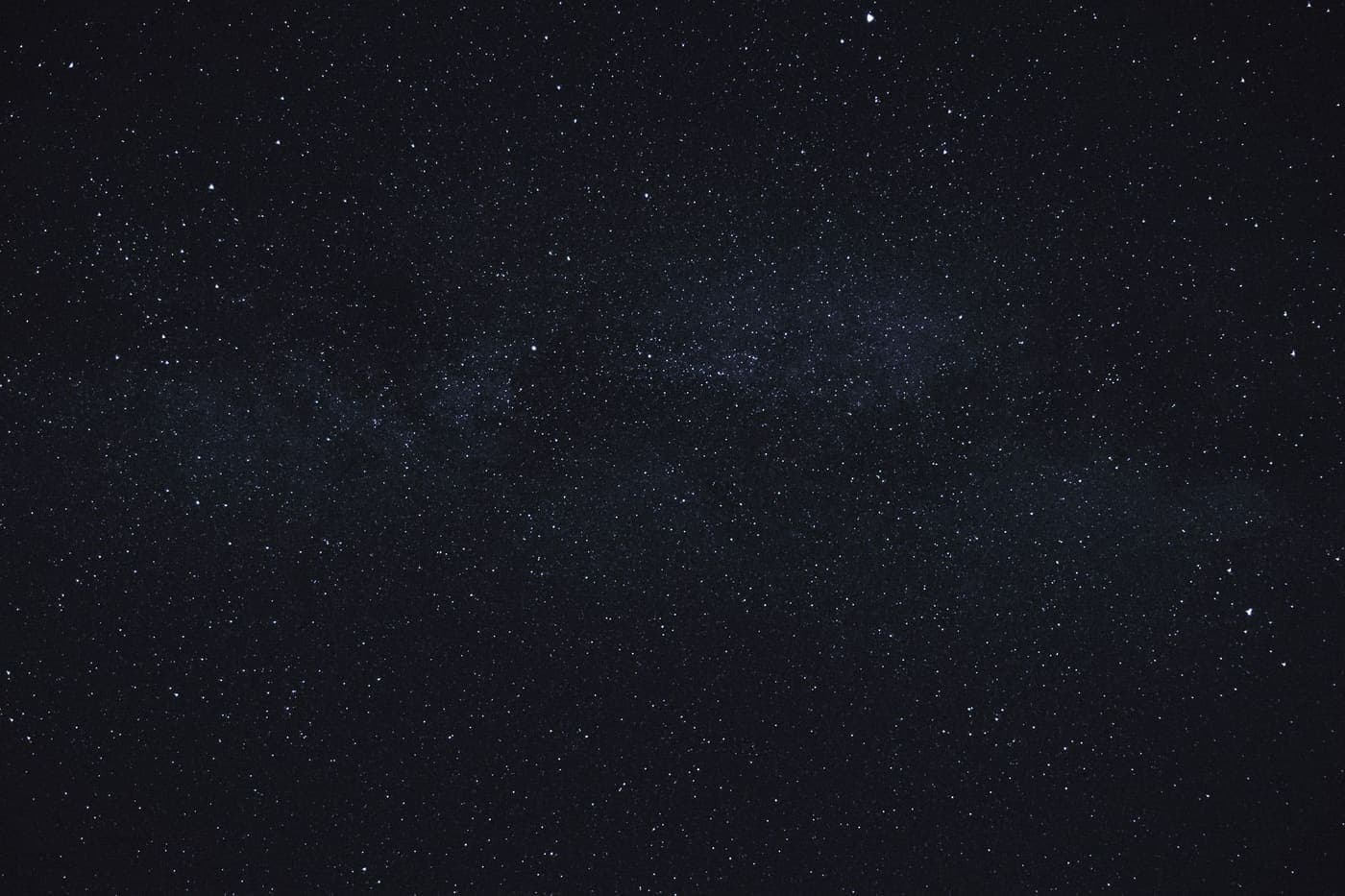
A 70mm telescope can see the Andromeda Galaxy at 2.5 million light-years, and cannot see Pluto at 0.0006 light-years. So the answer to "how far" is: distance does not set the limit — brightness does. If you want the practical version, the Sky-Watcher Classic 200P reaches about magnitude 14.2 under a dark sky against a 70mm's 11.9, and that gap is what buying aperture actually buys.
This matters commercially as well as intellectually. Telescope marketing quotes distances and magnifications because both sound impressive and neither is a specification. The figure that predicts what you will see is the limiting magnitude, and it follows from aperture and from your sky.
Why distance is the wrong variable
Andromeda is 2.5 million light-years away and shines at magnitude 3.44, bright enough to see with no telescope at all on a moonless night. Pluto, at roughly 39 times Earth's distance from the Sun, is about four billion times closer and sits around magnitude 14, which is beyond most amateur telescopes. The two facts together settle the question: what the eye needs is photons arriving per second, and distance is only one of several things that determines that.
A galaxy is faint because its light has spread out over a vast distance, but it started out as a hundred billion stars. Pluto is faint because it is a small dark rock reflecting a feeble amount of sunlight, even though it is next door by comparison. The telescope does not know or care how far away anything is.
The number that actually answers it
m = 5 log D + N, where D is the aperture in centimeters
N is about 7.69 at a dark site. 70mm: 5 x log(7) + 7.69 = 11.9 130mm: 5 x log(13) + 7.69 = 13.3 150mm: 5 x log(15) + 7.69 = 13.6 200mm: 5 x log(20) + 7.69 = 14.2
Published values of N range from 6.8 to 8.7 depending on the observer and the conditions, so treat these as the shape of the relationship rather than a guarantee. The same formula gives 12.7 for a 100mm telescope, which matches the published maximum for a 100mm under ideal conditions.
Two things in that arithmetic are worth noticing. First, the magnitude scale is logarithmic, so each step of one magnitude is about two and a half times the brightness. Second, doubling the aperture from 100mm to 200mm gains only 1.5 magnitudes. Aperture buys real depth, and it buys it slowly.
Your sky is worth as much as your aperture
The naked-eye limit is about magnitude 6 in a relatively clear sky and 7 from dark rural areas 200 km from a major city. In the suburbs of a large city it falls to about 4.0, in the outer boroughs about 3.0, and in midtown Manhattan about 2.0. That is a four-magnitude spread from the sky alone.
| Aperture | Dark sky | Suburban sky | What that reaches |
|---|---|---|---|
| Naked eye | ~6.5 | ~4.0 | Andromeda, the Orion Nebula, the planets |
| 50mm binoculars | ~11.0 | ~9 | Uranus, hundreds of clusters and nebulae |
| 70mm | ~11.9 | ~10 | The whole Messier catalog's brighter half |
| 130mm | ~13.3 | ~11 | Neptune, most Messier objects, brighter NGC galaxies |
| 150mm | ~13.6 | ~11.5 | Hundreds of galaxies, globular clusters resolved |
| 200mm | ~14.2 | ~12 | Thousands of galaxies; Pluto only at a dark site |
The suburban column is the one that should influence a purchase. Each gain of one unit of measured sky darkness raises the limit by roughly 0.3 to 0.4 magnitudes, which means that driving to a darker site can be worth more than the step from a 130mm to a 200mm. Light pollution has the full version of this argument, and the city-sky picks are chosen around the constraint rather than against it.
The other limit, which is not about faintness at all
Resolution is a separate ceiling. Dawes' limit says a telescope can separate detail no finer than 116 divided by its aperture in millimeters, so a 200mm resolves 0.58 arcseconds and a 70mm 1.66. That is why no telescope on Earth shows the Apollo hardware on the Moon, which is only a few meters across: the problem is angular size, not distance or brightness.
And on any given night the atmosphere imposes its own ceiling of 2 to 3 arcseconds, which is coarser than the resolving limit of every aperture on this site. So there are three limits stacked up — how faint, how fine, and what the air allows — and a sales claim about distance addresses none of them.
How these picks were judged
- Limiting magnitude per dollar. This page is about depth, so the ranking is the computed magnitude limit measured against price, which favors Dobsonians heavily.
- Then whether the aperture will be used. A limit you never reach because the telescope stays indoors is worth nothing, so portability is weighted rather than ignored.
- Then field width and eyepiece comfort, because faint extended objects need a wide, bright field more than they need magnification.
- No GoTo pick is included. Motors do not change the limiting magnitude, and on a fixed budget they are bought with aperture.
- The 70mm is on the list to anchor the scale, not as a recommendation for depth. It marks what the bottom of the range genuinely reaches.
Which of these is for you
| Telescope | Best for | The catch |
|---|---|---|
| Sky-Watcher Classic 200P | Best depth on this site: about magnitude 14.2 under a dark sky, which is thousands of galaxies | Heavy and bulky enough that it will not be carried to the dark sky its limit assumes |
| Sky-Watcher Heritage 150P | Best depth you will actually transport: 13.6 in a package that fits in a car and a cupboard | Half a magnitude short of the 200P, which is a real loss on the faintest targets |
| Sky-Watcher Heritage 130P | Best value: 13.3 is enough for Neptune and most of the Messier catalog | The faint NGC galaxies that make depth exciting stay mostly out of reach |
| Celestron AstroMaster 70AZ | Best for understanding the scale: 11.9 still reaches the brighter half of the Messier catalog | Only about two magnitudes above the naked eye, and the smallest step in depth here |
How this is funded: the buy buttons below are Amazon Associates links, and a qualifying purchase earns us a commission at no extra cost to you. It cannot move the ranking, because the order here is set by aperture per dollar, and no commission rate changes how much light a mirror collects. Full disclosure.
| # | Telescope | Best for | Aperture | Price |
|---|---|---|---|---|
| 1 | 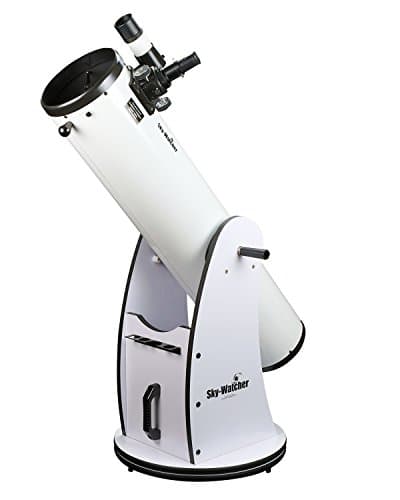 Sky-Watcher Classic 200P Dobsonian (8-inch)Top pickEight inches of aperture on the simplest mount ever designed. This is the telescope experienced observers tell beginners to buy. | The one you will not outgrow | 200mm (8 in)400x useful | Unavailable |
| 2 | 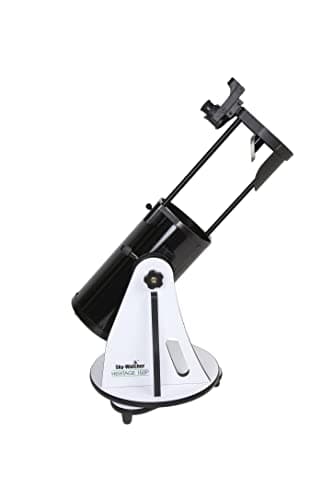 Sky-Watcher Heritage 150 Tabletop Dobsonian150mm at f/5 in a collapsible tube on a tabletop base. Deep-sky aperture that still stores next to the vacuum cleaner. | Maximum aperture in a cupboard | 150mm300x useful | |
| 3 | 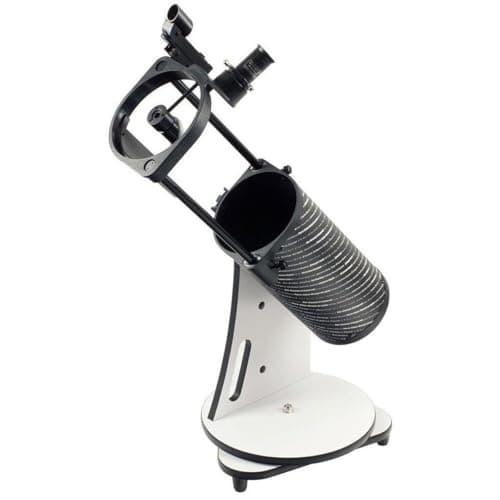 Sky-Watcher Heritage 130 Tabletop DobsonianThe same 130mm parabolic mirror as scopes costing far more, on a base with no tripod to wobble and nothing to set up. | Most aperture per dollar | 130mm260x useful | |
| 4 | 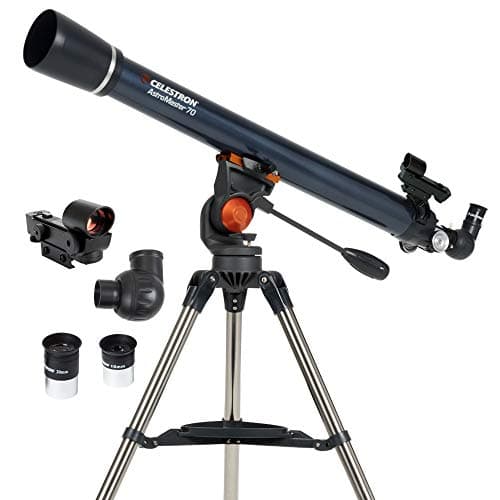 Celestron AstroMaster 70AZ70mm of refractor optics at f/13, on a steel tripod. A long, slow tube that trades field of view and weight for cleaner views of the Moon and planets. | The smallest scope worth owning | 70mm (2.76 in)140x useful |
Top pick · The one you will not outgrow
Sky-Watcher Classic 200P Dobsonian (8-inch)
Eight inches of aperture on the simplest mount ever designed. This is the telescope experienced observers tell beginners to buy.
What the aperture allows
- Maximum useful magnification
- 400x
- 2 × 200mm of aperture
- Resolving limit (Dawes)
- 0.58 arcseconds
- 116 ÷ 200mm
- Cassini division (0.7″)
- Within reach
- on a steady night, at high magnification
200mm is a different category of instrument, not an incremental upgrade. Against the 70mm refractor at the other end of this list the light-gathering ratio is 200 divided by 70, squared: 8.2 times more light reaching your eye.
Two times 200mm gives 400x of useful magnification, which is more than the atmosphere delivers on all but a handful of nights a year. In practice this telescope is limited by the sky rather than by its optics, which is exactly the position you want to be in.
Dawes' limit at 200mm is 116 divided by 200, which is 0.58 arcseconds. The Cassini division, at roughly 0.7 arcseconds, is comfortably inside that. So is the Great Red Spot, and so are hundreds of Messier objects a 70mm scope simply cannot reach.
The honest cost is bulk. The tube is long and the base is wide, and this is a telescope you carry outside in two trips. Everyone who owns one tells the same story: they used it far more once they stopped storing it somewhere awkward.
What it does well
- The aperture-per-dollar figure that no other design at this price approaches
- A mount that cannot be wobbly, because there is almost nothing to it
- The 2-inch focuser takes wide-field eyepieces the cheaper models cannot
- Genuinely a lifetime telescope; nobody outgrows eight inches of aperture in a hurry
What it costs you
- Big and heavy: two trips outside, and it needs real storage space
- No tracking, so at 200x objects drift out of view in well under a minute
- Needs collimation checks, and the mirror takes 30 to 45 minutes to reach outside temperature
Skip this one if: Skip it if you live upstairs with no lift, or if the observing spot is a fire escape. The best telescope in this list is the wrong one if carrying it is a chore.
| Optical design | Newtonian reflector, borosilicate parabolic primary with 94 percent reflective coatingsSource: Classic 200P Dobsonian — manufacturer specifications (retrieved September 1, 2026) |
|---|---|
| Aperture | 200mm (8 in)Source: Classic 200P Dobsonian — manufacturer specifications (retrieved September 1, 2026) |
| Mount | Dobsonian rocker box with Teflon bearings and a patented tension control handleSource: Classic 200P Dobsonian — manufacturer specifications (retrieved September 1, 2026) |
| Light gathering vs the eye | 816xSky-Watcher's own published figure.Source: Classic 200P Dobsonian — manufacturer specifications (retrieved September 1, 2026) |
| Focuser | 2-inch Crayford with a 1.25-inch adapterSource: Classic 200P Dobsonian — manufacturer specifications (retrieved September 1, 2026) |
| Versus the 6-inch model | 78 percent brighter than the 150mm versionSky-Watcher's own published comparison.Source: Classic 200P Dobsonian — manufacturer specifications (retrieved September 1, 2026) |
Currently unavailable at Amazon
Checked October 19, 2026. We are not linking to it while there is nothing to buy.
Pick 2 · Maximum aperture in a cupboard
Sky-Watcher Heritage 150 Tabletop Dobsonian
150mm at f/5 in a collapsible tube on a tabletop base. Deep-sky aperture that still stores next to the vacuum cleaner.
What the aperture allows
- Maximum useful magnification
- 300x
- 2 × 150mm of aperture
- Resolving limit (Dawes)
- 0.77 arcseconds
- 116 ÷ 150mm
- Cassini division (0.7″)
- Out of reach
- this aperture cannot resolve it
Worked example: a 25mm eyepiece in this telescope gives 750mm ÷ 25mm = 30x.
This is the Heritage 130's argument with 33 percent more mirror. Light gathering scales as the square of the aperture ratio, so 150 over 130, squared, is 1.33 times the light of its smaller sibling.
Two times 150mm is 300x of useful magnification and Dawes' limit is 0.77 arcseconds, which puts the Cassini division inside its reach on a good night.
At f/5 the 750mm focal length keeps the tube short enough to collapse, which is the entire reason this design exists. A conventional 150mm Newtonian tube is over a meter long and lives in a garage.
The same tabletop caveat applies as with the 130: it needs a stable surface at seated chest height. Check you have one before you buy, not after.
What it does well
- Deep-sky aperture in a package that genuinely stores in a cupboard
- Collapsible tube holds collimation between setups
- No tripod means no tripod wobble, the most common cause of a shaky first view
What it costs you
- The tabletop requirement is a real constraint, not a footnote
- The helical focuser is the weakest component
- An open tube collects dust and needs the occasional clean
Skip this one if: Skip it if you have the floor space for the Classic 150P. The floor-standing version has a better focuser and needs no furniture.
$355.00 · 13% off
#ad · how this is funded · price as of October 19, 2026
Pick 3 · Most aperture per dollar
Sky-Watcher Heritage 130 Tabletop Dobsonian
The same 130mm parabolic mirror as scopes costing far more, on a base with no tripod to wobble and nothing to set up.
What the aperture allows
- Maximum useful magnification
- 260x
- 2 × 130mm of aperture
- Resolving limit (Dawes)
- 0.89 arcseconds
- 116 ÷ 130mm
- Cassini division (0.7″)
- Out of reach
- this aperture cannot resolve it
Worked example: a 25mm eyepiece in this telescope gives 650mm ÷ 25mm = 26x.
This is the aperture-per-dollar champion of the beginner shelf and it is not close. You get the same 130mm parabolic mirror found in telescopes at twice the price, and you get it without paying for a tripod, a slow-motion assembly or a hand controller.
Two times 130mm is 260x of useful magnification. Dawes' limit at 130mm works out to 116 divided by 130, which is 0.89 arcseconds. The Cassini division in Saturn's rings spans roughly 0.7 arcseconds at its widest, so this telescope sits right at the edge of showing it on a still night and will show the rings themselves easily.
The catch is the word tabletop. It needs a surface at roughly chest height when you are seated. A garden table works, a plastic patio chair does not, and buying one without thinking about where it will stand is the single most common regret with this design.
The tube collapses, which is what makes it live in a cupboard rather than a garage. That matters more than it sounds: the telescope you can carry outside in one trip is the telescope you use.
What it does well
- The most aperture you can buy at this price, by a clear margin
- Nothing to assemble, no tripod to wobble, ready in the time it takes to carry it outside
- Collapsible tube stores in a cupboard and keeps its collimation
- The Dobsonian motion is intuitive: you push the tube where you want to look
What it costs you
- Needs a solid table or stool at the right height, which is a real constraint
- The helical focuser is coarser than a rack-and-pinion or a Crayford
- Open tube design collects dust and needs the odd mirror clean
Skip this one if: Skip it if you have nowhere to stand it. On the ground it points at treetops, and on a wobbly plastic table every view shakes.
$305.00 · 12% off
#ad · how this is funded · price as of October 19, 2026
Pick 4 · The smallest scope worth owning
Celestron AstroMaster 70AZ
70mm of refractor optics at f/13, on a steel tripod. A long, slow tube that trades field of view and weight for cleaner views of the Moon and planets.
What the aperture allows
- Maximum useful magnification
- 140x
- 2 × 70mm of aperture
- Resolving limit (Dawes)
- 1.66 arcseconds
- 116 ÷ 70mm
- Cassini division (0.7″)
- Out of reach
- this aperture cannot resolve it
Celestron publishes 165x as this telescope’s highest useful magnification. Our figure is 140x, from two times the aperture in millimeters. The gap of 25x comes from the slightly more generous per-inch constant makers use. Neither number describes a typical night: the atmosphere usually settles the question well below both.
Worked example: a 25mm eyepiece in this telescope gives 900mm ÷ 25mm = 36x.
70mm is the floor. Below it a telescope struggles to beat a decent pair of binoculars, and that is a real comparison rather than a rhetorical one. Two times 70mm gives 140x of useful magnification; Celestron publishes 165x.
The defining number is the focal length. Celestron publishes 900mm, which at 70mm is f/13, an unusually slow ratio for a beginner refractor. A slow achromat brings the colors closer to a common focus, so the violet fringe on the Moon and on Jupiter is smaller than on a faster tube of the same aperture.
The same slow ratio narrows the field. At 45x with the supplied 20mm eyepiece, large star clusters that fit comfortably in a short refractor will not fit here, and finding things takes a steadier hand on the red dot finder.
It is also a large, heavy package for 70mm of aperture: a 685mm tube and a published 10.8 lb kit. That buys a steadier steel tripod than the lightest travel telescopes carry, and it costs portability.
What it does well
- Sealed tube: no collimation, no mirror cleaning, essentially no maintenance
- At f/13, less false color on the Moon and bright planets than a faster 70mm tube
- A steel tripod that is steadier than the lightweight tripods on travel telescopes
- The supplied eyepieces give 45x and 90x, a useful planetary range with no extra purchase
What it costs you
- 70mm collects too little light for galaxies and most nebulae
- The f/13 focal ratio narrows the field, so large clusters and finding things are harder
- A published 10.8 lb and a 685mm tube is a lot to carry for 70mm of aperture
- Chromatic aberration is reduced at f/13, not eliminated
Skip this one if: Skip it if what you actually want is deep sky, or a telescope you can carry easily. No eyepiece will make 70mm show you a spiral arm, and a travel refractor does the carrying better.
$199.95 · 10% off
#ad · how this is funded · price as of October 19, 2026
So what is the farthest thing you can see?
With your eyes alone, the Andromeda Galaxy at about 2.5 million light-years, which is the usual answer and a reliable one: it is naked-eye visible on moonless nights even with moderate light pollution. With a 200mm from a dark site, galaxies at several hundred million light-years are within the magnitude limit, though they appear as the faintest possible smudges rather than as anything you would call a view.
How to use the number to plan a night
Once you know your telescope's limiting magnitude, every catalog becomes a shopping list, and this is the part that makes the arithmetic worth doing rather than merely interesting.
- Compute your figure, or take it from the table above. Then subtract one to two magnitudes for a suburban sky.
- Look up your target's magnitude. Any planetarium app or catalog lists it, and the Messier catalog's 110 objects are almost all brighter than magnitude 10.
- Leave a margin of at least a magnitude. An object exactly at your computed limit is a theoretical detection, not a view, and it will not survive any haze.
- Then check the object's size as well, because an extended object spreads its catalog magnitude thinly and behaves as though it were fainter. A magnitude-9 galaxy is harder than a magnitude-9 planetary nebula.
- Treat averted vision as worth about a magnitude, since looking slightly to one side of a faint object puts its light on the more sensitive part of the retina.
Doing that once for your own telescope is more useful than any amount of reading about other people's. It converts a vague sense that a telescope should show more into a specific, checkable prediction, and when the prediction fails you know to look at the sky or the night rather than at the equipment.
That is the real answer to the question, and it is a strange one: the farthest thing a beginner telescope can see is an enormous distance away, and it is easy. The hard targets are nearby, small and dim. Aperture is the page that puts numbers on what each step up genuinely delivers.
Questions people actually ask
How far can a telescope see?
Distance is not the limiting factor; brightness is. A 70mm telescope shows the Andromeda Galaxy at 2.5 million light-years but cannot show Pluto, which is 25 million times closer. The meaningful figure is limiting magnitude, which follows from aperture and from how dark your sky is.
What is the limiting magnitude of a telescope?
Roughly m = 5 log D + N, with D the aperture in centimeters and N about 7.69 at a dark site. That gives about 11.9 for a 70mm, 13.3 for a 130mm, 13.6 for a 150mm and 14.2 for a 200mm. Published N values range from 6.8 to 8.7, so treat these as the shape of the relationship.
What is the farthest object you can see with a beginner telescope?
Galaxies at hundreds of millions of light-years fall inside a 200mm's magnitude limit from a dark site, though they appear as the faintest smudges. Without any telescope, the usual answer is the Andromeda Galaxy at about 2.5 million light-years, which is naked-eye visible on a moonless night.
Does more magnification let you see further?
No. Magnification spreads the same collected light over a larger apparent area, which makes faint objects dimmer rather than more visible. Aperture determines how faint you can go, and no eyepiece changes it. That is why maximum-magnification claims on a box are not a specification.
Does light pollution affect how far a telescope can see?
Substantially. The naked-eye limit runs from about 6.5 at a dark site to about 4.0 in the suburbs of a large city and 2.0 in midtown Manhattan, and telescopic limits shift with it. Each unit of measured sky darkness is worth roughly 0.3 to 0.4 magnitudes, so driving somewhere darker can beat buying a bigger telescope.
Why can't a telescope see the flag on the Moon if it can see galaxies?
Because those are different limits. Seeing galaxies is about brightness; seeing the flag is about angular resolution. Dawes' limit gives a 200mm telescope 0.58 arcseconds, and the Apollo hardware subtends an angle thousands of times finer than that. The smallest lunar features a 200mm resolves are around a kilometer across.
Read next
Telescope Aperture: What It Is and What It Buys
What aperture is, what each size can resolve, and a calculator that runs the numbers on your own telescope.
Top pick: Sky-Watcher Heritage 130 Tabletop Dobsonian
$305.00 · 12% off
#ad · how this is funded · price as of October 19, 2026
The Magnification Myth: Why 525x Means Nothing
Why the magnification number on the box is meaningless, what the real ceiling is, and a calculator for your own telescope.
Top pick: Celestron Eyepiece, Barlow and Filter Kit (1.25")
$239.95 · 8% off
#ad · how this is funded · price as of October 19, 2026
What a City Sky Actually Allows
What survives a bright sky, what does not, and why light pollution changes what you should spend a telescope budget on.
Top pick: Celestron NexStar 6SE
#ad · how this is funded · price as of October 19, 2026
Found something wrong here? Tell us and we will correct it and date the correction, per our editorial policy.