Reviews
National Geographic Sky View 70mm Refractor
The cheapest telescope on this site, and the only one whose box claims survive the arithmetic intact. That is worth more than it sounds at the bottom of this market.
By Scooter M. · Published · How we pick

This is the least expensive telescope this site covers, and the shelf it sits on is mostly toys: 50mm and 60mm lenses on plastic tripods, advertising magnifications their optics cannot deliver. The useful question is which side of that line this one falls on. The answer is on National Geographic's own listing, and it is more interesting than usual.
The box claim, checked
Almost every page on this site ends up comparing a maker's advertised magnification against what the aperture can support, and almost every time the advertised figure is higher. This telescope is the exception, and it is worth showing the working.
max useful magnification = 2 x aperture. Dawes limit = 116 / aperture.
70 x 2 = 140x. 116 / 70 = 1.66 arcseconds.
National Geographic advertises a top magnification of 120x. That is UNDER the 140x ceiling rather than over it, which at this price is genuinely unusual. Compare the Celestron Travel Scope 70, the same aperture and focal length, where Celestron publishes 168x — twenty percent above the same ceiling.
The other four figures check out too. National Geographic publishes a 400mm focal length and advertises 16x, 40x, 48x and 120x with two eyepieces and a 3x Barlow. Work backwards and those are a 25mm and a 10mm eyepiece:
magnification = telescope focal length / eyepiece focal length
400 / 25 = 16x. 400 / 10 = 40x. With the 3x Barlow: 48x and 120x.
Every advertised figure is arithmetically consistent with the parts in the box. Nothing here is rounded up, and nothing is a number invented for the packaging.
That does not make it a better telescope than a bigger one. It makes it an honestly described one, and at this end of the market that is the first thing worth knowing. The magnification myth covers what the usual claims look like.
The 3x Barlow, and why the usual rule does not apply here
This site tells readers to avoid 3x Barlow lenses, on the grounds that even a 2x pushes most beginner telescopes to their ceiling. A 3x is in this box, and here it is fine. The reason is the focal length.
At 400mm, a 10mm eyepiece only reaches 40x on its own, so there is a great deal of headroom above it. Tripling that lands on 120x, still inside the 140x ceiling. On a 700mm telescope the same 10mm eyepiece starts at 70x and a 3x Barlow would take it to 210x, far past what 70mm supports.
What f/5.7 costs
400mm on a 70mm aperture is f/5.7, which is short for an achromatic refractor. The benefit is a wide field at low power, which suits large open clusters and sweeping along the Milky Way.
The cost is chromatic aberration. An achromatic lens brings two wavelengths to a common focus and lets the rest fall slightly short or long, and a fast lens separates them further than a slow one. You will see a violet fringe on the Moon's limb and on Venus. It is a property of the design rather than a fault in the sample, and refractor against reflector explains why a mirror does not do it at all.
exit pupil = aperture / magnification
70 / 16 = 4.4mm at the lowest power. 70 / 120 = 0.58mm at the highest.
A 0.58mm exit pupil is a small, dim beam. 120x is inside what the optics support, but it is the end of the useful range rather than the middle of it, and the mount will decide whether it is comfortable.
Which brings up the thing National Geographic does not publish.
How this is funded: the buy buttons below are Amazon Associates links, and a qualifying purchase earns us a commission at no extra cost to you. It cannot move the ranking, because the order here is set by aperture per dollar, and no commission rate changes how much light a mirror collects. Full disclosure.
| # | Telescope | Best for | Aperture | Price |
|---|---|---|---|---|
| 1 | 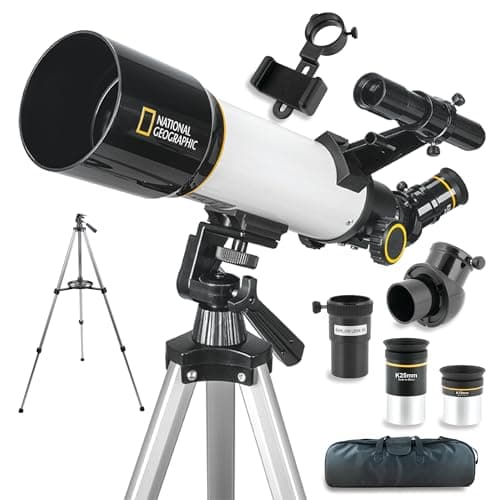 National Geographic Sky View 70mm RefractorTop pickA 70mm refractor on a panhandle mount, branded for the shelf it will be bought from. Honest optics inside a gift box. | A gift that looks like a gift | 70mm140x useful |
Top pick · A gift that looks like a gift
National Geographic Sky View 70mm Refractor
A 70mm refractor on a panhandle mount, branded for the shelf it will be bought from. Honest optics inside a gift box.
What the aperture allows
- Maximum useful magnification
- 140x
- 2 × 70mm of aperture
- Resolving limit (Dawes)
- 1.66 arcseconds
- 116 ÷ 70mm
- Cassini division (0.7″)
- Out of reach
- this aperture cannot resolve it
National Geographic publishes 120x as this telescope’s highest useful magnification. Our figure is 140x, from two times the aperture in millimeters. The two figures agree closely, which is the case whenever a maker states its ceiling honestly.
Worked example: a 25mm eyepiece in this telescope gives 400mm ÷ 25mm = 16x.
70mm of refractor aperture puts this at the floor of what is worth owning, and the same arithmetic applies as to every other 70mm on this site: 140x of useful magnification at the 2x rule, and a Dawes limit of 1.66 arcseconds.
The panhandle mount is the differentiator. A single handle that moves in both axes is far more intuitive for a child, or for an adult who has never used a telescope, than either a slow-motion alt-azimuth head or an equatorial one.
National Geographic publishes a 400mm focal length, which at 70mm gives f/5.7, and advertises 16x, 40x, 48x and 120x. Those four figures check out exactly against 25mm and 10mm eyepieces with the supplied 3x Barlow, and the top one sits under the 140x this aperture supports — which is not what the bottom of this market usually does.
As a gift this earns its place on presentation and on the mount. As an instrument it is a 70mm refractor, which means the Moon, the bright planets and not much else.
What it does well
- The panhandle mount is genuinely the easiest way for a beginner to aim a telescope
- 70mm of real refractor aperture rather than a 50mm toy
- Presents well as a gift, which matters more than enthusiasts like to admit
What it costs you
- A fast f/5.7 achromat shows false color on the Moon and the bright planets
- 70mm limits it to the Moon and the bright planets
- Branded packaging is part of what you are paying for
Skip this one if: Skip it if the recipient is already interested in astronomy rather than being introduced to it. They will want aperture, not a panhandle.
$49.99 · 20% off
#ad · how this is funded · price as of September 14, 2026
The panhandle mount is the real differentiator
A panhandle is a single arm that moves the telescope in both axes at once, the way a camera tripod head does. It is the most intuitive control a beginner can be handed: no slow-motion knobs to work out, no polar alignment, no sense that the telescope is moving in directions unrelated to the sky.
For a child, or for an adult who has never used a telescope, that matters more than an extra few millimeters of aperture would. The most common way a first telescope fails is that using it is a chore, and this is the least chore-like mount on the beginner shelf. The easiest telescopes to use ranks the whole field on exactly that quality.
Against the telescope it is optically identical to
| NG Sky View 70 | Celestron Travel Scope 70 | SkyMaster 15x70 | |
|---|---|---|---|
| Aperture | 70mm | 70mm | 70mm x2 |
| Focal length | 400mm | 400mm | Fixed 15x |
| Focal ratio | f/5.7 | f/5.7 | Not applicable |
| Max useful magnification | 140x | 140x | Fixed at 15x |
| Resolving limit | 1.66 arcsec | 1.66 arcsec | 1.66 arcsec |
| Advertised top magnification | 120x, under the ceiling | 168x, over the ceiling | Not advertised |
| Mount | Panhandle alt-azimuth | Lightweight photo tripod | Handheld, tripod adapter |
| Published kit weight | Not published | 3.3 lb | Not published |
| Saturn's rings separate | Yes, small | Yes, small | No |
The middle column is the honest comparison. The Travel Scope 70 has the same aperture, the same focal length and the same focal ratio, so the two see identically. Everything that differs is packaging: the Celestron packs into a backpack and publishes its weight, this one has the better mount for a beginner and a box designed to be unwrapped.
The right-hand column is the awkward one, and this site has been consistent about it: under about a hundred dollars, a pair of 70mm binoculars collects comparable light through two objectives, is far easier to use, and gets taken outside more often. What it will never do is separate Saturn's rings. If seeing a planet as a planet is the point of the purchase, that settles it in favor of the telescope.
What it will actually show
- The Moon in real detail, which is what 70mm does best and what most first sessions are about.
- Jupiter's four bright moons as points, and its two main cloud belts on a steady night.
- Saturn's rings, clearly separated from the disc but small. The Cassini division inside them needs roughly 150mm and is out of reach here.
- The phases of Venus, comfortably, with a violet fringe around it.
- Bright open clusters in a wide field, which is where the short focal length earns its place.
- Not galaxies. 70mm and a bright sky is not the combination that shows those, and no eyepiece changes it. What you can actually see sets expectations target by target.
Who should buy it, and who should not
Buy it as a gift for somebody being introduced to astronomy rather than somebody already interested in it, especially a child. The panhandle, the presentation and the honest box are all pointed at that buyer, and 70mm is genuine aperture rather than a 50mm toy.
Do not buy it if the recipient already wants a telescope. They will want aperture, and the same money plus a little more buys a 76mm tabletop Dobsonian or, one real step up, a 130mm one that collects nearly three and a half times the light. The beginner ranking puts those in order, and is a cheap telescope worth it works the bottom bracket through in full.
Questions people actually ask
Is the National Geographic Sky View 70 a real telescope or a toy?
A real telescope. It has 70mm of genuine refractor aperture, a published 400mm focal length, and advertised magnifications of 16x, 40x, 48x and 120x that all check out arithmetically against the eyepieces supplied. The top figure sits under the 140x the aperture supports, which is unusual at this price.
What can you see with a 70mm telescope?
Lunar craters in real detail, Jupiter's four bright moons and its two main belts, Saturn's rings separated from the disc but small, the phases of Venus, and bright open clusters. Its 1.66-arcsecond resolving limit puts the Cassini division out of reach, and galaxies need far more aperture and a darker sky.
Is a 3x Barlow lens bad?
Usually, but not here. On a 700mm telescope a 3x Barlow takes a 10mm eyepiece to 210x, far past what 70mm supports. On this telescope's 400mm focal length the same combination reaches 120x, which is inside the 140x ceiling. The rule of thumb is a shortcut for the arithmetic, not a replacement for it.
Sky View 70 or Celestron Travel Scope 70?
Optically they are the same telescope: both are 70mm at 400mm, so both resolve 1.66 arcseconds and top out at 140x. Choose on packaging. The Travel Scope packs into a backpack and publishes a 3.3 lb kit weight; the Sky View has a panhandle mount that a beginner will find easier to aim.
Why does the Moon look purple around the edge?
Chromatic aberration. An achromatic lens focuses two wavelengths together and lets the rest land slightly short or long, and a fast f/5.7 lens separates them more than a slow one. It shows only on bright targets and it is the design rather than a defect.
Is 70mm enough for a first telescope?
It is the floor this site sets, and it is a real floor rather than a preference: below 70mm a telescope struggles to beat a decent pair of binoculars. 70mm clears it. If the budget can stretch to a 130mm tabletop Dobsonian, that collects nearly three and a half times the light.
Read next

Celestron Travel Scope 70
3.3 lb complete, backpack included. A daytime spotting scope that moonlights at night, with a tripod that is the weak link.
Top pick: Celestron Travel Scope 70
$119.95 · 25% off
#ad · how this is funded · price as of September 14, 2026

Best for kids
The Best Telescopes for Kids
Telescopes chosen for how easily a child can aim and carry them, which matters more at this age than aperture does.
Top pick: Celestron FirstScope 76
#ad · how this is funded · price as of September 14, 2026

Is a Cheap Telescope Worth It?
The threshold below which a cheap telescope stops being worth owning, and the honest alternative when a budget cannot clear it.
Top pick: Celestron FirstScope 76
#ad · how this is funded · price as of September 14, 2026
Found something wrong here? Tell us and we will correct it and date the correction, per our editorial policy.