Telescopes by Budget
Is a Cheap Telescope Worth It?
Yes, above about 70mm of aperture and on a mount that does not shake. Below that, a pair of binoculars will show more and be used more.
By Scooter M. · Published · How we pick

A cheap telescope is worth it above roughly 70mm of aperture, on a mount that does not shake. Below that threshold, a pair of 70mm astronomy binoculars will show more, be easier to use, and get used more often. That is the honest answer and the rest of this page is the reasoning.
Why 70mm is the threshold
Below 70mm a telescope struggles to collect enough light to beat a good pair of binoculars, and it loses every practical comparison against them: it is harder to point, needs setup, and is useless in daylight.
maximum useful magnification = 2 x aperture, resolving limit = 116 / aperture
70 x 2 = 140x. 116 / 70 = 1.66 arcseconds.
Enough for lunar craters, Saturn's rings as rings, Jupiter's four bright moons and the phases of Venus. Not enough for the Cassini division or for faint deep-sky objects.
That list is genuinely worth having. Most people who look through a telescope for the first time are looking at exactly those targets, and a 70mm instrument delivers all of them.
Where cheap telescopes actually fail
The disappointing ones almost never fail on the objective lens. They fail on the mount, and on the expectation the box set.
- The tripod. Thin legs and plastic joints mean a three-second wobble after every touch. At 100x, focusing becomes impossible and the buyer blames the optics.
- The advertised magnification. A 60mm telescope claiming 525x sets an expectation the physics cannot meet, and the buyer concludes the telescope is faulty when it is behaving exactly as designed.
- The finder. A misaligned finderscope means the first session ends without finding anything. It is fixable in daylight in five minutes and almost nobody is told to do it.
- The eyepieces. The cheapest components in a cheap box, and the ones the buyer looks through.
Three of those four are visible in the listing before you buy. What to avoid works through all six traps.
The binocular alternative, taken seriously
This is not a consolation prize. A pair of 15x70 astronomy binoculars uses both eyes on 70mm objectives, needs no assembly, works in daylight, and shows the Pleiades, the Andromeda galaxy, the Milky Way star clouds and the whole Moon at once in a way no beginner telescope can. Which binoculars to buy covers the sizes, including the ones you can hold without a tripod.
Celestron publishes three limiting magnitudes for its 15x70 pair: 11.73 under ideal skies, 10.73 under moderate ones and 9.73 under poor ones. That is unusually honest for a binocular listing and it makes the important point twice: your sky matters as much as your optics.
How this is funded: the buy buttons below are Amazon Associates links, and a qualifying purchase earns us a commission at no extra cost to you. It cannot move the ranking, because the order here is set by aperture per dollar, and no commission rate changes how much light a mirror collects. Full disclosure.
| # | Telescope | Best for | Aperture | Price |
|---|---|---|---|---|
| 1 | 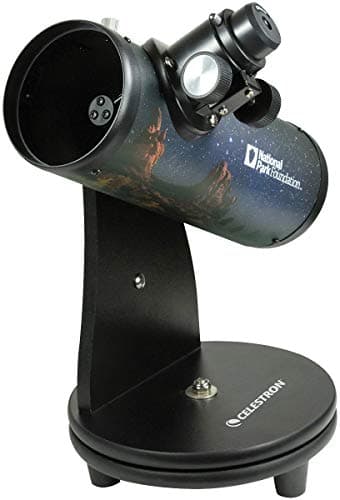 Celestron FirstScope 76Top pick76mm on a tiny Dobsonian base. The cheapest thing on this site that is a telescope rather than a toy shaped like one. | A real telescope under a hundred dollars | 76mm (2.99 in)152x useful | |
| 2 | 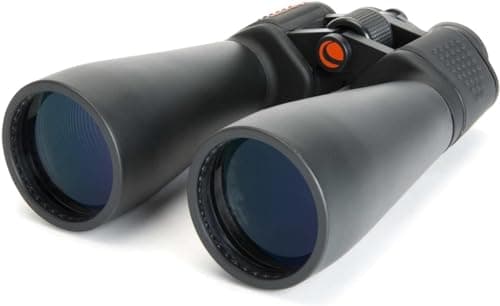 Celestron SkyMaster 15x70 Binoculars70mm of aperture in each barrel at a fixed 15x. For the money spent on a toy telescope, these show more and get used more. | The honest alternative to a cheap telescope | 70mm objective lenses (2.75 in)140x useful | |
| 3 | 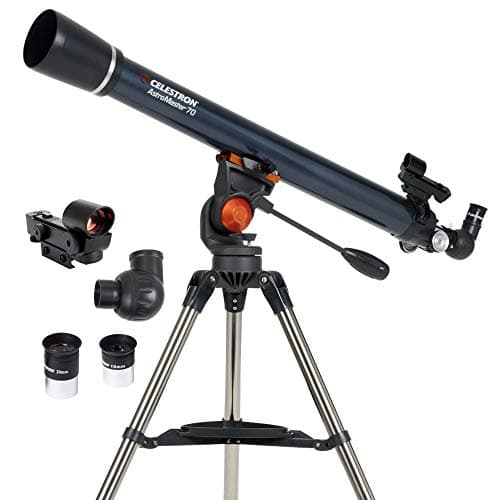 Celestron AstroMaster 70AZ70mm of refractor optics at f/13, on a steel tripod. A long, slow tube that trades field of view and weight for cleaner views of the Moon and planets. | The smallest scope worth owning | 70mm (2.76 in)140x useful |
Top pick · A real telescope under a hundred dollars
Celestron FirstScope 76
76mm on a tiny Dobsonian base. The cheapest thing on this site that is a telescope rather than a toy shaped like one.
What the aperture allows
- Maximum useful magnification
- 152x
- 2 × 76mm of aperture
- Resolving limit (Dawes)
- 1.53 arcseconds
- 116 ÷ 76mm
- Cassini division (0.7″)
- Out of reach
- this aperture cannot resolve it
Celestron publishes 180x as this telescope’s highest useful magnification. Our figure is 152x, from two times the aperture in millimeters. The gap of 28x comes from the slightly more generous per-inch constant makers use. Neither number describes a typical night: the atmosphere usually settles the question well below both.
Worked example: a 25mm eyepiece in this telescope gives 300mm ÷ 25mm = 12x.
76mm is small, and this page is not going to pretend otherwise. What it is not is a toy: the mirror is real, the mount is a proper Dobsonian, and it will show the Moon's craters and Jupiter's moons.
Two times 76mm gives 152x of useful magnification. Celestron publishes 180x. Either figure demolishes the 525x printed on the box of the department-store scope sitting beside it at the same price.
The f/3.95 focal ratio is very fast, which is hard on a spherical mirror and hard on cheap eyepieces. Expect softness at the edge of the field and do not expect much above about 60x to 75x in practice.
The right way to think about it: this is a lot better than nothing, it is enormously better than a 60mm toy scope on a plastic tripod, and it is meaningfully worse than the 130mm tabletop Dobsonian that costs roughly three times as much.
What it does well
- A genuine telescope at a price where most of the shelf is not
- Nothing to assemble, nothing to align, nothing to charge
- Small enough that a child can carry and aim it without help
What it costs you
- A fast spherical mirror at f/3.95 is soft away from the field center
- The bundled eyepieces are the cheapest part of a cheap package
- Very small; it needs a table and it is easy to knock over
Skip this one if: Skip it if the budget can stretch to a 130mm tabletop. The aperture difference is 2.9 times the light, and it is obvious at the eyepiece.
#ad · how this is funded · price as of October 19, 2026
Pick 2 · The honest alternative to a cheap telescope
Celestron SkyMaster 15x70 Binoculars
70mm of aperture in each barrel at a fixed 15x. For the money spent on a toy telescope, these show more and get used more.
What the aperture allows
- Maximum useful magnification
- 140x
- 2 × 70mm of aperture
- Resolving limit (Dawes)
- 1.66 arcseconds
- 116 ÷ 70mm
- Cassini division (0.7″)
- Out of reach
- this aperture cannot resolve it
Worked example: a 25mm eyepiece in this telescope gives 279.63mm ÷ 25mm = 11x.
Each barrel has the same 70mm aperture as the entry-level refractors on this site, and because you use both eyes the perceived brightness is higher than a single 70mm tube.
The fixed 15x is well below the 140x that 70mm could support, and that is deliberate. Binoculars are a wide-field instrument: the Pleiades, the Andromeda galaxy, the Milky Way star clouds and the whole Moon at once.
Celestron publishing three limiting magnitudes, 11.73 for ideal skies down to 9.73 for poor ones, is the single most useful number on this page. It says out loud what most listings hide: your sky matters as much as your optics.
At 15x these are heavy to hold steady. The included tripod adapter is not an accessory, it is a requirement for any sustained looking.
What it does well
- 70mm per barrel is real aperture, not a novelty
- Instantly usable: no assembly, no alignment, no learning curve
- Wide field shows large objects a telescope cannot fit in view
- Doubles as daytime and wildlife optics, so it gets used year-round
What it costs you
- Too heavy to hold steady at 15x for long; a tripod is effectively required
- Fixed magnification, so the planets stay small
- No detail on Saturn: at 15x the rings are a suggestion, not a shape
Skip this one if: Skip them if the goal is specifically to see Saturn's rings as rings. 15x will not do it; a 70mm telescope at 70x will.
$129.95 · 32% off
#ad · how this is funded · price as of October 19, 2026
Pick 3 · The smallest scope worth owning
Celestron AstroMaster 70AZ
70mm of refractor optics at f/13, on a steel tripod. A long, slow tube that trades field of view and weight for cleaner views of the Moon and planets.
What the aperture allows
- Maximum useful magnification
- 140x
- 2 × 70mm of aperture
- Resolving limit (Dawes)
- 1.66 arcseconds
- 116 ÷ 70mm
- Cassini division (0.7″)
- Out of reach
- this aperture cannot resolve it
Celestron publishes 165x as this telescope’s highest useful magnification. Our figure is 140x, from two times the aperture in millimeters. The gap of 25x comes from the slightly more generous per-inch constant makers use. Neither number describes a typical night: the atmosphere usually settles the question well below both.
Worked example: a 25mm eyepiece in this telescope gives 900mm ÷ 25mm = 36x.
70mm is the floor. Below it a telescope struggles to beat a decent pair of binoculars, and that is a real comparison rather than a rhetorical one. Two times 70mm gives 140x of useful magnification; Celestron publishes 165x.
The defining number is the focal length. Celestron publishes 900mm, which at 70mm is f/13, an unusually slow ratio for a beginner refractor. A slow achromat brings the colors closer to a common focus, so the violet fringe on the Moon and on Jupiter is smaller than on a faster tube of the same aperture.
The same slow ratio narrows the field. At 45x with the supplied 20mm eyepiece, large star clusters that fit comfortably in a short refractor will not fit here, and finding things takes a steadier hand on the red dot finder.
It is also a large, heavy package for 70mm of aperture: a 685mm tube and a published 10.8 lb kit. That buys a steadier steel tripod than the lightest travel telescopes carry, and it costs portability.
What it does well
- Sealed tube: no collimation, no mirror cleaning, essentially no maintenance
- At f/13, less false color on the Moon and bright planets than a faster 70mm tube
- A steel tripod that is steadier than the lightweight tripods on travel telescopes
- The supplied eyepieces give 45x and 90x, a useful planetary range with no extra purchase
What it costs you
- 70mm collects too little light for galaxies and most nebulae
- The f/13 focal ratio narrows the field, so large clusters and finding things are harder
- A published 10.8 lb and a 685mm tube is a lot to carry for 70mm of aperture
- Chromatic aberration is reduced at f/13, not eliminated
Skip this one if: Skip it if what you actually want is deep sky, or a telescope you can carry easily. No eyepiece will make 70mm show you a spiral arm, and a travel refractor does the carrying better.
$199.95 · 10% off
#ad · how this is funded · price as of October 19, 2026
The decision, in three lines
- If the budget clears 70mm on a stable mount, buy the telescope. A 76mm tabletop Dobsonian is the cheapest thing that qualifies.
- If it does not, buy 70mm binoculars. They will be used more and show more, and they cost the same.
- If the goal is specifically Saturn's rings, stretch to the telescope. That view needs magnification, and it is the one thing binoculars cannot deliver.
Questions people actually ask
Is a cheap telescope worth buying?
Above about 70mm of aperture on a stable mount, yes. It will show lunar craters, Saturn's rings, Jupiter's moons and the phases of Venus. Below that, a pair of 70mm astronomy binoculars will show more and be used far more often.
What is the cheapest good telescope?
A 76mm tabletop Dobsonian. Real mirror, real mount, a published Dawes limit of 1.53 arcseconds and nothing to assemble. It is the floor of what is genuinely worth owning.
Why do cheap telescopes get such bad reviews?
Usually because of the mount and the expectation rather than the optics. A shaking tripod makes focusing impossible, and a box advertising 525x sets an expectation that no telescope at that aperture can meet.
Are binoculars really better than a cheap telescope?
Below the 70mm threshold, usually yes. They use both eyes, need no setup, work in daylight and show large objects a beginner telescope cannot fit in view. The exception is Saturn's rings, which need a telescope's magnification.
Read next

Best under $100
The Best Telescopes Under $100
The under-$100 bracket, where a genuine 70mm refractor sits beside a shelf of toys advertising 525x.
Top pick: National Geographic Sky View 70mm Refractor
#ad · how this is funded · price as of October 19, 2026

Binoculars vs a Telescope: Which Should You Buy First?
Where astronomy binoculars beat a first telescope, where they do not, and the one view only a telescope delivers.
Top pick: Celestron SkyMaster 15x70 Binoculars
$129.95 · 32% off
#ad · how this is funded · price as of October 19, 2026

What to Avoid When Buying a First Telescope
The six traps that produce a disappointing first telescope, each one checkable from the product listing before you buy.
Top pick: Celestron FirstScope 76
#ad · how this is funded · price as of October 19, 2026
Found something wrong here? Tell us and we will correct it and date the correction, per our editorial policy.