Beginner Telescopes
The Easiest Telescopes to Use
A telescope that is difficult on the first night is a telescope that gets used twice. Four specific things cause that difficulty, and you can buy your way out of all of them.
By Scooter M. · Published · How we pick
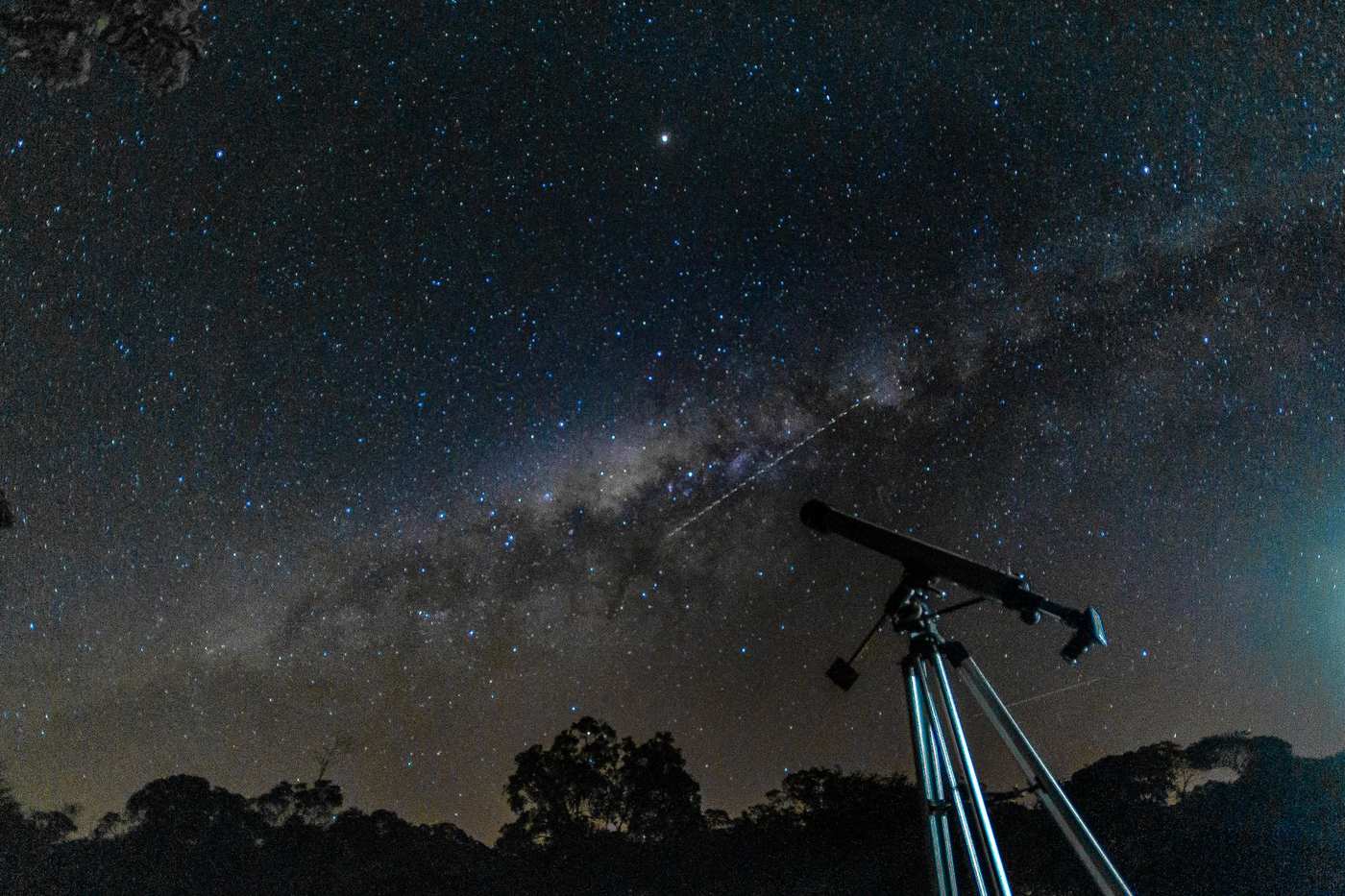
Ease of use is usually treated as a soft quality, as if some telescopes are just friendlier than others. It is not soft at all. Four specific, nameable things make a telescope hard, every one of them is a published specification, and you can check for all four before you buy.
The four things that make a telescope hard
- Assembly. A telescope that arrives as a box of parts with a tripod, a mount head, a counterweight and a finder to align is a two-hour job before it sees the sky. A telescope that arrives as a tube on a base is a two-minute job.
- Alignment. A German equatorial mount has to be roughly pointed at the celestial pole before its two axes make any sense, and a computerized GoTo mount has to be aligned on named stars before it will drive anywhere. Both are barriers on night one, and both assume knowledge a first-time buyer does not have.
- Collimation. A Newtonian reflector's mirrors can drift out of alignment, and a telescope that is slightly out looks soft in a way a beginner cannot diagnose. Collimation is not difficult, but it is one more thing.
- Power. Anything with motors needs batteries or a supply, and a dead battery ends a session in a way a Dobsonian never can.
How these picks are judged
Each one is scored on how many of the four barriers it removes, then on what it costs to remove them, and only then on aperture. That is a deliberate inversion of how the rest of this site ranks telescopes, and it is the right order for exactly one buyer: the one who will not tinker.
| Design | Assembly | Alignment | Collimation | Power |
|---|---|---|---|---|
| Tabletop Dobsonian | Minutes | None | Occasional check | None needed |
| Phone-guided tabletop | Minutes | None | Occasional check | Your phone |
| Phone-guided tripod | Moderate | None | Occasional check | Your phone |
| Tabletop GoTo | Minutes | Simple, app-driven | Occasional check | Batteries |
| Refractor on alt-azimuth | Moderate | None | Never | None needed |
| Newtonian on equatorial | Long | Polar alignment | Occasional check | None needed |
| Computerized fork GoTo | Moderate | Named alignment stars | Depends on design | Mains or batteries |
The last two rows are the telescopes people most often regret as first purchases, and neither is a bad telescope. They are simply the wrong shape for somebody who wants to look at the Moon on a Tuesday without a project. What to avoid covers why an equatorial mount is a poor gift specifically.
How this is funded: the buy buttons below are Amazon Associates links, and a qualifying purchase earns us a commission at no extra cost to you. It cannot move the ranking, because the order here is set by aperture per dollar, and no commission rate changes how much light a mirror collects. Full disclosure.
| # | Telescope | Best for | Aperture | Price |
|---|---|---|---|---|
| 1 | 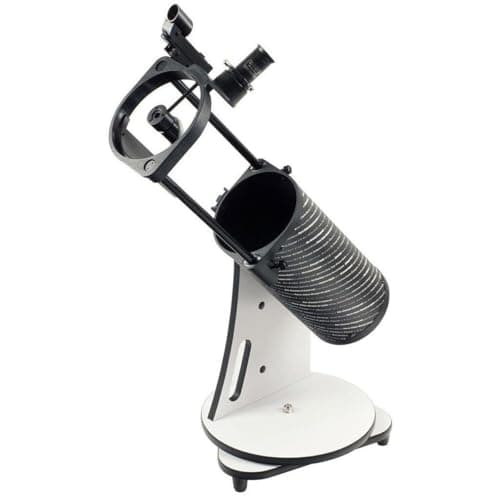 Sky-Watcher Heritage 130 Tabletop DobsonianTop pickThe same 130mm parabolic mirror as scopes costing far more, on a base with no tripod to wobble and nothing to set up. | Most aperture per dollar | 130mm260x useful | |
| 2 | 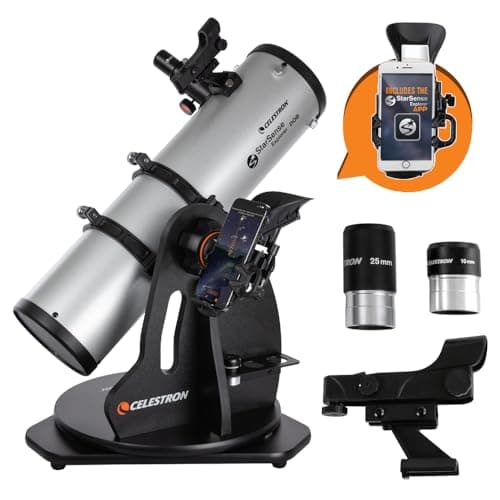 Celestron StarSense Explorer 130mm Tabletop Dobsonian130mm parabolic optics on a tabletop Dobsonian base with the StarSense phone dock. The two best beginner ideas in one box. | Phone finding plus tabletop simplicity | 130mm (5.12 in)260x useful | |
| 3 | 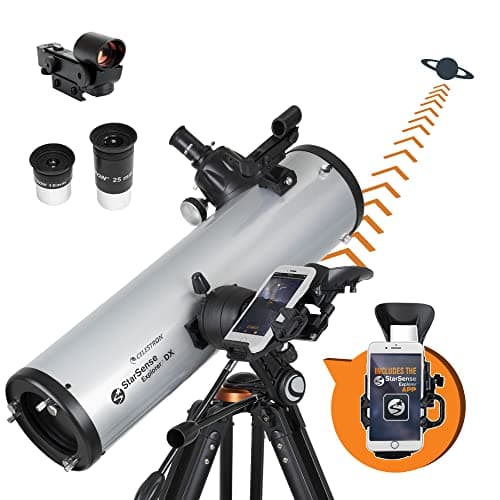 Celestron StarSense Explorer DX 130AZ130mm of parabolic aperture on a mount that stays still, plus the one piece of software that genuinely solves the find-it problem. | Most first buyers | 130mm (5.11 in)260x useful | |
| 4 | 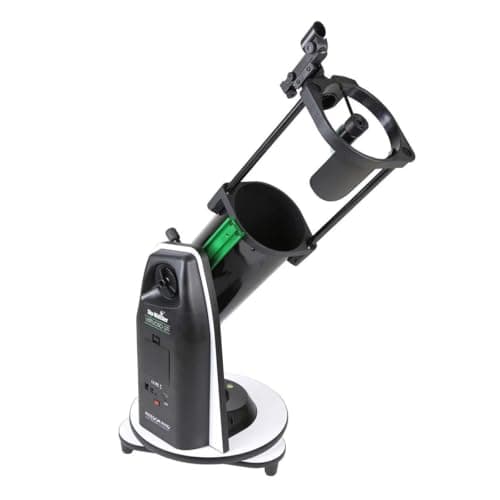 Sky-Watcher Virtuoso GTi 130PA 130mm collapsible Dobsonian with Wi-Fi GoTo built into the base, and it still lets you push the tube by hand. | GoTo without giving up aperture | 130mm260x useful | |
| 5 | 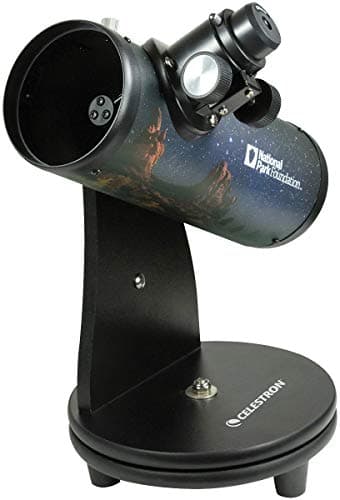 Celestron FirstScope 7676mm on a tiny Dobsonian base. The cheapest thing on this site that is a telescope rather than a toy shaped like one. | A real telescope under a hundred dollars | 76mm (2.99 in)152x useful |
Top pick · Most aperture per dollar
Sky-Watcher Heritage 130 Tabletop Dobsonian
The same 130mm parabolic mirror as scopes costing far more, on a base with no tripod to wobble and nothing to set up.
What the aperture allows
- Maximum useful magnification
- 260x
- 2 × 130mm of aperture
- Resolving limit (Dawes)
- 0.89 arcseconds
- 116 ÷ 130mm
- Cassini division (0.7″)
- Out of reach
- this aperture cannot resolve it
Worked example: a 25mm eyepiece in this telescope gives 650mm ÷ 25mm = 26x.
This is the aperture-per-dollar champion of the beginner shelf and it is not close. You get the same 130mm parabolic mirror found in telescopes at twice the price, and you get it without paying for a tripod, a slow-motion assembly or a hand controller.
Two times 130mm is 260x of useful magnification. Dawes' limit at 130mm works out to 116 divided by 130, which is 0.89 arcseconds. The Cassini division in Saturn's rings spans roughly 0.7 arcseconds at its widest, so this telescope sits right at the edge of showing it on a still night and will show the rings themselves easily.
The catch is the word tabletop. It needs a surface at roughly chest height when you are seated. A garden table works, a plastic patio chair does not, and buying one without thinking about where it will stand is the single most common regret with this design.
The tube collapses, which is what makes it live in a cupboard rather than a garage. That matters more than it sounds: the telescope you can carry outside in one trip is the telescope you use.
What it does well
- The most aperture you can buy at this price, by a clear margin
- Nothing to assemble, no tripod to wobble, ready in the time it takes to carry it outside
- Collapsible tube stores in a cupboard and keeps its collimation
- The Dobsonian motion is intuitive: you push the tube where you want to look
What it costs you
- Needs a solid table or stool at the right height, which is a real constraint
- The helical focuser is coarser than a rack-and-pinion or a Crayford
- Open tube design collects dust and needs the odd mirror clean
Skip this one if: Skip it if you have nowhere to stand it. On the ground it points at treetops, and on a wobbly plastic table every view shakes.
#ad · how this is funded · price as of September 13, 2026
Pick 2 · Phone finding plus tabletop simplicity
Celestron StarSense Explorer 130mm Tabletop Dobsonian
130mm parabolic optics on a tabletop Dobsonian base with the StarSense phone dock. The two best beginner ideas in one box.
What the aperture allows
- Maximum useful magnification
- 260x
- 2 × 130mm of aperture
- Resolving limit (Dawes)
- 0.89 arcseconds
- 116 ÷ 130mm
- Cassini division (0.7″)
- Out of reach
- this aperture cannot resolve it
Celestron publishes 307x as this telescope’s highest useful magnification. Our figure is 260x, from two times the aperture in millimeters. The gap of 47x comes from the slightly more generous per-inch constant makers use. Neither number describes a typical night: the atmosphere usually settles the question well below both.
Worked example: a 25mm eyepiece in this telescope gives 650mm ÷ 25mm = 26x.
This combines the two things that actually keep a first telescope in use: a mount with nothing to wobble, and a finder that removes the where-is-it problem.
Optically it is the same 130mm f/5 parabolic mirror as the DX 130AZ, and Celestron publishes the same figures: 307x maximum useful magnification, 345 times the light of the eye. Two times the aperture gives 260x and Dawes' limit is 0.89 arcseconds.
Against the tripod-mounted DX version you trade standing height for stability and a smaller footprint. Against the Sky-Watcher Heritage 130 you pay more and get the phone dock.
The tabletop condition applies here as much as anywhere: a stable surface at seated chest height, checked before purchase.
What it does well
- Parabolic 130mm mirror, not a spherical compromise
- A Dobsonian base cannot wobble the way a light tripod does
- The StarSense app removes the biggest cause of first-telescope abandonment
What it costs you
- Needs a table, which not every buyer has thought about
- Costs more than the equivalent manual tabletop Dobsonian
- The app needs a phone the whole time it is in use
Skip this one if: Skip it if the recipient wants to learn the constellations. Being walked to a target teaches you less than finding it.
$479.95 · 10% off
#ad · how this is funded · price as of September 13, 2026
Pick 3 · Most first buyers
Celestron StarSense Explorer DX 130AZ
130mm of parabolic aperture on a mount that stays still, plus the one piece of software that genuinely solves the find-it problem.
What the aperture allows
- Maximum useful magnification
- 260x
- 2 × 130mm of aperture
- Resolving limit (Dawes)
- 0.89 arcseconds
- 116 ÷ 130mm
- Cassini division (0.7″)
- Out of reach
- this aperture cannot resolve it
Celestron publishes 307x as this telescope’s highest useful magnification. Our figure is 260x, from two times the aperture in millimeters. The gap of 47x comes from the slightly more generous per-inch constant makers use. Neither number describes a typical night: the atmosphere usually settles the question well below both.
Worked example: a 25mm eyepiece in this telescope gives 650mm ÷ 25mm = 26x.
130mm is the aperture where the sky stops being a list of bright dots. Two times that aperture is 260x of useful magnification, which is more than the atmosphere will usually give you on any given night, so nothing in this telescope's optical budget is wasted on a number you cannot use.
Celestron's own published ceiling for it is 307x, which sits above the 2x-aperture rule of thumb. The gap is worth knowing about: manufacturers compute that figure per inch of aperture with a slightly more generous constant. Neither number describes a night you will actually have. Plan around 130x to 180x and treat anything higher as a rare-night bonus.
At f/5 the focal length is short, so the supplied 25mm eyepiece gives a wide, forgiving 26x that makes finding things possible in the first place. That is not a compromise; it is the eyepiece you will use most.
The StarSense part is the honest reason this sits at the top. It uses your phone's camera to plate-solve the actual sky and then walks you to a target with an on-screen arrow. It is not a motor and it does not track. It solves the problem that really kills first telescopes, which is not being able to find anything.
What it does well
- 130mm parabolic mirror rather than the cheaper spherical mirror used at this price by several competitors
- The phone-based finder works and needs no alignment stars, no power and no hand controller
- Full-height tripod, so an adult uses it standing up rather than kneeling on wet grass
- Manual mount means nothing to charge, nothing to fail and nothing to re-align next time
What it costs you
- The bundled 10mm eyepiece is the weakest part of the package
- A Newtonian needs collimation checks; not hard, but it is a task a refractor does not have
- No tracking, so at high magnification you are nudging the tube every 30 seconds
Skip this one if: Skip it if the person receiving it is under about ten and will be using it alone. The tripod is full height and the finding workflow assumes a phone.
$499.95 · 17% off
#ad · how this is funded · price as of September 13, 2026
Pick 4 · GoTo without giving up aperture
Sky-Watcher Virtuoso GTi 130P
A 130mm collapsible Dobsonian with Wi-Fi GoTo built into the base, and it still lets you push the tube by hand.
What the aperture allows
- Maximum useful magnification
- 260x
- 2 × 130mm of aperture
- Resolving limit (Dawes)
- 0.89 arcseconds
- 116 ÷ 130mm
- Cassini division (0.7″)
- Out of reach
- this aperture cannot resolve it
Worked example: a 25mm eyepiece in this telescope gives 650mm ÷ 25mm = 26x.
The usual GoTo trade is that you pay for motors instead of glass and end up with a smaller mirror. This one avoids that: it is the same 130mm f/5 optic as the manual Heritage, with the electronics in the base rather than in a tripod.
Two times 130mm is 260x of useful magnification and the published Dawes limit for that aperture is 0.89 arcseconds. The motors change nothing about what the optics can resolve, which is the point worth holding onto: GoTo buys you finding and tracking, never detail.
Freedom Find is the feature that matters in practice. Most GoTo mounts lose their alignment the moment somebody shoves the tube. This one uses encoders on both axes, so a curious nine-year-old grabbing it does not end the session.
Budget for power. Eight AA cells run down faster than you expect in the cold, and a cheap 12V supply is the difference between an evening and forty minutes.
What it does well
- Full aperture and full GoTo in the same package, which is unusual at this size
- Tracking keeps a planet centered at high magnification, which is what makes it worth looking at
- Manual override via dual encoders survives being grabbed
- Collapsible tube on a tabletop base, so it still stores easily
What it costs you
- Eats AA batteries; an external 12V supply is effectively mandatory and is not included
- Alignment is a step every session, however quick
- Tabletop base, so it still needs a surface
Skip this one if: Skip it if you would rather learn the sky than be driven around it. The manual Heritage 130 has the same optics for less.
#ad · how this is funded · price as of September 13, 2026
Pick 5 · A real telescope under a hundred dollars
Celestron FirstScope 76
76mm on a tiny Dobsonian base. The cheapest thing on this site that is a telescope rather than a toy shaped like one.
What the aperture allows
- Maximum useful magnification
- 152x
- 2 × 76mm of aperture
- Resolving limit (Dawes)
- 1.53 arcseconds
- 116 ÷ 76mm
- Cassini division (0.7″)
- Out of reach
- this aperture cannot resolve it
Celestron publishes 180x as this telescope’s highest useful magnification. Our figure is 152x, from two times the aperture in millimeters. The gap of 28x comes from the slightly more generous per-inch constant makers use. Neither number describes a typical night: the atmosphere usually settles the question well below both.
Worked example: a 25mm eyepiece in this telescope gives 300mm ÷ 25mm = 12x.
76mm is small, and this page is not going to pretend otherwise. What it is not is a toy: the mirror is real, the mount is a proper Dobsonian, and it will show the Moon's craters and Jupiter's moons.
Two times 76mm gives 152x of useful magnification. Celestron publishes 180x. Either figure demolishes the 525x printed on the box of the department-store scope sitting beside it at the same price.
The f/3.95 focal ratio is very fast, which is hard on a spherical mirror and hard on cheap eyepieces. Expect softness at the edge of the field and do not expect much above about 60x to 75x in practice.
The right way to think about it: this is a lot better than nothing, it is enormously better than a 60mm toy scope on a plastic tripod, and it is meaningfully worse than the 130mm tabletop Dobsonian that costs roughly three times as much.
What it does well
- A genuine telescope at a price where most of the shelf is not
- Nothing to assemble, nothing to align, nothing to charge
- Small enough that a child can carry and aim it without help
What it costs you
- A fast spherical mirror at f/3.95 is soft away from the field center
- The bundled eyepieces are the cheapest part of a cheap package
- Very small; it needs a table and it is easy to knock over
Skip this one if: Skip it if the budget can stretch to a 130mm tabletop. The aperture difference is 2.9 times the light, and it is obvious at the eyepiece.
#ad · how this is funded · price as of September 13, 2026
The refractor case, which this list does not lead with
A refractor is the only design here that never needs collimation at all — a sealed lens at the front and nothing inside to move. On the ease-of-use axis alone it wins outright.
It does not lead this list because at a beginner price a refractor buys noticeably less aperture than a mirror does, and because it arrives with a tripod and a mount head to assemble where a tabletop Dobsonian does not. If nobody in the house will ever check an alignment, that trade flips and the 102mm refractor review is the page to read.
An honest downside on every pick
- The manual tabletop: needs a stable surface at seated chest height, and you still have to find things yourself.
- The phone-guided tabletop: costs more than the manual version for the same mirror, and the workflow assumes a supported phone that is charged.
- The phone-guided tripod telescope: a full-height tripod means more to assemble and more to wobble than a tabletop base.
- The tabletop GoTo: motors mean batteries, and an inert telescope when they die. It also costs the most per millimeter of mirror on this page.
- The small tabletop: easiest of all to carry and set up, and its spherical mirror at a very fast focal ratio means it will not sharpen up at high power.
The general warning: easy is not the same as good, and it is possible to buy so far toward easy that you end up with a telescope that shows very little. The sweet spot for most buyers is a 130mm tabletop, which removes assembly and alignment entirely while keeping real aperture. Everything above and below that on this page is a deliberate trade in one direction or the other.
Three things that make any telescope easier, for free
- Align the finderscope in daylight, against a distant chimney, before your first night. It takes five minutes and it is the single most valuable thing you can do. The daylight procedure has the steps.
- Start with the longest eyepiece you own. The widest field is the finding field. Swapping to a shorter one after you have the target centered is far easier than hunting at high power.
- Pick a crescent Moon for the first night. Bright, easy, genuinely astonishing, and impossible to miss. The first night guide sets out the whole evening in order.
Questions people actually ask
What is the easiest telescope to use for a beginner?
A tabletop Dobsonian. There is nothing to assemble beyond lifting it out of the box, no alignment routine, no power supply and no tripod to wobble — you push the tube where you want to look. The one condition is a stable surface at roughly seated chest height.
Are GoTo telescopes easier to use?
Not on the first night. A conventional computerized mount asks you to identify and center two or three named stars before it will drive anywhere, which is precisely the knowledge a first-time buyer lacks. Phone-based finding removes that barrier instead, because the app identifies the sky for you.
What makes a telescope hard to use?
Four things, all of them published specifications: how much assembly it needs, whether the mount requires polar or star alignment, whether the optics need collimating, and whether it needs power. A telescope that avoids all four can be used on the night it arrives.
Do I need to collimate my telescope?
Refractors never. Newtonian reflectors occasionally, and more often the faster the focal ratio. It is a ten-minute job once you have done it, but if nobody in the household will ever do it, a refractor is the more honest purchase even at less aperture.
Is an easy telescope a worse telescope?
Not necessarily, but it can be if you buy too far in that direction. A 130mm tabletop Dobsonian removes assembly, alignment and power entirely while keeping real aperture, which is why it is the sweet spot. Going smaller for more ease starts costing you the view.
Read next
Best tabletop
Tabletop Telescopes, and the One Thing to Check First
The best value design in beginner astronomy, and the surface requirement that decides whether it works for you.
Top pick: Sky-Watcher Heritage 130 Tabletop Dobsonian
#ad · how this is funded · price as of September 13, 2026
What to Avoid When Buying a First Telescope
The six traps that produce a disappointing first telescope, each one checkable from the product listing before you buy.
Top pick: Celestron FirstScope 76
#ad · how this is funded · price as of September 13, 2026
How to Use a Telescope: Your First Night, Step by Step
The first evening with a telescope, in the order things actually happen, with the daylight steps that decide it.
Top pick: Celestron Night Vision Red LED Flashlight
$20.95 · 19% off
#ad · how this is funded · price as of September 13, 2026
Found something wrong here? Tell us and we will correct it and date the correction, per our editorial policy.