Reviews
Celestron Travel Scope 70
Three and a bit pounds for the whole kit including the tripod. Nothing else on this site goes in hand luggage, and that is the entire argument for it.
By Scooter M. · Published · How we pick

Celestron publishes a total kit weight of 3.3 lb (1.5 kg), tripod and backpack included. That single figure is the whole reason this telescope exists and the only reason to choose it over instruments that show considerably more.
What 70mm at f/5.7 gives you
max useful magnification = 2 x aperture. Dawes limit = 116 / aperture.
70 x 2 = 140x. 116 / 70 = 1.66 arcseconds.
Celestron publishes 168x and 1.66 arcseconds. The resolution figures agree exactly. A 1.66-arcsecond limit puts the Cassini division and tight double stars out of reach.
70mm is the floor of what is worth owning, and this site says the same thing on every page that mentions it. Below 70mm a telescope struggles to beat a decent pair of binoculars, which are easier to hold and useful in daylight.
At 70mm you get Saturn's rings as a separated ring, Jupiter's two main belts and its four bright moons, the phases of Venus, and a lunar terminator worth the price on its own. What you do not get is deep sky, because Celestron's published light-gathering figure for this aperture is 100 times the naked eye against 345 for a 130mm.
The short tube changes the character
The aperture is the same 70mm as the AstroMaster 70AZ, but Celestron publishes 400mm of focal length here against 900mm there. That is f/5.7 rather than f/13, and it changes what the telescope is good at. The National Geographic Sky View 70 publishes the same 70mm and the same 400mm, so the two see identically and differ only in packaging.
| Travel Scope 70 | AstroMaster 70AZ | |
|---|---|---|
| Aperture | 70mm | 70mm |
| Focal length | 400mm | 900mm |
| Focal ratio | f/5.7 | f/13 |
| Max useful magnification | 140x | 140x |
| Resolving limit | 1.66 arcsec | 1.66 arcsec |
| Widest field | Wider | Narrower |
| False color on bright objects | More | Less |
| Total kit weight | 3.3 lb | 10.8 lb |
The short tube gives a wider field, which makes finding things easy and star fields rewarding. It also shows more chromatic aberration, the faint violet fringe a simple lens puts around bright objects, because a fast achromat has less focal length to bring the colors together. On the Moon and on Jupiter it is visible. Why refractors do that.
The tripod is the weak link, and every owner says so
This is not a defect so much as a consequence of the 3.3 lb figure. A tripod stiff enough for 140x would weigh more than the rest of the kit, and the product would stop being the thing it was designed to be.
How this is funded: the buy buttons below are Amazon Associates links, and a qualifying purchase earns us a commission at no extra cost to you. It cannot move the ranking, because the order here is set by aperture per dollar, and no commission rate changes how much light a mirror collects. Full disclosure.
| # | Telescope | Best for | Aperture | Price |
|---|---|---|---|---|
| 1 | 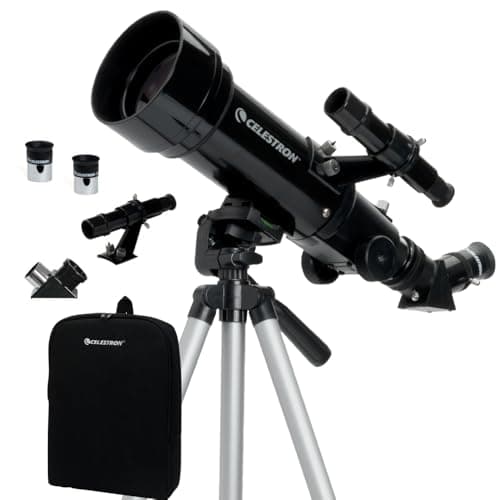 Celestron Travel Scope 70Top pick70mm at f/5.7 with a backpack. A daytime spotting scope that moonlights at night, rather than the other way round. | Packing light | 70mm (2.8 in)140x useful |
Top pick · Packing light
Celestron Travel Scope 70
70mm at f/5.7 with a backpack. A daytime spotting scope that moonlights at night, rather than the other way round.
What the aperture allows
- Maximum useful magnification
- 140x
- 2 × 70mm of aperture
- Resolving limit (Dawes)
- 1.66 arcseconds
- 116 ÷ 70mm
- Cassini division (0.7″)
- Out of reach
- this aperture cannot resolve it
Celestron publishes 168x as this telescope’s highest useful magnification. Our figure is 140x, from two times the aperture in millimeters. The gap of 28x comes from the slightly more generous per-inch constant makers use. Neither number describes a typical night: the atmosphere usually settles the question well below both.
Worked example: a 25mm eyepiece in this telescope gives 400mm ÷ 25mm = 16x.
3.3 pounds for the whole kit including the tripod is the entire pitch. Nothing else here goes in hand luggage.
The optics are the same 70mm as the AstroMaster LT but at f/5.7 rather than f/10, so the tube is much shorter and the widest field is much wider. That is good for landscapes and star fields and less good for the planets, where the shorter focal length shows more false color.
Two times 70mm gives 140x of useful magnification and Celestron publishes 168x. The published Dawes limit of 1.66 arcseconds means no Cassini division and no tight doubles.
The tripod is the weak link and everybody who owns one says so. It is a photo tripod carrying a telescope, and above about 60x it shakes. If you already own a decent tripod, use that instead.
What it does well
- Genuinely packable: 3.3 lb with the tripod, in a supplied backpack
- Doubles as a daytime spotting scope, which is where a lot of its use will come from
- A wide field at f/5.7 makes finding things easy
What it costs you
- The included tripod is not steady enough above modest magnification
- A short-focus achromat shows visible color fringing on the Moon and Jupiter
- 70mm is the aperture floor, and this one is optimized for portability over performance
Skip this one if: Skip it if it never actually leaves the house. At home, the same money buys a tabletop Dobsonian with twice the aperture and a mount that does not shake.
$119.95 · 25% off
#ad · how this is funded · price as of October 20, 2026
When this is genuinely the right buy
- It will actually travel. Hand luggage, a hiking pack, a boat. Nothing else here does that.
- You want a daytime spotting scope that also looks up. With an erecting diagonal it works on landscapes and wildlife, and 400mm of focal length suits that better than 900mm does.
- It is a second telescope. As the grab-and-go beside a Dobsonian it earns its place easily.
- A child will carry it themselves. 3.3 lb is a weight a seven-year-old can manage.
What is not on that list is home use. At home, the same money buys a tabletop Dobsonian with nearly twice the aperture on a mount that does not shake, and the home-use page makes that case with the numbers.
Who should not buy it
Anybody whose telescope will live in one place, because portability is the only thing this buys and it is paying for it with aperture and mount stability. And anybody expecting deep sky, because 70mm collects a third of the light a 130mm does.
For how this compares with the larger refractors, and why focal ratio matters so much in an achromat, see the best refractor telescopes.
Questions people actually ask
Is the Celestron Travel Scope 70 any good?
It is good at exactly one thing: being carried. Celestron publishes 3.3 lb for the complete kit including tripod and backpack. Optically it is a 70mm refractor with a 1.66-arcsecond resolving limit, and the supplied tripod limits it further above about 60x.
What can you see with the Travel Scope 70?
Saturn's rings as a separated ring, Jupiter's four bright moons and two main cloud belts, the phases of Venus, and lunar craters in real detail. Deep-sky objects are mostly beyond it: Celestron publishes 100 times the light of the naked eye for this aperture.
Travel Scope 70 or AstroMaster 70AZ?
Same 70mm aperture and the same 1.66-arcsecond limit. The Travel Scope is 400mm and 3.3 lb, so wider-field and packable but with more false color. The AstroMaster 70AZ is 900mm and 10.8 lb, so narrower-field, steadier and cleaner on the planets.
Is the tripod any good?
No, and that is the main complaint owners have. It is a lightweight photo tripod, and above roughly 60x the image shakes. Using a sturdier tripod you already own improves the telescope more than any accessory would.
Can you use it in the daytime?
Yes, and it is one of the better beginner telescopes for that because the short 400mm focal length suits terrestrial viewing. You need an erecting diagonal for a right-way-up image. Never point it at or near the Sun without a proper solar filter.
Read next
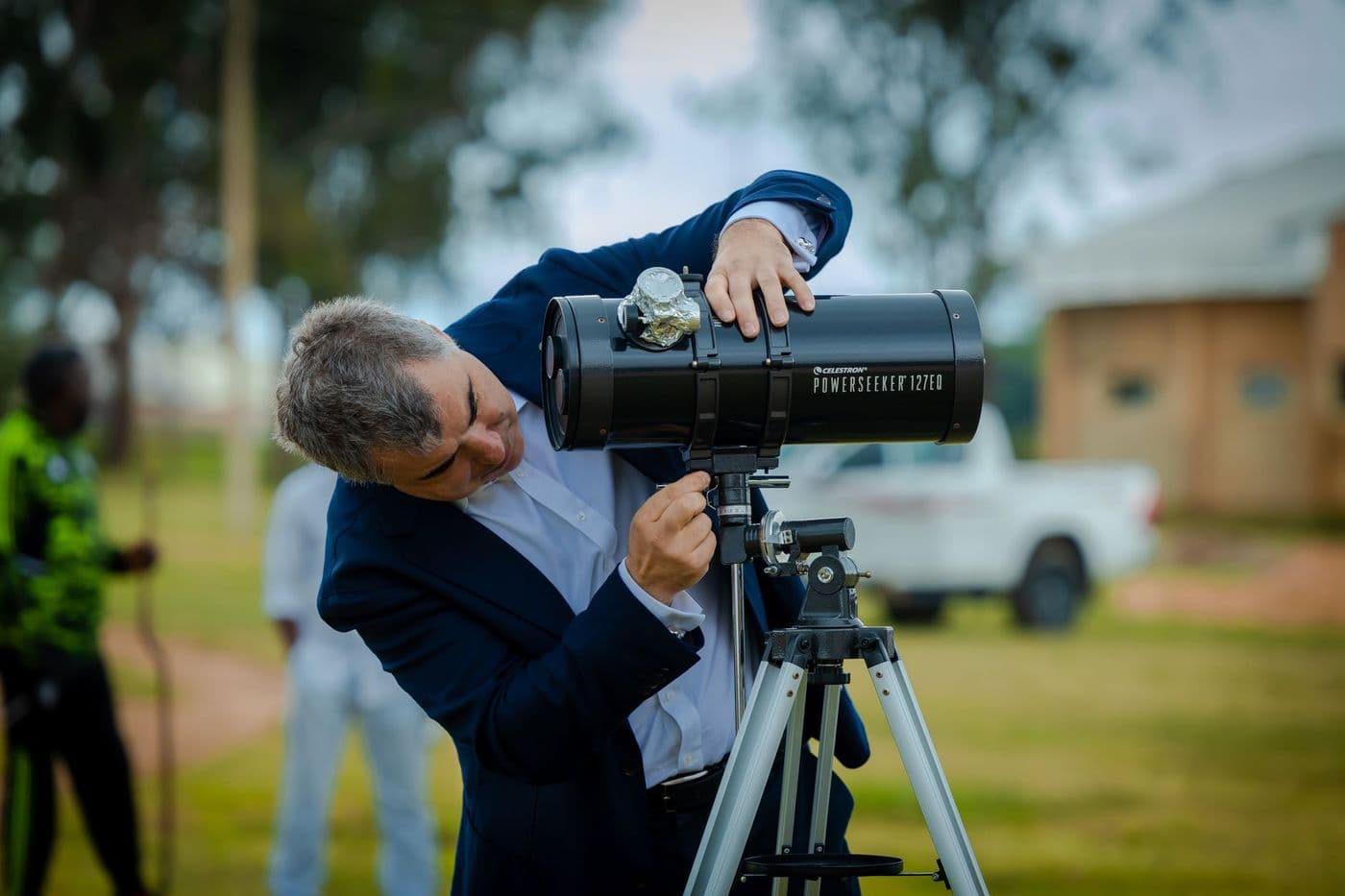
Celestron AstroMaster 70AZ
70mm at f/13 on a steel tripod: cleaner planetary views than a fast 70mm, paid for with a narrow field and a heavy package.
Top pick: Celestron AstroMaster 70AZ
$199.95 · 10% off
#ad · how this is funded · price as of October 20, 2026
Telescope vs Spotting Scope: Which One Do You Actually Want?
A spotting scope caps at its zoom's top magnification; a telescope takes any eyepiece. The decision, with both makers' published numbers.
Top pick: Sky-Watcher Heritage 130 Tabletop Dobsonian
$305.00 · 12% off
#ad · how this is funded · price as of October 20, 2026
Best under $200
The Best Telescopes Under $200
The bracket where aperture can jump from 70mm to 127mm, more than three times the light, and where a real tabletop Dobsonian first appears.
Top pick: Celestron FirstScope 76
#ad · how this is funded · price as of October 20, 2026
Found something wrong here? Tell us and we will correct it and date the correction, per our editorial policy.