Telescopes by Budget
The Best Telescopes Under $200
This is the most important bracket on the site. It is where a first telescope stops being a novelty and starts collecting enough light to show something faint.
By Scooter M. · Published · How we pick
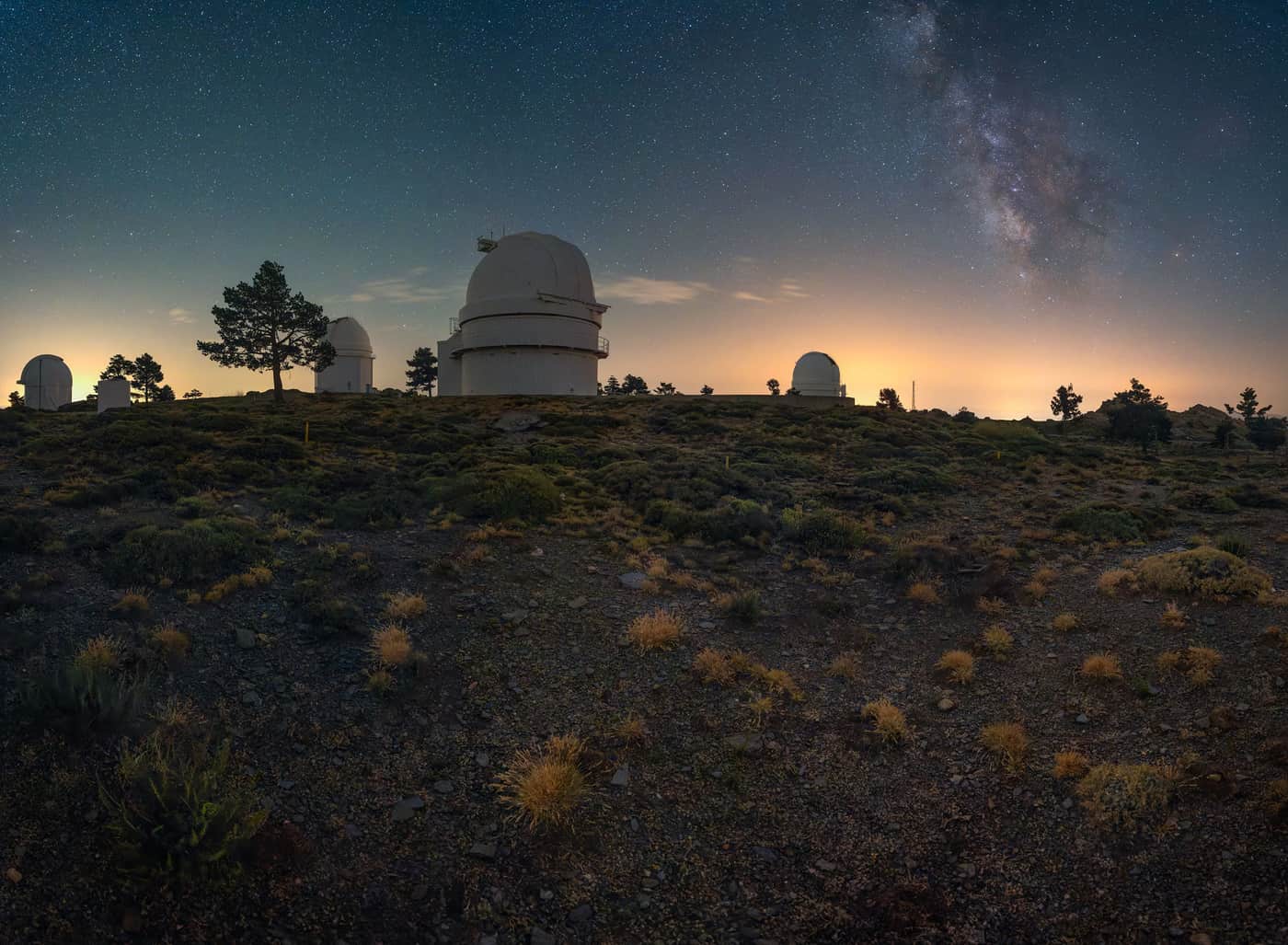
Under $200 there are two genuine telescopes, and they make opposite compromises. The Celestron FirstScope 76 is the one a beginner can use on the first night: a tabletop Dobsonian with nothing to set up and nothing to wobble. The Celestron PowerSeeker 127EQ is the one with the aperture: 127mm, on an equatorial mount that has to be learned first. The FirstScope 76 review and the PowerSeeker 127EQ review set each one out in full.
Why this bracket matters more than the ones above it
light ratio = (aperture 1 / aperture 2) squared
(127 / 70)squared = 3.29, so more than three times the light
That is the step from the under-$100 bracket's 70mm refractors to the largest aperture this bracket buys. No later step up in price multiplies the light by as much.
At 127mm the resolving limit is 0.91 arcseconds and the useful magnification ceiling is 254x. The Orion Nebula stops being a smudge and develops structure, the brighter globular clusters start to look granular, and Jupiter's cloud bands gain contrast.
The catch at the aperture end
The PowerSeeker reaches 127mm at this price with a spherical primary mirror and a corrector lens that folds a 1000mm focal length into a short tube, on a German equatorial mount. Celestron states the spherical mirror plainly. The result is a telescope that is less forgiving of collimation, and that makes no sense on its first night until the mount has been roughly polar aligned.
The tabletop condition, stated before you buy
If the honest answer is that there is no suitable surface, spend the same money on a 70mm refractor on a full-height tripod and accept the smaller aperture. A telescope at a workable height beats a bigger one you cannot look through comfortably.
What this bracket will show you
| Target | At 76mm | At 127mm |
|---|---|---|
| Lunar craters | Good detail | Detail toward the 0.91-arcsecond limit |
| Saturn's rings | Separated, small | Clearly separated |
| Jupiter | The four bright moons | The moons, and the two main belts with contrast |
| Orion Nebula | A gray shape | Structure begins to show |
| Globular clusters | Soft glows | Granular at the edges from a dark sky |
| Galaxies | Out of reach | Faint gray shapes, dark sky essential |
How this is funded: the buy buttons below are Amazon Associates links, and a qualifying purchase earns us a commission at no extra cost to you. It cannot move the ranking, because the order here is set by aperture per dollar, and no commission rate changes how much light a mirror collects. Full disclosure.
| # | Telescope | Best for | Aperture | Price |
|---|---|---|---|---|
| 1 | 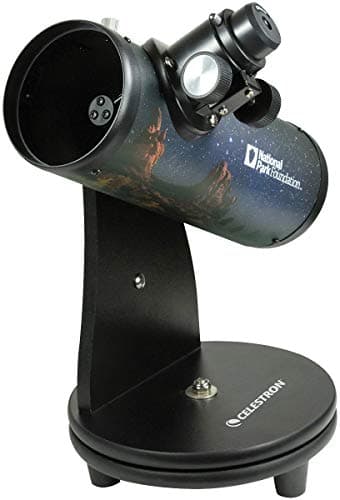 Celestron FirstScope 76Top pick76mm on a tiny Dobsonian base. The cheapest thing on this site that is a telescope rather than a toy shaped like one. | A real telescope under a hundred dollars | 76mm (2.99 in)152x useful | |
| 2 | 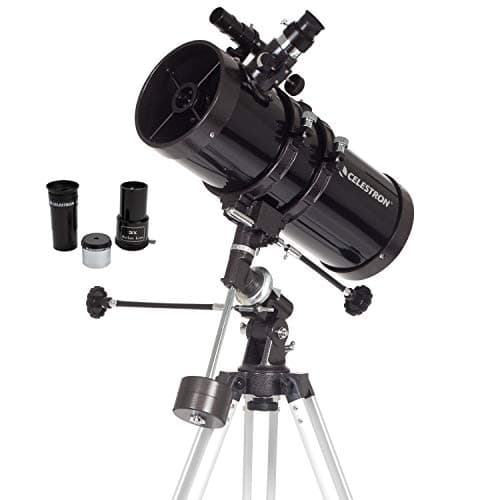 Celestron PowerSeeker 127EQ127mm of aperture, a spherical mirror, an equatorial mount a beginner has to learn, and the highest advertised magnification on the shelf. | The one to understand before you buy it | 127mm (5 in)254x useful | |
| 3 | 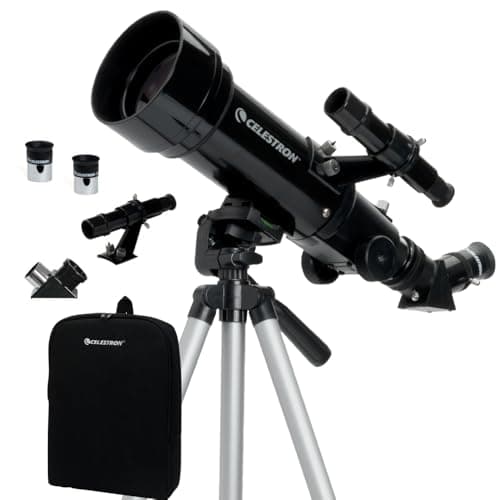 Celestron Travel Scope 7070mm at f/5.7 with a backpack. A daytime spotting scope that moonlights at night, rather than the other way round. | Packing light | 70mm (2.8 in)140x useful | |
| 4 | 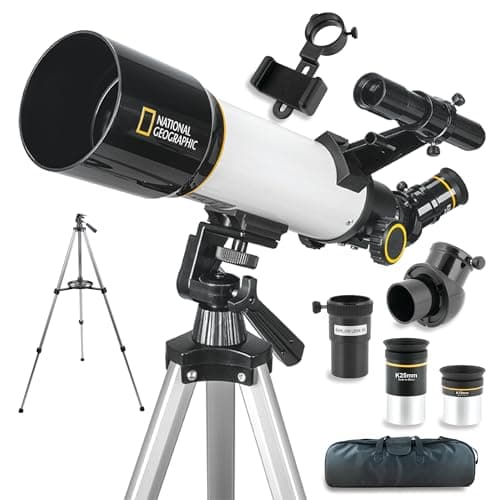 National Geographic Sky View 70mm RefractorA 70mm refractor on a panhandle mount, branded for the shelf it will be bought from. Honest optics inside a gift box. | A gift that looks like a gift | 70mm140x useful |
Top pick · A real telescope under a hundred dollars
Celestron FirstScope 76
76mm on a tiny Dobsonian base. The cheapest thing on this site that is a telescope rather than a toy shaped like one.
What the aperture allows
- Maximum useful magnification
- 152x
- 2 × 76mm of aperture
- Resolving limit (Dawes)
- 1.53 arcseconds
- 116 ÷ 76mm
- Cassini division (0.7″)
- Out of reach
- this aperture cannot resolve it
Celestron publishes 180x as this telescope’s highest useful magnification. Our figure is 152x, from two times the aperture in millimeters. The gap of 28x comes from the slightly more generous per-inch constant makers use. Neither number describes a typical night: the atmosphere usually settles the question well below both.
Worked example: a 25mm eyepiece in this telescope gives 300mm ÷ 25mm = 12x.
76mm is small, and this page is not going to pretend otherwise. What it is not is a toy: the mirror is real, the mount is a proper Dobsonian, and it will show the Moon's craters and Jupiter's moons.
Two times 76mm gives 152x of useful magnification. Celestron publishes 180x. Either figure demolishes the 525x printed on the box of the department-store scope sitting beside it at the same price.
The f/3.95 focal ratio is very fast, which is hard on a spherical mirror and hard on cheap eyepieces. Expect softness at the edge of the field and do not expect much above about 60x to 75x in practice.
The right way to think about it: this is a lot better than nothing, it is enormously better than a 60mm toy scope on a plastic tripod, and it is meaningfully worse than the 130mm tabletop Dobsonian that costs roughly three times as much.
What it does well
- A genuine telescope at a price where most of the shelf is not
- Nothing to assemble, nothing to align, nothing to charge
- Small enough that a child can carry and aim it without help
What it costs you
- A fast spherical mirror at f/3.95 is soft away from the field center
- The bundled eyepieces are the cheapest part of a cheap package
- Very small; it needs a table and it is easy to knock over
Skip this one if: Skip it if the budget can stretch to a 130mm tabletop. The aperture difference is 2.9 times the light, and it is obvious at the eyepiece.
#ad · how this is funded · price as of October 19, 2026
Pick 2 · The one to understand before you buy it
Celestron PowerSeeker 127EQ
127mm of aperture, a spherical mirror, an equatorial mount a beginner has to learn, and the highest advertised magnification on the shelf.
What the aperture allows
- Maximum useful magnification
- 254x
- 2 × 127mm of aperture
- Resolving limit (Dawes)
- 0.91 arcseconds
- 116 ÷ 127mm
- Cassini division (0.7″)
- Out of reach
- this aperture cannot resolve it
Celestron publishes 300x as this telescope’s highest useful magnification. Our figure is 254x, from two times the aperture in millimeters. The gap of 46x comes from the slightly more generous per-inch constant makers use. Neither number describes a typical night: the atmosphere usually settles the question well below both.
Worked example: a 25mm eyepiece in this telescope gives 1000mm ÷ 25mm = 40x.
This telescope is on the site because it is one of the best-selling beginner scopes there is, and because buying it without understanding it is how a lot of people end up disappointed.
Start with the arithmetic. 127mm of aperture gives 254x of useful magnification at the 2x rule; Celestron publishes 300x. Retail listings for this model have long advertised figures far above both. The optics do not change because a shorter eyepiece is fitted.
The design detail that matters: Celestron's own optical design line says spherical primary mirror, and the tube is far shorter than a 1000mm focal length would normally require. That combination is achieved with a corrector lens in the focuser tube, and the arrangement is much more sensitive to collimation than a straightforward Newtonian.
The mount is a German equatorial, which is the right tool for tracking but is genuinely confusing on night one. It has to be roughly polar aligned before its motions make sense, and a gift recipient who has never seen one will usually assume it is broken.
What it does well
- 127mm is real aperture and it does collect 329 times the light of the eye, per Celestron's own figure
- The equatorial mount tracks properly once you understand it, which an alt-azimuth cannot
- Widely available and well supported
What it costs you
- A spherical primary in a compressed optical path is harder to collimate and less forgiving than a plain Newtonian
- The equatorial mount is the single most common reason a first telescope goes back in the box
- Retail listings for this model routinely advertise magnification figures the optics cannot deliver
Skip this one if: Skip it if it is a gift for somebody who has never used a telescope. The same aperture on a Dobsonian base needs no explanation at all.
$229.95 · 13% off
#ad · how this is funded · price as of October 19, 2026
Pick 3 · Packing light
Celestron Travel Scope 70
70mm at f/5.7 with a backpack. A daytime spotting scope that moonlights at night, rather than the other way round.
What the aperture allows
- Maximum useful magnification
- 140x
- 2 × 70mm of aperture
- Resolving limit (Dawes)
- 1.66 arcseconds
- 116 ÷ 70mm
- Cassini division (0.7″)
- Out of reach
- this aperture cannot resolve it
Celestron publishes 168x as this telescope’s highest useful magnification. Our figure is 140x, from two times the aperture in millimeters. The gap of 28x comes from the slightly more generous per-inch constant makers use. Neither number describes a typical night: the atmosphere usually settles the question well below both.
Worked example: a 25mm eyepiece in this telescope gives 400mm ÷ 25mm = 16x.
3.3 pounds for the whole kit including the tripod is the entire pitch. Nothing else here goes in hand luggage.
The optics are the same 70mm as the AstroMaster LT but at f/5.7 rather than f/10, so the tube is much shorter and the widest field is much wider. That is good for landscapes and star fields and less good for the planets, where the shorter focal length shows more false color.
Two times 70mm gives 140x of useful magnification and Celestron publishes 168x. The published Dawes limit of 1.66 arcseconds means no Cassini division and no tight doubles.
The tripod is the weak link and everybody who owns one says so. It is a photo tripod carrying a telescope, and above about 60x it shakes. If you already own a decent tripod, use that instead.
What it does well
- Genuinely packable: 3.3 lb with the tripod, in a supplied backpack
- Doubles as a daytime spotting scope, which is where a lot of its use will come from
- A wide field at f/5.7 makes finding things easy
What it costs you
- The included tripod is not steady enough above modest magnification
- A short-focus achromat shows visible color fringing on the Moon and Jupiter
- 70mm is the aperture floor, and this one is optimized for portability over performance
Skip this one if: Skip it if it never actually leaves the house. At home, the same money buys a tabletop Dobsonian with twice the aperture and a mount that does not shake.
$119.95 · 25% off
#ad · how this is funded · price as of October 19, 2026
Pick 4 · A gift that looks like a gift
National Geographic Sky View 70mm Refractor
A 70mm refractor on a panhandle mount, branded for the shelf it will be bought from. Honest optics inside a gift box.
What the aperture allows
- Maximum useful magnification
- 140x
- 2 × 70mm of aperture
- Resolving limit (Dawes)
- 1.66 arcseconds
- 116 ÷ 70mm
- Cassini division (0.7″)
- Out of reach
- this aperture cannot resolve it
National Geographic publishes 120x as this telescope’s highest useful magnification. Our figure is 140x, from two times the aperture in millimeters. The two figures agree closely, which is the case whenever a maker states its ceiling honestly.
Worked example: a 25mm eyepiece in this telescope gives 400mm ÷ 25mm = 16x.
70mm of refractor aperture puts this at the floor of what is worth owning, and the same arithmetic applies as to every other 70mm on this site: 140x of useful magnification at the 2x rule, and a Dawes limit of 1.66 arcseconds.
The panhandle mount is the differentiator. A single handle that moves in both axes is far more intuitive for a child, or for an adult who has never used a telescope, than either a slow-motion alt-azimuth head or an equatorial one.
National Geographic publishes a 400mm focal length, which at 70mm gives f/5.7, and advertises 16x, 40x, 48x and 120x. Those four figures check out exactly against 25mm and 10mm eyepieces with the supplied 3x Barlow, and the top one sits under the 140x this aperture supports — which is not what the bottom of this market usually does.
As a gift this earns its place on presentation and on the mount. As an instrument it is a 70mm refractor, which means the Moon, the bright planets and not much else.
What it does well
- The panhandle mount is genuinely the easiest way for a beginner to aim a telescope
- 70mm of real refractor aperture rather than a 50mm toy
- Presents well as a gift, which matters more than enthusiasts like to admit
What it costs you
- A fast f/5.7 achromat shows false color on the Moon and the bright planets
- 70mm limits it to the Moon and the bright planets
- Branded packaging is part of what you are paying for
Skip this one if: Skip it if the recipient is already interested in astronomy rather than being introduced to it. They will want aperture, not a panhandle.
#ad · how this is funded · price as of October 19, 2026
The one exception to the tabletop rule
If the telescope genuinely has to travel — hand luggage, a hiking pack — none of the above applies, because a tabletop Dobsonian does not pack. The Travel Scope 70 review covers the 3.3 lb option and is honest about what its tripod costs you.
What to spend the last twenty dollars on
A moon filter, without hesitation. The full Moon through a 127mm telescope is genuinely uncomfortable, and the discomfort costs you detail because a dazzled eye resolves less. After that, a 32mm eyepiece for wide-field views, which no bundled eyepiece in this bracket matches. The eyepiece guide works out which focal lengths suit your telescope specifically, and the accessory order covers what comes after that.
Questions people actually ask
What is the best telescope under $200?
For a first-time buyer, the Celestron FirstScope 76: a tabletop Dobsonian with nothing to set up and a published 1.53-arcsecond resolving limit. For the most aperture, the Celestron PowerSeeker 127EQ at 127mm, which collects more than three times the light of a 70mm telescope but needs its equatorial mount learned first.
Is the PowerSeeker 127EQ a good first telescope?
Not usually as a gift. It has 127mm of real aperture, but Celestron publishes a spherical primary in a compressed optical path, and its equatorial mount needs polar aligning before its motions make sense. A buyer willing to learn both gets a lot of aperture for the money.
Why is a tabletop telescope cheaper for the same aperture?
Because it does not include a tripod or a mount head. On a tripod telescope a substantial share of the price goes into the stand, and on a Dobsonian almost all of it goes into the mirror.
Will a telescope in this bracket show galaxies?
At 127mm and from a genuinely dark sky, yes, as faint gray shapes rather than the colored spirals in photographs. From a suburban garden, mostly not, and at 76mm essentially not. Sky darkness matters as much as aperture for these targets.
Do I need a table for a tabletop Dobsonian?
Yes, and it is a real requirement rather than a footnote. It needs a stable surface at seated chest height. Check you have one before buying, because on the ground the telescope points at treetops.
Read next
Best under $300
The Best Telescopes Under $300
The bracket where the choice becomes aperture against finding assistance, with both sides of the trade computed.
Top pick: Celestron StarSense Explorer LT 114AZ
$259.95 · 8% off
#ad · how this is funded · price as of October 19, 2026
Best aperture per dollar
Dobsonian Telescopes, and Why Experienced Observers Recommend Them
Why a Dobsonian gives the most aperture per dollar, what the design costs you, and which size to buy.
Top pick: Sky-Watcher Heritage 130 Tabletop Dobsonian
$305.00 · 12% off
#ad · how this is funded · price as of October 19, 2026
Best accessory upgrade
Telescope Eyepieces: Which Ones You Actually Need
Which eyepiece focal lengths suit your telescope, what exit pupil means, and the cheapest real upgrade available.
Top pick: Celestron Eyepiece, Barlow and Filter Kit (1.25")
$239.95 · 8% off
#ad · how this is funded · price as of October 19, 2026
Found something wrong here? Tell us and we will correct it and date the correction, per our editorial policy.