Reviews
Celestron FirstScope 76
The cheapest thing on this site that is a genuine telescope rather than a toy. It earns that description narrowly, and the specification shows exactly where the line is.
By Scooter M. · Published · How we pick

Almost everything at this price is a toy: a 50mm or 60mm lens on a plastic tripod, advertising a magnification its optics cannot deliver. The FirstScope is not that. It is a 76mm reflector on a Dobsonian base, which makes it a real telescope, and the useful question is how much telescope 76mm actually is.
The arithmetic, and the box claim
max useful magnification = 2 x aperture. Dawes limit = 116 / aperture.
76 x 2 = 152x. 116 / 76 = 1.53 arcseconds.
Celestron publishes 180x and 1.53 arcseconds. The resolution figures agree exactly. Retail listings around this model have historically advertised far higher magnifications, and the optics do not change because a shorter eyepiece is fitted.
Celestron publishes 118 times the light-gathering of the human eye. That is a real instrument and it is a small one: against a 130mm tabletop the ratio 130 over 76, squared, is 2.93, so the next step up collects nearly three times the light. What your money buys sets those steps against the price brackets.
The number that decides it: f/3.95
Celestron publishes a 300mm focal length on a 76mm aperture, which gives f/3.95, and a spherical primary mirror. Both facts are on the maker's own page, and together they are the most demanding version of a compromise this site has written about twice before.
A spherical mirror does not bring parallel light to one point, and the error grows as the focal ratio falls. At f/9 it is small enough to ignore. At f/5 it starts to matter. At f/3.95 it is the defining characteristic of the view, and it is why this telescope is soft at the high magnifications its 152x ceiling might suggest.
How this is funded: the buy buttons below are Amazon Associates links, and a qualifying purchase earns us a commission at no extra cost to you. It cannot move the ranking, because the order here is set by aperture per dollar, and no commission rate changes how much light a mirror collects. Full disclosure.
| # | Telescope | Best for | Aperture | Price |
|---|---|---|---|---|
| 1 | 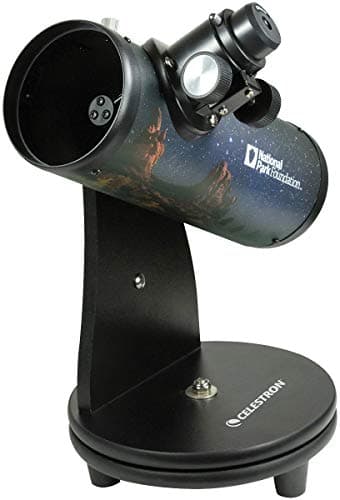 Celestron FirstScope 76Top pick76mm on a tiny Dobsonian base. The cheapest thing on this site that is a telescope rather than a toy shaped like one. | A real telescope under a hundred dollars | 76mm (2.99 in)152x useful |
Top pick · A real telescope under a hundred dollars
Celestron FirstScope 76
76mm on a tiny Dobsonian base. The cheapest thing on this site that is a telescope rather than a toy shaped like one.
What the aperture allows
- Maximum useful magnification
- 152x
- 2 × 76mm of aperture
- Resolving limit (Dawes)
- 1.53 arcseconds
- 116 ÷ 76mm
- Cassini division (0.7″)
- Out of reach
- this aperture cannot resolve it
Celestron publishes 180x as this telescope’s highest useful magnification. Our figure is 152x, from two times the aperture in millimeters. The gap of 28x comes from the slightly more generous per-inch constant makers use. Neither number describes a typical night: the atmosphere usually settles the question well below both.
Worked example: a 25mm eyepiece in this telescope gives 300mm ÷ 25mm = 12x.
76mm is small, and this page is not going to pretend otherwise. What it is not is a toy: the mirror is real, the mount is a proper Dobsonian, and it will show the Moon's craters and Jupiter's moons.
Two times 76mm gives 152x of useful magnification. Celestron publishes 180x. Either figure demolishes the 525x printed on the box of the department-store scope sitting beside it at the same price.
The f/3.95 focal ratio is very fast, which is hard on a spherical mirror and hard on cheap eyepieces. Expect softness at the edge of the field and do not expect much above about 60x to 75x in practice.
The right way to think about it: this is a lot better than nothing, it is enormously better than a 60mm toy scope on a plastic tripod, and it is meaningfully worse than the 130mm tabletop Dobsonian that costs roughly three times as much.
What it does well
- A genuine telescope at a price where most of the shelf is not
- Nothing to assemble, nothing to align, nothing to charge
- Small enough that a child can carry and aim it without help
What it costs you
- A fast spherical mirror at f/3.95 is soft away from the field center
- The bundled eyepieces are the cheapest part of a cheap package
- Very small; it needs a table and it is easy to knock over
Skip this one if: Skip it if the budget can stretch to a 130mm tabletop. The aperture difference is 2.9 times the light, and it is obvious at the eyepiece.
#ad · how this is funded · price as of September 13, 2026
What the Dobsonian base gets right
The single best thing about this telescope is what it does not have: a tripod. A wobbly tripod is the most common reason a cheap telescope is abandoned, and a Dobsonian base has nothing to wobble. You push the tube where you want to look and it stays there.
The cost is furniture. Like every tabletop Dobsonian it needs a stable surface at roughly chest height when you are seated — on the ground it points at treetops. The tabletop page covers the condition in full, and it is worth checking before you buy rather than after.
Against the two things people weigh it against
| FirstScope 76 | SkyMaster 15x70 | Heritage 130 | |
|---|---|---|---|
| Aperture | 76mm | 70mm (x2) | 130mm |
| Design | Newtonian, spherical, f/3.95 | Porro binocular | Newtonian, parabolic, f/5 |
| Max useful magnification | 152x | Fixed at 15x | 260x |
| Resolving limit | 1.53 arcsec | 1.66 arcsec | 0.89 arcsec |
| Saturn's rings separate | Yes, small | No | Yes, clearly |
| Needs a surface | Yes | A tripod, ideally | Yes |
| Sharp at high power | No | Not applicable | Yes |
The comparison that matters most is the middle column. A pair of 70mm binoculars costs about the same, collects a comparable amount of light through two objectives, and is far easier to use — but it will never show Saturn's rings, and this telescope will. That is the whole decision in one sentence.
Who should buy it, and who should not
Buy it if the budget is genuinely fixed at the bottom of the market and you want a telescope rather than binoculars, or as a child's own first instrument where being light, low and unbreakable-looking matters more than optical ceiling. Telescopes for kids covers that case properly.
Do not buy it expecting it to grow with you. It will not sharpen up at high power and there is no upgrade path inside the telescope. If the budget can stretch to a 130mm tabletop, that is nearly three times the light and a parabolic mirror, and it is the step this site recommends saving for.
Questions people actually ask
Is the Celestron FirstScope 76 any good?
It is a genuine telescope rather than a toy: 76mm of aperture on a Dobsonian base with nothing to wobble. Its limits are real too — a spherical mirror at f/3.95 means it is soft well below the 152x its aperture would otherwise support, so use it between about 15x and 40x.
What can you see with a FirstScope 76?
Lunar craters in good detail, Jupiter's four bright moons, Saturn's rings as a small separated ring on a steady night, bright open clusters, and the Orion Nebula as a gray shape. Faint galaxies are out of reach at 118 times the light-gathering of the eye.
Why is the FirstScope blurry at high magnification?
Because Celestron publishes a spherical primary mirror at f/3.95. A spherical mirror does not focus all its light to one point and the error grows as the focal ratio falls, so at this very fast ratio the image will not tighten up however carefully you focus. It is the design, not a fault.
FirstScope 76 or binoculars?
Binoculars are easier to use and just as bright, but they will never separate Saturn's rings. The FirstScope will. If seeing a planet as a planet is the ambition, take the telescope; if sweeping the sky comfortably is, take the binoculars.
Does the FirstScope need a table?
Yes. It is a tabletop Dobsonian, so it needs a stable surface at roughly seated chest height. On the ground it points at treetops, which is the most common regret with the design and entirely avoidable.
Read next
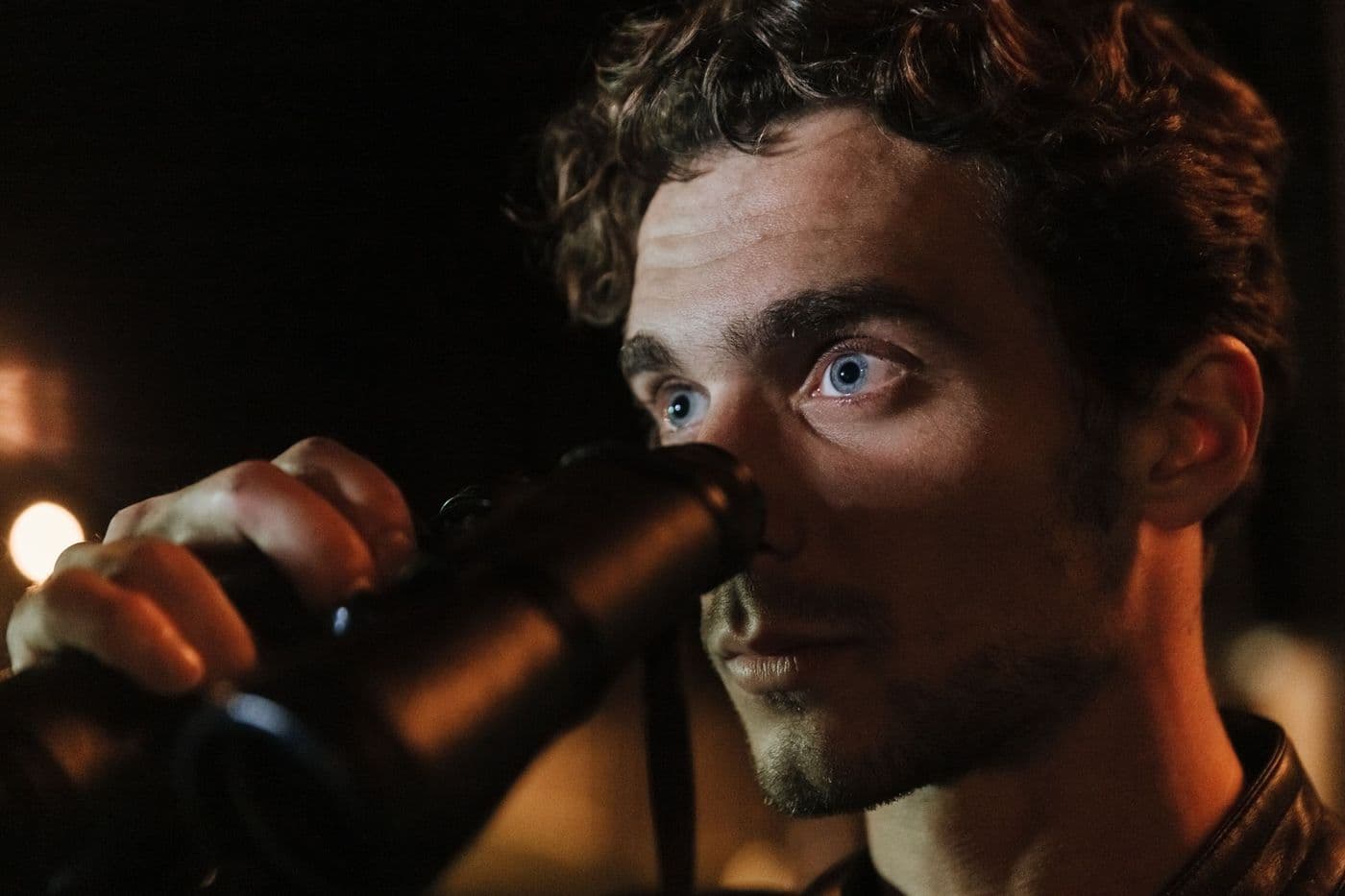
Celestron SkyMaster 15x70 Binoculars
70mm objectives at 15x, both eyes, with published limiting magnitudes for three sky qualities. The honest first instrument.
Top pick: Celestron SkyMaster 15x70 Binoculars
#ad · how this is funded · price as of September 13, 2026
Best tabletop
Tabletop Telescopes, and the One Thing to Check First
The best value design in beginner astronomy, and the surface requirement that decides whether it works for you.
Top pick: Sky-Watcher Heritage 130 Tabletop Dobsonian
#ad · how this is funded · price as of September 13, 2026

Is a Cheap Telescope Worth It?
The threshold below which a cheap telescope stops being worth owning, and the honest alternative when a budget cannot clear it.
Top pick: Celestron FirstScope 76
#ad · how this is funded · price as of September 13, 2026
Found something wrong here? Tell us and we will correct it and date the correction, per our editorial policy.