Telescopes by Budget
The Best Telescopes Under $300
This is the bracket where the decision stops being about how much telescope you can afford and starts being about what kind of help you want.
By Scooter M. · Published · How we pick
Under $300 there are two right answers and they solve different problems. The Celestron StarSense Explorer LT 114AZ if finding things is what would stop the telescope being used, and a 130mm Newtonian on an equatorial mount if you want the most light this bracket can buy: the Celestron AstroMaster 130EQ, or the PowerSeeker 127EQ at 127mm. The LT 114AZ review and the AstroMaster 130EQ review set out the compromise each one makes.
The trade, with the numbers on it
light ratio = (aperture 1 / aperture 2) squared
(130 / 114)squared = 1.30, so 30 percent more light
The 130mm also drops the resolving limit from 1.02 to 0.89 arcseconds. Neither reaches the Cassini division at roughly 0.7 arcseconds. Check any pair with the aperture calculator.
Thirty percent more light is a real difference on faint objects. Against it: the StarSense app removes the most common reason a first telescope stops being used, and it does so on the very first night rather than after three frustrating ones.
There is no universally correct answer, only a correct answer for a particular buyer. StarSense against manual finding works the decision through properly.
The catch on the aperture side
Both 130mm-class options here reach that aperture at this price the same way: a spherical primary mirror on a German equatorial mount. Celestron states the spherical mirror plainly for each. On the AstroMaster 130EQ that mirror works at f/5, where a spherical figure costs sharpness at high power; on the PowerSeeker 127EQ it sits in a compressed light path that is harder to collimate. The LT 114AZ's spherical mirror works at f/9, which is why it forgives the same compromise.
The four shapes this bracket takes
| Option | Aperture | Max useful magnification | Resolving limit | Buys you |
|---|---|---|---|---|
| Tripod, phone finding | 114mm | 228x | 1.02 arcsec | Finding on the first night |
| Equatorial Newtonian | 130mm | 260x | 0.89 arcsec | The most light, and tracking by hand once aligned |
| Equatorial, compressed path | 127mm | 254x | 0.91 arcsec | Nearly as much light, with more collimation fuss |
| Small tabletop | 76mm | 152x | 1.53 arcsec | Nothing to set up at all |
How this is funded: the buy buttons below are Amazon Associates links, and a qualifying purchase earns us a commission at no extra cost to you. It cannot move the ranking, because the order here is set by aperture per dollar, and no commission rate changes how much light a mirror collects. Full disclosure.
| # | Telescope | Best for | Aperture | Price |
|---|---|---|---|---|
| 1 | 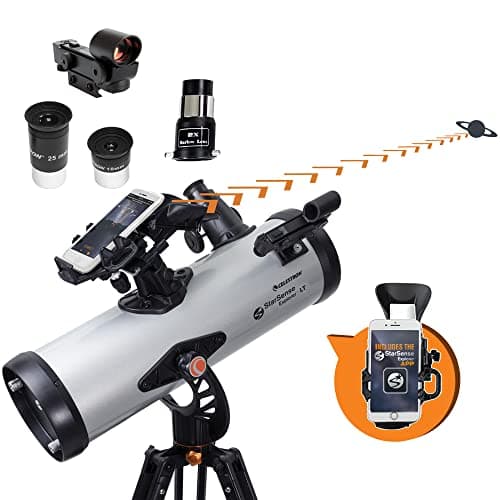 Celestron StarSense Explorer LT 114AZTop pickThe StarSense phone finder at a lower price, paid for with a spherical mirror instead of a parabolic one. | Phone finding on a budget | 114mm (4.5 in)228x useful | |
| 2 | 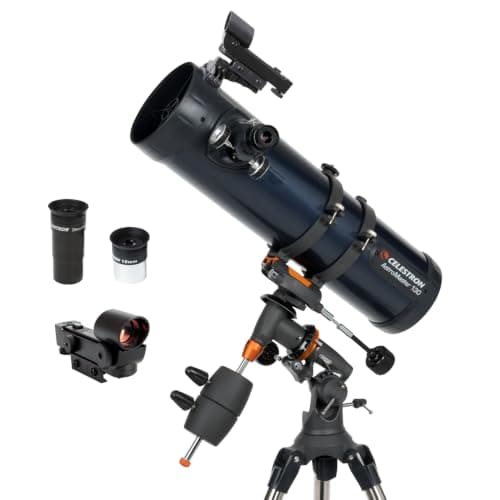 Celestron AstroMaster 130EQThe same 130mm f/5 geometry as the best telescopes on this site, with a spherical primary instead of a parabolic one, on a mount the buyer has to learn. | 130mm with the compromises stated | 130mm (5.11 in)260x useful | |
| 3 | 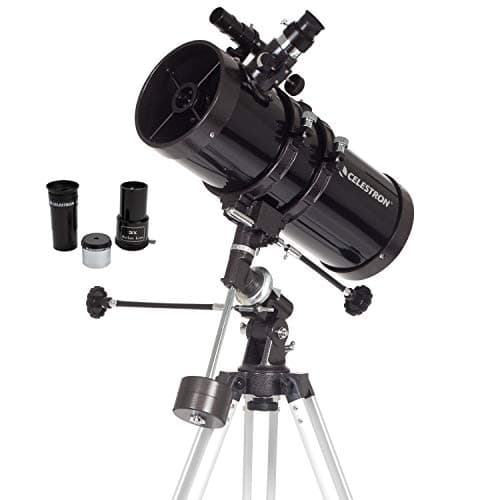 Celestron PowerSeeker 127EQ127mm of aperture, a spherical mirror, an equatorial mount a beginner has to learn, and the highest advertised magnification on the shelf. | The one to understand before you buy it | 127mm (5 in)254x useful | |
| 4 | 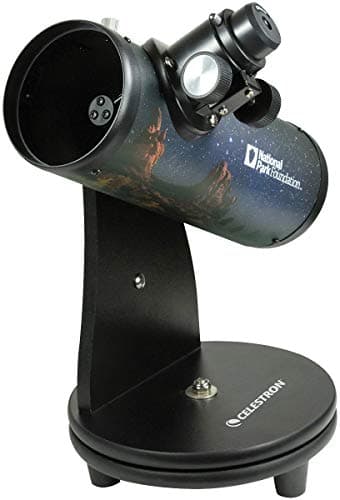 Celestron FirstScope 7676mm on a tiny Dobsonian base. The cheapest thing on this site that is a telescope rather than a toy shaped like one. | A real telescope under a hundred dollars | 76mm (2.99 in)152x useful | |
| 5 | 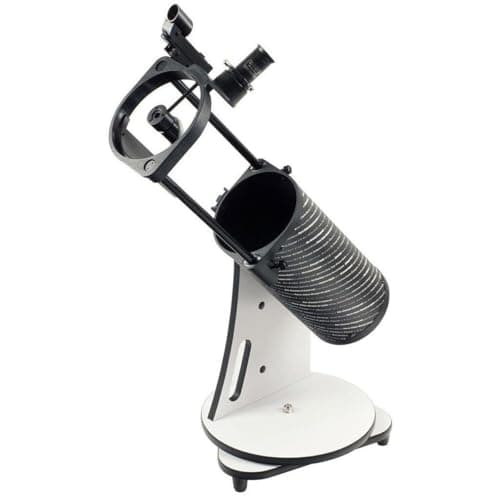 Sky-Watcher Heritage 130 Tabletop DobsonianThe same 130mm parabolic mirror as scopes costing far more, on a base with no tripod to wobble and nothing to set up. | Most aperture per dollar | 130mm260x useful |
Top pick · Phone finding on a budget
Celestron StarSense Explorer LT 114AZ
The StarSense phone finder at a lower price, paid for with a spherical mirror instead of a parabolic one.
What the aperture allows
- Maximum useful magnification
- 228x
- 2 × 114mm of aperture
- Resolving limit (Dawes)
- 1.02 arcseconds
- 116 ÷ 114mm
- Cassini division (0.7″)
- Out of reach
- this aperture cannot resolve it
Celestron publishes 269x as this telescope’s highest useful magnification. Our figure is 228x, from two times the aperture in millimeters. The gap of 41x comes from the slightly more generous per-inch constant makers use. Neither number describes a typical night: the atmosphere usually settles the question well below both.
Worked example: a 25mm eyepiece in this telescope gives 1000mm ÷ 25mm = 40x.
The StarSense phone finder is the same one on the DX 130AZ and it works just as well here. What is different is the mirror: Celestron's own optical design line says spherical rather than parabolic.
That matters at this focal ratio less than it would at f/5. A spherical mirror's error falls off sharply as the focal ratio gets longer, and at f/9 a 114mm sphere is close enough to a paraboloid that most observers will not see the difference.
Two times 114mm is 228x of useful magnification; Celestron publishes 269x. Its published Dawes limit of 1.02 arcseconds is a fraction short of the Cassini division.
The honest comparison is with the Heritage 130 tabletop, which has 30 percent more light-gathering area and a parabolic mirror but no phone finder. If finding things is the barrier, this wins. If light is the barrier, it does not.
What it does well
- The phone-based finder, which is the feature that keeps first telescopes in use
- f/9 is forgiving of both cheap eyepieces and the spherical mirror
- Light enough to carry out in one hand
What it costs you
- Spherical rather than parabolic primary, which is a real optical compromise
- A 1000mm focal length in a light tube on a light mount vibrates easily
- 114mm is a modest aperture for the price once you compare it with tabletop Dobsonians
Skip this one if: Skip it if you would happily learn to star-hop. The same money buys noticeably more aperture without the app.
$259.95 · 8% off
#ad · how this is funded · price as of October 19, 2026
Pick 2 · 130mm with the compromises stated
Celestron AstroMaster 130EQ
The same 130mm f/5 geometry as the best telescopes on this site, with a spherical primary instead of a parabolic one, on a mount the buyer has to learn.
What the aperture allows
- Maximum useful magnification
- 260x
- 2 × 130mm of aperture
- Resolving limit (Dawes)
- 0.89 arcseconds
- 116 ÷ 130mm
- Cassini division (0.7″)
- Out of reach
- this aperture cannot resolve it
Celestron publishes 307x as this telescope’s highest useful magnification. Our figure is 260x, from two times the aperture in millimeters. The gap of 47x comes from the slightly more generous per-inch constant makers use. Neither number describes a typical night: the atmosphere usually settles the question well below both.
Worked example: a 25mm eyepiece in this telescope gives 650mm ÷ 25mm = 26x.
The aperture is not the problem here and it never was. 130mm gives 260x of useful magnification at the 2x rule and a 0.89-arcsecond resolving limit, and Celestron publishes 345 times the light-gathering of the human eye for it. On paper that is the same telescope as the two 130mm scopes at the top of the beginner ranking.
The difference is one line in Celestron's own specification: the primary mirror is spherical, not parabolic. A sphere does not focus parallel light to a single point, and the size of that error grows as the focal ratio falls. At f/9 the error is small enough to ignore. This telescope is f/5.
The mount is a CG-3 German equatorial, which tracks properly once it is roughly polar aligned and makes no sense at all before that. Total kit weight is 17 lb, of which 9.3 lb is the mount and tripod, so more than half the weight is the part a beginner finds confusing.
The 20mm eyepiece has a built-in erect image corrector, which is a daytime feature: it puts the view the right way up for terrestrial use and adds glass to the light path to do it. The 10mm gives 65x, well under the 260x ceiling, so there is real headroom for a Barlow here.
What it does well
- 130mm of genuine aperture, with 345 times the light-gathering of the eye published by Celestron
- A true f/5 Newtonian rather than a compressed optical path, so collimation is the ordinary kind
- The equatorial mount tracks a star with one slow-motion control once aligned, which an alt-azimuth cannot
- Steel tripod legs and a published 17 lb kit weight make it steadier than the lightest tripod telescopes
What it costs you
- Celestron states a spherical primary, and f/5 is the focal ratio at which that matters most
- The German equatorial mount is the single most common reason a first telescope goes back in its box
- The published 307x ceiling is above the 260x that 130mm of aperture supports
- The 20mm eyepiece carries an erect image corrector that astronomy does not need
Skip this one if: Skip it if the same money would buy you a 130mm parabolic mirror on a Dobsonian base, which it usually will. You would be trading the better mirror and the simpler mount for tracking you may never use.
| Optical design | Newtonian reflector, spherical primary mirrorCelestron publishes the optical design as Newtonian Reflector, Spherical Primary Mirror.Source: AstroMaster 130EQ — manufacturer specifications (retrieved September 7, 2026) |
|---|---|
| Aperture | 130mm (5.11 in)Source: AstroMaster 130EQ — manufacturer specifications (retrieved September 7, 2026) |
| Focal length | 650mm (25.6 in)Source: AstroMaster 130EQ — manufacturer specifications (retrieved September 7, 2026) |
| Focal ratio | f/5Source: AstroMaster 130EQ — manufacturer specifications (retrieved September 7, 2026) |
| Mount | CG-3 German equatorial on 31.75mm (1.25 in) steel tripod legsSource: AstroMaster 130EQ — manufacturer specifications (retrieved September 7, 2026) |
| Eyepieces supplied | 20mm with a built-in erect image corrector, and a standard 10mmCelestron publishes the erect image corrector as part of the 20mm eyepiece. On the 650mm focal length those give 32.5x and 65x.Source: AstroMaster 130EQ — manufacturer specifications (retrieved September 7, 2026) |
| Weight | 17 lb (7.71 kg) total kit weightCelestron publishes 7.7 lb for the tube alone and 9.3 lb for the mount and tripod together.Source: AstroMaster 130EQ — manufacturer specifications (retrieved September 7, 2026) |
| Maker's maximum magnification | 307xCelestron computes per inch of aperture with a more generous constant than the 2x rule this site uses.Source: AstroMaster 130EQ — manufacturer specifications (retrieved September 7, 2026) |
| Published resolution (Dawes) | 0.89 arcsecondsSource: AstroMaster 130EQ — manufacturer specifications (retrieved September 7, 2026) |
| Published resolution (Rayleigh) | 1.07 arcsecondsSource: AstroMaster 130EQ — manufacturer specifications (retrieved September 7, 2026) |
| Light gathering vs the eye | 345xSource: AstroMaster 130EQ — manufacturer specifications (retrieved September 7, 2026) |
| Limiting stellar magnitude | 13.1Source: AstroMaster 130EQ — manufacturer specifications (retrieved September 7, 2026) |
| Coatings | Aluminum with an SiO2 overcoatSource: AstroMaster 130EQ — manufacturer specifications (retrieved September 7, 2026) |
$359.95 · 19% off
#ad · how this is funded · price as of October 19, 2026
Pick 3 · The one to understand before you buy it
Celestron PowerSeeker 127EQ
127mm of aperture, a spherical mirror, an equatorial mount a beginner has to learn, and the highest advertised magnification on the shelf.
What the aperture allows
- Maximum useful magnification
- 254x
- 2 × 127mm of aperture
- Resolving limit (Dawes)
- 0.91 arcseconds
- 116 ÷ 127mm
- Cassini division (0.7″)
- Out of reach
- this aperture cannot resolve it
Celestron publishes 300x as this telescope’s highest useful magnification. Our figure is 254x, from two times the aperture in millimeters. The gap of 46x comes from the slightly more generous per-inch constant makers use. Neither number describes a typical night: the atmosphere usually settles the question well below both.
Worked example: a 25mm eyepiece in this telescope gives 1000mm ÷ 25mm = 40x.
This telescope is on the site because it is one of the best-selling beginner scopes there is, and because buying it without understanding it is how a lot of people end up disappointed.
Start with the arithmetic. 127mm of aperture gives 254x of useful magnification at the 2x rule; Celestron publishes 300x. Retail listings for this model have long advertised figures far above both. The optics do not change because a shorter eyepiece is fitted.
The design detail that matters: Celestron's own optical design line says spherical primary mirror, and the tube is far shorter than a 1000mm focal length would normally require. That combination is achieved with a corrector lens in the focuser tube, and the arrangement is much more sensitive to collimation than a straightforward Newtonian.
The mount is a German equatorial, which is the right tool for tracking but is genuinely confusing on night one. It has to be roughly polar aligned before its motions make sense, and a gift recipient who has never seen one will usually assume it is broken.
What it does well
- 127mm is real aperture and it does collect 329 times the light of the eye, per Celestron's own figure
- The equatorial mount tracks properly once you understand it, which an alt-azimuth cannot
- Widely available and well supported
What it costs you
- A spherical primary in a compressed optical path is harder to collimate and less forgiving than a plain Newtonian
- The equatorial mount is the single most common reason a first telescope goes back in the box
- Retail listings for this model routinely advertise magnification figures the optics cannot deliver
Skip this one if: Skip it if it is a gift for somebody who has never used a telescope. The same aperture on a Dobsonian base needs no explanation at all.
$229.95 · 13% off
#ad · how this is funded · price as of October 19, 2026
Pick 4 · A real telescope under a hundred dollars
Celestron FirstScope 76
76mm on a tiny Dobsonian base. The cheapest thing on this site that is a telescope rather than a toy shaped like one.
What the aperture allows
- Maximum useful magnification
- 152x
- 2 × 76mm of aperture
- Resolving limit (Dawes)
- 1.53 arcseconds
- 116 ÷ 76mm
- Cassini division (0.7″)
- Out of reach
- this aperture cannot resolve it
Celestron publishes 180x as this telescope’s highest useful magnification. Our figure is 152x, from two times the aperture in millimeters. The gap of 28x comes from the slightly more generous per-inch constant makers use. Neither number describes a typical night: the atmosphere usually settles the question well below both.
Worked example: a 25mm eyepiece in this telescope gives 300mm ÷ 25mm = 12x.
76mm is small, and this page is not going to pretend otherwise. What it is not is a toy: the mirror is real, the mount is a proper Dobsonian, and it will show the Moon's craters and Jupiter's moons.
Two times 76mm gives 152x of useful magnification. Celestron publishes 180x. Either figure demolishes the 525x printed on the box of the department-store scope sitting beside it at the same price.
The f/3.95 focal ratio is very fast, which is hard on a spherical mirror and hard on cheap eyepieces. Expect softness at the edge of the field and do not expect much above about 60x to 75x in practice.
The right way to think about it: this is a lot better than nothing, it is enormously better than a 60mm toy scope on a plastic tripod, and it is meaningfully worse than the 130mm tabletop Dobsonian that costs roughly three times as much.
What it does well
- A genuine telescope at a price where most of the shelf is not
- Nothing to assemble, nothing to align, nothing to charge
- Small enough that a child can carry and aim it without help
What it costs you
- A fast spherical mirror at f/3.95 is soft away from the field center
- The bundled eyepieces are the cheapest part of a cheap package
- Very small; it needs a table and it is easy to knock over
Skip this one if: Skip it if the budget can stretch to a 130mm tabletop. The aperture difference is 2.9 times the light, and it is obvious at the eyepiece.
#ad · how this is funded · price as of October 19, 2026
Pick 5 · Most aperture per dollar
Sky-Watcher Heritage 130 Tabletop Dobsonian
The same 130mm parabolic mirror as scopes costing far more, on a base with no tripod to wobble and nothing to set up.
What the aperture allows
- Maximum useful magnification
- 260x
- 2 × 130mm of aperture
- Resolving limit (Dawes)
- 0.89 arcseconds
- 116 ÷ 130mm
- Cassini division (0.7″)
- Out of reach
- this aperture cannot resolve it
Worked example: a 25mm eyepiece in this telescope gives 650mm ÷ 25mm = 26x.
This is the aperture-per-dollar champion of the beginner shelf and it is not close. You get the same 130mm parabolic mirror found in telescopes at twice the price, and you get it without paying for a tripod, a slow-motion assembly or a hand controller.
Two times 130mm is 260x of useful magnification. Dawes' limit at 130mm works out to 116 divided by 130, which is 0.89 arcseconds. The Cassini division in Saturn's rings spans roughly 0.7 arcseconds at its widest, so this telescope sits right at the edge of showing it on a still night and will show the rings themselves easily.
The catch is the word tabletop. It needs a surface at roughly chest height when you are seated. A garden table works, a plastic patio chair does not, and buying one without thinking about where it will stand is the single most common regret with this design.
The tube collapses, which is what makes it live in a cupboard rather than a garage. That matters more than it sounds: the telescope you can carry outside in one trip is the telescope you use.
What it does well
- The most aperture you can buy at this price, by a clear margin
- Nothing to assemble, no tripod to wobble, ready in the time it takes to carry it outside
- Collapsible tube stores in a cupboard and keeps its collimation
- The Dobsonian motion is intuitive: you push the tube where you want to look
What it costs you
- Needs a solid table or stool at the right height, which is a real constraint
- The helical focuser is coarser than a rack-and-pinion or a Crayford
- Open tube design collects dust and needs the odd mirror clean
Skip this one if: Skip it if you have nowhere to stand it. On the ground it points at treetops, and on a wobbly plastic table every view shakes.
$305.00 · 12% off
#ad · how this is funded · price as of October 19, 2026
What this bracket does not buy
It does not buy motorized tracking. The equatorial mounts here let you follow an object with a single slow-motion control once they are roughly polar aligned, but nothing moves the telescope for you, and on the phone-guided and tabletop options an object at 150x drifts out of the field in well under a minute. That is normal, and it stops being annoying within about two sessions.
It also does not buy astrophotography. Long exposures need a motorized tracking mount, and a tracking mount at this price would cost you most of the aperture. GoTo versus manual explains the trade in full.
Questions people actually ask
What is the best telescope under $300?
The Celestron StarSense Explorer LT 114AZ for most first-time buyers, because its phone-based finder removes the most common reason first telescopes go unused, and at f/9 its spherical mirror is forgiving. If you would rather have the light, a 130mm equatorial Newtonian such as the AstroMaster 130EQ collects 30 percent more, with a mount to learn.
Is 130mm noticeably better than 114mm?
On faint objects, yes: 30 percent more light and a resolving limit that drops from 1.02 to 0.89 arcseconds. On the Moon and bright planets the difference is much smaller, and at this price the 130mm option comes with an equatorial mount and a spherical mirror at f/5.
Can I get a GoTo telescope for under $300?
Sometimes, but it will have a much smaller aperture than a manual telescope at the same price, because the motors and electronics have to be paid for out of the same money. A phone-guided manual telescope is usually the better trade.
Is this bracket enough for a lifetime telescope?
For some people, but this is the bracket where the compromises are most visible. A 150mm telescope is where most people stop wanting more, and that is the next bracket.
Read next

StarSense Phone Finding vs Finding Things Yourself
Phone-guided finding against learning to star-hop: what each costs in aperture, and which suits which buyer.
Top pick: Celestron StarSense Explorer DX 130AZ
#ad · how this is funded · price as of October 19, 2026
Best under $500
The Best Telescopes Under $500
The bracket where 150mm arrives, resolving 0.77 arcseconds and bringing the Cassini division into reach on a steady night.
Top pick: Sky-Watcher Heritage 150 Tabletop Dobsonian
$355.00 · 13% off
#ad · how this is funded · price as of October 19, 2026

Telescope Aperture: What It Is and What It Buys
What aperture is, what each size can resolve, and a calculator that runs the numbers on your own telescope.
Top pick: Sky-Watcher Heritage 130 Tabletop Dobsonian
$305.00 · 12% off
#ad · how this is funded · price as of October 19, 2026
Found something wrong here? Tell us and we will correct it and date the correction, per our editorial policy.