Reviews
Celestron AstroMaster 130EQ
A telescope whose two real compromises are both printed in its own specification sheet, and neither of them is the aperture. Here is what each one costs you.
By Scooter M. · Published · How we pick
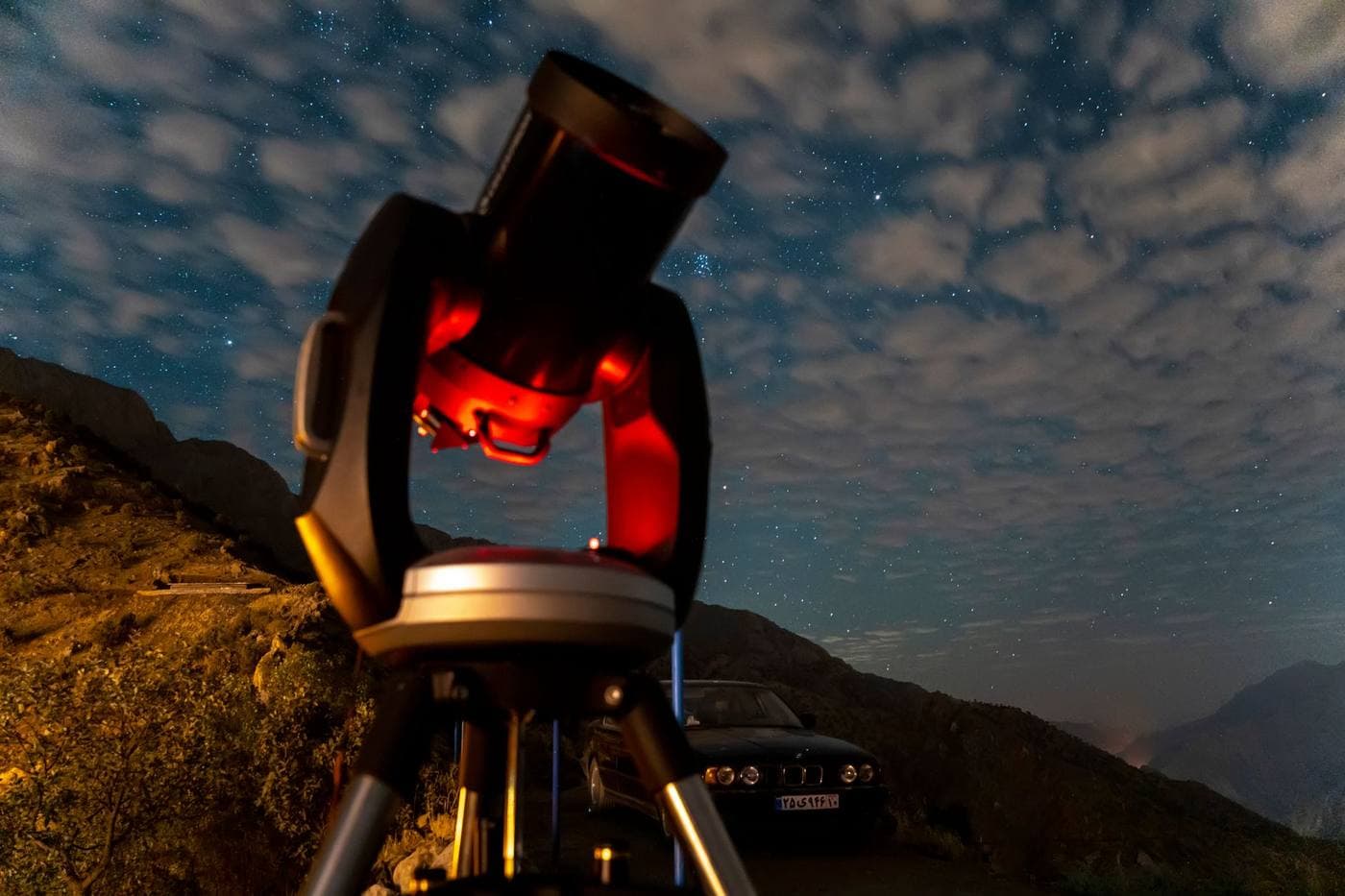
The AstroMaster 130EQ is one of the telescopes people arrive at after deciding that 130mm is the aperture they want. That instinct is right, and this telescope really does have 130mm. The question worth answering is what else comes with it, and Celestron answers most of that question itself, in print, on its own specification page.
The arithmetic first
max useful magnification = 2 x aperture. Dawes limit = 116 / aperture.
130 x 2 = 260x. 116 / 130 = 0.89 arcseconds.
Celestron publishes 307x and .89 arcseconds. The resolution figures agree exactly; the magnification figures differ because makers compute per inch with a more generous constant. 307x is about 18 percent above what the aperture supports.
Those numbers are good ones. A 0.89-arcsecond resolving limit sits right at the edge of the Cassini division, which spans roughly 0.7 arcseconds at its widest, so on a genuinely steady night this telescope is in the hunt for it. Celestron publishes 345 times the light-gathering of the human eye and a limiting stellar magnitude of 13.1, which is deep enough for the brighter Messier objects from a reasonable sky.
None of that is in dispute, and none of it is where this telescope loses. Aperture explains why those two numbers are the only ones that matter, and the magnification myth explains why the 307x is not the headline it looks like.
The line in the specification that decides this telescope
Celestron publishes the optical design as Newtonian Reflector, Spherical Primary Mirror. Not parabolic. The maker states it plainly rather than burying it, which is to its credit, and it is the single most consequential line on the page.
A parabolic mirror brings parallel light to one focus. A sphere does not: rays striking further out on the mirror cross the axis at a slightly different place, and the image never fully tightens to a point. How much that costs depends almost entirely on the focal ratio, because a shallower curve at a longer focal ratio sits closer to a paraboloid.
What this looks like at the eyepiece is softness at higher magnifications that no amount of focusing removes, on a telescope that is otherwise correctly built. It is not a defect and there is nothing to send back. It is the design, stated on the box.
What the eyepieces in the box actually give you
magnification = telescope focal length / eyepiece focal length
650 / 20 = 32.5x. 650 / 10 = 65x.
Exit pupil is aperture divided by magnification: 130 / 32.5 = 4mm, and 130 / 65 = 2mm. Both are comfortable. Neither is anywhere near the 260x ceiling, so there is genuine headroom above what the box contains.
Celestron publishes something unusual about the 20mm: it has a built-in erect image corrector. That is a daytime feature. It turns the view the right way up for looking at birds and boats, and it does so by adding glass to the light path, which astronomy neither needs nor benefits from. Using a telescope in daylight covers what that is for.
The practical consequence is that the most useful upgrade here is not a shorter eyepiece but a plain one. A 2x Barlow on the 10mm reaches 130x, still half the computed ceiling, and the Barlow arithmetic shows why that is the right place to spend first.
The mount is the part people underestimate
This is a CG-3 German equatorial mount on steel tripod legs. Celestron publishes 17 lb for the complete kit, of which 7.7 lb is the tube and 9.3 lb is the mount and tripod together. More than half the weight of this telescope is the part beginners find confusing.
An equatorial mount has two axes, one of which has to be tilted to point at the celestial pole. Until that is done its motions bear no relation to up, down, left and right, and somebody who has never seen one will reasonably conclude it is broken. Once it is aligned, a single slow-motion control follows a star across the sky, which no alt-azimuth mount can do.
That payoff is real and it arrives after the learning curve rather than before it. The mounts guide explains what an equatorial is doing, and what to avoid covers why it is the wrong mount to give somebody as a present.
How this is funded: the buy buttons below are Amazon Associates links, and a qualifying purchase earns us a commission at no extra cost to you. It cannot move the ranking, because the order here is set by aperture per dollar, and no commission rate changes how much light a mirror collects. Full disclosure.
| # | Telescope | Best for | Aperture | Price |
|---|---|---|---|---|
| 1 | 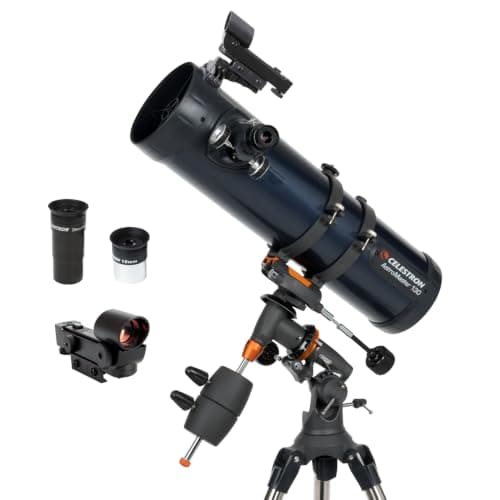 Celestron AstroMaster 130EQTop pickThe same 130mm f/5 geometry as the best telescopes on this site, with a spherical primary instead of a parabolic one, on a mount the buyer has to learn. | 130mm with the compromises stated | 130mm (5.11 in)260x useful |
Top pick · 130mm with the compromises stated
Celestron AstroMaster 130EQ
The same 130mm f/5 geometry as the best telescopes on this site, with a spherical primary instead of a parabolic one, on a mount the buyer has to learn.
What the aperture allows
- Maximum useful magnification
- 260x
- 2 × 130mm of aperture
- Resolving limit (Dawes)
- 0.89 arcseconds
- 116 ÷ 130mm
- Cassini division (0.7″)
- Out of reach
- this aperture cannot resolve it
Celestron publishes 307x as this telescope’s highest useful magnification. Our figure is 260x, from two times the aperture in millimeters. The gap of 47x comes from the slightly more generous per-inch constant makers use. Neither number describes a typical night: the atmosphere usually settles the question well below both.
Worked example: a 25mm eyepiece in this telescope gives 650mm ÷ 25mm = 26x.
The aperture is not the problem here and it never was. 130mm gives 260x of useful magnification at the 2x rule and a 0.89-arcsecond resolving limit, and Celestron publishes 345 times the light-gathering of the human eye for it. On paper that is the same telescope as the two 130mm scopes at the top of the beginner ranking.
The difference is one line in Celestron's own specification: the primary mirror is spherical, not parabolic. A sphere does not focus parallel light to a single point, and the size of that error grows as the focal ratio falls. At f/9 the error is small enough to ignore. This telescope is f/5.
The mount is a CG-3 German equatorial, which tracks properly once it is roughly polar aligned and makes no sense at all before that. Total kit weight is 17 lb, of which 9.3 lb is the mount and tripod, so more than half the weight is the part a beginner finds confusing.
The 20mm eyepiece has a built-in erect image corrector, which is a daytime feature: it puts the view the right way up for terrestrial use and adds glass to the light path to do it. The 10mm gives 65x, well under the 260x ceiling, so there is real headroom for a Barlow here.
What it does well
- 130mm of genuine aperture, with 345 times the light-gathering of the eye published by Celestron
- A true f/5 Newtonian rather than a compressed optical path, so collimation is the ordinary kind
- The equatorial mount tracks a star with one slow-motion control once aligned, which an alt-azimuth cannot
- Steel tripod legs and a published 17 lb kit weight make it steadier than the lightest tripod telescopes
What it costs you
- Celestron states a spherical primary, and f/5 is the focal ratio at which that matters most
- The German equatorial mount is the single most common reason a first telescope goes back in its box
- The published 307x ceiling is above the 260x that 130mm of aperture supports
- The 20mm eyepiece carries an erect image corrector that astronomy does not need
Skip this one if: Skip it if the same money would buy you a 130mm parabolic mirror on a Dobsonian base, which it usually will. You would be trading the better mirror and the simpler mount for tracking you may never use.
| Optical design | Newtonian reflector, spherical primary mirrorCelestron publishes the optical design as Newtonian Reflector, Spherical Primary Mirror.Source: AstroMaster 130EQ — manufacturer specifications (retrieved September 7, 2026) |
|---|---|
| Aperture | 130mm (5.11 in)Source: AstroMaster 130EQ — manufacturer specifications (retrieved September 7, 2026) |
| Focal length | 650mm (25.6 in)Source: AstroMaster 130EQ — manufacturer specifications (retrieved September 7, 2026) |
| Focal ratio | f/5Source: AstroMaster 130EQ — manufacturer specifications (retrieved September 7, 2026) |
| Mount | CG-3 German equatorial on 31.75mm (1.25 in) steel tripod legsSource: AstroMaster 130EQ — manufacturer specifications (retrieved September 7, 2026) |
| Eyepieces supplied | 20mm with a built-in erect image corrector, and a standard 10mmCelestron publishes the erect image corrector as part of the 20mm eyepiece. On the 650mm focal length those give 32.5x and 65x.Source: AstroMaster 130EQ — manufacturer specifications (retrieved September 7, 2026) |
| Weight | 17 lb (7.71 kg) total kit weightCelestron publishes 7.7 lb for the tube alone and 9.3 lb for the mount and tripod together.Source: AstroMaster 130EQ — manufacturer specifications (retrieved September 7, 2026) |
| Maker's maximum magnification | 307xCelestron computes per inch of aperture with a more generous constant than the 2x rule this site uses.Source: AstroMaster 130EQ — manufacturer specifications (retrieved September 7, 2026) |
| Published resolution (Dawes) | 0.89 arcsecondsSource: AstroMaster 130EQ — manufacturer specifications (retrieved September 7, 2026) |
| Published resolution (Rayleigh) | 1.07 arcsecondsSource: AstroMaster 130EQ — manufacturer specifications (retrieved September 7, 2026) |
| Light gathering vs the eye | 345xSource: AstroMaster 130EQ — manufacturer specifications (retrieved September 7, 2026) |
| Limiting stellar magnitude | 13.1Source: AstroMaster 130EQ — manufacturer specifications (retrieved September 7, 2026) |
| Coatings | Aluminum with an SiO2 overcoatSource: AstroMaster 130EQ — manufacturer specifications (retrieved September 7, 2026) |
$359.95 · 19% off
#ad · how this is funded · price as of October 23, 2026
Against the telescopes buyers actually weigh it against
| AstroMaster 130EQ | Sky-Watcher Heritage 130 | PowerSeeker 127EQ | |
|---|---|---|---|
| Aperture | 130mm | 130mm | 127mm |
| Primary mirror | Spherical | Parabolic | Spherical |
| Focal ratio | f/5 | f/5 | f/7.87 |
| Optical path | Plain Newtonian | Plain Newtonian | Corrector in the focuser |
| Max useful magnification | 260x | 260x | 254x |
| Resolving limit | 0.89 arcsec | 0.89 arcsec | 0.91 arcsec |
| Mount | German equatorial | Tabletop Dobsonian | German equatorial |
| Published kit weight | 17 lb | Not published | 13 lb |
| Night one | Polar alignment first | Carry it out and look | Polar alignment first |
Read left to right, the middle column is the awkward one. The Heritage 130 is the same aperture and the same focal ratio with a parabolic mirror, no tripod to wobble and nothing to align, and it usually costs less. That comparison is difficult for the AstroMaster to win on anything except the ability to track.
Read right to left, though, the AstroMaster is clearly the better of the two equatorial telescopes. The PowerSeeker 127EQ folds its 1000mm focal length into a short tube with a corrector lens in the focuser, and that arrangement is far less forgiving of imperfect collimation. The AstroMaster is a plain f/5 Newtonian, so a collimation check is the ordinary kind rather than a specialist one.
Who should buy it, and who should not
Buy it if you specifically want an equatorial mount, you already know why you want one, and you would rather have 130mm on a tracking mount than 130mm on a base that does not track. On those terms the compromises are ones you are choosing deliberately, and the coatings, the steel tripod and the true f/5 optical path are all sound.
Do not buy it as a first telescope for somebody else. The mount needs explaining before it makes sense, the mirror is the compromised one of the three 130mm options this site covers, and the same money on a Dobsonian base buys a better mirror with nothing to set up. The beginner ranking puts the alternatives in order.
The telescope most often weighed against this one is the PowerSeeker 127EQ. The two compared shows where they genuinely differ, which is not the aperture.
Questions people actually ask
Is the Celestron AstroMaster 130EQ a good telescope?
The optics are 130mm at f/5, which supports 260x and resolves to 0.89 arcseconds, and Celestron publishes 345 times the light-gathering of the eye. The two compromises are both published: the primary mirror is spherical rather than parabolic, and the mount is a German equatorial that has to be polar aligned before it makes sense.
Does the AstroMaster 130EQ have a parabolic mirror?
No. Celestron's own optical design line reads Newtonian Reflector, Spherical Primary Mirror. That matters more here than on some other telescopes because the focal ratio is f/5, and the error a spherical mirror introduces grows as the focal ratio falls.
Can the AstroMaster 130EQ really reach 307x?
307x is Celestron's own published ceiling; two times the 130mm aperture gives 260x. Both are theoretical anyway, because atmospheric seeing usually limits a telescope this size to well under 200x on an average night. The supplied eyepieces give 32.5x and 65x.
Is the AstroMaster 130EQ or the PowerSeeker 127EQ better?
The AstroMaster, on the optics. It has 3mm more aperture and, more importantly, a plain f/5 light path, where the PowerSeeker uses a corrector lens in the focuser to compress a 1000mm focal length into a short tube, which makes collimation less forgiving. Both share the same equatorial mount barrier.
Is the AstroMaster 130EQ good for a beginner?
It is a difficult first telescope, not because of the aperture but because of the mount. A German equatorial has to be roughly polar aligned before its two axes make sense, and a first-time owner usually assumes it is faulty until somebody explains it. The same aperture on a Dobsonian base needs no explanation at all.
Why does the 20mm eyepiece have an erect image corrector?
Because Celestron sells this telescope for daytime use as well. An erect image corrector puts the view the right way up, which matters for terrestrial viewing and not at all for astronomy, and it adds glass to the light path to do it.
Read next
Celestron PowerSeeker 127EQ
A best-seller worth understanding before you buy: a spherical mirror in a compressed path, on a mount beginners find baffling.
Top pick: Celestron PowerSeeker 127EQ
$229.95 · 13% off
#ad · how this is funded · price as of October 23, 2026
Telescope Mounts, and Why They Decide Everything
The four mount types compared, why the mount matters as much as the optics, and whether they are interchangeable.
Top pick: Celestron AstroMaster 102AZ
$359.95 · 11% off
#ad · how this is funded · price as of October 23, 2026

Sky-Watcher Heritage 130 Tabletop Dobsonian
The aperture-per-dollar champion: 130mm parabolic in a collapsible tube, with one condition to check first.
Top pick: Sky-Watcher Heritage 130 Tabletop Dobsonian
$305.00 · 12% off
#ad · how this is funded · price as of October 23, 2026
Found something wrong here? Tell us and we will correct it and date the correction, per our editorial policy.