Reviews
Celestron PowerSeeker 127EQ
One of the best-selling beginner telescopes there is, and one of the most commonly regretted. The reasons are in its own published specification sheet.
By Scooter M. · Published · How we pick

This telescope is on the site because it sells in enormous numbers and because buying it without understanding it is a well-worn route to disappointment. None of what follows requires an opinion about the view: it is all in Celestron's own published specification sheet.
The magnification arithmetic first
max useful magnification = 2 x aperture. Dawes limit = 116 / aperture.
127 x 2 = 254x. 116 / 127 = 0.91 arcseconds.
Celestron publishes 300x and 0.91 arcseconds. The resolution figures agree exactly. Retail listings for this model have long advertised magnification figures far above both, and the optics do not change because a shorter eyepiece is fitted.
127mm is real aperture and it does real work. Celestron publishes 329 times the light-gathering of the human eye for it, which is genuinely more than a 130mm f/5 telescope's 345 is far from. This is not a bad mirror in a small tube; the issues are elsewhere.
The optical design detail that matters
Celestron's own optical design line for this telescope says spherical primary mirror, not parabolic. That is a real distinction and the maker states it plainly.
The second detail is geometric. The published focal length is 1000mm, which at 127mm gives f/7.87, and yet the tube is far shorter than 1000mm. That compression is achieved with a corrector lens in the focuser tube, and the resulting arrangement is considerably more sensitive to correct alignment than a straightforward Newtonian is.
The mount is the bigger problem
This is a manual German equatorial mount, and it is the single most common reason a first telescope goes back in its box.
An equatorial mount has two axes tilted so that one points at the celestial pole. Until it is roughly polar aligned its motions have no relation to up, down, left or right, and a recipient who has never seen one will usually conclude it is broken. Once aligned it tracks a star with a single slow-motion control, which is genuinely useful, but that payoff arrives after the learning curve rather than before it.
The mounts guide explains what an equatorial does and why, and what to avoid covers why it is the wrong mount for a gift.
How this is funded: the buy buttons below are Amazon Associates links, and a qualifying purchase earns us a commission at no extra cost to you. It cannot move the ranking, because the order here is set by aperture per dollar, and no commission rate changes how much light a mirror collects. Full disclosure.
| # | Telescope | Best for | Aperture | Price |
|---|---|---|---|---|
| 1 | 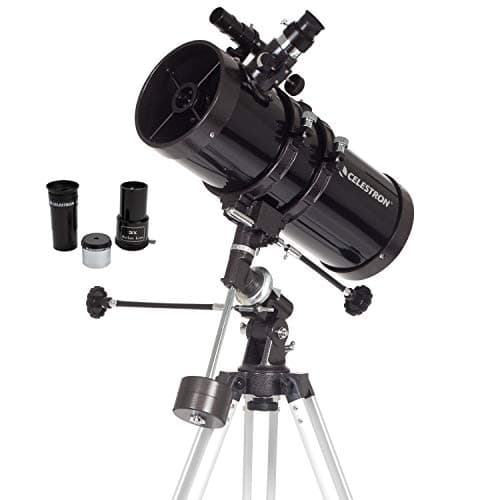 Celestron PowerSeeker 127EQTop pick127mm of aperture, a spherical mirror, an equatorial mount a beginner has to learn, and the highest advertised magnification on the shelf. | The one to understand before you buy it | 127mm (5 in)254x useful |
Top pick · The one to understand before you buy it
Celestron PowerSeeker 127EQ
127mm of aperture, a spherical mirror, an equatorial mount a beginner has to learn, and the highest advertised magnification on the shelf.
What the aperture allows
- Maximum useful magnification
- 254x
- 2 × 127mm of aperture
- Resolving limit (Dawes)
- 0.91 arcseconds
- 116 ÷ 127mm
- Cassini division (0.7″)
- Out of reach
- this aperture cannot resolve it
Celestron publishes 300x as this telescope’s highest useful magnification. Our figure is 254x, from two times the aperture in millimeters. The gap of 46x comes from the slightly more generous per-inch constant makers use. Neither number describes a typical night: the atmosphere usually settles the question well below both.
Worked example: a 25mm eyepiece in this telescope gives 1000mm ÷ 25mm = 40x.
This telescope is on the site because it is one of the best-selling beginner scopes there is, and because buying it without understanding it is how a lot of people end up disappointed.
Start with the arithmetic. 127mm of aperture gives 254x of useful magnification at the 2x rule; Celestron publishes 300x. Retail listings for this model have long advertised figures far above both. The optics do not change because a shorter eyepiece is fitted.
The design detail that matters: Celestron's own optical design line says spherical primary mirror, and the tube is far shorter than a 1000mm focal length would normally require. That combination is achieved with a corrector lens in the focuser tube, and the arrangement is much more sensitive to collimation than a straightforward Newtonian.
The mount is a German equatorial, which is the right tool for tracking but is genuinely confusing on night one. It has to be roughly polar aligned before its motions make sense, and a gift recipient who has never seen one will usually assume it is broken.
What it does well
- 127mm is real aperture and it does collect 329 times the light of the eye, per Celestron's own figure
- The equatorial mount tracks properly once you understand it, which an alt-azimuth cannot
- Widely available and well supported
What it costs you
- A spherical primary in a compressed optical path is harder to collimate and less forgiving than a plain Newtonian
- The equatorial mount is the single most common reason a first telescope goes back in the box
- Retail listings for this model routinely advertise magnification figures the optics cannot deliver
Skip this one if: Skip it if it is a gift for somebody who has never used a telescope. The same aperture on a Dobsonian base needs no explanation at all.
$229.95 · 13% off
#ad · how this is funded · price as of October 18, 2026
Who this telescope is actually for
Somebody who wants 127mm of aperture with tracking on a budget and is willing to learn a polar alignment, check collimation, and ignore whatever the retail listing says about magnification. On those terms it is a lot of aperture for the money.
Who it is not for: a gift recipient with no telescope experience. The same aperture on a Dobsonian base needs no explanation at all, has a parabolic mirror, and costs about the same. The beginner ranking has the alternatives. If the equatorial mount is the part you actually want, the AstroMaster 130EQ is the better of the two: a plain f/5 Newtonian rather than a compressed light path.
The comparison that makes the point
| PowerSeeker 127EQ | Sky-Watcher Heritage 130 | |
|---|---|---|
| Aperture | 127mm | 130mm |
| Primary mirror | Spherical (Celestron's own spec) | Parabolic |
| Max useful magnification | 254x | 260x |
| Resolving limit | 0.91 arcsec | 0.89 arcsec |
| Mount | German equatorial | Tabletop Dobsonian |
| Setup on night one | Polar alignment needed | Carry it out and look |
| Tracks a star | Yes, once aligned | No |
The usual alternative on the same shelf is the AstroMaster 130EQ. The two compared works through both on Celestron's own published figures.
Questions people actually ask
Is the Celestron PowerSeeker 127EQ any good?
It has 127mm of genuine aperture and Celestron publishes 329 times the light-gathering of the eye for it. The difficulties are a spherical primary in a compressed optical path, which makes collimation less forgiving, and an equatorial mount that beginners find baffling.
Why is the PowerSeeker 127EQ tube so short for a 1000mm focal length?
Because a corrector lens in the focuser tube extends the effective focal length. That is what allows a 1000mm focal length in a much shorter tube, and it is also what makes the design more sensitive to correct collimation.
Can the PowerSeeker 127EQ really do 300x?
300x is Celestron's own published ceiling and two times the aperture gives 254x. Both are theoretical: atmospheric seeing usually limits a telescope this size to well under 200x on a typical night. Any listing advertising far more than 300x is describing an eyepiece, not the optics.
Is the PowerSeeker 127EQ good for a gift?
Not for somebody who has never used a telescope. The equatorial mount needs polar aligning before its motions make sense, and a recipient unfamiliar with one typically assumes it is faulty. A Dobsonian at the same price needs no explanation.
Read next

What to Avoid When Buying a First Telescope
The six traps that produce a disappointing first telescope, each one checkable from the product listing before you buy.
Top pick: Sky-Watcher Heritage 130 Tabletop Dobsonian
$305.00 · 12% off
#ad · how this is funded · price as of October 18, 2026
Telescope Mounts, and Why They Decide Everything
The four mount types compared, why the mount matters as much as the optics, and whether they are interchangeable.
Top pick: Celestron AstroMaster 102AZ
$359.95 · 11% off
#ad · how this is funded · price as of October 18, 2026

The Magnification Myth: Why 525x Means Nothing
Why the magnification number on the box is meaningless, what the real ceiling is, and a calculator for your own telescope.
Top pick: Celestron Eyepiece, Barlow and Filter Kit (1.25")
$239.95 · 8% off
#ad · how this is funded · price as of October 18, 2026
Found something wrong here? Tell us and we will correct it and date the correction, per our editorial policy.