Reviews
Celestron AstroMaster 70AZ
A 70mm refractor with an unusually long 900mm tube. That one number explains both why the Moon looks clean through it and why it is harder to find things with.
By Scooter M. · Published · How we pick
70mm is the floor of what is worth owning, and the AstroMaster 70AZ sits on it. What sets it apart from every other 70mm telescope on this site is not its aperture but its focal length, and Celestron publishes everything you need to understand what that costs and what it buys. Nothing on this page requires an opinion about a view.
What 70mm allows
max useful magnification = 2 x aperture. Dawes limit = 116 / aperture.
70 x 2 = 140x. 116 / 70 = 1.66 arcseconds.
Celestron publishes 165x and 1.66 arcseconds. The resolution figures agree exactly. A box on the same shelf advertising 525x is describing an eyepiece swap, not an optical capability.
A 1.66-arcsecond resolving limit means the Cassini division, at roughly 0.7 arcseconds, is well out of reach. What is comfortably within reach: Saturn's rings as a separated ring, Jupiter's two main cloud belts and its four bright moons, the phases of Venus, and the lunar terminator. Celestron publishes 100 times the light-gathering of the human eye, which is also why galaxies and most nebulae are not on that list.
What f/13 does
focal ratio = focal length / aperture
900 / 70 = 12.9, published by Celestron as f/13
That is slow for a beginner refractor. The Celestron Travel Scope 70 has the same aperture at f/5.7; the difference is entirely in the length of the light path.
A slow focal ratio does two useful things for a simple achromatic lens. It reduces chromatic aberration, the violet fringe an achromat puts around bright objects, because a longer light path gives the colors more room to come to a common focus. And it is forgiving of basic eyepieces, which show closer to their best at f/13 than at f/5.
What it takes away is field. A long focal length magnifies more with any given eyepiece, so the widest view this telescope can show is narrower than a short tube of the same aperture. Large open clusters like the Pleiades will not fit comfortably, and finding a target with the red dot finder takes more care because the eyepiece shows so little sky around it. Refractor against reflector sets the design trade out in full.
magnification = telescope focal length / eyepiece focal length
900 / 20 = 45x. 900 / 10 = 90x.
Celestron publishes 20mm and 10mm eyepieces in the box. 90x is past the roughly 70x at which Saturn's ring separation becomes obvious, and it sits well inside the 140x ceiling. Exit pupil at 90x is 70 / 90 = 0.78mm.
One consequence worth knowing before you buy accessories: a 2x Barlow on the 10mm eyepiece gives 180x, past what 70mm supports. On this telescope a Barlow belongs on the 20mm eyepiece, where it gives 90x. The Barlow arithmetic runs that check for every telescope on this site.
The maintenance case
This is the real argument for a refractor, and it is a good one. The lens is fixed in its cell at the factory. There is no collimation, no mirror to clean, and essentially no cool-down: point it and use it. For a household that will not enjoy adjusting anything, that is worth the aperture it costs.
Celestron also publishes an erect image diagonal in the box, which puts the view the right way up. That is a daytime convenience rather than an astronomical one, and it makes the telescope usable for daytime terrestrial viewing as well. Using a telescope in daylight covers what that is good for, and the one rule about the Sun that has no exceptions.
How this is funded: the buy buttons below are Amazon Associates links, and a qualifying purchase earns us a commission at no extra cost to you. It cannot move the ranking, because the order here is set by aperture per dollar, and no commission rate changes how much light a mirror collects. Full disclosure.
| # | Telescope | Best for | Aperture | Price |
|---|---|---|---|---|
| 1 | 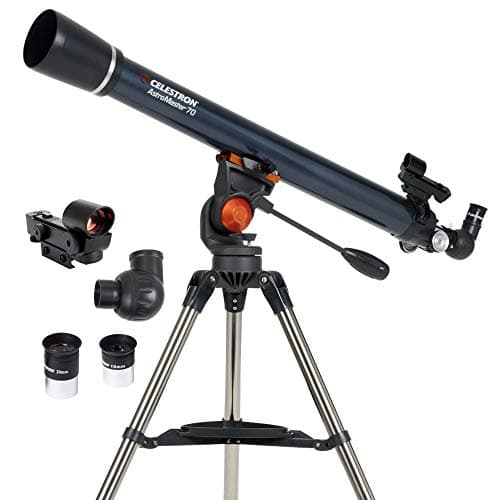 Celestron AstroMaster 70AZTop pick70mm of refractor optics at f/13, on a steel tripod. A long, slow tube that trades field of view and weight for cleaner views of the Moon and planets. | The smallest scope worth owning | 70mm (2.76 in)140x useful |
Top pick · The smallest scope worth owning
Celestron AstroMaster 70AZ
70mm of refractor optics at f/13, on a steel tripod. A long, slow tube that trades field of view and weight for cleaner views of the Moon and planets.
What the aperture allows
- Maximum useful magnification
- 140x
- 2 × 70mm of aperture
- Resolving limit (Dawes)
- 1.66 arcseconds
- 116 ÷ 70mm
- Cassini division (0.7″)
- Out of reach
- this aperture cannot resolve it
Celestron publishes 165x as this telescope’s highest useful magnification. Our figure is 140x, from two times the aperture in millimeters. The gap of 25x comes from the slightly more generous per-inch constant makers use. Neither number describes a typical night: the atmosphere usually settles the question well below both.
Worked example: a 25mm eyepiece in this telescope gives 900mm ÷ 25mm = 36x.
70mm is the floor. Below it a telescope struggles to beat a decent pair of binoculars, and that is a real comparison rather than a rhetorical one. Two times 70mm gives 140x of useful magnification; Celestron publishes 165x.
The defining number is the focal length. Celestron publishes 900mm, which at 70mm is f/13, an unusually slow ratio for a beginner refractor. A slow achromat brings the colors closer to a common focus, so the violet fringe on the Moon and on Jupiter is smaller than on a faster tube of the same aperture.
The same slow ratio narrows the field. At 45x with the supplied 20mm eyepiece, large star clusters that fit comfortably in a short refractor will not fit here, and finding things takes a steadier hand on the red dot finder.
It is also a large, heavy package for 70mm of aperture: a 685mm tube and a published 10.8 lb kit. That buys a steadier steel tripod than the lightest travel telescopes carry, and it costs portability.
What it does well
- Sealed tube: no collimation, no mirror cleaning, essentially no maintenance
- At f/13, less false color on the Moon and bright planets than a faster 70mm tube
- A steel tripod that is steadier than the lightweight tripods on travel telescopes
- The supplied eyepieces give 45x and 90x, a useful planetary range with no extra purchase
What it costs you
- 70mm collects too little light for galaxies and most nebulae
- The f/13 focal ratio narrows the field, so large clusters and finding things are harder
- A published 10.8 lb and a 685mm tube is a lot to carry for 70mm of aperture
- Chromatic aberration is reduced at f/13, not eliminated
Skip this one if: Skip it if what you actually want is deep sky, or a telescope you can carry easily. No eyepiece will make 70mm show you a spiral arm, and a travel refractor does the carrying better.
$199.95 · 10% off
#ad · how this is funded · price as of September 17, 2026
Against the two 70mm telescopes it is compared with
| AstroMaster 70AZ | AstroMaster LT 70AZ | Travel Scope 70 | |
|---|---|---|---|
| Aperture | 70mm | 70mm | 70mm |
| Focal length | 900mm | 700mm | 400mm |
| Focal ratio | f/13 | f/10 | f/5.7 |
| Max useful magnification | 140x | 140x | 140x |
| Resolving limit | 1.66 arcsec | 1.66 arcsec | 1.66 arcsec |
| False color on bright objects | Least | More | Most |
| Widest field | Narrowest | Wider | Widest |
| Total kit weight | 10.8 lb | 7.2 lb | 3.3 lb |
| Available to buy | Yes | No | Yes |
All three see exactly the same amount of sky detail, because they share an aperture. What changes along the row is a single trade: a longer tube gives cleaner views of bright targets and a narrower field, and it gets heavier. The Travel Scope 70 is the opposite end of that line, built to go in a backpack.
Who should buy it, and who should not
Buy it if the Moon and the bright planets are what you want to look at, if nobody in the house will maintain a mirror, and if the telescope will be carried a short distance to the garden rather than taken anywhere. On those terms the slow optics and the steel tripod are genuine advantages.
Do not buy it for deep sky, which 70mm cannot deliver, or for travel, where a 685mm tube and a 10.8 lb kit are the wrong shape. And if you want wide star fields, a short refractor or a pair of binoculars will show them far better. The best binoculars for astronomy covers that alternative.
Questions people actually ask
Is the Celestron AstroMaster 70AZ a good telescope?
For the Moon and the bright planets, yes. It has 70mm of aperture, a 1.66-arcsecond resolving limit and a slow f/13 focal ratio that keeps false color low, on a steel tripod. Its limits are a narrow field of view, a published 10.8 lb kit weight, and too little light for galaxies.
What happened to the AstroMaster LT 70AZ?
The lighter LT version is no longer available to buy from any listing this site links to, so it is no longer one of our picks. The AstroMaster 70AZ is the closest current alternative, but it is a different telescope: 900mm and f/13 rather than 700mm and f/10, and 10.8 lb rather than 7.2 lb.
What magnification does the AstroMaster 70AZ support?
The useful ceiling is 140x from two times the 70mm aperture; Celestron publishes 165x. The supplied 20mm and 10mm eyepieces give 45x and 90x on its 900mm focal length, which covers the useful planetary range without buying anything else.
Can you see Saturn's rings with the AstroMaster 70AZ?
Yes, clearly separated from the planet, and the supplied 10mm eyepiece gives 90x, which is more than enough. The Cassini division inside the rings, at roughly 0.7 arcseconds, is beyond a 70mm aperture.
AstroMaster 70AZ or Travel Scope 70?
The same 70mm aperture and the same resolving limit, built for opposite jobs. The AstroMaster is 900mm and 10.8 lb, so cleaner on bright targets and steadier, with a narrow field. The Travel Scope is 400mm and 3.3 lb, so wide-field and packable, with more false color.
Read next

Celestron Travel Scope 70
3.3 lb complete, backpack included. A daytime spotting scope that moonlights at night, with a tripod that is the weak link.
Top pick: Celestron Travel Scope 70
$119.95 · 25% off
#ad · how this is funded · price as of September 17, 2026

Refractor vs Reflector: Which Should You Buy?
Aperture against maintenance, with the light-gathering arithmetic worked out and a stated verdict.
Top pick: Sky-Watcher Heritage 130 Tabletop Dobsonian
#ad · how this is funded · price as of September 17, 2026
What Size Telescope Do You Need to See Saturn's Rings?
70mm shows the rings; 150mm shows the Cassini division. Both computed, with what the ring tilt is doing this season.
Top pick: Celestron AstroMaster 70AZ
$199.95 · 10% off
#ad · how this is funded · price as of September 17, 2026
Found something wrong here? Tell us and we will correct it and date the correction, per our editorial policy.