Reviews
Celestron NexStar 102SLT
The only telescope on this site that finds objects by itself, needs no collimation, and can be carried outside in one hand. Every one of those is a real advantage. The aperture is the bill.
By Scooter M. · Published · How we pick

Most computerized telescopes ask you to accept a compromise you did not expect. The fork-mounted Schmidt-Cassegrains are heavy and show a narrow field. The motorized Newtonians need collimating. This one asks for something different and simpler: it asks you to accept a small mirror-free aperture, and in return it gives up almost nothing else.
That trade is worth working through carefully, because for one specific buyer it is the best deal on this site, and for most buyers it is not.
The arithmetic first
max useful magnification = 2 x aperture. Dawes limit = 116 / aperture.
102 x 2 = 204x. 116 / 102 = 1.14 arcseconds.
Celestron publishes 241x and 1.14 arcseconds. The resolving limits agree exactly; the magnification figures differ by 37x because makers compute per inch with a more generous constant. Celestron also publishes a lowest useful magnification of 15x, which is the aperture divided by a 7mm dark-adapted pupil.
The number that matters most here is 1.14 arcseconds, and it is a limit rather than an achievement. The Cassini division in Saturn's rings sits at roughly 0.7 arcseconds, so this telescope cannot show it at any magnification. Saturn will be a disc with rings around it, cleanly separated from the planet, and the gap inside those rings will not appear. Celestron publishes 212 times the light-gathering of the eye and a limiting stellar magnitude of 12.5.
What the aperture costs against the alternatives
light ratio = (aperture 1 / aperture 2) squared
(130 / 102)squared = 1.62. (150 / 102)squared = 2.16. (203 / 102)squared = 3.96.
A 130mm telescope collects 62 percent more light than this, a 150mm more than twice as much, and an 8-inch Dobsonian nearly four times as much. For faint objects that ordering is the whole story. What you can see sets out the thresholds object by object.
So on deep sky this is a modest instrument, and a limiting magnitude of 12.5 says so plainly. The brighter Messier objects are available from a decent sky; structure inside them mostly is not. If galaxies and nebulae are the reason you are buying a telescope, the arithmetic above points somewhere else and the best GoTo telescopes ranks the larger options.
Where this telescope is genuinely unbeaten
Celestron publishes a total kit weight of 15.5 lb and an optical tube 812.8mm long, about 32 inches. Those two figures are the reason this telescope exists, and nothing else on this site combines them with motors.
- It goes outside in one trip, by one person. 15.5 lb is the complete kit including the tripod. The nearest computerized alternative here is 28 lb, and the nearest Dobsonian with comparable finding help is 43.4 lb.
- Nothing to collimate, ever. The lens is fixed in its cell at the factory. There is no alignment to check, no open tube for warm air to churn inside, and no cool-down period before the optics settle. Collimation is a job this telescope simply does not have.
- It finds objects on its own. Celestron publishes over 40,000 objects in the hand control, including 220 named deep-sky and solar-system targets, with nine slew speeds to a maximum of 3 degrees per second. No phone is involved, so nothing depends on a battery or a signal.
- It tracks. Once an object is centered it stays centered, which is what makes sharing an eyepiece practical and what lets a phone take a usable frame of the Moon.
The widest field of any GoTo telescope here
This is the advantage nobody puts in a product listing, and it follows directly from the short focal length.
magnification = focal length / eyepiece. true field = apparent field / magnification.
660 / 32 = 20.6x. 48 / 20.6 = 2.33 degrees.
With a 32mm eyepiece of the 48-degree apparent field Celestron publishes for its Omni 32mm, this telescope shows about two and a third degrees of sky. The NexStar 6SE manages about 1.02 degrees and the 8SE about 0.76. That is a genuinely different kind of view.
Two and a third degrees is roughly four and a half full Moons across. The Pleiades fit with room to spare, large open clusters fit, and sweeping along the Milky Way is actually enjoyable rather than a keyhole exercise. A Schmidt-Cassegrain of twice the aperture cannot do this, which is why field of view belongs in the decision alongside light grasp.
How this is funded: the buy buttons below are Amazon Associates links, and a qualifying purchase earns us a commission at no extra cost to you. It cannot move the ranking, because the order here is set by aperture per dollar, and no commission rate changes how much light a mirror collects. Full disclosure.
| # | Telescope | Best for | Aperture | Price |
|---|---|---|---|---|
| 1 | 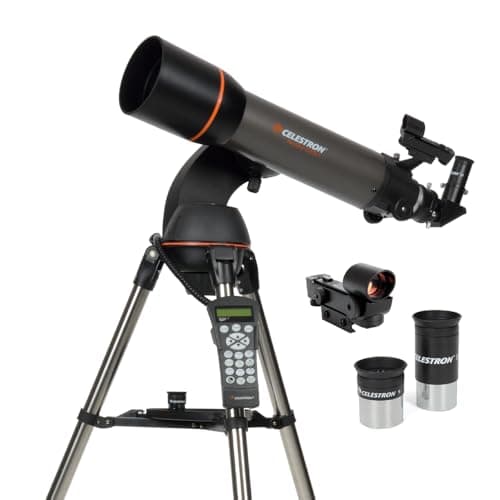 Celestron NexStar 102SLTTop pick102mm of refractor at f/6.47 on a computerized fork. Nothing to collimate, nothing to cool down, and it drives itself to the target. | A refractor that finds things for you | 102mm (4.02")204x useful |
Top pick · A refractor that finds things for you
Celestron NexStar 102SLT
102mm of refractor at f/6.47 on a computerized fork. Nothing to collimate, nothing to cool down, and it drives itself to the target.
What the aperture allows
- Maximum useful magnification
- 204x
- 2 × 102mm of aperture
- Resolving limit (Dawes)
- 1.14 arcseconds
- 116 ÷ 102mm
- Cassini division (0.7″)
- Out of reach
- this aperture cannot resolve it
Celestron publishes 241x as this telescope’s highest useful magnification. Our figure is 204x, from two times the aperture in millimeters. The gap of 37x comes from the slightly more generous per-inch constant makers use. Neither number describes a typical night: the atmosphere usually settles the question well below both.
Worked example: a 25mm eyepiece in this telescope gives 660mm ÷ 25mm = 26x.
Two times 102mm gives 204x. Celestron publishes 241x, and Dawes' limit is 1.14 arcseconds, which the maker's own figure matches exactly. At 1.14 arcseconds the Cassini division, at about 0.7, is out of reach: this telescope shows Saturn's rings as rings, not as rings with a gap in them.
The refractor advantage is that none of this needs maintenance. There is no mirror to collimate, no open tube for the air to churn inside, and the optics are sealed. Point it at something and it is already as sharp as it is going to be.
At 660mm the supplied 25mm eyepiece gives 26x and the 9mm gives 73x. Exit pupil at 26x is 102 / 26 = 3.9mm, which is bright and comfortable, and the widest field here is genuinely wide for a computerized telescope.
The 15.5 lb kit weight is the real argument for this one. It is the only telescope on this site that both finds objects by itself and can be carried outside in one trip without thinking about it.
What it does well
- Nothing to collimate and no cool-down, ever
- 15.5 lb total, so the GoTo convenience does not cost you portability
- A genuinely wide lowest power at 26x for a computerized telescope
What it costs you
- 102mm cannot resolve the Cassini division at 1.14 arcseconds
- An achromatic refractor shows some color fringing on the Moon and bright planets
- Needs batteries or mains power, and an alignment on named stars each session
Skip this one if: Skip it if deep sky is the point. 102mm and a limiting magnitude of 12.5 is a modest light bucket, and a 200mm Dobsonian collects 3.8 times more light than it does.
#ad · how this is funded · price as of September 26, 2026
What the supplied eyepieces give you
magnification = telescope focal length / eyepiece focal length
660 / 25 = 26x. 660 / 9 = 73x.
Exit pupil is the aperture divided by the magnification: 102 / 26 = 3.9mm and 102 / 73 = 1.4mm. Both are comfortable. Neither is close to the 204x ceiling, so there is real headroom above what the box contains. Which eyepieces to buy.
The gap in the box is at the top end. 73x is a modest planetary magnification for a telescope that supports about 204x, so a shorter eyepiece is the obvious first purchase. It is also worth knowing that the useful ceiling here is set by the aperture rather than by the mount, which is unusual at this price and is a consequence of the fork being properly sized for a light tube.
The honest drawbacks
- It is an achromat at f/6.47. A simple two-element lens does not bring every wavelength to focus at the same point, and at this focal ratio a violet fringe around the lunar limb and around Venus is a normal part of the view rather than a fault. Refractor against reflector covers the design trade.
- It needs power every session. Celestron publishes 12 VDC or eight AA batteries, not included. A motorized mount draws current continuously and alkaline cells fade in the cold, so a mains adapter or a rechargeable pack is effectively required equipment.
- It wants an alignment on named stars. The mount does not know where it is pointing at switch-on. That is quick once you know the sky and genuinely awkward before you do, which is the standard objection to fork-mounted GoTo. GoTo against manual works it through.
- 1.14 arcseconds is a hard ceiling on detail. No Cassini division, and double stars closer than about 1.1 arcseconds stay single.
- 12.5 limiting magnitude is modest. This is not the telescope for chasing faint galaxies, whatever the database says it can point at.
The comparison that decides it
Celestron sells the same lens without the motors, and the published figures are the cleanest illustration on this whole site of what a computerized mount costs.
| NexStar 102SLT | AstroMaster 102AZ | NexStar 6SE | |
|---|---|---|---|
| Aperture | 102mm | 102mm | 150mm |
| Focal length | 660mm | 660mm | 1500mm |
| Focal ratio | f/6.47 | f/6.5 | f/10 |
| Max useful magnification (computed) | 204x | 204x | 300x |
| Maker's published maximum | 241x | 241x | 354x |
| Resolving limit | 1.14 arcsec | 1.14 arcsec | 0.77 arcsec |
| Light grasp vs the eye (published) | 212x | 212x | 459x |
| Widest true field, 32mm eyepiece | 2.33 degrees | 2.33 degrees | 1.02 degrees |
| Finds objects | Motorized GoTo | You do | Motorized GoTo |
| Tracks | Yes | No | Yes |
| Needs power | Yes, 8 AA | No | Yes, 8 AA |
| Total kit weight | 15.5 lb | Not published | 28 lb |
Read the first two columns and every optical figure is identical, because it is the same 102mm lens at the same 660mm focal length. The entire price difference buys the fork, the motors and the database. Nothing in those columns buys a better view. The AstroMaster 102AZ review covers the manual version, and it is the right telescope for anybody who would rather spend the difference on eyepieces.
Read across to the 6SE and the trade reverses: more than twice the light grasp and a resolving limit that crosses into planetary detail, paid for with 12.5 lb and a field less than half as wide. The 6SE review and the 6SE against the 8SE cover that end of the range.
Who should buy it, and who should not
Buy it if portability and low maintenance genuinely decide whether a telescope gets used. That is a real category of buyer and it is badly served elsewhere: somebody in an apartment carrying gear down to a courtyard, somebody who observes from campsites, somebody with a bad back, or somebody who simply knows that a telescope needing two trips will stay indoors. 15.5 lb that points itself and never needs collimating will be used, and a telescope that gets used beats a bigger one that does not.
Buy it also if wide fields are what you enjoy. At 2.33 degrees it shows star fields no Schmidt-Cassegrain here can frame, and it tracks them while you look.
Do not buy it for planetary detail, because 1.14 arcseconds rules out the Cassini division permanently. Do not buy it for faint galaxies, because 102mm and magnitude 12.5 are modest. And do not buy it if you can already find objects yourself and will observe from one fixed spot, because the same lens without the motors shows an identical view for considerably less, and a Dobsonian at this price collects nearly four times the light.
Questions people actually ask
Is the Celestron NexStar 102SLT worth it?
It is worth it if weight and maintenance are what stop you observing. Celestron publishes 15.5 lb for the complete kit, there is nothing to collimate, and it finds and tracks objects from a 40,000-object database. It is poor value if you want detail or faint objects: at 1.14 arcseconds it cannot resolve the Cassini division, and an 8-inch Dobsonian collects nearly four times the light.
What can you see with a NexStar 102SLT?
Lunar craters and mountains in real detail, the phases of Venus, Jupiter's belts and four bright moons, Saturn's rings clearly separated from the planet but with no gap visible inside them, and the brighter Messier clusters and nebulae. Celestron publishes a limiting stellar magnitude of 12.5. Its wide 2.33-degree field makes large open clusters a particular strength.
NexStar 102SLT or AstroMaster 102AZ?
Optically they are the same telescope: Celestron publishes 102mm, 660mm, 241x, 1.14 arcseconds and 212x light grasp for both. The 102SLT adds a computerized fork that finds and tracks objects, and needs batteries and an alignment each session. If you can find things yourself and observe from one place, the AstroMaster shows an identical view for less.
How heavy is the NexStar 102SLT?
Celestron publishes 15.5 lb (7.03 kg) for the total kit weight, with an optical tube 812.8mm long. That makes it the lightest computerized telescope covered on this site by a wide margin, and one person can carry the whole thing outside in a single trip.
Does the NexStar 102SLT need batteries?
Yes. Celestron publishes 12 VDC or eight AA batteries, which are not included. A motorized mount draws current the whole time it is switched on and alkaline cells lose capacity in the cold, so most owners run it from a mains adapter or a rechargeable power pack.
Is the NexStar 102SLT good for beginners?
It is one of the more forgiving computerized telescopes for a beginner, because there is no collimation and it is light enough to set up without help. The one obstacle is the alignment routine, which asks you to center named stars before the mount will drive anywhere, and that is exactly what a complete beginner cannot yet do.
Read next
Celestron AstroMaster 102AZ
102mm of refractor at f/6.5 on a simple mount. Wide fields and zero maintenance, paid for in false color on bright targets.
Top pick: Celestron AstroMaster 102AZ
#ad · how this is funded · price as of September 26, 2026
Best GoTo
The Best GoTo Telescopes
Computerized telescopes ranked on what the motors cost in aperture, whether they track as well as find, and what they need to run.
Top pick: Sky-Watcher Virtuoso GTi 130P
#ad · how this is funded · price as of September 26, 2026

Best refractor
The Best Refractor Telescopes
Refractors ranked on aperture, focal ratio and mount, with the light they give up against a reflector computed from the published figures.
Top pick: Celestron AstroMaster 102AZ
#ad · how this is funded · price as of September 26, 2026
Found something wrong here? Tell us and we will correct it and date the correction, per our editorial policy.