Reviews
Celestron NexStar 6SE
150mm of aperture and a 1500mm focal length folded into a tube about a foot long, on a computerized fork. Portability and tracking, at a real cost in aperture per dollar.
By Scooter M. · Published · How we pick
The NexStar 6SE is the telescope people buy when portability and tracking matter more than raw aperture per dollar. It is a genuinely good instrument, and it is worth being clear about what it costs.
What the Schmidt-Cassegrain design does
Light enters through a corrector plate, travels to a primary mirror at the back, reflects forward to a secondary mirror, and then back through a hole in the primary to the eyepiece. That folded path is why a 1500mm focal length fits in a tube about a foot long. The design in full, including what the folding costs.
max useful magnification = 2 x aperture. Dawes limit = 116 / aperture.
150 x 2 = 300x. 116 / 150 = 0.77 arcseconds.
Celestron publishes 354x and 0.77 arcseconds. The resolution figures agree exactly. At 0.77 arcseconds the Cassini division, at roughly 0.7, is within reach on a steady night.
Celestron also publishes 459 times the light-gathering of the human eye and a limiting stellar magnitude of 13.4 for this telescope. Both put it comfortably into deep-sky territory for the brighter objects.
What f/10 means for the view
magnification = telescope focal length / eyepiece focal length
A 25mm eyepiece: 1500 / 25 = 60x here. In a 650mm f/5 Newtonian: 650 / 25 = 26x.
That is the long-focal-ratio trade. High magnification comes easily and with comfortable long eyepieces, but the widest possible field is much narrower, so large open clusters do not fit.
In practice this is a planetary and double-star instrument first and a deep-sky one second. It excels at the targets that reward magnification and gives up ground on the large faint ones.
The cost, against a Dobsonian
light ratio = (aperture 1 / aperture 2) squared
A 200mm Dobsonian against this: (200 / 150)squared = 1.78
The Dobsonian collects 78 percent more light and resolves 0.58 arcseconds against 0.77, at roughly half the price. On optics alone it wins outright.
So why buy this? Because it fits in a car boot, it finds objects by itself, and it tracks them. A Dobsonian is the better telescope and this is often the one that gets used on a Tuesday. The under-$1,000 bracket sets out the trade.
The two practical costs nobody mentions
- Dew. The corrector plate at the front of the tube is exposed to the sky and dews up readily. A dew shield is close to mandatory and a heated one is better. A dewed corrector ends a session.
- Cool-down. A sealed tube with a substantial mirror takes a while to reach air temperature, and the image is soft until it does. Put it out early.
How this is funded: the buy buttons below are Amazon Associates links, and a qualifying purchase earns us a commission at no extra cost to you. It cannot move the ranking, because the order here is set by aperture per dollar, and no commission rate changes how much light a mirror collects. Full disclosure.
| # | Telescope | Best for | Aperture | Price |
|---|---|---|---|---|
| 1 | 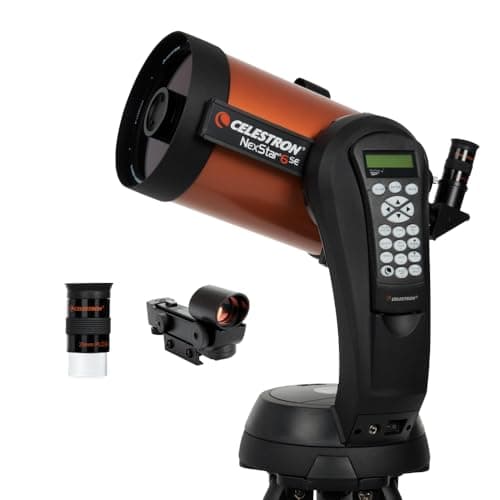 Celestron NexStar 6SETop pick150mm of Schmidt-Cassegrain at f/10 on a computerized fork. Long focal length in a short tube, and the planetary views to match. | The serious step up | 150mm (5.91 in)300x useful |
Top pick · The serious step up
Celestron NexStar 6SE
150mm of Schmidt-Cassegrain at f/10 on a computerized fork. Long focal length in a short tube, and the planetary views to match.
What the aperture allows
- Maximum useful magnification
- 300x
- 2 × 150mm of aperture
- Resolving limit (Dawes)
- 0.77 arcseconds
- 116 ÷ 150mm
- Cassini division (0.7″)
- Out of reach
- this aperture cannot resolve it
Celestron publishes 354x as this telescope’s highest useful magnification. Our figure is 300x, from two times the aperture in millimeters. The gap of 54x comes from the slightly more generous per-inch constant makers use. Neither number describes a typical night: the atmosphere usually settles the question well below both.
Worked example: a 25mm eyepiece in this telescope gives 1500mm ÷ 25mm = 60x.
The Schmidt-Cassegrain folds a 1500mm light path into a tube about a foot long. That is what you are paying for: 150mm of aperture and a long focal length in something you can pick up with one hand.
Two times 150mm gives 300x of useful magnification. Celestron publishes 354x. Dawes' limit is 0.77 arcseconds, so the Cassini division and the Great Red Spot are both genuinely within reach.
At f/10 a 25mm eyepiece gives 60x rather than the 26x it would give on an f/5 Newtonian, so the widest view this telescope offers is narrower than a Dobsonian's. It is a planetary and double-star instrument first and a deep-sky one second.
This is the point on the list where the price stops being a beginner price. It earns that if the buyer already knows they are staying with the hobby; it is a lot of telescope to gamble on somebody who has never looked through one.
What it does well
- 150mm of aperture in a genuinely portable tube
- Long focal length suits the Moon, the planets and double stars extremely well
- Full GoTo and tracking on a mount that is properly steady for the tube
What it costs you
- Narrow widest field: large open clusters do not fit
- The corrector plate dews up and needs a dew shield or a heater
- Long cool-down before the optics settle
Skip this one if: Skip it if this would be the first telescope in the house. Buy a Dobsonian, find out whether the hobby sticks, and spend this money in a year with much better information.
#ad · how this is funded · price as of October 19, 2026
Who should buy it
Somebody who already knows they are staying with the hobby, who will travel with the telescope, and who wants tracking for high-magnification planetary work. On those terms it is excellent.
Who should not: anybody buying their first telescope. It is a lot of money to spend on somebody who has never looked through one, and the alignment step assumes knowledge a beginner does not have yet. Buy a Dobsonian, find out whether the hobby sticks, and spend this money in a year with much better information.
The obvious question about this telescope is whether to buy the larger one instead. The 6SE against the 8SE answers it on the published figures, and the full 8SE review covers what the extra aperture does.
Questions people actually ask
Is the Celestron NexStar 6SE worth it?
For a second telescope, or for somebody who already knows they will keep observing, yes: 150mm of aperture with GoTo and tracking in a genuinely portable tube. As a first telescope it is a lot of money and its alignment step assumes knowledge a beginner does not have.
What can you see with a NexStar 6SE?
The Cassini division on a steady night, Jupiter's Great Red Spot and belt structure, double stars near its 0.77-arcsecond resolving limit, and the brighter deep-sky objects. Celestron publishes a limiting stellar magnitude of 13.4 for it.
Is a NexStar 6SE better than an 8-inch Dobsonian?
Optically, no. The Dobsonian collects 78 percent more light and resolves finer detail at roughly half the price. The 6SE wins on portability, on finding objects automatically, and on tracking, which are real advantages that show you nothing new.
Do I need a dew shield for a Schmidt-Cassegrain?
Effectively yes. The corrector plate at the front is exposed to the open sky and dews up readily, and a dewed corrector ends the session. A simple dew shield helps and a heated one is more reliable.
Can you do astrophotography with a NexStar 6SE?
Lunar and planetary imaging, yes, and it is well suited to it. Deep-sky astrophotography is limited because an alt-azimuth fork mount rotates the field over time, which caps usable exposure length unless a wedge is added.
Read next

GoTo vs Manual: What the Motors Actually Cost You
What a GoTo mount costs in aperture, when it earns that back, and the phone-guided middle option most buyers miss.
Top pick: Celestron NexStar 130SLT
#ad · how this is funded · price as of October 19, 2026
Best under $1,000
The Best Telescopes Under $1,000
The bracket where the money buys tracking and portability rather than aperture, and what that trade is actually worth.
Top pick: Celestron StarSense Explorer 8-inch Dobsonian
#ad · how this is funded · price as of October 19, 2026
Best for the planets
The Best Telescopes for Seeing the Planets
Telescopes ranked for planetary detail, where resolving limit and mount steadiness matter more than raw light-gathering.
Top pick: Celestron NexStar 6SE
#ad · how this is funded · price as of October 19, 2026
Found something wrong here? Tell us and we will correct it and date the correction, per our editorial policy.