Reviews
Celestron NexStar 8SE
The most aperture on this site that still finds and follows objects by itself, folded into a tube you can carry in one hand. The field of view is the price.
By Scooter M. · Published · How we pick
This is the telescope people mean when they say they want a proper one, and most of what is written about it is either enthusiasm or a specification table repeated back. What follows is the arithmetic, and then the two things the specification table does not tell you.
The arithmetic first
max useful magnification = 2 x aperture. Dawes limit = 116 / aperture.
203.2 x 2 = 406x. 116 / 203.2 = 0.57 arcseconds.
Celestron publishes 480x and 0.57 arcseconds. The resolving limits agree exactly. Celestron also publishes a lowest useful magnification of 29x, 843 times the light grasp of the eye, and a limiting stellar magnitude of 14.
At 0.57 arcseconds the Cassini division is within reach, since the gap sits at roughly 0.7 arcseconds. So is the Great Red Spot, and so are double stars that a 130mm telescope shows as single. This is the aperture at which planetary observing stops being about seeing the planet and starts being about seeing detail on it.
What the fork buys, and what it costs
Two things happen when you put this aperture on a computerized fork instead of a Dobsonian base. The first is that the telescope finds objects from a database Celestron publishes at 40,000 entries, plus 200 you can define, and then follows them. The second is that the whole assembly weighs 32 lb and needs power.
- Tracking, which is the real luxury. An object centered at 250x stays centered. You can look away, let somebody else look, take a phone photograph, and come back to it still in the field.
- A database you can drive without a phone. The hand control carries its own catalog, so nothing depends on a phone's battery or a cell signal.
- An alignment every session. The mount does not know where it is pointing at switch-on, so each night starts by centering named stars. GoTo against manual explains why that is a bigger obstacle than it sounds for a first-time buyer.
- Power, every session. Celestron publishes 12 VDC at 750 mA, or eight AA batteries, not included. Alkaline cells fade in the cold, so a mains adapter or a rechargeable pack is not optional equipment on this telescope.
The narrow field nobody mentions
This is the most useful thing on the page, and it almost never appears in a review. The Schmidt-Cassegrain folds a 2032mm focal length into a short tube, and a long focal length makes every eyepiece a high-power eyepiece.
magnification = focal length / eyepiece. true field = apparent field / magnification.
2032 / 25 = 81x. 2032 / 32 = 63.5x. 48 / 63.5 = 0.76 degrees.
Celestron publishes the supplied 25mm as 81x. Even a 32mm Plossl, the longest a 1.25-inch focuser usefully takes, gives only 63.5x and about three quarters of a degree of sky with the 48-degree apparent field Celestron publishes for its Omni 32mm.
How this is funded: the buy buttons below are Amazon Associates links, and a qualifying purchase earns us a commission at no extra cost to you. It cannot move the ranking, because the order here is set by aperture per dollar, and no commission rate changes how much light a mirror collects. Full disclosure.
| # | Telescope | Best for | Aperture | Price |
|---|---|---|---|---|
| 1 | 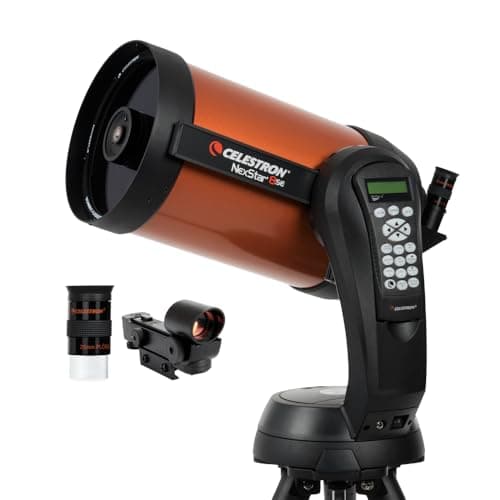 Celestron NexStar 8SETop pick203mm of Schmidt-Cassegrain at f/10 on a computerized fork. The largest aperture on this site that still finds and follows objects by itself. | The most aperture that still tracks | 203.2mm (8")406x useful |
Top pick · The most aperture that still tracks
Celestron NexStar 8SE
203mm of Schmidt-Cassegrain at f/10 on a computerized fork. The largest aperture on this site that still finds and follows objects by itself.
What the aperture allows
- Maximum useful magnification
- 406x
- 2 × 203.2mm of aperture
- Resolving limit (Dawes)
- 0.57 arcseconds
- 116 ÷ 203.2mm
- Cassini division (0.7″)
- Within reach
- on a steady night, at high magnification
Celestron publishes 480x as this telescope’s highest useful magnification. Our figure is 406x, from two times the aperture in millimeters. The gap of 74x comes from the slightly more generous per-inch constant makers use. Neither number describes a typical night: the atmosphere usually settles the question well below both.
Worked example: a 25mm eyepiece in this telescope gives 2032mm ÷ 25mm = 81x.
Two times 203.2mm gives 406x of useful magnification, and Dawes' limit is 0.57 arcseconds. That is comfortably inside the 0.7 arcseconds the Cassini division needs, so the gap in Saturn's rings is genuinely available on a steady night rather than theoretically available.
Celestron publishes 843 times the light-gathering of the eye and a limiting stellar magnitude of 14. Against the 150mm NexStar 6SE the collecting area ratio is (203.2 / 150) squared = 1.83, so this telescope collects 83 percent more light than the 6SE.
At f/10 the focal length is 2032mm, so the supplied 25mm eyepiece gives 81x. That is a high lowest power: the widest true field this telescope offers is narrow, and large open clusters and the Andromeda galaxy will not fit in it.
The number that decides most purchases is not on the spec sheet. The optical tube and the fork are one 32 lb assembly with a separate tripod, and it is carried in two hands, not one. A telescope that lives in a closet because it is awkward to move sees less sky than a smaller one by the door.
What it does well
- 203mm of aperture that finds and tracks objects on its own
- Resolves the Cassini division at 0.57 arcseconds on a steady night
- The long 2032mm focal length suits planets and double stars exceptionally well
What it costs you
- 32 lb of kit weight, in two pieces, every session
- The narrowest widest-field of any telescope on this site: 81x with the supplied eyepiece
- Needs mains power or a battery pack, and a dew shield for the corrector plate
Skip this one if: Skip it if this is a first telescope. It is a lot of money and a lot of weight to gamble on a hobby that has not stuck yet, and an 8-inch Dobsonian shows the same sky without the motors, the batteries or the fork.
$1,699.00 · 12% off
#ad · how this is funded · price as of September 21, 2026
Against the telescopes it is actually compared with
| NexStar 8SE | NexStar 6SE | StarSense 8" Dob | Classic 200P | |
|---|---|---|---|---|
| Aperture | 203.2mm | 150mm | 203mm | 203mm |
| Focal length | 2032mm | 1500mm | 1200mm | 1200mm |
| Focal ratio | f/10 | f/10 | f/5.9 | f/5.9 |
| Max useful magnification | 406x | 300x | 406x | 406x |
| Resolving limit | 0.57 arcsec | 0.77 arcsec | 0.57 arcsec | 0.57 arcsec |
| Relative light gathering | 1.83x | Baseline | 1.83x | 1.83x |
| Cassini division | Within reach | Out of reach | Within reach | Within reach |
| Finds objects | Motorized GoTo | Motorized GoTo | Phone | You do |
| Tracks | Yes | Yes | No | No |
| Total weight | 32 lb | 28 lb | 43.4 lb | Not published |
The 6SE column is the interesting one: 0.77 arcseconds puts the Cassini division out of reach, so the step from 150mm to 203mm is not a small upgrade but a change in what the telescope can resolve at all. The 6SE against the 8SE is the comparison most buyers are actually making, and it has its own page. Against the 8-inch Dobsonian, the optics are equals and the difference is tracking against field of view.
The maintenance nobody budgets for
- Dew. The corrector plate at the front of the tube fogs on a clear night far more readily than an open Newtonian tube does. A dew shield is the cheap fix and a heated strip is the reliable one.
- Cool-down. A thick corrector and a sealed tube take time to reach air temperature, and until they do the image shimmers. Put it outside half an hour before you plan to observe.
- Collimation, occasionally. Less often than a Newtonian, but it is not a never. Collimation covers what the process actually involves.
Who should buy it, and who should not
Buy it if you already know you are staying with the hobby, you want planetary detail above everything else, and you want the telescope to do the finding and following so the evening is spent looking rather than hunting. It is very good at exactly that, and the 32 lb splits into pieces that fit in a car without a debate.
Do not buy it as a first telescope. It is a lot of money against a hobby that has not proved itself yet, the alignment routine asks you to know named stars, and an 8-inch Dobsonian shows the same sky at the same resolving limit for far less. Do not buy it if wide star fields are what you enjoy, because 0.76 degrees is the ceiling. And do not buy it without a power supply in the same order.
Questions people actually ask
Is the Celestron NexStar 8SE worth it?
It is worth it for a committed observer who wants planetary detail and tracking. 203.2mm computes to a 0.57-arcsecond resolving limit, which puts the Cassini division and the Great Red Spot within reach, and the fork follows them all night. It is poor value as a first telescope, where the same aperture on a Dobsonian base costs far less and shows the same detail.
What can you see with a NexStar 8SE?
The Cassini division in Saturn's rings, the Great Red Spot and belt structure on Jupiter, lunar detail down to 0.57 arcseconds, the polar caps on Mars near opposition, and globular clusters resolved into individual stars. Celestron publishes a limiting stellar magnitude of 14 and 843 times the light grasp of the eye. Large open clusters and nebulae mostly will not fit in the field.
NexStar 6SE or 8SE?
The 8SE resolves finer detail in a way that is not marginal: 0.57 arcseconds against 0.77 puts the Cassini division within reach on the 8SE and out of reach on the 6SE, and it collects 83 percent more light. The 6SE is lighter at 28 lb and cheaper. If planets are the reason you are buying, the 8SE is the one that changes what you see.
Does the NexStar 8SE need batteries?
It needs power of some kind every session. Celestron publishes 12 VDC at 750 mA or eight AA batteries, which are not included. AA cells drain quickly in a motorized mount and fade in the cold, so most owners run it from a mains adapter or a rechargeable power pack.
Is the NexStar 8SE good for beginners?
It is usable by a beginner but it is not the sensible first purchase. Every session starts with an alignment on named stars, which a complete beginner cannot yet identify, and the money buys motors rather than mirror. A Dobsonian of the same aperture is cheaper, simpler and shows the same detail.
How heavy is the NexStar 8SE?
Celestron publishes 32 lb for the total kit weight. It separates into the optical tube with the fork arm, and the tripod, so it is a two-trip telescope for most people but each trip is manageable.
Read next
Celestron NexStar 6SE vs NexStar 8SE
The two most-bought Celestron fork-mounted telescopes compared on the published figures: what 53mm more aperture buys, and the threshold it crosses.
Top pick: Celestron NexStar 8SE
$1,699.00 · 12% off
#ad · how this is funded · price as of September 21, 2026
Celestron NexStar 6SE
150mm Schmidt-Cassegrain with GoTo in a genuinely portable tube. What it does well and what it costs in light.
Top pick: Celestron NexStar 6SE
#ad · how this is funded · price as of September 21, 2026
Best GoTo
The Best GoTo Telescopes
Computerized telescopes ranked on what the motors cost in aperture, whether they track as well as find, and what they need to run.
Top pick: Sky-Watcher Virtuoso GTi 130P
#ad · how this is funded · price as of September 21, 2026
Found something wrong here? Tell us and we will correct it and date the correction, per our editorial policy.