Telescope Types & Comparisons
Celestron NexStar 6SE vs NexStar 8SE
Two telescopes from the same family that differ in one specification. That specification happens to sit on either side of a line, which makes this a cleaner decision than it looks.
By Scooter M. · Published · How we pick
These two telescopes share almost everything. The same computerized fork, the same f/10 Schmidt-Cassegrain design, the same hand control with the same published 40,000-object database, the same alignment routine and the same power arrangement. Celestron sells them side by side and the marketing copy for each could be swapped with barely a word changed.
So the whole decision comes down to aperture, and aperture is the one thing this site can compute rather than quote.
The number that decides it
Dawes limit = 116 / aperture in millimeters
116 / 150 = 0.77 arcseconds. 116 / 203.2 = 0.57 arcseconds.
Celestron publishes 0.77 and 0.57 for these two telescopes, so the computed figures and the maker's own agree exactly. The Cassini division in Saturn's rings sits at roughly 0.7 arcseconds.
Magnification cannot rescue the smaller telescope here. Pushing past the resolving limit makes the image bigger and no more detailed, which is the magnification myth in its purest form. Two times the aperture gives 300x on the 6SE and 406x on the 8SE, and neither number has anything to do with whether the Cassini division appears.
What the extra aperture collects
light ratio = (aperture 1 / aperture 2) squared
(203.2 / 150)squared = 1.83.
Celestron publishes 843 times the light grasp of the eye for the 8SE and 459 times for the 6SE. 843 / 459 = 1.84, so the maker's own figures and the computed ratio agree. The 8SE collects about 83 percent more light.
Eighty-three percent more light is roughly two thirds of a magnitude. On faint fuzzy objects that is the difference between suspecting something is there and seeing its shape, and on globular clusters it is often the difference between a ball of haze and a ball of haze with stars resolving around the edge.
Where the smaller telescope wins
| NexStar 6SE | NexStar 8SE | |
|---|---|---|
| Aperture | 150mm | 203.2mm |
| Focal length | 1500mm | 2032mm |
| Focal ratio | f/10 | f/10 |
| Max useful magnification (computed) | 300x | 406x |
| Maker's published maximum | 354x | 480x |
| Resolving limit | 0.77 arcsec | 0.57 arcsec |
| Cassini division | Out of reach | Within reach |
| Light grasp vs the eye (published) | 459x | 843x |
| Lowest power with a 32mm eyepiece | 47x | 64x |
| Widest true field, same eyepiece | 1.02 degrees | 0.76 degrees |
| Total kit weight | 28 lb | 32 lb |
Two rows in that table favor the 6SE, and only two. It is 4 lb lighter, which is less of a difference than most buyers expect. And its shorter focal length gives a genuinely wider field: a full degree against three quarters of one, which is the difference between the Pleiades fitting and not fitting.
The weight row is worth dwelling on because it is the one people assume will decide this. Four pounds across a 28 lb baseline is not what stops a telescope being used. If portability is the real constraint, neither of these is the answer and the portable telescopes page is a better place to start.
How this is funded: the buy buttons below are Amazon Associates links, and a qualifying purchase earns us a commission at no extra cost to you. It cannot move the ranking, because the order here is set by aperture per dollar, and no commission rate changes how much light a mirror collects. Full disclosure.
| # | Telescope | Best for | Aperture | Price |
|---|---|---|---|---|
| 1 | 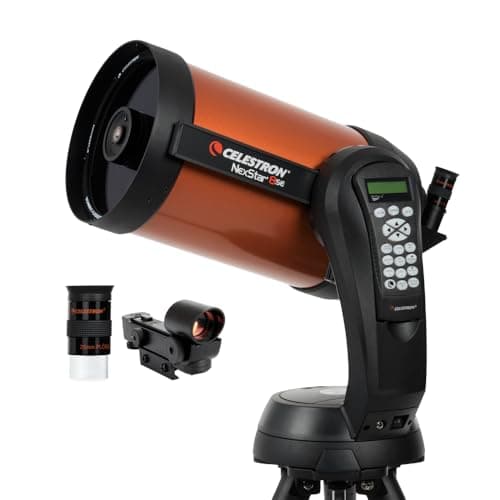 Celestron NexStar 8SETop pick203mm of Schmidt-Cassegrain at f/10 on a computerized fork. The largest aperture on this site that still finds and follows objects by itself. | The most aperture that still tracks | 203.2mm (8")406x useful | |
| 2 | 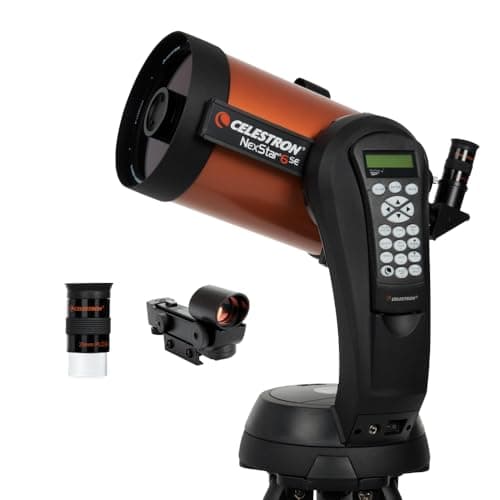 Celestron NexStar 6SE150mm of Schmidt-Cassegrain at f/10 on a computerized fork. Long focal length in a short tube, and the planetary views to match. | The serious step up | 150mm (5.91 in)300x useful |
Top pick · The most aperture that still tracks
Celestron NexStar 8SE
203mm of Schmidt-Cassegrain at f/10 on a computerized fork. The largest aperture on this site that still finds and follows objects by itself.
What the aperture allows
- Maximum useful magnification
- 406x
- 2 × 203.2mm of aperture
- Resolving limit (Dawes)
- 0.57 arcseconds
- 116 ÷ 203.2mm
- Cassini division (0.7″)
- Within reach
- on a steady night, at high magnification
Celestron publishes 480x as this telescope’s highest useful magnification. Our figure is 406x, from two times the aperture in millimeters. The gap of 74x comes from the slightly more generous per-inch constant makers use. Neither number describes a typical night: the atmosphere usually settles the question well below both.
Worked example: a 25mm eyepiece in this telescope gives 2032mm ÷ 25mm = 81x.
Two times 203.2mm gives 406x of useful magnification, and Dawes' limit is 0.57 arcseconds. That is comfortably inside the 0.7 arcseconds the Cassini division needs, so the gap in Saturn's rings is genuinely available on a steady night rather than theoretically available.
Celestron publishes 843 times the light-gathering of the eye and a limiting stellar magnitude of 14. Against the 150mm NexStar 6SE the collecting area ratio is (203.2 / 150) squared = 1.83, so this telescope collects 83 percent more light than the 6SE.
At f/10 the focal length is 2032mm, so the supplied 25mm eyepiece gives 81x. That is a high lowest power: the widest true field this telescope offers is narrow, and large open clusters and the Andromeda galaxy will not fit in it.
The number that decides most purchases is not on the spec sheet. The optical tube and the fork are one 32 lb assembly with a separate tripod, and it is carried in two hands, not one. A telescope that lives in a closet because it is awkward to move sees less sky than a smaller one by the door.
What it does well
- 203mm of aperture that finds and tracks objects on its own
- Resolves the Cassini division at 0.57 arcseconds on a steady night
- The long 2032mm focal length suits planets and double stars exceptionally well
What it costs you
- 32 lb of kit weight, in two pieces, every session
- The narrowest widest-field of any telescope on this site: 81x with the supplied eyepiece
- Needs mains power or a battery pack, and a dew shield for the corrector plate
Skip this one if: Skip it if this is a first telescope. It is a lot of money and a lot of weight to gamble on a hobby that has not stuck yet, and an 8-inch Dobsonian shows the same sky without the motors, the batteries or the fork.
$1,699.00 · 12% off
#ad · how this is funded · price as of September 21, 2026
Pick 2 · The serious step up
Celestron NexStar 6SE
150mm of Schmidt-Cassegrain at f/10 on a computerized fork. Long focal length in a short tube, and the planetary views to match.
What the aperture allows
- Maximum useful magnification
- 300x
- 2 × 150mm of aperture
- Resolving limit (Dawes)
- 0.77 arcseconds
- 116 ÷ 150mm
- Cassini division (0.7″)
- Out of reach
- this aperture cannot resolve it
Celestron publishes 354x as this telescope’s highest useful magnification. Our figure is 300x, from two times the aperture in millimeters. The gap of 54x comes from the slightly more generous per-inch constant makers use. Neither number describes a typical night: the atmosphere usually settles the question well below both.
Worked example: a 25mm eyepiece in this telescope gives 1500mm ÷ 25mm = 60x.
The Schmidt-Cassegrain folds a 1500mm light path into a tube about a foot long. That is what you are paying for: 150mm of aperture and a long focal length in something you can pick up with one hand.
Two times 150mm gives 300x of useful magnification. Celestron publishes 354x. Dawes' limit is 0.77 arcseconds, so the Cassini division and the Great Red Spot are both genuinely within reach.
At f/10 a 25mm eyepiece gives 60x rather than the 26x it would give on an f/5 Newtonian, so the widest view this telescope offers is narrower than a Dobsonian's. It is a planetary and double-star instrument first and a deep-sky one second.
This is the point on the list where the price stops being a beginner price. It earns that if the buyer already knows they are staying with the hobby; it is a lot of telescope to gamble on somebody who has never looked through one.
What it does well
- 150mm of aperture in a genuinely portable tube
- Long focal length suits the Moon, the planets and double stars extremely well
- Full GoTo and tracking on a mount that is properly steady for the tube
What it costs you
- Narrow widest field: large open clusters do not fit
- The corrector plate dews up and needs a dew shield or a heater
- Long cool-down before the optics settle
Skip this one if: Skip it if this would be the first telescope in the house. Buy a Dobsonian, find out whether the hobby sticks, and spend this money in a year with much better information.
#ad · how this is funded · price as of September 21, 2026
What neither of them does well
- Wide fields. Both are f/10 with long focal lengths, so both make every eyepiece a high-power eyepiece. Large open clusters and extended nebulae do not fit in either.
- Starting quickly. Both want an alignment on named stars at the beginning of every session, which is the routine that defeats beginners. GoTo against manual sets out why.
- Running without power. Celestron publishes eight AA cells or a 12 VDC supply for both. A motorized mount draws current continuously and AA cells fade in the cold.
- Aperture per dollar. Neither is close to a Dobsonian on this measure. An 8-inch Dobsonian resolves to the same 0.57 arcseconds as the 8SE for a fraction of the price, because none of the money went into motors.
Which to buy
Buy the 8SE if planets are why you are buying. It crosses the resolving threshold that the 6SE does not reach, and no amount of eyepiece spending closes that gap. The full 8SE review works through what that aperture does and what the narrow field costs.
Buy the 6SE if the budget stops there or the field of view matters to you. It is a capable telescope with a real advantage in width, and 150mm at 0.77 arcseconds still shows Jupiter's belts, Saturn's rings as rings, and a great deal of lunar detail. The 6SE review covers it in full.
Buy neither if this would be a first telescope. Both ask you to know named stars before they will help you find anything, and both spend most of the budget below the tube. An 8-inch Dobsonian gives you the 8SE's resolving limit and a wider field, and finds objects with a phone instead of an alignment routine.
Questions people actually ask
Is the NexStar 8SE worth the extra over the 6SE?
For planetary observing, yes, and the reason is specific. The 8SE resolves to 0.57 arcseconds and the 6SE to 0.77, while the Cassini division in Saturn's rings needs about 0.7. The larger telescope crosses that line and the smaller one does not, at any magnification. The 8SE also collects 83 percent more light.
How much heavier is the NexStar 8SE than the 6SE?
Celestron publishes 32 lb for the 8SE and 28 lb for the 6SE, so 4 lb across the whole kit. That is a smaller difference than most buyers expect and it rarely decides the purchase on its own.
Which has the wider field of view, the 6SE or the 8SE?
The 6SE, by a clear margin. Its 1500mm focal length against the 8SE's 2032mm means the same eyepiece gives lower magnification and more sky. With a 32mm eyepiece the 6SE gives about 1.02 degrees against the 8SE's 0.76, which is the difference between the Pleiades fitting in the field and not fitting.
Do the 6SE and 8SE use the same mount?
They use the same single fork arm design and the same hand control with the same published 40,000-object database, and both run on eight AA cells or a 12 VDC supply. The 8SE carries a heavier tube on that fork, which is the usual reason owners add a wedge or upgrade the tripod later.
Is a NexStar 6SE or 8SE good for deep sky?
Both are limited for it by their focal ratio rather than their aperture. At f/10 the widest field either can produce is around a degree, so large nebulae and open clusters do not fit. They are excellent on globular clusters, planetary nebulae and galaxies that are small and bright, and awkward on anything extended.
Read next
Celestron NexStar 8SE
203.2mm of Schmidt-Cassegrain at f/10 with full GoTo. Resolves the Cassini division, tracks all night, and shows the narrowest field here.
Top pick: Celestron NexStar 8SE
$1,699.00 · 12% off
#ad · how this is funded · price as of September 21, 2026
Celestron NexStar 6SE
150mm Schmidt-Cassegrain with GoTo in a genuinely portable tube. What it does well and what it costs in light.
Top pick: Celestron NexStar 6SE
#ad · how this is funded · price as of September 21, 2026
Best GoTo
The Best GoTo Telescopes
Computerized telescopes ranked on what the motors cost in aperture, whether they track as well as find, and what they need to run.
Top pick: Sky-Watcher Virtuoso GTi 130P
#ad · how this is funded · price as of September 21, 2026
Found something wrong here? Tell us and we will correct it and date the correction, per our editorial policy.