Reviews
Celestron StarSense Explorer 8" Dobsonian
Eight inches of aperture that finds objects with your phone and needs no alignment, no batteries and no hand control. What it does not do is follow them.
By Scooter M. · Published · How we pick
Eight inches is the aperture most of this site has been pointing at. It is the size where the Cassini division becomes genuinely available, where galaxies stop being smudges and start having shape, and where the arithmetic stops arguing for something bigger. This is that aperture with the finding problem solved, and it is the last telescope in the registry that had never had a review of its own.
The arithmetic first
max useful magnification = 2 x aperture. Dawes limit = 116 / aperture.
203 x 2 = 406x. 116 / 203 = 0.57 arcseconds.
Celestron publishes 480x and 0.57 arcseconds. The resolving limits agree exactly; the magnification figures differ by 74x because makers compute per inch with a more generous constant. Celestron also publishes a lowest useful magnification of 29x, which is the aperture divided by a 7mm dark-adapted pupil.
At 0.57 arcseconds the Cassini division is inside the limit. That matters more than any other number on this page: the gap in Saturn's rings sits at roughly 0.7 arcseconds, so every telescope on this site under about 170mm can only show you rings, and this one can show you rings with a gap in them on a night when the air is steady. Celestron publishes 841 times the light-gathering of the human eye and a limiting stellar magnitude of 14.2.
What eight inches changes against what you probably own
light ratio = (aperture 1 / aperture 2) squared
(203 / 130)squared = 2.44. (203 / 150)squared = 1.83.
This collects nearly two and a half times the light of a 130mm beginner telescope and 83 percent more than a 150mm one. Light is what deep sky is made of: what you can actually see sets the thresholds object by object.
The step from 130mm to 203mm is the largest single jump in capability a beginner can make, and it is almost entirely about faint objects. On the Moon and the planets the difference is real but modest, because the atmosphere usually settles that argument before the aperture does. On galaxies and nebulae it is the whole difference between seeing something and seeing nothing.
How it finds things without a single motor
A phone clamps into a dock on the side of the tube with a mirror under it. The app photographs the sky through that mirror, matches the star pattern against its catalog, and works out where the telescope is pointing. Then it draws arrows on screen and you push the tube until the target is centered. Celestron calls the underlying technique sky recognition; the general name for it is plate solving.
- No alignment routine. It does not ask you to center named stars first, which is the step that defeats beginners on a computerized mount. StarSense against manual finding covers why that one difference matters so much.
- No power in the telescope. Nothing under the tube draws current. The only battery involved is the one in your phone.
- It works from a driveway. Plate solving needs enough stars to match a pattern, not a dark sky, so it functions in exactly the light-polluted places where recognizing constellations is hardest.
- The aperture is untouched. Every dollar that a computerized mount spends on motors, this telescope spends on mirror. That is why it is 203mm and not 130mm.
The thing the app does not do
The second limitation is the dock. It holds a phone within a size range, and a large phone in a thick case is a real-world fitting problem rather than a theoretical one. Take the case off before deciding it does not fit.
How this is funded: the buy buttons below are Amazon Associates links, and a qualifying purchase earns us a commission at no extra cost to you. It cannot move the ranking, because the order here is set by aperture per dollar, and no commission rate changes how much light a mirror collects. Full disclosure.
| # | Telescope | Best for | Aperture | Price |
|---|---|---|---|---|
| 1 | 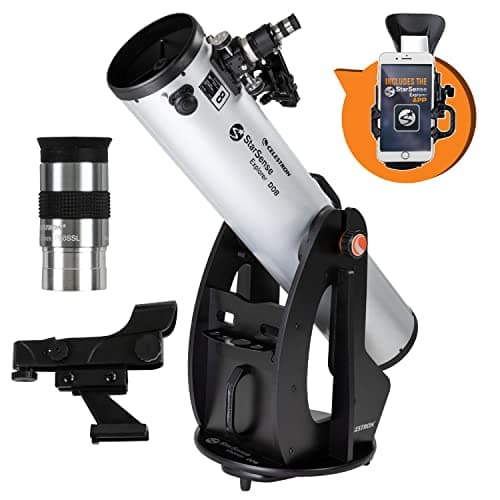 Celestron StarSense Explorer 8-inch DobsonianTop pick203mm of Dobsonian aperture with the phone finder bolted on. The largest telescope here that a beginner can genuinely operate on night one. | Big aperture, no star-hopping | 203mm (8 in)406x useful |
Top pick · Big aperture, no star-hopping
Celestron StarSense Explorer 8-inch Dobsonian
203mm of Dobsonian aperture with the phone finder bolted on. The largest telescope here that a beginner can genuinely operate on night one.
What the aperture allows
- Maximum useful magnification
- 406x
- 2 × 203mm of aperture
- Resolving limit (Dawes)
- 0.57 arcseconds
- 116 ÷ 203mm
- Cassini division (0.7″)
- Within reach
- on a steady night, at high magnification
Celestron publishes 480x as this telescope’s highest useful magnification. Our figure is 406x, from two times the aperture in millimeters. The gap of 74x comes from the slightly more generous per-inch constant makers use. Neither number describes a typical night: the atmosphere usually settles the question well below both.
Worked example: a 25mm eyepiece in this telescope gives 1200mm ÷ 25mm = 48x.
203mm gathers 841 times the light of the naked eye, which is Celestron's own published figure. Against the 130mm scopes further up this list it is 2.4 times the light, from the ratio 203 over 130, squared.
Two times 203mm gives 406x of useful magnification; Celestron publishes 480x. Dawes' limit is 0.57 arcseconds, so the Cassini division, the Great Red Spot and hundreds of Messier objects are all inside its reach.
The published limiting stellar magnitude of 14.2 is the number that explains what deep sky means. It is roughly 4,000 times fainter than the faintest star a good naked eye sees from a dark site.
The reason to choose this over a plain 8-inch Dobsonian is the phone finder. An 8-inch tube with a 0.57-arcsecond resolution limit is wasted on somebody who cannot locate anything to point it at.
What it does well
- The largest aperture here that a beginner can realistically use on the first night
- The phone finder removes the learning curve that stops most people using this much telescope
- A Dobsonian base is rock steady under a big tube
What it costs you
- Heavy and bulky; two trips outside and real storage space
- No tracking, so at 200x objects leave the field quickly
- Collimation and a long cool-down are part of owning it
Skip this one if: Skip it if storage or stairs are a problem. That is the single most common reason a large Dobsonian stops getting used.
#ad · how this is funded · price as of September 21, 2026
The weight, which is the real decision
Celestron publishes a 20.6 lb optical tube and 43.4 lb in total. Those two numbers are the honest description of this telescope: it comes apart into a tube one person can carry and a base one person can carry, and it does not come apart any further than that.
A telescope that needs two trips still gets used if the trips are short. The same telescope down a flight of stairs and across a parking lot is a telescope that goes out once a month. Aperture you do not set up is worth exactly nothing, which is the argument the tabletop Dobsonians keep winning.
What the supplied eyepiece gives you, and what to add
magnification = telescope focal length / eyepiece focal length
1200 / 25 = 48x. exit pupil = 203 / 48 = 4.2mm.
Celestron publishes the supplied 25mm Plossl as 48x, which agrees. A 4.2mm exit pupil is comfortable and bright. The gap in the box is at the top end: 48x is a finding power, and nothing supplied gets near the 406x the mirror supports.
The first purchase after this telescope is a shorter eyepiece, not a bigger telescope. At f/5.9 it is also not especially demanding about eyepiece quality, which is not true of the faster 10-inch version. Which eyepieces to buy sets out the four that cover the range.
Against the three telescopes buyers weigh it against
| StarSense 8" | Classic 200P | NexStar 8SE | StarSense 10" | |
|---|---|---|---|---|
| Aperture | 203mm | 203mm | 203.2mm | 254mm |
| Focal length | 1200mm | 1200mm | 2032mm | 1200mm |
| Focal ratio | f/5.9 | f/5.9 | f/10 | f/4.7 |
| Max useful magnification | 406x | 406x | 406x | 508x |
| Resolving limit | 0.57 arcsec | 0.57 arcsec | 0.57 arcsec | 0.46 arcsec |
| Relative light gathering | Baseline | Same | Same | 1.57x |
| Finds objects | Phone plate solving | You do | Motorized GoTo | Phone plate solving |
| Tracks | No | No | Yes | No |
| Needs power | Your phone | No | Yes, 8 AA | Your phone |
| Total weight | 43.4 lb | Not published | 32 lb | 54.8 lb |
Read across and the argument is clear enough. The Classic 200P is the same mirror with nothing to help you point it, for less. The NexStar 8SE is the same aperture that also follows, in a package that weighs less but costs a great deal more and shows a much narrower field. The 10-inch is 57 percent more light and 11 lb more to carry.
Who should buy it, and who should not
Buy it if you want serious aperture and you have already worked out that finding things is your bottleneck rather than following them. It is the shortest path from a driveway to a galaxy that this site can recommend, and the reason is arithmetic rather than enthusiasm: nothing else here puts 203mm behind a beginner's eye without asking them to learn the sky first.
Do not buy it if the telescope has to live upstairs and come down each time. Do not buy it if you specifically want to sit on Jupiter at high power without touching anything, because that is what tracking is for. And do not buy it as a gift for somebody who has not asked for a telescope, because 43.4 lb of enthusiasm is a heavy thing to be wrong about. Buying for somebody else is the page for that.
Questions people actually ask
Is the Celestron StarSense Explorer 8" Dobsonian worth it?
It is worth it if finding objects is what stops you observing. You get 203mm of aperture, which computes to 406x of useful magnification and a 0.57-arcsecond resolving limit, and the phone app removes the aiming problem without spending any of the budget on motors. If you want the telescope to follow objects as well as find them, a fork-mounted GoTo telescope does that and this does not.
What can you see with an 8" Dobsonian?
The Cassini division in Saturn's rings on a steady night, because 0.57 arcseconds is inside the roughly 0.7 arcseconds it needs. Jupiter's belts and the Great Red Spot, lunar detail to the same limit, and the brighter galaxies with visible shape rather than as smudges. Celestron publishes a limiting stellar magnitude of 14.2 and 841 times the light grasp of the eye.
Does the StarSense Explorer track objects?
No. There are no motors of any kind. The app tells you where to push the telescope, and once the object is centered it drifts across the field as the Earth turns, so you nudge it back by hand. At high magnification that is every 30 seconds or so.
Do you need a phone for the StarSense Explorer to work?
For the finding system, yes. The telescope works perfectly well as an ordinary Dobsonian without one, using the red-dot finder, but the plate solving that the name refers to needs a supported smartphone clamped into the dock. Check your phone fits the dock without its case.
StarSense Explorer 8" or Sky-Watcher Classic 200P?
Same aperture, same focal length, same computed limits. The difference is entirely in how you point it: the StarSense uses your phone, the Classic 200P uses your knowledge of the sky. If you can already find things, the Sky-Watcher gives you identical optics for less.
How heavy is the 8" StarSense Explorer Dobsonian?
Celestron publishes 20.6 lb for the optical tube and 43.4 lb in total. It separates into two pieces, each of which one person can carry, and it does not break down any smaller than that.
Read next
Sky-Watcher Classic 200P Dobsonian (8-inch)
Eight inches of aperture, 0.58 arcseconds of resolution, and the honest cost: it is a two-trip telescope.
Top pick: Sky-Watcher Classic 200P Dobsonian (8-inch)
#ad · how this is funded · price as of September 21, 2026
Celestron NexStar 8SE
203.2mm of Schmidt-Cassegrain at f/10 with full GoTo. Resolves the Cassini division, tracks all night, and shows the narrowest field here.
Top pick: Celestron NexStar 8SE
$1,699.00 · 12% off
#ad · how this is funded · price as of September 21, 2026
Best aperture per dollar
Dobsonian Telescopes, and Why Experienced Observers Recommend Them
Why a Dobsonian gives the most aperture per dollar, what the design costs you, and which size to buy.
Top pick: Sky-Watcher Classic 200P Dobsonian (8-inch)
#ad · how this is funded · price as of September 21, 2026
Found something wrong here? Tell us and we will correct it and date the correction, per our editorial policy.