Reviews
Sky-Watcher Classic 200P Dobsonian (8-inch)
The telescope experienced observers tell beginners to buy, and the arithmetic explains why without any appeal to authority.
By Scooter M. · Published · How we pick
The Classic 200P is what experienced observers recommend to beginners, and unusually for a piece of advice given that often, the arithmetic backs it up entirely.
What 200mm actually buys
max useful magnification = 2 x aperture. Dawes limit = 116 / aperture.
200 x 2 = 400x. 116 / 200 = 0.58 arcseconds.
The Cassini division spans roughly 0.7 arcseconds at its widest, so this telescope resolves it comfortably rather than borderline. Sky-Watcher publishes 816 times the light-gathering of the human eye for this aperture.
400x is more magnification than the atmosphere delivers on all but a handful of nights a year, which is exactly the position you want: the telescope is limited by the sky rather than by its own optics.
Sky-Watcher also publishes a direct comparison of its own: the 200P is 78 percent brighter than its 150mm model. That single figure is the clearest statement of the aperture argument any manufacturer on this site makes.
What that means at the eyepiece
- Globular clusters resolve into individual stars rather than staying as fuzzy balls. This is the single most striking difference from a 130mm telescope.
- Galaxies show shape, and the brighter ones show structure from a dark site.
- The Cassini division is a routine sight on a steady night rather than a rare one.
- Jupiter's Great Red Spot is visible when it is facing Earth, along with belt structure a smaller telescope flattens out.
What you can actually see works through the targets object by object, and deep sky covers what this aperture unlocks specifically.
The honest cost, which is not money
The tube is over a meter long and the base is a wide box. This is a two-trip telescope, and it needs somewhere to live that you will actually retrieve it from.
The mirror also needs 30 to 45 minutes outside to reach air temperature, and it needs an occasional collimation check. Neither is difficult, and both are normal Newtonian ownership. Collimation.
The 2-inch focuser is not a footnote
Sky-Watcher fits a 2-inch Crayford focuser with a 1.25-inch adapter. That matters because a 2-inch eyepiece can deliver a genuinely wide low-power field that 1.25-inch eyepieces physically cannot, which is exactly what a large fast Dobsonian is best at.
It is also a real upgrade path rather than a dead end: the telescope will accept better eyepieces than it ships with, for as long as you own it. The eyepiece guide covers which focal lengths suit it.
How this is funded: the buy buttons below are Amazon Associates links, and a qualifying purchase earns us a commission at no extra cost to you. It cannot move the ranking, because the order here is set by aperture per dollar, and no commission rate changes how much light a mirror collects. Full disclosure.
| # | Telescope | Best for | Aperture | Price |
|---|---|---|---|---|
| 1 | 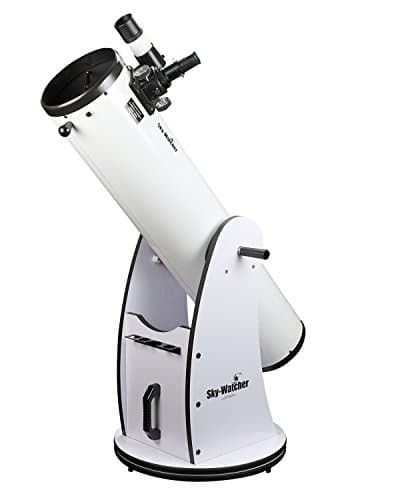 Sky-Watcher Classic 200P Dobsonian (8-inch)Top pickEight inches of aperture on the simplest mount ever designed. This is the telescope experienced observers tell beginners to buy. | The one you will not outgrow | 200mm (8 in)400x useful | Unavailable |
Top pick · The one you will not outgrow
Sky-Watcher Classic 200P Dobsonian (8-inch)
Eight inches of aperture on the simplest mount ever designed. This is the telescope experienced observers tell beginners to buy.
What the aperture allows
- Maximum useful magnification
- 400x
- 2 × 200mm of aperture
- Resolving limit (Dawes)
- 0.58 arcseconds
- 116 ÷ 200mm
- Cassini division (0.7″)
- Within reach
- on a steady night, at high magnification
200mm is a different category of instrument, not an incremental upgrade. Against the 70mm refractor at the other end of this list the light-gathering ratio is 200 divided by 70, squared: 8.2 times more light reaching your eye.
Two times 200mm gives 400x of useful magnification, which is more than the atmosphere delivers on all but a handful of nights a year. In practice this telescope is limited by the sky rather than by its optics, which is exactly the position you want to be in.
Dawes' limit at 200mm is 116 divided by 200, which is 0.58 arcseconds. The Cassini division, at roughly 0.7 arcseconds, is comfortably inside that. So is the Great Red Spot, and so are hundreds of Messier objects a 70mm scope simply cannot reach.
The honest cost is bulk. The tube is long and the base is wide, and this is a telescope you carry outside in two trips. Everyone who owns one tells the same story: they used it far more once they stopped storing it somewhere awkward.
What it does well
- The aperture-per-dollar figure that no other design at this price approaches
- A mount that cannot be wobbly, because there is almost nothing to it
- The 2-inch focuser takes wide-field eyepieces the cheaper models cannot
- Genuinely a lifetime telescope; nobody outgrows eight inches of aperture in a hurry
What it costs you
- Big and heavy: two trips outside, and it needs real storage space
- No tracking, so at 200x objects drift out of view in well under a minute
- Needs collimation checks, and the mirror takes 30 to 45 minutes to reach outside temperature
Skip this one if: Skip it if you live upstairs with no lift, or if the observing spot is a fire escape. The best telescope in this list is the wrong one if carrying it is a chore.
| Optical design | Newtonian reflector, borosilicate parabolic primary with 94 percent reflective coatingsSource: Classic 200P Dobsonian — manufacturer specifications (retrieved September 1, 2026) |
|---|---|
| Aperture | 200mm (8 in)Source: Classic 200P Dobsonian — manufacturer specifications (retrieved September 1, 2026) |
| Mount | Dobsonian rocker box with Teflon bearings and a patented tension control handleSource: Classic 200P Dobsonian — manufacturer specifications (retrieved September 1, 2026) |
| Light gathering vs the eye | 816xSky-Watcher's own published figure.Source: Classic 200P Dobsonian — manufacturer specifications (retrieved September 1, 2026) |
| Focuser | 2-inch Crayford with a 1.25-inch adapterSource: Classic 200P Dobsonian — manufacturer specifications (retrieved September 1, 2026) |
| Versus the 6-inch model | 78 percent brighter than the 150mm versionSky-Watcher's own published comparison.Source: Classic 200P Dobsonian — manufacturer specifications (retrieved September 1, 2026) |
Currently unavailable at Amazon
Checked October 18, 2026. We are not linking to it while there is nothing to buy.
Who should buy the 6-inch instead
Anybody for whom the 8-inch would be a chore to move. The Classic 150P fits across a back seat, one person carries it in a single trip, and it gives up 44 percent of the light. A telescope that gets used beats one that is technically better and stays in the garage. The under-$1,000 bracket sets them side by side.
If you want this aperture but cannot yet find your way around the sky, the StarSense Explorer 8-inch Dobsonian is the same 203mm with phone-guided finding on top.
Questions people actually ask
Is an 8-inch Dobsonian good for a beginner?
Optically it is ideal: 0.58 arcseconds of resolution and 816 times the light-gathering of the naked eye, per Sky-Watcher's own figure. Practically it depends on your storage and your stairs, because carrying it is what decides how often it gets used.
What can you see with a Sky-Watcher Classic 200P?
The Cassini division in Saturn's rings, Jupiter's Great Red Spot and belt structure, globular clusters resolved into individual stars, and galaxies showing shape from a dark site. It is the aperture at which deep sky stops being a list of smudges.
How heavy is an 8-inch Dobsonian?
Enough to be a two-trip telescope: the tube and the base are carried separately by most owners. That is the main practical constraint on the design and the reason some buyers choose the 6-inch instead.
Does it need collimation?
Occasionally, like any Newtonian. A star test before a session you care about is the sensible habit, and the adjustment itself takes a few minutes with a cheap tool.
Can you do astrophotography with it?
Lunar and bright-planet imaging, yes. Deep-sky astrophotography needs tracking and long exposures, which an undriven Dobsonian mount does not provide.
Read next
Best aperture per dollar
Dobsonian Telescopes, and Why Experienced Observers Recommend Them
Why a Dobsonian gives the most aperture per dollar, what the design costs you, and which size to buy.
Top pick: Sky-Watcher Heritage 130 Tabletop Dobsonian
$305.00 · 12% off
#ad · how this is funded · price as of October 18, 2026
Best under $500
The Best Telescopes Under $500
The bracket where 150mm arrives, resolving 0.77 arcseconds and bringing the Cassini division into reach on a steady night.
Top pick: Sky-Watcher Heritage 150 Tabletop Dobsonian
$355.00 · 13% off
#ad · how this is funded · price as of October 18, 2026
Best for deep sky
Telescopes for Deep Space, and What Deep Sky Really Looks Like
What galaxies and nebulae genuinely look like at each aperture, and why sky darkness matters as much as the telescope.
Top pick: Celestron StarSense Explorer 8-inch Dobsonian
#ad · how this is funded · price as of October 18, 2026
Found something wrong here? Tell us and we will correct it and date the correction, per our editorial policy.