Aperture, Magnification & First Light
The Best Telescope Eyepieces
Two eyepieces come in the box and they are usually the least considered objects in it. This is what to replace them with, and how to work out which focal lengths your telescope can use at all.
By Scooter M. · Published · How we pick
A telescope's aperture is fixed the day you buy it. Its focal length is fixed. The mount is fixed. The eyepiece is the one component you choose, change and keep, and it sets the magnification, the width of the view and whether looking through the thing is comfortable or a chore.
It is also where the manufacturer economizes, because the two eyepieces in the box are the part of the package a buyer does not compare. What eyepieces are and how they work covers the concepts. This page is about what to buy.
How these are judged
- Whether your telescope can use the focal length at all. Magnification is your telescope's focal length divided by the eyepiece's, and the useful ceiling is two times the aperture in millimeters. A shorter eyepiece than that ceiling allows is glass you cannot use.
- Apparent field of view. How wide the circle looks. 48 to 52 degrees is the classic Plossl range; 60 to 68 degrees is noticeably more open and costs more.
- Eye relief. How far your eye sits from the glass. Below about 12mm it gets uncomfortable, and spectacle wearers need roughly 15mm to see the whole field.
- Barrel size, which is a hard ceiling. A 1.25-inch eyepiece cannot show more sky than its field stop allows, no matter what is printed on it.
- Whether it duplicates what you own. Four eyepieces that give 40x, 45x, 50x and 55x are one eyepiece and three mistakes.
Work out your own numbers first
magnification = telescope focal length / eyepiece focal length. ceiling = 2 x aperture.
1200 / 32 = 37.5x. 1200 / 9 = 133x. 650 / 32 = 20x. 650 / 9 = 72x. 2032 / 32 = 63.5x. 2032 / 9 = 226x.
The same two eyepieces behave completely differently in three common telescopes: an 8-inch Dobsonian at 1200mm, a 130mm beginner Newtonian at 650mm and an 8-inch Schmidt-Cassegrain at 2032mm. Buy for your telescope's focal length, never from a list of recommended focal lengths.
Then check the result against the ceiling. Two times the aperture gives 260x on a 130mm telescope, 406x on a 203mm one and 140x on a 70mm one. Any eyepiece whose magnification lands above that number shows you a larger, dimmer, softer version of the same detail. The magnification myth is the long version of why.
The published specifications, side by side
| Focal length | Apparent field | Eye relief | In a 1200mm | In a 650mm | |
|---|---|---|---|---|---|
| Celestron Omni 32mm | 32mm | 48 degrees | 22mm | 37.5x | 20x |
| Celestron X-Cel LX 9mm | 9mm | 60 degrees | 16mm | 133x | 72x |
| SVBONY 68-degree set | 20 / 15 / 9 / 6mm | 68 degrees | 17mm | 60x to 200x | 33x to 108x |
| Celestron X-Cel LX 2x Barlow | Halves any eyepiece | Unchanged | Unchanged | Doubles | Doubles |
| Celestron eyepiece and filter kit | 32 to 6mm, plus Barlow | 52 degrees | Not published | 37.5x to 200x | 20x to 108x |
Eye relief is the specification nobody reads
Eye relief is the distance between the glass and the point where your eye sees the whole field. In simple eyepiece designs it shrinks roughly in proportion to focal length, which is why a cheap 6mm is a pinhole you have to press your eyelashes against, and why so many beginners conclude that high magnification is simply unpleasant.
It does not have to be. Celestron publishes 16mm of eye relief for the X-Cel LX 9mm and SVBONY publishes 17mm across all four of its 68-degree eyepieces, including the 6mm. That is a design choice that costs money and it is the single biggest comfort difference between a budget eyepiece and a good one. If you wear glasses at the eyepiece, treat 15mm as a minimum and ignore everything below it.
The 1.25-inch ceiling, and when it matters
Celestron publishes a 27.5mm field stop for the Omni 32mm. The field stop is the aperture inside the eyepiece that crops the view, and 27.5mm is close to the physical maximum a 1.25-inch barrel can contain.
The practical consequence: no 1.25-inch eyepiece will show you more sky than a good 32mm does. A 40mm in the same barrel gives lower magnification but no more field, because the field stop has already run out of room. If you want a genuinely wider view than that, the telescope needs a 2-inch focuser, which is why the focuser size is worth checking before buying eyepieces at all.
Exit pupil is the other end of the same limit. It is the aperture divided by the magnification, and a dark-adapted eye opens to roughly 7mm. On a 203mm f/5.9 telescope the 32mm gives a 5.4mm exit pupil, which is comfortable. On a faster f/4.7 telescope the same eyepiece gives 6.8mm, which is at the edge of what the eye can take in.
How this is funded: the buy buttons below are Amazon Associates links, and a qualifying purchase earns us a commission at no extra cost to you. It cannot move the ranking, because the order here is set by aperture per dollar, and no commission rate changes how much light a mirror collects. Full disclosure.
| # | Telescope | Best for | Aperture | Price |
|---|---|---|---|---|
| 1 | 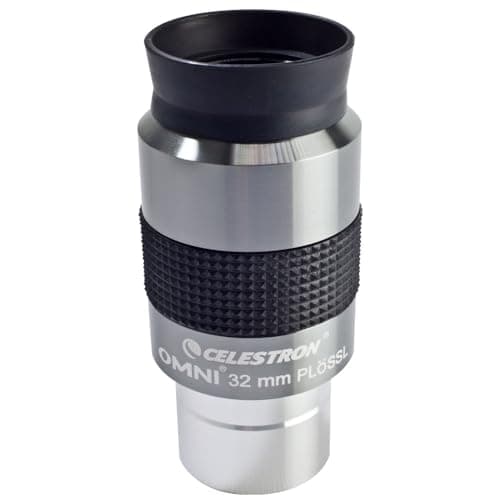 Celestron Omni 32mm Eyepiece (1.25")Top pickA 4-element Plossl at the longest focal length a 1.25-inch barrel can usefully carry. This is the eyepiece that makes a telescope feel wide. | The widest view a 1.25-inch focuser can give | 1.25" barrel64x useful | |
| 2 | 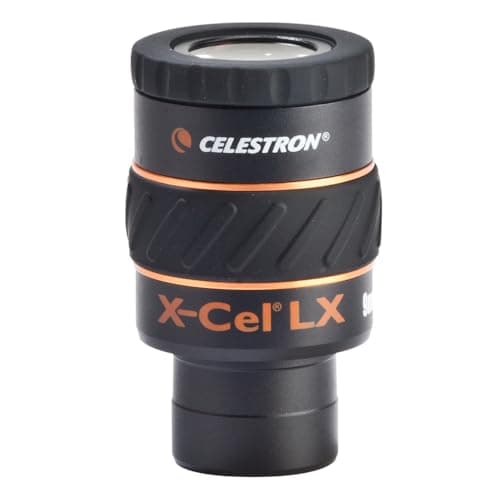 Celestron X-Cel LX 9mm Eyepiece (1.25")A 6-element design with 16mm of eye relief at 9mm of focal length. Short-focal-length eyepieces are usually uncomfortable; this one is not. | Planetary detail without squinting | 1.25" barrel64x useful | |
| 3 | 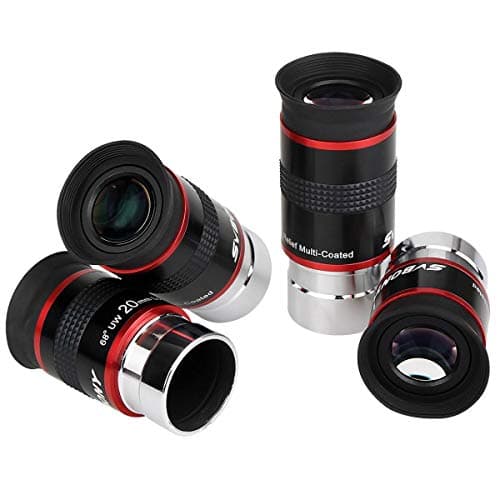 SVBONY 68-Degree Eyepiece Set, 6/9/15/20mm (1.25")Four wide-field eyepieces covering 20mm down to 6mm, each with 68 degrees of apparent field and 17mm of eye relief. | A whole magnification range at once | 1.25" barrel64x useful | |
| 4 | 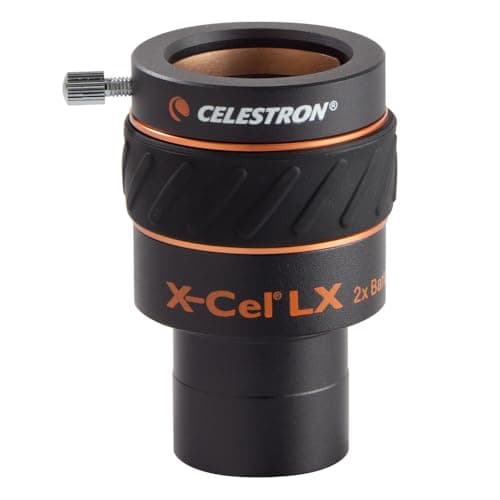 Celestron X-Cel LX 2x Barlow Lens (1.25")A three-element apochromatic Barlow that turns every eyepiece you own into two. Useful in the middle of a range, pointless at the short end. | Doubling an eyepiece set | 1.25" barrel (31.75mm)64x useful | |
| 5 | 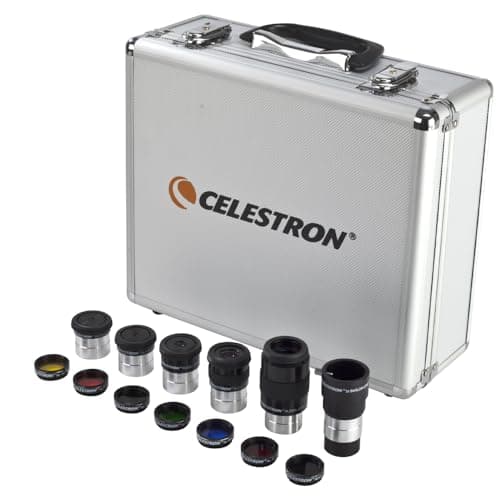 Celestron Eyepiece, Barlow and Filter Kit (1.25")Five Plossl eyepieces from 32mm down to 6mm plus a 2x Barlow. This is the accessory that actually changes what you see. | The upgrade that changes the most | 1.25" barrel64x useful |
Top pick · The widest view a 1.25-inch focuser can give
Celestron Omni 32mm Eyepiece (1.25")
A 4-element Plossl at the longest focal length a 1.25-inch barrel can usefully carry. This is the eyepiece that makes a telescope feel wide.
What the aperture allows
- Maximum useful magnification
- 64x
- 2 × 31.75mm of aperture
- Resolving limit (Dawes)
- 3.65 arcseconds
- 116 ÷ 31.75mm
- Cassini division (0.7″)
- Out of reach
- this aperture cannot resolve it
Magnification is the telescope's focal length divided by the eyepiece's. In a 1200mm Dobsonian this gives 1200 / 32 = 37.5x, and in a 650mm f/5 Newtonian it gives 650 / 32 = 20x. Both are lower than the eyepieces most telescopes ship with, which is the entire point.
Exit pupil is the aperture divided by the magnification. On a 203mm f/5.9 telescope at 37.5x that is 5.4mm, which a dark-adapted eye takes comfortably. On a faster f/4.7 telescope the same eyepiece gives 6.8mm, close enough to the eye's roughly 7mm limit that a little light spills past the pupil.
The 27.5mm field stop is the specification that matters most and the one nobody reads. True field is set by the field stop, not by the apparent field, and 27.5mm is the widest a 1.25-inch barrel physically allows. No other 1.25-inch eyepiece will show you more sky than this one.
48 degrees of apparent field is modest by modern standards. The view is a well-corrected circle rather than an immersive window, and on a fast telescope the outer part of that circle will not be as sharp as the middle.
What it does well
- The widest true field a 1.25-inch focuser can physically deliver
- 22mm of eye relief, which is comfortable with glasses on
- A simple 4-element design with little to go wrong optically
What it costs you
- 48 degrees of apparent field feels narrow beside a modern wide-angle design
- Plossl edge correction suffers on telescopes faster than about f/5
- At 20x in a short telescope the exit pupil can exceed what your eye can use
Skip this one if: Skip it if your telescope has a 2-inch focuser. The 1.25-inch field stop is the ceiling this eyepiece runs into, and a 2-inch eyepiece removes that ceiling entirely.
| Optical design | 4-element symmetrical Plossl, in 2 groupsSource: Omni 32mm Eyepiece — manufacturer specifications (retrieved September 21, 2026) |
|---|---|
| Aperture | 1.25" barrelThe fitting size, not a light-collecting aperture. An eyepiece collects nothing; the telescope does.Source: Omni 32mm Eyepiece — manufacturer specifications (retrieved September 21, 2026) |
| Focal length | 32mm (1.25")Source: Omni 32mm Eyepiece — manufacturer specifications (retrieved September 21, 2026) |
| Weight | 3.96 oz (112.5 g)Source: Omni 32mm Eyepiece — manufacturer specifications (retrieved September 21, 2026) |
| Apparent field of view | 48 degreesSource: Omni 32mm Eyepiece — manufacturer specifications (retrieved September 21, 2026) |
| Eye relief | 22mm (0.87")Generous. This is the comfortable end of the range for spectacle wearers.Source: Omni 32mm Eyepiece — manufacturer specifications (retrieved September 21, 2026) |
| Field stop diameter | 27.5mm (1.08")The physical limit on true field in a 1.25-inch barrel, which is why no 1.25-inch eyepiece shows more sky than this one.Source: Omni 32mm Eyepiece — manufacturer specifications (retrieved September 21, 2026) |
| Coatings | Multi-coatedSource: Omni 32mm Eyepiece — manufacturer specifications (retrieved September 21, 2026) |
$52.95 · 6% off
#ad · how this is funded · price as of September 21, 2026
Pick 2 · Planetary detail without squinting
Celestron X-Cel LX 9mm Eyepiece (1.25")
A 6-element design with 16mm of eye relief at 9mm of focal length. Short-focal-length eyepieces are usually uncomfortable; this one is not.
What the aperture allows
- Maximum useful magnification
- 64x
- 2 × 31.75mm of aperture
- Resolving limit (Dawes)
- 3.65 arcseconds
- 116 ÷ 31.75mm
- Cassini division (0.7″)
- Out of reach
- this aperture cannot resolve it
In a 1200mm Dobsonian this gives 1200 / 9 = 133x, and in a 650mm f/5 Newtonian 650 / 9 = 72x. On a 2032mm Schmidt-Cassegrain it gives 226x, which is at the edge of what most nights will support.
Check the result against two times your aperture before buying. On a 130mm telescope the ceiling is 260x and 133x sits comfortably below it; on a 76mm tabletop the ceiling is 152x and this eyepiece is already most of the way there.
Eye relief is the distance your eye sits from the glass, and 16mm is the whole argument for this eyepiece. A budget 9mm Plossl offers around 6mm, which means pressing your eye to the lens and seeing your own eyelashes. Spectacle wearers need roughly 15mm to see the full field at all.
60 degrees of apparent field is noticeably more open than a Plossl's 48 to 52, which matters at high power on a manual telescope: a wider field is a longer wait before the planet drifts out of it.
What it does well
- 16mm of eye relief at 9mm focal length, which is unusual and genuinely comfortable
- 60-degree field gives a planet longer in view on an untracked telescope
- Parfocal with the rest of the series, so swapping eyepieces barely disturbs focus
What it costs you
- Costs several times what a basic 9mm Plossl does
- 170 g is heavy enough to shift the balance of a light tabletop telescope
- 9mm is too much magnification for the smallest beginner apertures
Skip this one if: Skip it if your telescope is under about 100mm of aperture. Two times the aperture is the ceiling, and on a small telescope a 9mm eyepiece spends most nights above it showing a big, dim, soft image.
#ad · how this is funded · price as of September 21, 2026
Pick 3 · A whole magnification range at once
SVBONY 68-Degree Eyepiece Set, 6/9/15/20mm (1.25")
Four wide-field eyepieces covering 20mm down to 6mm, each with 68 degrees of apparent field and 17mm of eye relief.
What the aperture allows
- Maximum useful magnification
- 64x
- 2 × 31.75mm of aperture
- Resolving limit (Dawes)
- 3.65 arcseconds
- 116 ÷ 31.75mm
- Cassini division (0.7″)
- Out of reach
- this aperture cannot resolve it
In a 1200mm Dobsonian the four give 60x, 80x, 133x and 200x. In a 650mm f/5 Newtonian they give 33x, 43x, 72x and 108x. That is a usable spread in both telescopes rather than four steps bunched at one end.
The 6mm is the one to check against your aperture. Two times the aperture is the ceiling, so 200x in a 203mm telescope is fine, while the same eyepiece in a 114mm telescope asks for 200x where 228x is the absolute limit and a typical night supports far less.
17mm of eye relief on every focal length is the genuinely unusual specification here. Eye relief normally shrinks with focal length, which is why cheap short eyepieces are uncomfortable; holding it constant across the set is what a more complex optical design buys.
68 degrees is a wide apparent field, and on a fast telescope wide fields are where budget eyepieces show their limits. Expect the outer part of the field to soften on an f/5 or faster telescope; the middle, which is where you put the planet, holds up.
What it does well
- Covers 20mm to 6mm in one purchase, which is the whole useful range in most telescopes
- 17mm of eye relief on all four, including the 6mm
- 68-degree field is noticeably more open than the Plossls most telescopes ship with
What it costs you
- Edge sharpness falls off on telescopes faster than about f/5
- The 6mm exceeds the useful magnification of any telescope under about 100mm
- SVBONY publishes less optical detail than the established eyepiece brands
Skip this one if: Skip it if you already own a decent 25mm and only need one more eyepiece. Buying a single well-chosen focal length beats buying four and using two.
$134.99 · 5% off
#ad · how this is funded · price as of September 21, 2026
Pick 4 · Doubling an eyepiece set
Celestron X-Cel LX 2x Barlow Lens (1.25")
A three-element apochromatic Barlow that turns every eyepiece you own into two. Useful in the middle of a range, pointless at the short end.
What the aperture allows
- Maximum useful magnification
- 64x
- 2 × 31.75mm of aperture
- Resolving limit (Dawes)
- 3.65 arcseconds
- 116 ÷ 31.75mm
- Cassini division (0.7″)
- Out of reach
- this aperture cannot resolve it
A Barlow multiplies the magnification of whatever eyepiece sits in it. At 2x, a 25mm eyepiece behaves like a 12.5mm one and a 10mm behaves like a 5mm, so a three-eyepiece case becomes a six-magnification case for the price of one accessory.
That arithmetic is real, and it has a hard edge. On a 700mm f/10 refractor with a 70mm objective, a 10mm eyepiece Barlowed to an effective 5mm gives 140x, which is exactly the 2x-aperture ceiling for 70mm. Anything shorter than that behind the Barlow is empty magnification, and the Barlow will happily produce it.
Three elements in two groups is a better construction than the two-element Barlows bundled in budget kits. The optical cost of a cheap Barlow is real: it is extra glass in the light path, and poor glass shows as softness and false color exactly where you were trying to gain detail.
The filter thread is the quietly useful feature. A moon filter on the Barlow stays put while you swap eyepieces above it, rather than being unscrewed and rescrewed in the dark.
What it does well
- Doubles the useful range of an eyepiece set for one purchase
- Three-element apochromatic construction rather than the two-element budget design
- Threaded for 1.25-inch filters, so a filter can live on the Barlow instead of the eyepiece
- Light at 5.3 oz, so it does not upset the balance of a small telescope
What it costs you
- Adds glass to the light path, which always costs a little contrast
- Pairs badly with the shortest eyepiece you own — that combination is usually past the aperture ceiling
- Redundant if you would rather buy one more dedicated eyepiece
- Needs enough focuser travel; some telescopes cannot reach focus with a Barlow fitted
Skip this one if: Skip it if your telescope is under about 100mm and you already own a short eyepiece. The Barlow will only take you past what the aperture supports.
$124.95 · 21% off
#ad · how this is funded · price as of September 21, 2026
Pick 5 · The upgrade that changes the most
Celestron Eyepiece, Barlow and Filter Kit (1.25")
Five Plossl eyepieces from 32mm down to 6mm plus a 2x Barlow. This is the accessory that actually changes what you see.
What the aperture allows
- Maximum useful magnification
- 64x
- 2 × 31.75mm of aperture
- Resolving limit (Dawes)
- 3.65 arcseconds
- 116 ÷ 31.75mm
- Cassini division (0.7″)
- Out of reach
- this aperture cannot resolve it
Magnification is telescope focal length divided by eyepiece focal length, so this kit is the variable in that equation. On a 650mm f/5 telescope the 32mm gives 20x, the 13mm gives 50x and the 6mm gives 108x. On a 1200mm Dobsonian the same three give 38x, 92x and 200x.
The 2x Barlow halves every eyepiece's effective focal length, which is where the ten-eyepieces-in-one claim comes from. It is true arithmetic, but a Barlow on a 6mm eyepiece produces 3mm, and on most beginner telescopes 3mm is beyond the useful magnification the aperture supports.
The useful lesson is that the two eyepieces in the telescope's box are usually the two least considered items in it. A 32mm Plossl in a fast Dobsonian gives a genuinely wide, bright field that no bundled eyepiece will match.
A moon filter is not optional at full Moon in anything over about 100mm. The Moon at 130mm is uncomfortably bright, and that is not a figure of speech.
What it does well
- Covers the whole useful magnification range in one purchase rather than five
- Plossl is a well-corrected classic design at a price where the alternatives are not
- The moon filter alone earns its place in anything over 100mm
What it costs you
- The shortest eyepieces exceed the useful magnification of a small telescope
- Plossl eye relief at 6mm is tight, which is awkward for spectacle wearers
- Several of the colored planetary filters see very little use
Skip this one if: Skip it if your telescope has a 2-inch focuser and you would rather put the money toward one good wide-field 2-inch eyepiece.
| Optical design | Five 1.25-inch four-element Plossl eyepieces, a 2x Barlow and seven filtersSource: Celestron Eyepiece, Barlow and Filter Kit — the brand's own listing on Amazon.com (retrieved September 1, 2026) |
|---|---|
| Aperture | 1.25" barrelThe fitting size, not a light-collecting aperture. Check your focuser takes 1.25-inch eyepieces.Source: Celestron Eyepiece, Barlow and Filter Kit — the brand's own listing on Amazon.com (retrieved September 1, 2026) |
| Eyepieces supplied | 32mm, 17mm, 13mm, 8mm and 6mm Plossl, each with a 52-degree apparent fieldSource: Celestron Eyepiece, Barlow and Filter Kit — the brand's own listing on Amazon.com (retrieved September 1, 2026) |
| Barlow | 2x, which doubles the magnification of every eyepiece in the caseSource: Celestron Eyepiece, Barlow and Filter Kit — the brand's own listing on Amazon.com (retrieved September 1, 2026) |
| Filters | A moon filter plus the common colored planetary filtersSource: Celestron Eyepiece, Barlow and Filter Kit — the brand's own listing on Amazon.com (retrieved September 1, 2026) |
$239.95 · 8% off
#ad · how this is funded · price as of September 21, 2026
What not to buy
- A 3x Barlow bundled with a beginner telescope. Its purpose is to put a large magnification number on the box. Tripling the power of a supplied eyepiece usually lands well above the aperture's ceiling.
- Anything shorter than your ceiling allows. Work out two times your aperture before buying, not after.
- A second eyepiece close to one you own. Aim for steps of roughly half: 32mm, 15mm, 9mm covers a telescope properly. 25mm, 20mm, 17mm does not.
- A large kit for a small telescope. The bottom half of the case will never be usable on a 70mm or 76mm aperture.
Which to buy
- Buy the Omni 32mm first, whatever you own. It gives the widest true field a 1.25-inch focuser can produce, it has 22mm of eye relief, and it is the eyepiece that makes finding objects easier because more sky is in view.
- Then the X-Cel LX 9mm for planetary detail, if your aperture supports the magnification it produces. On anything from about 100mm upward it does, comfortably.
- Or the SVBONY 68-degree set instead of both, if you would rather cover the whole range in one purchase. Four focal lengths, 68 degrees and 17mm of eye relief on all of them.
- Add the 2x Barlow only once you have two eyepieces you like, since it doubles what you already own rather than filling a gap. What a Barlow actually does.
- Take the eyepiece and filter kit if you want one purchase that covers everything including a moon filter, and you own a telescope of at least about 100mm so the short focal lengths are usable.
Where this sits against everything else competing for the same money is covered in accessories worth buying, in order. The short version is that eyepieces come first, because they change every object you look at rather than one kind of object.
Questions people actually ask
What eyepiece should I buy first?
A 32mm. It gives the widest true field a 1.25-inch focuser can physically produce, which makes finding objects much easier, and long eyepieces have generous eye relief so they are comfortable. Celestron publishes 48 degrees of apparent field and 22mm of eye relief for its Omni 32mm.
What magnification will an eyepiece give me?
Divide your telescope's focal length by the eyepiece's focal length. A 9mm eyepiece in a 1200mm telescope gives 133x; the same eyepiece in a 650mm telescope gives 72x. Then check the result against two times your aperture in millimeters, which is the useful ceiling.
What is a good eye relief for a telescope eyepiece?
At least 12mm for comfort, and at least 15mm if you observe with glasses on. Cheap short-focal-length eyepieces often offer around 6mm, which means pressing your eye against the glass. Celestron publishes 16mm for the X-Cel LX 9mm and SVBONY publishes 17mm across its 68-degree range.
Is a 40mm eyepiece better than a 32mm?
Not in a 1.25-inch focuser. The field stop inside the barrel caps how much sky any eyepiece can show, and a good 32mm already reaches close to that limit. A 40mm gives lower magnification and a larger exit pupil, but no more field, and on a fast telescope the exit pupil can exceed what your eye can use.
How many eyepieces do I actually need?
Three covers almost everything: a long one around 32mm for finding and wide views, a medium one around 15mm, and a short one around 9mm for planets. Aim for steps of roughly half each time. Buying several close together in focal length duplicates what you already have.
Are expensive eyepieces worth it?
Up to a point, and the money buys comfort and field width rather than resolution. A better eyepiece gives a wider apparent field, usable eye relief at short focal lengths and cleaner edges on a fast telescope. It cannot make your telescope collect more light or resolve finer detail, both of which are set by aperture.
Read next
Best accessory upgrade
Telescope Eyepieces: Which Ones You Actually Need
Which eyepiece focal lengths suit your telescope, what exit pupil means, and the cheapest real upgrade available.
Top pick: Celestron Eyepiece, Barlow and Filter Kit (1.25")
$239.95 · 8% off
#ad · how this is funded · price as of September 21, 2026
Buy this first
Telescope Accessories Worth Buying, In Order
Which telescope accessories change a session and which duplicate what came in the box, ranked by what they actually do.
Top pick: Celestron Moon Filter (1.25")
$12.95 · 12% off
#ad · how this is funded · price as of September 21, 2026
The Magnification Myth: Why 525x Means Nothing
Why the magnification number on the box is meaningless, what the real ceiling is, and a calculator for your own telescope.
Top pick: Celestron Eyepiece, Barlow and Filter Kit (1.25")
$239.95 · 8% off
#ad · how this is funded · price as of September 21, 2026
Found something wrong here? Tell us and we will correct it and date the correction, per our editorial policy.