Reviews
Celestron Eyepiece, Barlow and Filter Kit
The most commonly bought telescope upgrade, and the one whose value depends entirely on the aperture you already own. For some telescopes half the case is unusable.
By Scooter M. · Published · How we pick
A telescope usually arrives with two eyepieces, and they are usually the least considered items in the box. That makes an accessory kit the obvious first upgrade, and this is the one most people buy. Whether it is good value is not a question about the kit — the contents are honest and the case is genuinely useful. It is a question about your telescope's focal length and aperture, and it has an arithmetic answer.
What is in the case
Celestron's own listing publishes five 1.25-inch four-element Plossl eyepieces at 32mm, 17mm, 13mm, 8mm and 6mm, each with a 52-degree apparent field; a 2x Barlow lens; and seven filters, comprising a moon filter and the common colored planetary filters.
Plossl is a well-corrected classic design and 52 degrees is a modest but honest apparent field. Nothing here is exotic and nothing here is junk. The question is which of these focal lengths your telescope can turn into a usable magnification.
Work it out for your own telescope first
magnification = telescope focal length / eyepiece focal length
650mm: 20x, 38x, 50x, 81x, 108x. 1200mm: 38x, 71x, 92x, 150x, 200x. 900mm: 28x, 53x, 69x, 113x, 150x.
The three rows are a 130mm f/5 beginner Newtonian at 650mm, an 8-inch Dobsonian at 1200mm, and the 70mm AstroMaster refractor at 900mm. The same five eyepieces behave completely differently in each.
Then check each result against the ceiling, which is two times the aperture in millimeters. That is where the kit's value is decided.
| Telescope | Aperture | Ceiling | Top of kit | With the 2x Barlow | Usable? |
|---|---|---|---|---|---|
| 130mm f/5 Newtonian | 130mm | 260x | 108x | 217x | All five, Barlow useful |
| 8-inch Dobsonian | 203mm | 406x | 200x | 400x | All five, Barlow useful |
| 102mm refractor | 102mm | 204x | 110x | 220x | All five, Barlow marginal |
| 70mm refractor, 900mm | 70mm | 140x | 150x | 300x | 6mm already over; Barlow unusable |
| 76mm tabletop, 300mm | 76mm | 152x | 50x | 100x | All five, but low powers only |
What the Barlow actually does
A 2x Barlow halves the effective focal length of whatever eyepiece you put behind it, which doubles the magnification. That is where the ten-eyepieces-in-one claim comes from, and the arithmetic is true: five eyepieces plus a 2x Barlow gives ten distinct magnifications.
The practical caveat is that the doubled values bunch up at the top. A 6mm behind a 2x Barlow behaves like a 3mm, and on most beginner telescopes 3mm is beyond the useful ceiling. The Barlow earns its place in the middle of the range, not at the end of it. What a Barlow actually does covers the optics.
The filters, sorted honestly
- The moon filter earns its place in anything over about 100mm of aperture, where the full Moon at low power is genuinely uncomfortable. The moon filter review covers when you need one and when raising magnification does the same job for free.
- A light yellow or orange filter can lift contrast on Jupiter's belts and on Mars a little. The effect is real and modest.
- A deep blue or deep red filter sees very little use in practice. They are traditional inclusions and most owners try them twice.
- None of these is a light-pollution filter. Colored planetary filters do nothing for city skies; that needs a different filter entirely. Filters explained sets out which does what.
How this is funded: the buy buttons below are Amazon Associates links, and a qualifying purchase earns us a commission at no extra cost to you. It cannot move the ranking, because the order here is set by aperture per dollar, and no commission rate changes how much light a mirror collects. Full disclosure.
| # | Telescope | Best for | Aperture | Price |
|---|---|---|---|---|
| 1 | 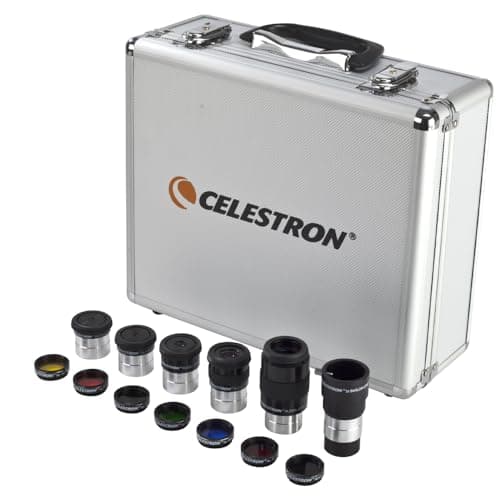 Celestron Eyepiece, Barlow and Filter Kit (1.25")Top pickFive Plossl eyepieces from 32mm down to 6mm plus a 2x Barlow. This is the accessory that actually changes what you see. | The upgrade that changes the most | 1.25" barrel64x useful |
Top pick · The upgrade that changes the most
Celestron Eyepiece, Barlow and Filter Kit (1.25")
Five Plossl eyepieces from 32mm down to 6mm plus a 2x Barlow. This is the accessory that actually changes what you see.
What the aperture allows
- Maximum useful magnification
- 64x
- 2 × 31.75mm of aperture
- Resolving limit (Dawes)
- 3.65 arcseconds
- 116 ÷ 31.75mm
- Cassini division (0.7″)
- Out of reach
- this aperture cannot resolve it
Magnification is telescope focal length divided by eyepiece focal length, so this kit is the variable in that equation. On a 650mm f/5 telescope the 32mm gives 20x, the 13mm gives 50x and the 6mm gives 108x. On a 1200mm Dobsonian the same three give 38x, 92x and 200x.
The 2x Barlow halves every eyepiece's effective focal length, which is where the ten-eyepieces-in-one claim comes from. It is true arithmetic, but a Barlow on a 6mm eyepiece produces 3mm, and on most beginner telescopes 3mm is beyond the useful magnification the aperture supports.
The useful lesson is that the two eyepieces in the telescope's box are usually the two least considered items in it. A 32mm Plossl in a fast Dobsonian gives a genuinely wide, bright field that no bundled eyepiece will match.
A moon filter is not optional at full Moon in anything over about 100mm. The Moon at 130mm is uncomfortably bright, and that is not a figure of speech.
What it does well
- Covers the whole useful magnification range in one purchase rather than five
- Plossl is a well-corrected classic design at a price where the alternatives are not
- The moon filter alone earns its place in anything over 100mm
What it costs you
- The shortest eyepieces exceed the useful magnification of a small telescope
- Plossl eye relief at 6mm is tight, which is awkward for spectacle wearers
- Several of the colored planetary filters see very little use
Skip this one if: Skip it if your telescope has a 2-inch focuser and you would rather put the money toward one good wide-field 2-inch eyepiece.
| Optical design | Five 1.25-inch four-element Plossl eyepieces, a 2x Barlow and seven filtersSource: Celestron Eyepiece, Barlow and Filter Kit — the brand's own listing on Amazon.com (retrieved September 1, 2026) |
|---|---|
| Aperture | 1.25" barrelThe fitting size, not a light-collecting aperture. Check your focuser takes 1.25-inch eyepieces.Source: Celestron Eyepiece, Barlow and Filter Kit — the brand's own listing on Amazon.com (retrieved September 1, 2026) |
| Eyepieces supplied | 32mm, 17mm, 13mm, 8mm and 6mm Plossl, each with a 52-degree apparent fieldSource: Celestron Eyepiece, Barlow and Filter Kit — the brand's own listing on Amazon.com (retrieved September 1, 2026) |
| Barlow | 2x, which doubles the magnification of every eyepiece in the caseSource: Celestron Eyepiece, Barlow and Filter Kit — the brand's own listing on Amazon.com (retrieved September 1, 2026) |
| Filters | A moon filter plus the common colored planetary filtersSource: Celestron Eyepiece, Barlow and Filter Kit — the brand's own listing on Amazon.com (retrieved September 1, 2026) |
$239.95 · 8% off
#ad · how this is funded · price as of September 27, 2026
The case for buying two good eyepieces instead
This is the honest alternative and it deserves stating, because for many buyers it is the better one. This kit costs roughly what two well-chosen individual eyepieces cost. Those two would have wider apparent fields than 52 degrees, and crucially more eye relief at the short end.
Plossl eye relief shrinks with focal length, so the 6mm in this case has very little — you press your eye close and see your own lashes. A modern 6mm to 9mm design with 16mm or 17mm of eye relief is a completely different experience at high power, particularly with glasses on. The best telescope eyepieces sets out the individual pieces worth buying.
So the kit wins on breadth and on cost per piece; individual eyepieces win on comfort and field. Which matters more depends on whether you would rather have every magnification available or two magnifications you enjoy using.
The honest drawbacks
- On a small telescope the short eyepieces are unusable, as the table above shows. This is the single biggest reason buyers are disappointed.
- Plossl eye relief at 6mm is tight, which makes the highest-power eyepiece the least pleasant to use.
- 52 degrees is a narrow apparent field beside modern 60 to 68 degree designs.
- Several colored filters will sit unused.
- It is not cheap. The case represents real money that could buy aperture instead, and aperture is the only thing that changes what your telescope can resolve.
- No light-pollution filter is included, which is the filter city observers actually want.
The case, and what else the money buys
The aluminum case is a real part of the value and it is rarely mentioned. Eyepieces are small, they roll, and they live outdoors in the dark on damp grass. A fitted case means every piece has a place, you can find the one you want by feel, and nothing gets stood on. Owners who assemble the same collection piece by piece usually end up buying a case anyway.
Set against that, here is what the same outlay buys if you spend it differently, which is the comparison worth making before you commit:
- Two good individual eyepieces, with wider fields and far more eye relief at the short end. Better to use, much narrower in coverage.
- One good eyepiece and a light-pollution filter, if you observe from a town. That filter does more for a suburban observer than any of the colored ones in this case.
- A meaningful step up in aperture, if you have not bought the telescope yet. Aperture is the only thing that changes what the telescope can resolve, and no eyepiece can add it. What your money buys sets the brackets against each other.
Who should buy it, and who should not
Buy it if you own a telescope of about 130mm or more and you want the whole magnification range available in one purchase, with a case to keep it in. On a 200mm Dobsonian this kit is straightforwardly good value: every eyepiece lands somewhere useful, the Barlow extends the top end sensibly, and the moon filter is genuinely needed at that aperture.
Do not buy it for a 70mm or 76mm telescope, where the short focal lengths exceed what the aperture supports and you are paying for glass you cannot use. Do not buy it if comfort at high power matters more to you than breadth, in which case two better eyepieces are the answer. And do not buy it before you have used the telescope enough to know which magnifications you reach for, because that knowledge changes the decision.
Questions people actually ask
Is the Celestron eyepiece and filter kit worth it?
It is good value on a telescope of about 130mm or more, where all five eyepieces produce usable magnifications and the moon filter is genuinely needed. It is poor value on a 70mm or 76mm telescope, where the 6mm eyepiece already exceeds the roughly 140x that aperture supports and the Barlow pushes it far beyond.
What comes in the Celestron eyepiece and filter kit?
Celestron's listing publishes five 1.25-inch four-element Plossl eyepieces at 32mm, 17mm, 13mm, 8mm and 6mm, each with a 52-degree apparent field, plus a 2x Barlow lens and seven filters including a moon filter and the common colored planetary filters, in a fitted case.
What magnification will these eyepieces give my telescope?
Divide your telescope's focal length by each eyepiece. In a 650mm telescope the five give 20x, 38x, 50x, 81x and 108x; in a 1200mm Dobsonian they give 38x, 71x, 92x, 150x and 200x. Then check each against two times your aperture in millimeters, which is the useful ceiling.
Is an eyepiece kit better than buying single eyepieces?
The kit wins on breadth and cost per piece; single eyepieces win on comfort and field. This kit costs about what two good individual eyepieces cost, and those would offer a wider apparent field than 52 degrees and much more eye relief at short focal lengths, which is where Plossls are least comfortable.
Do the colored filters in the kit help with light pollution?
No. Colored planetary filters raise contrast on planetary detail and do nothing for a light-polluted sky. Reducing skyglow requires a light-pollution filter, which is a different product and is not included in this kit.
Read next
Best eyepiece
The Best Telescope Eyepieces
Eyepieces ranked on field, eye relief and what your telescope can actually use, with the magnification arithmetic worked for three common focal lengths.
Top pick: Celestron Omni 32mm Eyepiece (1.25")
$52.95 · 6% off
#ad · how this is funded · price as of September 27, 2026
Buy this first
Telescope Accessories Worth Buying, In Order
Which telescope accessories change a session and which duplicate what came in the box, ranked by what they actually do.
Top pick: Celestron Moon Filter (1.25")
$12.95 · 12% off
#ad · how this is funded · price as of September 27, 2026
Best Barlow
Barlow Lenses: When They Double Your Eyepieces and When They Waste Them
A Barlow doubles every eyepiece you own. The arithmetic that decides whether that helps your telescope or wastes it.
Top pick: Celestron X-Cel LX 2x Barlow Lens (1.25")
$124.95 · 20% off
#ad · how this is funded · price as of September 27, 2026
Found something wrong here? Tell us and we will correct it and date the correction, per our editorial policy.