Aperture, Magnification & First Light
Telescope Filters: Which Ones Earn Their Place
Every filter works by throwing light away. That is worth doing when there is too much of it, and a bad idea when there is not, which is most of the time on a beginner telescope.
By Scooter M. · Published · How we pick
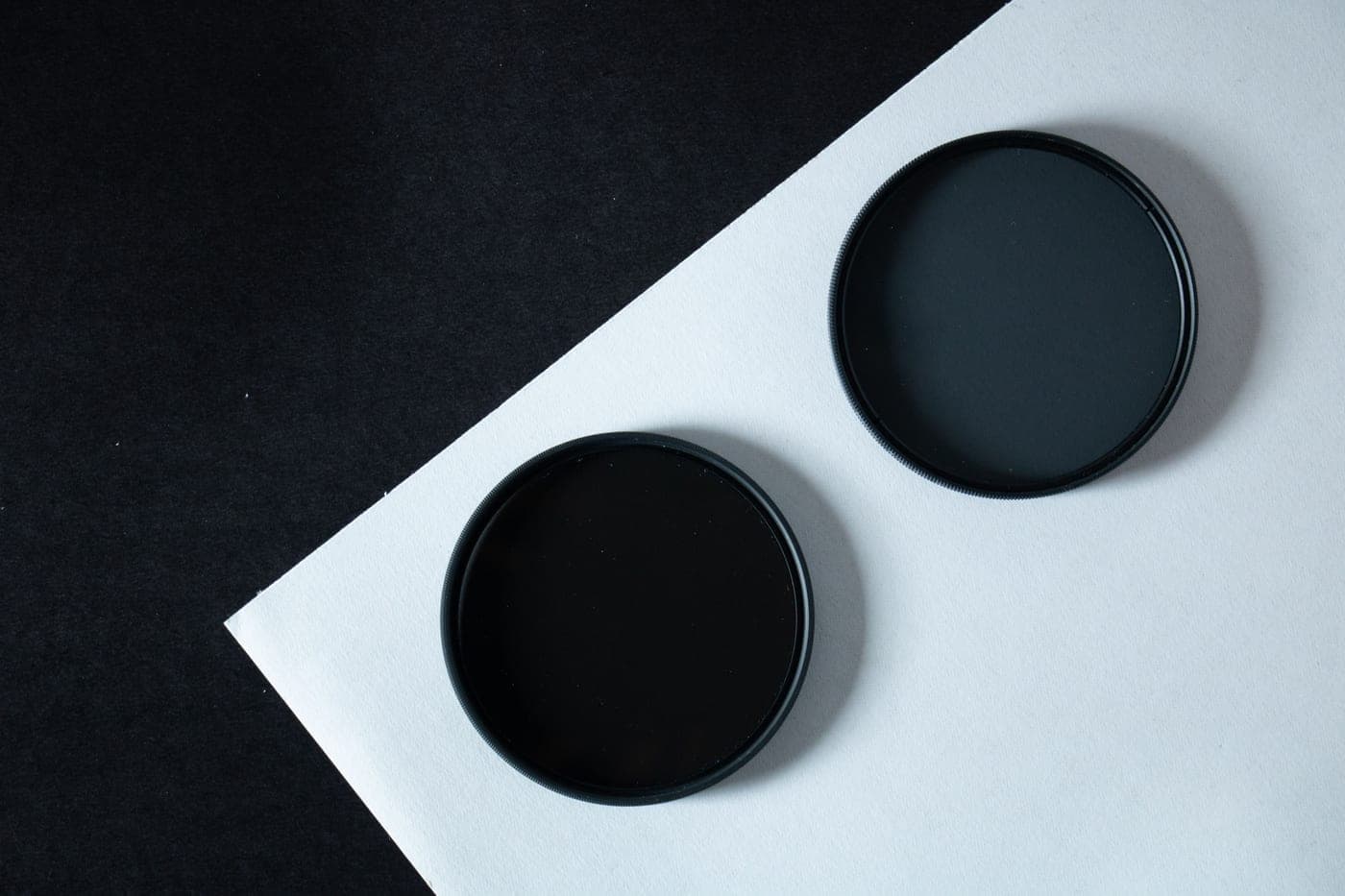
A filter never adds anything. It works by subtraction: it blocks part of the light so that whatever survives stands out better against what is left. That is the whole mechanism, and it explains both when a filter helps enormously and when it is actively harmful.
The short version: buy a moon filter if your telescope is over about 100mm, and be skeptical about everything else until you have a specific problem a specific filter solves. Everything on this page is a night-time filter; solar filters are a separate category with their own absolute rules.
The moon filter, which is the one that matters
The full Moon through a 130mm telescope is genuinely uncomfortable to look at. That is not a figure of speech, and the discomfort has a cost beyond comfort: a dazzled eye resolves less detail, and it takes twenty minutes to rebuild the dark adaptation you just destroyed.
A neutral-density moon filter cuts the light without shifting the color. Celestron's ND-96-0.3 passes 50 percent transmission, which is about one magnitude of brightness. Contrast goes up, the glare goes, and the terminator becomes the best thing in the sky.
Colored planetary filters, honestly assessed
A colored filter raises contrast on a feature that differs in color from its surroundings, by blocking the part of the spectrum the surroundings sit in. When the target genuinely has that color difference, the effect is real. When it does not, you have simply made the image dimmer.
| Filter | What it blocks | Stated purpose | Honest use |
|---|---|---|---|
| #21 Orange | Blue and green | Sharpens the Martian plains; enhances Jupiter and Saturn belt detail | The one worth owning |
| ND-96-0.3 | Half of everything | Neutral density, 50 percent transmission | The Moon, above 100mm |
| #80A Light blue | Red and orange | Not stated in detail | Occasionally on Mars polar caps |
| #12 Deep yellow | Blue | Not stated in detail | Rarely; a mild Jupiter belt lift |
Celestron's description of the #21 orange is specific in a way most filter marketing is not: it sharpens the boundaries along the plains of Mars by reducing blue and green transmission, and lifts belt detail on Jupiter and Saturn. A narrow, mechanistic claim like that is worth more than a broad one.
The other two are harder to justify for a beginner. They are not useless, but neither is a filter most owners reach for twice a year, and knowing that before you buy a set is better than discovering it after.
The cost every filter charges
light gathered goes as aperture squared
A 70mm telescope collects 100x the naked eye. Half of that through an ND filter is 50x — about what a 50mm aperture would have collected unfiltered.
On a small telescope a filter can cost you more than it buys. On a 200mm collecting 816x, the same filter is a rounding error. This is why the aperture threshold matters.
Light-pollution filters, and the honest limit
A narrowband nebula filter passes the specific wavelengths emission nebulae radiate at and blocks much of the rest, including a good deal of artificial light. On the right target under a bright sky the improvement is real and sometimes dramatic.
It does nothing at all for galaxies and star clusters, because those emit across the whole spectrum: any filter that blocks sky glow blocks their light equally. A filter sold as a general light-pollution cure is being oversold, and the light pollution page sets out what actually helps.
How this is funded: the buy buttons below are Amazon Associates links, and a qualifying purchase earns us a commission at no extra cost to you. It cannot move the ranking, because the order here is set by aperture per dollar, and no commission rate changes how much light a mirror collects. Full disclosure.
| # | Telescope | Best for | Aperture | Price |
|---|---|---|---|---|
| 1 | 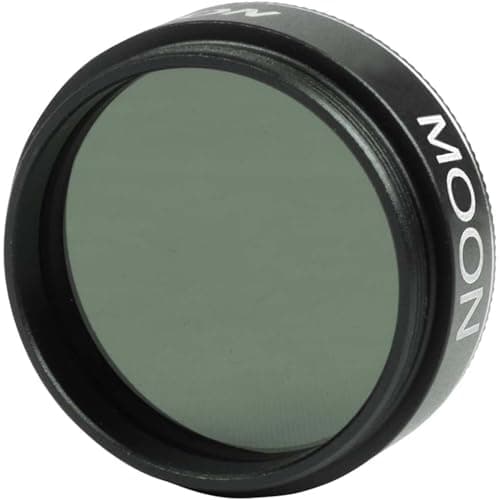 Celestron Moon Filter (1.25")Top pickA neutral-density filter that screws into an eyepiece and makes the full Moon comfortable to look at. | The cheapest real upgrade | 1.25" thread64x useful | |
| 2 | 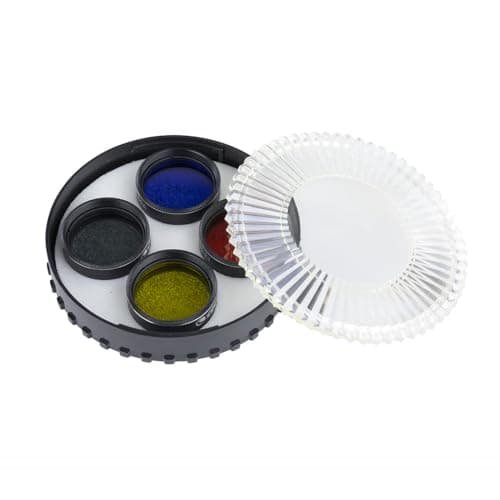 Celestron Lunar and Planetary Filter Set (1.25")Four stackable filters: deep yellow, orange, light blue and a 50 percent neutral density. Two of them earn their place and two will sit in the case. | Pulling detail out of a bright planet | 1.25" thread64x useful | |
| 3 | 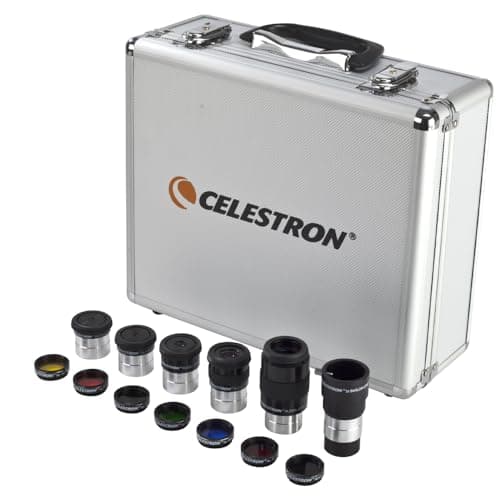 Celestron Eyepiece, Barlow and Filter Kit (1.25")Five Plossl eyepieces from 32mm down to 6mm plus a 2x Barlow. This is the accessory that actually changes what you see. | The upgrade that changes the most | 1.25" barrel64x useful |
Top pick · The cheapest real upgrade
Celestron Moon Filter (1.25")
A neutral-density filter that screws into an eyepiece and makes the full Moon comfortable to look at.
What the aperture allows
- Maximum useful magnification
- 64x
- 2 × 31.75mm of aperture
- Resolving limit (Dawes)
- 3.65 arcseconds
- 116 ÷ 31.75mm
- Cassini division (0.7″)
- Out of reach
- this aperture cannot resolve it
The full Moon through a 130mm telescope is genuinely too bright to look at comfortably, and the discomfort costs you detail: a dazzled eye resolves less.
The filter is neutral density, meaning it cuts the light without shifting the color. Contrast goes up, the glare goes away, and the terminator, the line between lunar day and night where the shadows are longest, becomes the best thing in the sky.
It is the single cheapest item that changes an observing session, and it is the one accessory almost every beginner buys second rather than first.
What it does well
- Turns the full Moon from uncomfortable into detailed
- Threads into any standard 1.25-inch eyepiece
- Costs less than almost anything else that improves a view
What it costs you
- Only useful on the Moon and on Venus
- Redundant if you buy an accessory kit, which usually includes one
Skip this one if: Skip it if you are already buying an eyepiece and filter kit. There is one in the case.
| Optical design | Neutral-density filter that threads into a 1.25-inch eyepiece barrelSource: Celestron Moon Filter — the brand's own listing on Amazon.com (retrieved September 1, 2026) |
|---|---|
| Aperture | 1.25" threadThe fitting size. It threads into the eyepiece, not into the telescope.Source: Celestron Moon Filter — the brand's own listing on Amazon.com (retrieved September 1, 2026) |
| Effect | Reduces lunar glare, improves contrast and reveals surface detailCelestron's own description of what the filter does.Source: Celestron Moon Filter — the brand's own listing on Amazon.com (retrieved September 1, 2026) |
$12.95 · 12% off
#ad · how this is funded · price as of October 21, 2026
Pick 2 · Pulling detail out of a bright planet
Celestron Lunar and Planetary Filter Set (1.25")
Four stackable filters: deep yellow, orange, light blue and a 50 percent neutral density. Two of them earn their place and two will sit in the case.
What the aperture allows
- Maximum useful magnification
- 64x
- 2 × 31.75mm of aperture
- Resolving limit (Dawes)
- 3.65 arcseconds
- 116 ÷ 31.75mm
- Cassini division (0.7″)
- Out of reach
- this aperture cannot resolve it
A colored filter works by subtraction. It blocks part of the spectrum so that whatever is left stands out against it, which raises contrast on a feature that differs in color from its surroundings. It cannot add detail the aperture never resolved.
The #21 orange is the one that earns the set. Celestron's own description is specific about why: cutting blue and green sharpens the boundaries of the Martian plains and lifts the belt structure on Jupiter and Saturn. That is a real, narrow claim rather than a vague one.
The ND-96-0.3 is the workhorse. At 50 percent transmission it cuts the Moon's glare by about a magnitude, which matters above roughly 100mm of aperture where the full Moon is genuinely uncomfortable.
The deep yellow and light blue see far less use. Blue on Mars can help the polar caps stand out and yellow can steady a low-contrast Jupiter belt, but neither is a filter most owners reach for twice a year. That is worth knowing before you buy the set rather than after.
What it does well
- The orange filter has a specific, stated effect on Mars and on the gas-giant belts
- The neutral density filter is the cheapest fix for an uncomfortably bright Moon
- Aluminum cells thread top and bottom, so filters stack
- Cheaper as a set than buying the two useful ones separately
What it costs you
- Two of the four will see very little use
- Every filter costs light, so on a small aperture the cure can be worse than the glare
- Colored filters cannot add detail the aperture did not resolve in the first place
- Redundant on the Moon if you already own a dedicated moon filter
Skip this one if: Skip it if your telescope is under about 100mm. At that aperture you cannot spare the light a colored filter takes, and a plain moon filter covers the one case that matters.
| Optical design | Four 1.25-inch filters in aluminum cells, threaded top and bottom so they stackSource: Celestron — Lunar and Planetary Filter Set - 1.25", published specifications (retrieved September 6, 2026) |
|---|---|
| Aperture | 1.25" threadThe fitting size. Filters thread into the eyepiece barrel, not into the telescope.Source: Celestron — Lunar and Planetary Filter Set - 1.25", published specifications (retrieved September 6, 2026) |
| Contents | Wratten #12 deep yellow, #21 orange, #80A light blue, and an ND-96-0.3 neutral densitySource: Celestron — Lunar and Planetary Filter Set - 1.25", published specifications (retrieved September 6, 2026) |
| Neutral density transmission | 50 percentHalf the light through, which is about one magnitude.Source: Celestron — Lunar and Planetary Filter Set - 1.25", published specifications (retrieved September 6, 2026) |
| What Celestron says the orange does | Sharpens the boundaries along the plains of Mars by reducing blue and green transmission, and enhances belt detail on Jupiter and SaturnSource: Celestron — Lunar and Planetary Filter Set - 1.25", published specifications (retrieved September 6, 2026) |
#ad · how this is funded · price as of October 21, 2026
Pick 3 · The upgrade that changes the most
Celestron Eyepiece, Barlow and Filter Kit (1.25")
Five Plossl eyepieces from 32mm down to 6mm plus a 2x Barlow. This is the accessory that actually changes what you see.
What the aperture allows
- Maximum useful magnification
- 64x
- 2 × 31.75mm of aperture
- Resolving limit (Dawes)
- 3.65 arcseconds
- 116 ÷ 31.75mm
- Cassini division (0.7″)
- Out of reach
- this aperture cannot resolve it
Magnification is telescope focal length divided by eyepiece focal length, so this kit is the variable in that equation. On a 650mm f/5 telescope the 32mm gives 20x, the 13mm gives 50x and the 6mm gives 108x. On a 1200mm Dobsonian the same three give 38x, 92x and 200x.
The 2x Barlow halves every eyepiece's effective focal length, which is where the ten-eyepieces-in-one claim comes from. It is true arithmetic, but a Barlow on a 6mm eyepiece produces 3mm, and on most beginner telescopes 3mm is beyond the useful magnification the aperture supports.
The useful lesson is that the two eyepieces in the telescope's box are usually the two least considered items in it. A 32mm Plossl in a fast Dobsonian gives a genuinely wide, bright field that no bundled eyepiece will match.
A moon filter is not optional at full Moon in anything over about 100mm. The Moon at 130mm is uncomfortably bright, and that is not a figure of speech.
What it does well
- Covers the whole useful magnification range in one purchase rather than five
- Plossl is a well-corrected classic design at a price where the alternatives are not
- The moon filter alone earns its place in anything over 100mm
What it costs you
- The shortest eyepieces exceed the useful magnification of a small telescope
- Plossl eye relief at 6mm is tight, which is awkward for spectacle wearers
- Several of the colored planetary filters see very little use
Skip this one if: Skip it if your telescope has a 2-inch focuser and you would rather put the money toward one good wide-field 2-inch eyepiece.
| Optical design | Five 1.25-inch four-element Plossl eyepieces, a 2x Barlow and seven filtersSource: Celestron Eyepiece, Barlow and Filter Kit — the brand's own listing on Amazon.com (retrieved September 1, 2026) |
|---|---|
| Aperture | 1.25" barrelThe fitting size, not a light-collecting aperture. Check your focuser takes 1.25-inch eyepieces.Source: Celestron Eyepiece, Barlow and Filter Kit — the brand's own listing on Amazon.com (retrieved September 1, 2026) |
| Eyepieces supplied | 32mm, 17mm, 13mm, 8mm and 6mm Plossl, each with a 52-degree apparent fieldSource: Celestron Eyepiece, Barlow and Filter Kit — the brand's own listing on Amazon.com (retrieved September 1, 2026) |
| Barlow | 2x, which doubles the magnification of every eyepiece in the caseSource: Celestron Eyepiece, Barlow and Filter Kit — the brand's own listing on Amazon.com (retrieved September 1, 2026) |
| Filters | A moon filter plus the common colored planetary filtersSource: Celestron Eyepiece, Barlow and Filter Kit — the brand's own listing on Amazon.com (retrieved September 1, 2026) |
$239.95 · 8% off
#ad · how this is funded · price as of October 21, 2026
What to buy, in order
- A moon filter, if your telescope is over about 100mm. Cheapest item here that changes a session immediately.
- Nothing else, for a while. Observe first, find a specific problem, then buy the filter that addresses it.
- The lunar and planetary set, if Mars and Jupiter are what you care about. The orange filter does a stated, specific job and the set costs little more than two filters bought separately.
- A narrowband nebula filter, only from a bright sky and only for nebulae. It is a specialist tool with a narrow, genuine use.
And one thing not to buy: a large colored filter set. Seven filters means five you will not use, and the two that matter are available on their own. The eyepiece and filter kit is the exception, because there the eyepieces justify it and the filters come along.
The two filters most owners end up buying are reviewed in full: the moon filter, which is worth it above about 100mm of aperture and a waste below it, and the colored planetary set inside the eyepiece and filter kit.
Two targets make the strongest case for a filter, for opposite reasons. Venus is bright enough to dazzle, where a neutral-density filter is the only upgrade that improves the view at all. The Orion Nebula is an emission nebula, where a narrowband filter blocks sky glow while passing the nebula's own light.
Questions people actually ask
Do I need a moon filter?
Above about 100mm of aperture at full Moon, effectively yes. The view is uncomfortably bright without one, a dazzled eye resolves less detail, and recovering dark adaptation takes twenty minutes. Below 70mm it is optional.
Do colored telescope filters actually work?
The good ones do a narrow job. Celestron states that its #21 orange sharpens the boundaries of the Martian plains by cutting blue and green transmission, and lifts belt detail on Jupiter and Saturn. That is real. A filter cannot add detail your aperture never resolved.
What is a neutral density filter?
A filter that cuts light evenly across the spectrum, so it dims without shifting color. Celestron's ND-96-0.3 passes 50 percent, roughly one magnitude, which is what makes the full Moon comfortable in a mid-sized telescope.
Do light pollution filters work?
Narrowband filters work well on emission nebulae, which radiate at specific wavelengths the filter passes. They do nothing for galaxies and star clusters, which emit across the whole spectrum, so any filter that blocks sky glow blocks their light too.
Can a filter make my telescope show more?
Only by raising contrast on something already resolved. Filters work by subtraction, so they always reduce total light. On a small aperture that trade often costs more than it returns.
Where do filters go?
They thread into the bottom of the eyepiece barrel, not into the telescope. Most Barlow lenses are also threaded, so a filter can sit on the Barlow while you change eyepieces above it.
Read next
Best accessory upgrade
Telescope Eyepieces: Which Ones You Actually Need
Which eyepiece focal lengths suit your telescope, what exit pupil means, and the cheapest real upgrade available.
Top pick: Celestron Eyepiece, Barlow and Filter Kit (1.25")
$239.95 · 8% off
#ad · how this is funded · price as of October 21, 2026
The Moon Through a Telescope, and the Magnification to Use
The magnification that suits the Moon, why full Moon is the worst night to look, and what a moon filter actually fixes.
Top pick: Celestron Moon Filter (1.25")
$12.95 · 12% off
#ad · how this is funded · price as of October 21, 2026
Best Barlow
Barlow Lenses: When They Double Your Eyepieces and When They Waste Them
A Barlow doubles every eyepiece you own. The arithmetic that decides whether that helps your telescope or wastes it.
Top pick: Celestron X-Cel LX 2x Barlow Lens (1.25")
$124.95 · 20% off
#ad · how this is funded · price as of October 21, 2026
Found something wrong here? Tell us and we will correct it and date the correction, per our editorial policy.