What You Can Actually See
What Venus Looks Like Through a Telescope
Venus is the one bright planet where buying a bigger telescope changes almost nothing. It is a phase, not a surface, and the thing that improves the view costs eleven dollars.
By Scooter M. · Published · How we pick
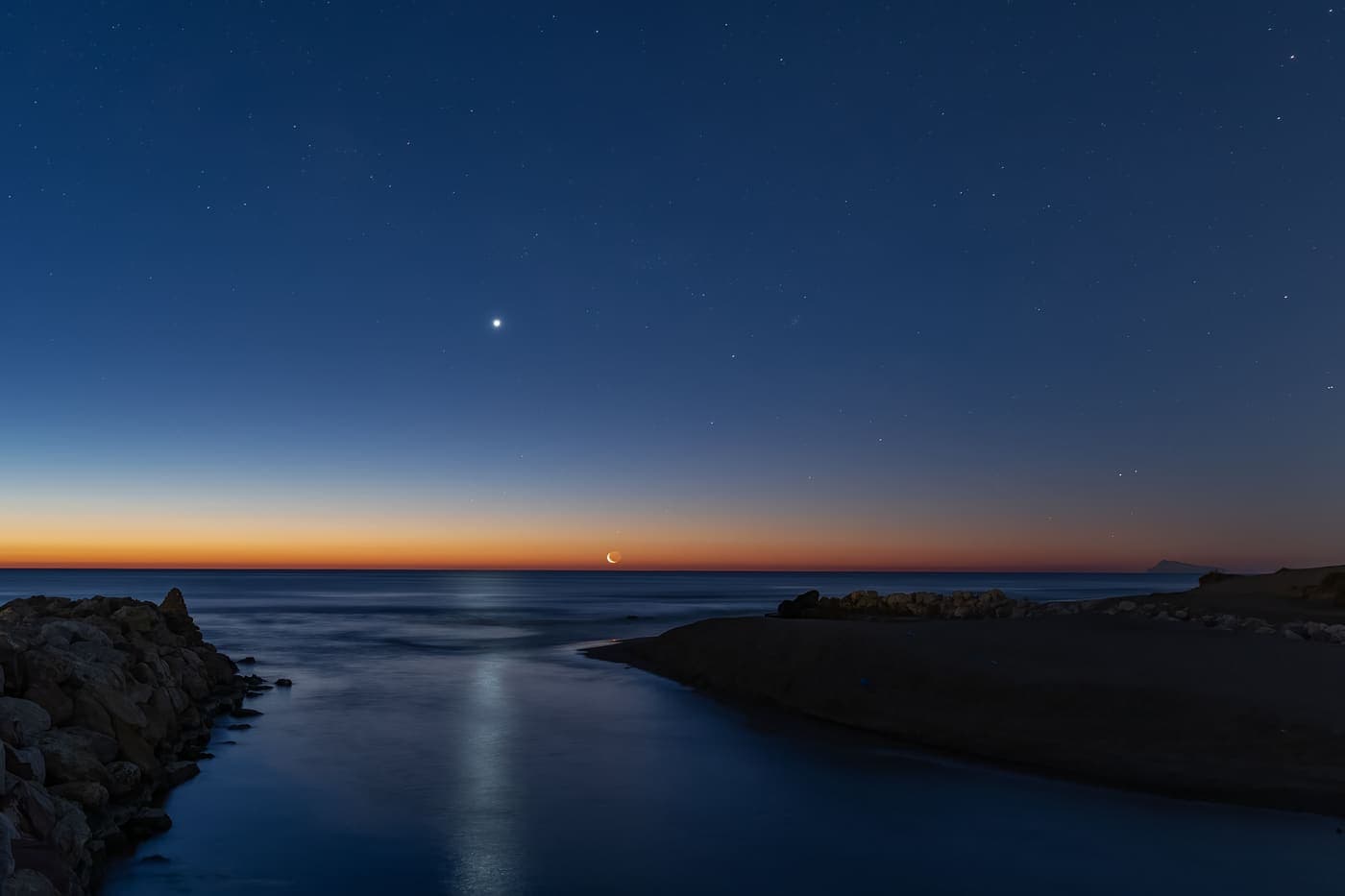
Venus through any telescope is a brilliant white crescent or gibbous disc with no markings on it at all, and a 70mm refractor such as the AstroMaster 70AZ shows that as completely as a 200mm does. The upgrade that actually changes this view is not aperture: it is an $11 neutral-density filter, because Venus at magnitude -4.9 is bright enough to dazzle the eye that is trying to resolve it.
That makes Venus unusual and worth understanding before you spend money. Everywhere else on this site the answer to "what will I see more of" is aperture. On Venus it genuinely is not.
Why there is no surface to see
Venus is wrapped in cloud that covers the whole planet and prevents visual observation of the surface. Those clouds are also why it is so bright: they reflect nearly 70% of the sunlight that reaches them, an albedo of 0.68. NASA calls it a cloud-swaddled planet, and from an eyepiece that is exactly what it is.
So no telescope on Earth shows a feature on Venus. A 200mm shows the same blank white shape a 70mm does, slightly brighter and slightly sharper-edged. This is the one case on this site where we would actively tell a buyer not to spend more.
The phases, which are the actual reward
Venus orbits inside Earth's orbit, so it shows phases exactly as the Moon does. Seeing Venus as a crescent for the first time is a genuine surprise for most people, because nothing in everyday life suggests the brightest object in the evening sky is a crescent.
nearest = largest and thinnest. farthest = smallest and fullest.
Angular diameter range: 9.7 arcsec (full, far side of the Sun) to 66.0 arcsec (new, between Earth and Sun).
Venus is at its largest and at its "new" phase when it is between Earth and the Sun, and a small full disc when it is on the far side. At maximum elongation it shows a larger quarter-phase disc. A 66-arcsecond crescent is bigger than Jupiter ever gets.
What you will actually see, by aperture
| Aperture | What appears |
|---|---|
| 70mm | The phase, cleanly. A sharp bright crescent or gibbous disc. |
| 102mm | The same phase, brighter. Dazzling without a filter. |
| 130mm | The same phase, brighter again. A filter is now close to necessary. |
| 150mm | No additional detail. More glare to manage. |
| 200mm | No additional detail. Markedly uncomfortable unfiltered. |
A refractor has a small edge here that has nothing to do with aperture: no secondary mirror or support vanes in the light path means slightly higher contrast on a bright, simple target and no diffraction spikes off the vanes. On a blank white crescent, that is the only optical difference worth naming.
Magnification is similarly undemanding. At 66 arcseconds Venus is larger than Jupiter ever gets, so 60x to 100x shows the phase comfortably and more power mostly magnifies the atmospheric turbulence along with it. If a view of Venus looks soft, the usual cause is that it is low in the sky rather than that the magnification is too low.
Finding Venus, which is easier than finding anything else
Venus always lies within about 47 degrees of the Sun, so it is only ever a morning or an evening object, never visible in the middle of the night. In practice that is a help rather than a limit: it means Venus is the brilliant point low in the west after sunset or low in the east before dawn, and there is nothing else it can be confused with.
It is also the one planet worth observing in daylight. Venus is bright enough to find in a blue sky if you know exactly where to point, which is where a phone-finding or GoTo mount earns its money, and the sky being bright suppresses the glare problem for free.
How these picks were judged
- Contrast before aperture. Venus is a bright, simple, low-contrast-requirement target, so an unobstructed refractor leads rather than the biggest mirror.
- Glare control counts as performance. A dazzled eye resolves less, so the filters here are ranked as genuine Venus equipment rather than as accessories.
- Finding it in twilight and daylight is a real feature. A mount that can point at a specific blue-sky coordinate turns daytime Venus from luck into a plan.
- Aperture was deliberately not rewarded. No pick is ranked higher for being bigger, because on this one target bigger does not help.
- Nothing here is a Venus-only purchase. Every pick is useful across the rest of the sky, because a telescope bought for Venus alone would be a poor buy.
Which of these is for you
| Pick | Best for | The catch |
|---|---|---|
| Celestron AstroMaster 70AZ | Best for Venus specifically: an unobstructed 70mm shows the phase as well as anything does, with the least glare to manage | Everything fainter than a planet is limited by this aperture, so it is a poor only-telescope |
| Celestron StarSense Explorer DX 130AZ | Best all-rounder that includes Venus, and the phone finding is what makes daylight Venus repeatable | 130mm makes Venus brighter, not better, so budget for a filter alongside it |
| Sky-Watcher Heritage 130P | Best value if Venus is one target among many rather than the reason for buying | A fast Newtonian is the least natural Venus instrument here, and it needs the filter most |
| Celestron Moon Filter | Best upgrade on this entire page, at a fraction of the cost of any telescope on it | Only useful on the Moon and Venus, and redundant if you buy the filter set below |
| Celestron Lunar and Planetary Filter Set | Best for someone who will observe all the planets and wants the color filters too | Overkill if Venus and the Moon are the only bright targets you care about |
How this is funded: the buy buttons below are Amazon Associates links, and a qualifying purchase earns us a commission at no extra cost to you. It cannot move the ranking, because the order here is set by aperture per dollar, and no commission rate changes how much light a mirror collects. Full disclosure.
| # | Telescope | Best for | Aperture | Price |
|---|---|---|---|---|
| 1 | 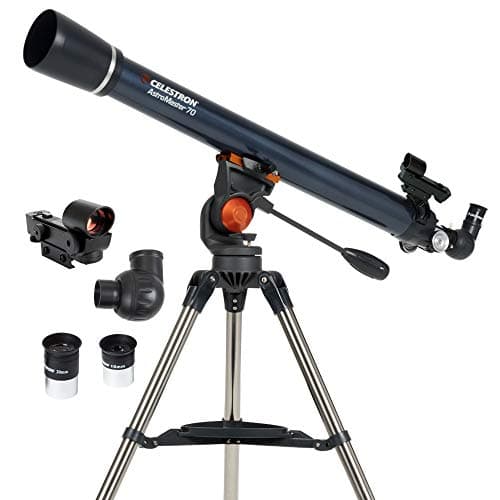 Celestron AstroMaster 70AZTop pick70mm of refractor optics at f/13, on a steel tripod. A long, slow tube that trades field of view and weight for cleaner views of the Moon and planets. | The smallest scope worth owning | 70mm (2.76 in)140x useful | |
| 2 | 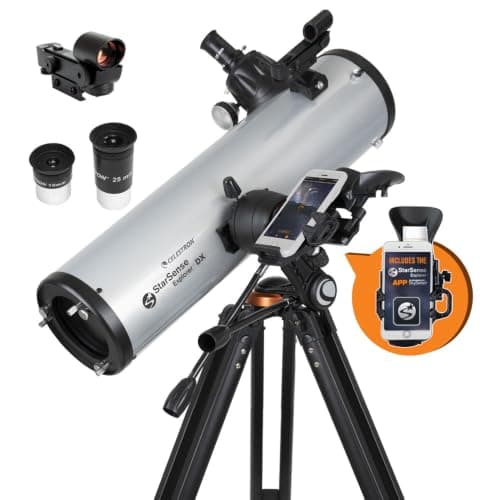 Celestron StarSense Explorer DX 130AZ130mm of parabolic aperture on a mount that stays still, plus the one piece of software that genuinely solves the find-it problem. | Most first buyers | 130mm (5.11 in)260x useful | |
| 3 | 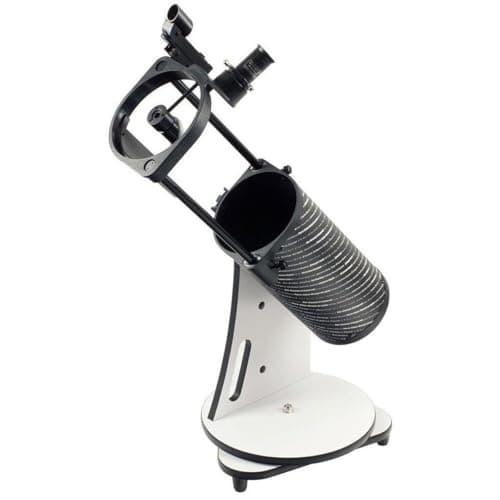 Sky-Watcher Heritage 130 Tabletop DobsonianThe same 130mm parabolic mirror as scopes costing far more, on a base with no tripod to wobble and nothing to set up. | Most aperture per dollar | 130mm260x useful | |
| 4 | 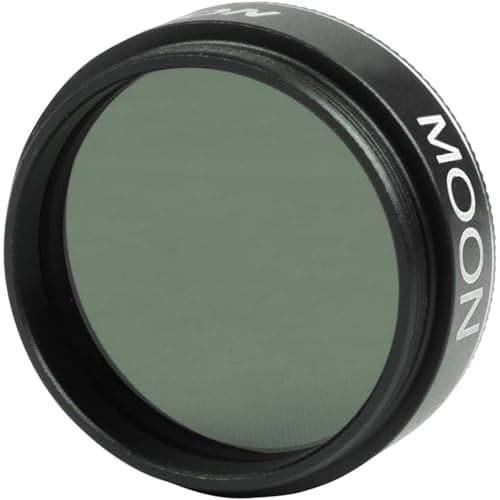 Celestron Moon Filter (1.25")A neutral-density filter that screws into an eyepiece and makes the full Moon comfortable to look at. | The cheapest real upgrade | 1.25" thread64x useful | |
| 5 | 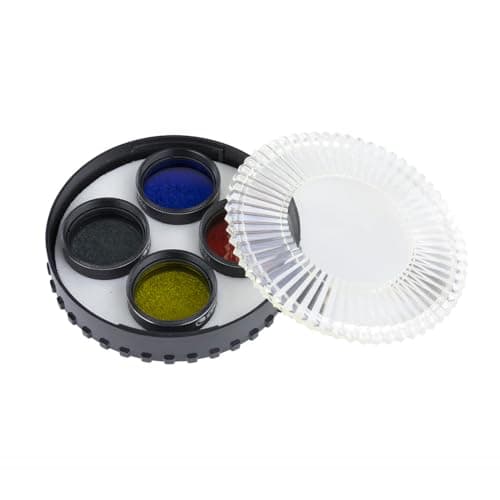 Celestron Lunar and Planetary Filter Set (1.25")Four stackable filters: deep yellow, orange, light blue and a 50 percent neutral density. Two of them earn their place and two will sit in the case. | Pulling detail out of a bright planet | 1.25" thread64x useful |
Top pick · The smallest scope worth owning
Celestron AstroMaster 70AZ
70mm of refractor optics at f/13, on a steel tripod. A long, slow tube that trades field of view and weight for cleaner views of the Moon and planets.
What the aperture allows
- Maximum useful magnification
- 140x
- 2 × 70mm of aperture
- Resolving limit (Dawes)
- 1.66 arcseconds
- 116 ÷ 70mm
- Cassini division (0.7″)
- Out of reach
- this aperture cannot resolve it
Celestron publishes 165x as this telescope’s highest useful magnification. Our figure is 140x, from two times the aperture in millimeters. The gap of 25x comes from the slightly more generous per-inch constant makers use. Neither number describes a typical night: the atmosphere usually settles the question well below both.
Worked example: a 25mm eyepiece in this telescope gives 900mm ÷ 25mm = 36x.
70mm is the floor. Below it a telescope struggles to beat a decent pair of binoculars, and that is a real comparison rather than a rhetorical one. Two times 70mm gives 140x of useful magnification; Celestron publishes 165x.
The defining number is the focal length. Celestron publishes 900mm, which at 70mm is f/13, an unusually slow ratio for a beginner refractor. A slow achromat brings the colors closer to a common focus, so the violet fringe on the Moon and on Jupiter is smaller than on a faster tube of the same aperture.
The same slow ratio narrows the field. At 45x with the supplied 20mm eyepiece, large star clusters that fit comfortably in a short refractor will not fit here, and finding things takes a steadier hand on the red dot finder.
It is also a large, heavy package for 70mm of aperture: a 685mm tube and a published 10.8 lb kit. That buys a steadier steel tripod than the lightest travel telescopes carry, and it costs portability.
What it does well
- Sealed tube: no collimation, no mirror cleaning, essentially no maintenance
- At f/13, less false color on the Moon and bright planets than a faster 70mm tube
- A steel tripod that is steadier than the lightweight tripods on travel telescopes
- The supplied eyepieces give 45x and 90x, a useful planetary range with no extra purchase
What it costs you
- 70mm collects too little light for galaxies and most nebulae
- The f/13 focal ratio narrows the field, so large clusters and finding things are harder
- A published 10.8 lb and a 685mm tube is a lot to carry for 70mm of aperture
- Chromatic aberration is reduced at f/13, not eliminated
Skip this one if: Skip it if what you actually want is deep sky, or a telescope you can carry easily. No eyepiece will make 70mm show you a spiral arm, and a travel refractor does the carrying better.
$199.95 · 10% off
#ad · how this is funded · price as of October 18, 2026
Pick 2 · Most first buyers
Celestron StarSense Explorer DX 130AZ
130mm of parabolic aperture on a mount that stays still, plus the one piece of software that genuinely solves the find-it problem.
What the aperture allows
- Maximum useful magnification
- 260x
- 2 × 130mm of aperture
- Resolving limit (Dawes)
- 0.89 arcseconds
- 116 ÷ 130mm
- Cassini division (0.7″)
- Out of reach
- this aperture cannot resolve it
Celestron publishes 307x as this telescope’s highest useful magnification. Our figure is 260x, from two times the aperture in millimeters. The gap of 47x comes from the slightly more generous per-inch constant makers use. Neither number describes a typical night: the atmosphere usually settles the question well below both.
Worked example: a 25mm eyepiece in this telescope gives 650mm ÷ 25mm = 26x.
130mm is the aperture where the sky stops being a list of bright dots. Two times that aperture is 260x of useful magnification, which is more than the atmosphere will usually give you on any given night, so nothing in this telescope's optical budget is wasted on a number you cannot use.
Celestron's own published ceiling for it is 307x, which sits above the 2x-aperture rule of thumb. The gap is worth knowing about: manufacturers compute that figure per inch of aperture with a slightly more generous constant. Neither number describes a night you will actually have. Plan around 130x to 180x and treat anything higher as a rare-night bonus.
At f/5 the focal length is short, so the supplied 25mm eyepiece gives a wide, forgiving 26x that makes finding things possible in the first place. That is not a compromise; it is the eyepiece you will use most.
The StarSense part is the honest reason this sits at the top. It uses your phone's camera to plate-solve the actual sky and then walks you to a target with an on-screen arrow. It is not a motor and it does not track. It solves the problem that really kills first telescopes, which is not being able to find anything.
What it does well
- 130mm parabolic mirror rather than the cheaper spherical mirror used at this price by several competitors
- The phone-based finder works and needs no alignment stars, no power and no hand controller
- Full-height tripod, so an adult uses it standing up rather than kneeling on wet grass
- Manual mount means nothing to charge, nothing to fail and nothing to re-align next time
What it costs you
- The bundled 10mm eyepiece is the weakest part of the package
- A Newtonian needs collimation checks; not hard, but it is a task a refractor does not have
- No tracking, so at high magnification you are nudging the tube every 30 seconds
Skip this one if: Skip it if the person receiving it is under about ten and will be using it alone. The tripod is full height and the finding workflow assumes a phone.
#ad · how this is funded · price as of October 18, 2026
Pick 3 · Most aperture per dollar
Sky-Watcher Heritage 130 Tabletop Dobsonian
The same 130mm parabolic mirror as scopes costing far more, on a base with no tripod to wobble and nothing to set up.
What the aperture allows
- Maximum useful magnification
- 260x
- 2 × 130mm of aperture
- Resolving limit (Dawes)
- 0.89 arcseconds
- 116 ÷ 130mm
- Cassini division (0.7″)
- Out of reach
- this aperture cannot resolve it
Worked example: a 25mm eyepiece in this telescope gives 650mm ÷ 25mm = 26x.
This is the aperture-per-dollar champion of the beginner shelf and it is not close. You get the same 130mm parabolic mirror found in telescopes at twice the price, and you get it without paying for a tripod, a slow-motion assembly or a hand controller.
Two times 130mm is 260x of useful magnification. Dawes' limit at 130mm works out to 116 divided by 130, which is 0.89 arcseconds. The Cassini division in Saturn's rings spans roughly 0.7 arcseconds at its widest, so this telescope sits right at the edge of showing it on a still night and will show the rings themselves easily.
The catch is the word tabletop. It needs a surface at roughly chest height when you are seated. A garden table works, a plastic patio chair does not, and buying one without thinking about where it will stand is the single most common regret with this design.
The tube collapses, which is what makes it live in a cupboard rather than a garage. That matters more than it sounds: the telescope you can carry outside in one trip is the telescope you use.
What it does well
- The most aperture you can buy at this price, by a clear margin
- Nothing to assemble, no tripod to wobble, ready in the time it takes to carry it outside
- Collapsible tube stores in a cupboard and keeps its collimation
- The Dobsonian motion is intuitive: you push the tube where you want to look
What it costs you
- Needs a solid table or stool at the right height, which is a real constraint
- The helical focuser is coarser than a rack-and-pinion or a Crayford
- Open tube design collects dust and needs the odd mirror clean
Skip this one if: Skip it if you have nowhere to stand it. On the ground it points at treetops, and on a wobbly plastic table every view shakes.
$305.00 · 12% off
#ad · how this is funded · price as of October 18, 2026
Pick 4 · The cheapest real upgrade
Celestron Moon Filter (1.25")
A neutral-density filter that screws into an eyepiece and makes the full Moon comfortable to look at.
What the aperture allows
- Maximum useful magnification
- 64x
- 2 × 31.75mm of aperture
- Resolving limit (Dawes)
- 3.65 arcseconds
- 116 ÷ 31.75mm
- Cassini division (0.7″)
- Out of reach
- this aperture cannot resolve it
The full Moon through a 130mm telescope is genuinely too bright to look at comfortably, and the discomfort costs you detail: a dazzled eye resolves less.
The filter is neutral density, meaning it cuts the light without shifting the color. Contrast goes up, the glare goes away, and the terminator, the line between lunar day and night where the shadows are longest, becomes the best thing in the sky.
It is the single cheapest item that changes an observing session, and it is the one accessory almost every beginner buys second rather than first.
What it does well
- Turns the full Moon from uncomfortable into detailed
- Threads into any standard 1.25-inch eyepiece
- Costs less than almost anything else that improves a view
What it costs you
- Only useful on the Moon and on Venus
- Redundant if you buy an accessory kit, which usually includes one
Skip this one if: Skip it if you are already buying an eyepiece and filter kit. There is one in the case.
| Optical design | Neutral-density filter that threads into a 1.25-inch eyepiece barrelSource: Celestron Moon Filter — the brand's own listing on Amazon.com (retrieved September 1, 2026) |
|---|---|
| Aperture | 1.25" threadThe fitting size. It threads into the eyepiece, not into the telescope.Source: Celestron Moon Filter — the brand's own listing on Amazon.com (retrieved September 1, 2026) |
| Effect | Reduces lunar glare, improves contrast and reveals surface detailCelestron's own description of what the filter does.Source: Celestron Moon Filter — the brand's own listing on Amazon.com (retrieved September 1, 2026) |
$12.95 · 12% off
#ad · how this is funded · price as of October 18, 2026
Pick 5 · Pulling detail out of a bright planet
Celestron Lunar and Planetary Filter Set (1.25")
Four stackable filters: deep yellow, orange, light blue and a 50 percent neutral density. Two of them earn their place and two will sit in the case.
What the aperture allows
- Maximum useful magnification
- 64x
- 2 × 31.75mm of aperture
- Resolving limit (Dawes)
- 3.65 arcseconds
- 116 ÷ 31.75mm
- Cassini division (0.7″)
- Out of reach
- this aperture cannot resolve it
A colored filter works by subtraction. It blocks part of the spectrum so that whatever is left stands out against it, which raises contrast on a feature that differs in color from its surroundings. It cannot add detail the aperture never resolved.
The #21 orange is the one that earns the set. Celestron's own description is specific about why: cutting blue and green sharpens the boundaries of the Martian plains and lifts the belt structure on Jupiter and Saturn. That is a real, narrow claim rather than a vague one.
The ND-96-0.3 is the workhorse. At 50 percent transmission it cuts the Moon's glare by about a magnitude, which matters above roughly 100mm of aperture where the full Moon is genuinely uncomfortable.
The deep yellow and light blue see far less use. Blue on Mars can help the polar caps stand out and yellow can steady a low-contrast Jupiter belt, but neither is a filter most owners reach for twice a year. That is worth knowing before you buy the set rather than after.
What it does well
- The orange filter has a specific, stated effect on Mars and on the gas-giant belts
- The neutral density filter is the cheapest fix for an uncomfortably bright Moon
- Aluminum cells thread top and bottom, so filters stack
- Cheaper as a set than buying the two useful ones separately
What it costs you
- Two of the four will see very little use
- Every filter costs light, so on a small aperture the cure can be worse than the glare
- Colored filters cannot add detail the aperture did not resolve in the first place
- Redundant on the Moon if you already own a dedicated moon filter
Skip this one if: Skip it if your telescope is under about 100mm. At that aperture you cannot spare the light a colored filter takes, and a plain moon filter covers the one case that matters.
| Optical design | Four 1.25-inch filters in aluminum cells, threaded top and bottom so they stackSource: Celestron — Lunar and Planetary Filter Set - 1.25", published specifications (retrieved September 6, 2026) |
|---|---|
| Aperture | 1.25" threadThe fitting size. Filters thread into the eyepiece barrel, not into the telescope.Source: Celestron — Lunar and Planetary Filter Set - 1.25", published specifications (retrieved September 6, 2026) |
| Contents | Wratten #12 deep yellow, #21 orange, #80A light blue, and an ND-96-0.3 neutral densitySource: Celestron — Lunar and Planetary Filter Set - 1.25", published specifications (retrieved September 6, 2026) |
| Neutral density transmission | 50 percentHalf the light through, which is about one magnitude.Source: Celestron — Lunar and Planetary Filter Set - 1.25", published specifications (retrieved September 6, 2026) |
| What Celestron says the orange does | Sharpens the boundaries along the plains of Mars by reducing blue and green transmission, and enhances belt detail on Jupiter and SaturnSource: Celestron — Lunar and Planetary Filter Set - 1.25", published specifications (retrieved September 6, 2026) |
#ad · how this is funded · price as of October 18, 2026
Four things that genuinely improve a Venus view
- Use a neutral-density or moon filter. This is the whole recommendation. It cuts the glare without shifting the color, and the phase edge becomes crisp instead of flaring.
- Observe it in twilight rather than full darkness. A bright sky reduces the brightness contrast between Venus and its background, which is exactly the problem you are trying to solve.
- Try it in daylight. Venus against a blue sky is comfortable, sharp and a completely different experience from Venus as a searchlight in a dark sky.
- Watch it over weeks, not minutes. The phase changes visibly over a month. That progression is the reward here, and it is the one thing a single session cannot give you.
The project worth building a few months around
Venus rewards a sequence of short observations far more than one long session, because the thing that changes is the phase and it changes over weeks. Sketch or photograph it once a fortnight through an apparition and you end up with the actual geometry of the inner solar system drawn in your own notebook.
The shape of that sequence follows from the orbit. Venus swings out to about 47 degrees from the Sun, shows a larger quarter-phase disc near that maximum elongation, then grows while thinning toward a brilliant crescent as it comes around between Earth and the Sun. Catch it at three or four points along that path and the progression is unmistakable.
If the filter is the real conclusion of this page, the filters guide covers what each type does and which are worth owning, and the accessories order puts it in sequence against everything else you might buy next.
Questions people actually ask
What does Venus look like through a telescope?
A brilliant white crescent, half or gibbous disc with no markings at all. Its clouds cover the whole planet and prevent visual observation of the surface, so no amateur telescope shows a feature. The phase is the thing to look for, and it changes noticeably over a few weeks.
What size telescope do you need to see Venus?
60mm to 70mm is genuinely enough, and more aperture adds brightness rather than detail. Venus ranges from 9.7 to 66.0 arcseconds, so the phase is easy at any aperture on this site. The useful upgrade is a neutral-density filter, not a bigger telescope.
Why can't you see the surface of Venus?
Because of permanent global cloud. Those clouds also give Venus an albedo of 0.68, reflecting nearly 70% of the light that hits them, which is why it is the brightest planet. Radar and orbiters have mapped the surface; no optical telescope on Earth can see it.
Why is Venus so bright in my telescope?
Because it reaches magnitude -4.92, brighter than any other planet. At 130mm and up it is uncomfortable to look at and the discomfort costs you sharpness, since a dazzled eye resolves less. A moon or neutral-density filter solves it for about $11.
Can you see Venus during the day?
Yes, if you can point accurately. Venus is bright enough to be found against a blue sky, and a phone-finding or GoTo mount makes that repeatable rather than lucky. Daytime Venus is often the sharpest, most comfortable view of it you will get.
Why does Venus have phases?
Because it orbits inside Earth's orbit, so we see varying fractions of its lit hemisphere. It is largest and "new" when between Earth and the Sun, and a small full disc when on the far side. Its brightest magnitude comes during the crescent phase about a month either side of inferior conjunction.
Read next
Best for the planets
The Best Telescopes for Seeing the Planets
Telescopes ranked for planetary detail, where resolving limit and mount steadiness matter more than raw light-gathering.
Top pick: Celestron NexStar 6SE
#ad · how this is funded · price as of October 18, 2026
Best filter buy
Telescope Filters: Which Ones Earn Their Place
A moon filter is the one that changes a session. What the colored planetary filters do, and why most of them stay in the case.
Top pick: Celestron Moon Filter (1.25")
$12.95 · 12% off
#ad · how this is funded · price as of October 18, 2026
Can You See Mercury With a Telescope?
Mercury shows a phase and nothing else. Why a clear western horizon matters more than aperture, and how to catch it safely.
Top pick: Celestron AstroMaster 70AZ
$199.95 · 10% off
#ad · how this is funded · price as of October 18, 2026
Found something wrong here? Tell us and we will correct it and date the correction, per our editorial policy.