What You Can Actually See
Can You See Mercury With a Telescope?
Mercury is the planet most amateur astronomers have never knowingly looked at, and the obstacle is not that it is faint. It is that it is never far from the Sun.
By Scooter M. · Published · How we pick
Yes. Mercury shows a small phase, like a miniature Venus, and a 70mm refractor such as the AstroMaster 70AZ is enough to show it. What decides whether you see it is not the telescope: Mercury never gets further than 27.8 degrees from the Sun, so it is always low in a bright twilight sky, and an unobstructed western or eastern horizon matters more than any amount of aperture.
Set expectations correctly and Mercury is a good target. Set them from a photograph and it is the most disappointing object in the solar system. Ground-based telescopes show an illuminated partial disk with limited detail, and that is the whole view at any aperture.
Why Mercury is hard, and it is not brightness
Mercury reaches magnitude -2.48, which is brighter than any star in the sky. Faintness is not the problem. Geometry is.
Mercury orbits the Sun every 88 days at an average distance of 36 million miles, well inside Earth's orbit. From here it therefore always appears close to the Sun, as either a morning or an evening object, and it is lost in the Sun's glare for much of the time. Even at greatest elongation, the best separation it ever achieves is 27.8 degrees at aphelion.
Twenty-seven degrees sounds like plenty until you translate it. It means Mercury sets roughly an hour and a half after the Sun at best, and for most of that time it is sitting in the murk within 10 degrees of the horizon, where you are looking through several times as much atmosphere as at the zenith.
Making sure it is actually Mercury
Three things in a twilight sky get mistaken for it, and all three are easy to rule out. An aircraft moves visibly within seconds and usually shows a blinking light. Venus, when it is on the same side of the sky, is over ten times brighter and higher up; if there are two bright points low in the west, Mercury is the fainter and lower one. A bright star twinkles hard near the horizon, where Mercury's small disc twinkles noticeably less.
The decisive test is simply looking again fifteen minutes later. Mercury will have moved with the sky and sunk lower; an aircraft will be gone. Confirming the identification matters more here than on any other planet, because a first sighting of Mercury is usually a sighting of something else.
What you will actually see, by aperture
| Aperture | Resolving limit | What appears |
|---|---|---|
| 70mm | 1.66 arcsec | A tiny pinkish-white disc; the phase on a good evening. |
| 102mm | 1.14 arcsec | The phase clearly, when the air is steady. |
| 130mm | 0.89 arcsec | A clean phase. No surface markings. |
| 200mm | 0.58 arcsec | A clean phase, often blurred by low-altitude seeing anyway. |
Note what the right-hand column does not do: it does not improve. Mercury shows phases like the Moon and Venus, is new at inferior conjunction and full at superior conjunction, and is invisible from Earth at both. Between those points you get a crescent or a gibbous disc, and that is the complete list of Mercury observations available from the ground. Even the Hubble Space Telescope cannot observe it, because pointing that close to the Sun is prohibited.
Why low altitude costs more than small aperture
atmospheric seeing on a typical night = 2 to 3 arcsec
Mercury's angular diameter: 4.5 to 13 arcsec. At 13 arcsec, a 3-arcsec blur removes nearly a quarter of the disc's width.
And seeing near the horizon is far worse than the typical figure, because you are looking through a longer path of turbulent air. This is why a 70mm at a site with a flat western horizon regularly beats a 200mm with a rooftop in the way.
How these picks were judged
- Portability ranks above aperture. The decisive factor is getting to a spot with a clear low horizon, which usually means carrying the telescope somewhere rather than using the yard.
- No cooldown is an advantage. A twilight window lasts under an hour. A refractor works the moment you set it down; a large mirror may still be shedding heat when Mercury sets.
- Pointing accuracy earns its place. Knowing exactly where to look in a bright sky is most of the problem, so phone-finding and GoTo are genuine Mercury features.
- Aperture was not rewarded for its own sake. Nothing above 100mm shows more of Mercury, so the 203mm is on this list for its tracking and pointing, not its mirror.
- Every pick is a general-purpose telescope. Nobody should buy an instrument for Mercury alone, and none of these would need to be.
Which of these is for you
| Telescope | Best for | The catch |
|---|---|---|
| Celestron AstroMaster 70AZ | Best for Mercury: no cooldown, light enough to carry to a clear horizon, and 70mm is all the aperture the target needs | A poor choice as an only telescope, because everything faint is beyond it |
| Celestron StarSense Explorer DX 130AZ | Best for finding it at all: the phone plate-solves your actual sky, which beats guessing in bright twilight | Heavier to carry to a horizon spot, and 130mm adds nothing to the view itself |
| Celestron NexStar 8SE | Best if you want it centered and tracked in a short twilight window with no fiddling | Needs to be aligned before the window opens, and a warm tube in cool evening air blurs a low target |
| Celestron Travel Scope 70 | Best for the one job that matters here: walking to a spot where the western sky is actually open | A compromise optically and mechanically; buy it as a travel scope that can catch Mercury, not as a Mercury telescope |
How this is funded: the buy buttons below are Amazon Associates links, and a qualifying purchase earns us a commission at no extra cost to you. It cannot move the ranking, because the order here is set by aperture per dollar, and no commission rate changes how much light a mirror collects. Full disclosure.
| # | Telescope | Best for | Aperture | Price |
|---|---|---|---|---|
| 1 | 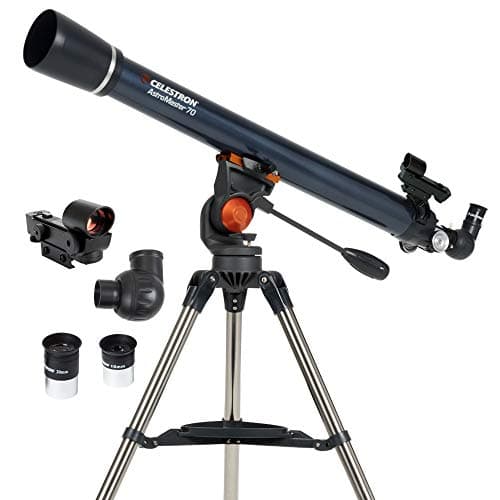 Celestron AstroMaster 70AZTop pick70mm of refractor optics at f/13, on a steel tripod. A long, slow tube that trades field of view and weight for cleaner views of the Moon and planets. | The smallest scope worth owning | 70mm (2.76 in)140x useful | |
| 2 | 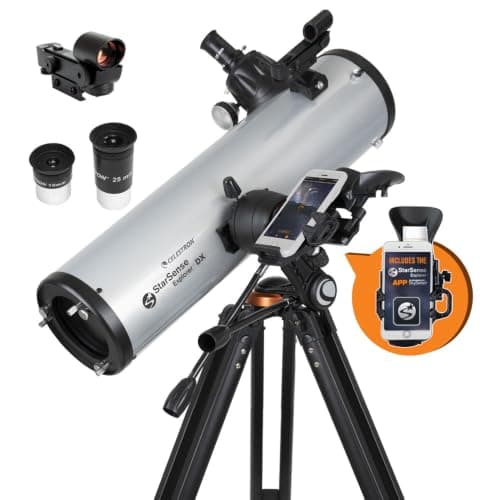 Celestron StarSense Explorer DX 130AZ130mm of parabolic aperture on a mount that stays still, plus the one piece of software that genuinely solves the find-it problem. | Most first buyers | 130mm (5.11 in)260x useful | |
| 3 | 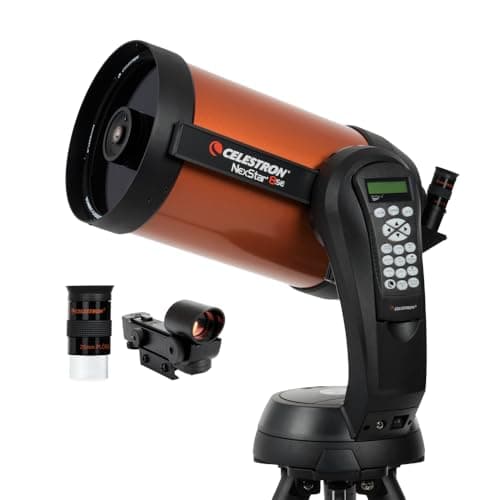 Celestron NexStar 8SE203mm of Schmidt-Cassegrain at f/10 on a computerized fork. The largest aperture on this site that still finds and follows objects by itself. | The most aperture that still tracks | 203.2mm (8")406x useful | |
| 4 | 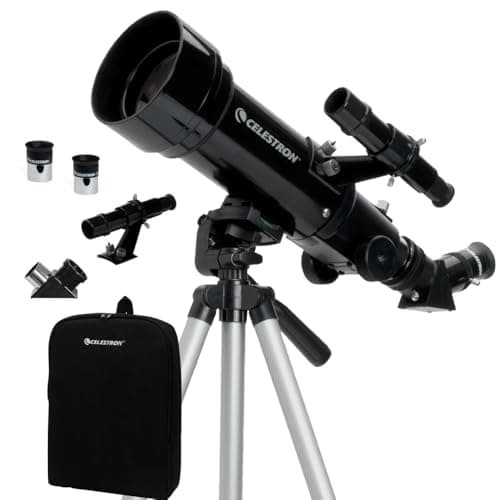 Celestron Travel Scope 7070mm at f/5.7 with a backpack. A daytime spotting scope that moonlights at night, rather than the other way round. | Packing light | 70mm (2.8 in)140x useful |
Top pick · The smallest scope worth owning
Celestron AstroMaster 70AZ
70mm of refractor optics at f/13, on a steel tripod. A long, slow tube that trades field of view and weight for cleaner views of the Moon and planets.
What the aperture allows
- Maximum useful magnification
- 140x
- 2 × 70mm of aperture
- Resolving limit (Dawes)
- 1.66 arcseconds
- 116 ÷ 70mm
- Cassini division (0.7″)
- Out of reach
- this aperture cannot resolve it
Celestron publishes 165x as this telescope’s highest useful magnification. Our figure is 140x, from two times the aperture in millimeters. The gap of 25x comes from the slightly more generous per-inch constant makers use. Neither number describes a typical night: the atmosphere usually settles the question well below both.
Worked example: a 25mm eyepiece in this telescope gives 900mm ÷ 25mm = 36x.
70mm is the floor. Below it a telescope struggles to beat a decent pair of binoculars, and that is a real comparison rather than a rhetorical one. Two times 70mm gives 140x of useful magnification; Celestron publishes 165x.
The defining number is the focal length. Celestron publishes 900mm, which at 70mm is f/13, an unusually slow ratio for a beginner refractor. A slow achromat brings the colors closer to a common focus, so the violet fringe on the Moon and on Jupiter is smaller than on a faster tube of the same aperture.
The same slow ratio narrows the field. At 45x with the supplied 20mm eyepiece, large star clusters that fit comfortably in a short refractor will not fit here, and finding things takes a steadier hand on the red dot finder.
It is also a large, heavy package for 70mm of aperture: a 685mm tube and a published 10.8 lb kit. That buys a steadier steel tripod than the lightest travel telescopes carry, and it costs portability.
What it does well
- Sealed tube: no collimation, no mirror cleaning, essentially no maintenance
- At f/13, less false color on the Moon and bright planets than a faster 70mm tube
- A steel tripod that is steadier than the lightweight tripods on travel telescopes
- The supplied eyepieces give 45x and 90x, a useful planetary range with no extra purchase
What it costs you
- 70mm collects too little light for galaxies and most nebulae
- The f/13 focal ratio narrows the field, so large clusters and finding things are harder
- A published 10.8 lb and a 685mm tube is a lot to carry for 70mm of aperture
- Chromatic aberration is reduced at f/13, not eliminated
Skip this one if: Skip it if what you actually want is deep sky, or a telescope you can carry easily. No eyepiece will make 70mm show you a spiral arm, and a travel refractor does the carrying better.
$199.95 · 10% off
#ad · how this is funded · price as of October 18, 2026
Pick 2 · Most first buyers
Celestron StarSense Explorer DX 130AZ
130mm of parabolic aperture on a mount that stays still, plus the one piece of software that genuinely solves the find-it problem.
What the aperture allows
- Maximum useful magnification
- 260x
- 2 × 130mm of aperture
- Resolving limit (Dawes)
- 0.89 arcseconds
- 116 ÷ 130mm
- Cassini division (0.7″)
- Out of reach
- this aperture cannot resolve it
Celestron publishes 307x as this telescope’s highest useful magnification. Our figure is 260x, from two times the aperture in millimeters. The gap of 47x comes from the slightly more generous per-inch constant makers use. Neither number describes a typical night: the atmosphere usually settles the question well below both.
Worked example: a 25mm eyepiece in this telescope gives 650mm ÷ 25mm = 26x.
130mm is the aperture where the sky stops being a list of bright dots. Two times that aperture is 260x of useful magnification, which is more than the atmosphere will usually give you on any given night, so nothing in this telescope's optical budget is wasted on a number you cannot use.
Celestron's own published ceiling for it is 307x, which sits above the 2x-aperture rule of thumb. The gap is worth knowing about: manufacturers compute that figure per inch of aperture with a slightly more generous constant. Neither number describes a night you will actually have. Plan around 130x to 180x and treat anything higher as a rare-night bonus.
At f/5 the focal length is short, so the supplied 25mm eyepiece gives a wide, forgiving 26x that makes finding things possible in the first place. That is not a compromise; it is the eyepiece you will use most.
The StarSense part is the honest reason this sits at the top. It uses your phone's camera to plate-solve the actual sky and then walks you to a target with an on-screen arrow. It is not a motor and it does not track. It solves the problem that really kills first telescopes, which is not being able to find anything.
What it does well
- 130mm parabolic mirror rather than the cheaper spherical mirror used at this price by several competitors
- The phone-based finder works and needs no alignment stars, no power and no hand controller
- Full-height tripod, so an adult uses it standing up rather than kneeling on wet grass
- Manual mount means nothing to charge, nothing to fail and nothing to re-align next time
What it costs you
- The bundled 10mm eyepiece is the weakest part of the package
- A Newtonian needs collimation checks; not hard, but it is a task a refractor does not have
- No tracking, so at high magnification you are nudging the tube every 30 seconds
Skip this one if: Skip it if the person receiving it is under about ten and will be using it alone. The tripod is full height and the finding workflow assumes a phone.
#ad · how this is funded · price as of October 18, 2026
Pick 3 · The most aperture that still tracks
Celestron NexStar 8SE
203mm of Schmidt-Cassegrain at f/10 on a computerized fork. The largest aperture on this site that still finds and follows objects by itself.
What the aperture allows
- Maximum useful magnification
- 406x
- 2 × 203.2mm of aperture
- Resolving limit (Dawes)
- 0.57 arcseconds
- 116 ÷ 203.2mm
- Cassini division (0.7″)
- Within reach
- on a steady night, at high magnification
Celestron publishes 480x as this telescope’s highest useful magnification. Our figure is 406x, from two times the aperture in millimeters. The gap of 74x comes from the slightly more generous per-inch constant makers use. Neither number describes a typical night: the atmosphere usually settles the question well below both.
Worked example: a 25mm eyepiece in this telescope gives 2032mm ÷ 25mm = 81x.
Two times 203.2mm gives 406x of useful magnification, and Dawes' limit is 0.57 arcseconds. That is comfortably inside the 0.7 arcseconds the Cassini division needs, so the gap in Saturn's rings is genuinely available on a steady night rather than theoretically available.
Celestron publishes 843 times the light-gathering of the eye and a limiting stellar magnitude of 14. Against the 150mm NexStar 6SE the collecting area ratio is (203.2 / 150) squared = 1.83, so this telescope collects 83 percent more light than the 6SE.
At f/10 the focal length is 2032mm, so the supplied 25mm eyepiece gives 81x. That is a high lowest power: the widest true field this telescope offers is narrow, and large open clusters and the Andromeda galaxy will not fit in it.
The number that decides most purchases is not on the spec sheet. The optical tube and the fork are one 32 lb assembly with a separate tripod, and it is carried in two hands, not one. A telescope that lives in a closet because it is awkward to move sees less sky than a smaller one by the door.
What it does well
- 203mm of aperture that finds and tracks objects on its own
- Resolves the Cassini division at 0.57 arcseconds on a steady night
- The long 2032mm focal length suits planets and double stars exceptionally well
What it costs you
- 32 lb of kit weight, in two pieces, every session
- The narrowest widest-field of any telescope on this site: 81x with the supplied eyepiece
- Needs mains power or a battery pack, and a dew shield for the corrector plate
Skip this one if: Skip it if this is a first telescope. It is a lot of money and a lot of weight to gamble on a hobby that has not stuck yet, and an 8-inch Dobsonian shows the same sky without the motors, the batteries or the fork.
#ad · how this is funded · price as of October 18, 2026
Pick 4 · Packing light
Celestron Travel Scope 70
70mm at f/5.7 with a backpack. A daytime spotting scope that moonlights at night, rather than the other way round.
What the aperture allows
- Maximum useful magnification
- 140x
- 2 × 70mm of aperture
- Resolving limit (Dawes)
- 1.66 arcseconds
- 116 ÷ 70mm
- Cassini division (0.7″)
- Out of reach
- this aperture cannot resolve it
Celestron publishes 168x as this telescope’s highest useful magnification. Our figure is 140x, from two times the aperture in millimeters. The gap of 28x comes from the slightly more generous per-inch constant makers use. Neither number describes a typical night: the atmosphere usually settles the question well below both.
Worked example: a 25mm eyepiece in this telescope gives 400mm ÷ 25mm = 16x.
3.3 pounds for the whole kit including the tripod is the entire pitch. Nothing else here goes in hand luggage.
The optics are the same 70mm as the AstroMaster LT but at f/5.7 rather than f/10, so the tube is much shorter and the widest field is much wider. That is good for landscapes and star fields and less good for the planets, where the shorter focal length shows more false color.
Two times 70mm gives 140x of useful magnification and Celestron publishes 168x. The published Dawes limit of 1.66 arcseconds means no Cassini division and no tight doubles.
The tripod is the weak link and everybody who owns one says so. It is a photo tripod carrying a telescope, and above about 60x it shakes. If you already own a decent tripod, use that instead.
What it does well
- Genuinely packable: 3.3 lb with the tripod, in a supplied backpack
- Doubles as a daytime spotting scope, which is where a lot of its use will come from
- A wide field at f/5.7 makes finding things easy
What it costs you
- The included tripod is not steady enough above modest magnification
- A short-focus achromat shows visible color fringing on the Moon and Jupiter
- 70mm is the aperture floor, and this one is optimized for portability over performance
Skip this one if: Skip it if it never actually leaves the house. At home, the same money buys a tabletop Dobsonian with twice the aperture and a mount that does not shake.
$119.95 · 25% off
#ad · how this is funded · price as of October 18, 2026
How to actually catch it
- Look up the next greatest elongation. Any free planetarium app lists them. Outside those windows, do not bother.
- Find a site with a genuinely flat horizon in the right direction, west for an evening apparition and east for a morning one. This single step does more than any equipment choice.
- Start about 30 minutes after sunset, once the Sun is safely down, and look for the brightest point low in the twilight.
- Use binoculars to locate it first, then put the telescope on it. Mercury is bright, and a wide field finds it far faster than a narrow one.
- Use moderate magnification, around 100x. Low-altitude turbulence will not support more, and the phase does not need it.
- Try the morning side too. Morning apparitions are often steadier, because the ground has cooled overnight instead of radiating the day's heat upward.
How often the windows come around
Mercury reaches its nearest approach to Earth about every 116 days on average, ranging from 105 to 129 days, and it spends 8 to 15 days either side of inferior conjunction moving retrograde against the stars. Those numbers set the rhythm: roughly three usable apparitions a year, each a few weeks long, alternating between the evening and the morning sky.
That is more opportunity than most people assume, and it is the reason Mercury is best treated as a habit rather than an expedition. Check the elongation dates once, put the two or three good weeks in a calendar, and look on whichever of those evenings happens to be clear.
Mercury is best understood as a collecting target: you go and get it, you see the phase, and you have observed the hardest of the five naked-eye planets. If you want an inner-planet view that rewards repeat visits instead, Venus does everything Mercury does on a much larger and easier scale.
Questions people actually ask
Can you see Mercury with a telescope?
Yes. It shows a small phase, like a miniature Venus, from about 70mm upward. The difficulty is its position rather than its brightness: it never appears more than 27.8 degrees from the Sun, so it is always low in twilight, and a clear horizon matters more than aperture.
What does Mercury look like through a telescope?
A tiny pinkish-white disc showing a crescent or gibbous phase, 4.5 to 13 arcseconds across. No surface detail is visible: ground-based telescopes show an illuminated partial disk with limited detail, and that does not improve with aperture.
What size telescope do you need to see Mercury?
About 70mm shows the phase. Larger apertures add nothing, because the limit is atmospheric turbulence near the horizon rather than resolving power. A portable telescope you can carry to a site with an open low horizon beats a bigger one that cannot see past a rooftop.
When can you see Mercury?
Only for a few weeks either side of a greatest elongation, which happens several times a year. Mercury reaches its nearest approach to Earth about every 116 days on average. Outside those windows it is lost in the Sun's glare, and it is invisible at both inferior and superior conjunction.
Is it dangerous to look for Mercury with a telescope?
It is if you search while the Sun is still up. Pointing a telescope near the Sun without a certified front-mounted filter can cause permanent eye injury almost instantly. Wait until the Sun has fully set, and know Mercury's position in advance rather than sweeping for it.
Can you see Mercury's surface or craters?
No. Mercury is heavily cratered, but from Earth it presents at most a 13-arcsecond disc, low in turbulent air, with no contrast to work with. No amateur telescope resolves surface features on it, and Hubble is barred from pointing that near the Sun at all.
Read next
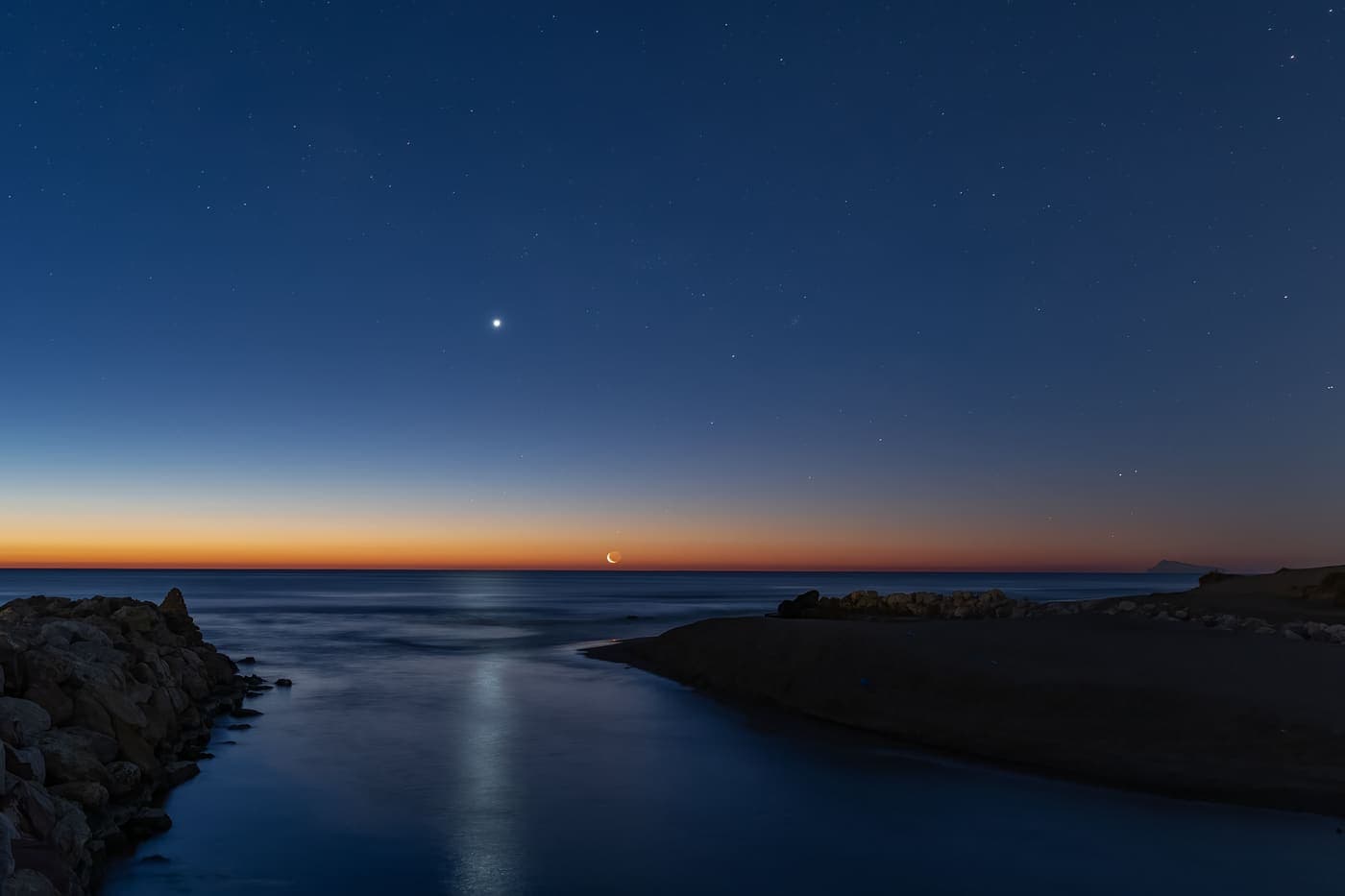
What Venus Looks Like Through a Telescope
Venus shows a crescent or a gibbous disc and never a surface. What aperture does and does not buy, and why a filter is the real upgrade.
Top pick: Celestron AstroMaster 70AZ
$199.95 · 10% off
#ad · how this is funded · price as of October 18, 2026
Best for the planets
The Best Telescopes for Seeing the Planets
Telescopes ranked for planetary detail, where resolving limit and mount steadiness matter more than raw light-gathering.
Top pick: Celestron NexStar 6SE
#ad · how this is funded · price as of October 18, 2026
Safest fit
Telescope Solar Filters: What Is Safe and What Fits
Front-mounted solar filters explained: the ISO standard to look for, the measurement everyone gets wrong, and what never to buy.
Top pick: Celestron EclipSmart Solar Filter for 127mm and 130mm Reflectors
$31.95 · 28% off
#ad · how this is funded · price as of October 18, 2026
Found something wrong here? Tell us and we will correct it and date the correction, per our editorial policy.