Reviews
Celestron StarSense Explorer 10" Dobsonian
The most light-collecting telescope on this site, and the heaviest. Everything good about it and everything difficult about it comes from the same specification.
By Scooter M. · Published · How we pick
This is the largest telescope in this site's registry, and reviewing it is mostly an exercise in being honest about one number. The optical case for a 10-inch Dobsonian is overwhelming and takes two paragraphs to make. The practical case against it takes one number, 54.8 lb, and that number decides the purchase far more often than the optics do.
The arithmetic first
max useful magnification = 2 x aperture. Dawes limit = 116 / aperture.
254 x 2 = 508x. 116 / 254 = 0.46 arcseconds.
Celestron publishes 600x and 0.46 arcseconds. The resolving limits agree exactly; the magnification figures differ by 92x because makers compute per inch with a more generous constant. Celestron also publishes a lowest useful magnification of 36x, which is the aperture divided by a 7mm dark-adapted pupil.
At 0.46 arcseconds this is the finest resolving limit on this site, comfortably inside the roughly 0.7 arcseconds the Cassini division needs and inside what the atmosphere will typically deliver on a good night. Celestron publishes 1317 times the light-gathering of the human eye and a limiting stellar magnitude of 14.7. In practice the resolving limit stops being the constraint at this aperture: the air above your head becomes the constraint instead.
What ten inches collects
light ratio = (aperture 1 / aperture 2) squared
(254 / 203)squared = 1.57. (254 / 150)squared = 2.87. (254 / 130)squared = 3.82.
57 percent more light than an 8-inch, nearly three times a 150mm, and 3.8 times a 130mm beginner telescope. What you can see sets out which objects those thresholds actually move.
There is a clean check available on that first figure, and it is worth showing because it is the kind of thing a specification sheet usually hides. A light ratio of 1.57 works out to about half a magnitude. Celestron publishes a limiting stellar magnitude of 14.7 for this telescope and 14.2 for the 8-inch. The difference in the maker's own published figures is 0.5, which is exactly what the computed ratio predicts.
Half a magnitude is a real gain and it is also a smaller gain than the price difference suggests. It is the difference between a galaxy being a faint smudge and a smudge with a brighter core, not the difference between invisible and obvious. The step from 130mm to 203mm is a far bigger change than the step from 203mm to 254mm, which is the honest shape of aperture economics. Your second telescope works through where the returns start flattening.
What f/4.7 costs you
Celestron publishes a 1200mm focal length on a 254mm mirror, which is f/4.7. That is a fast mirror, and the same focal length as the 8-inch version despite the larger aperture. It keeps the tube short enough to be manageable and it charges for that in three places.
- Collimation matters more. A fast mirror has a tighter tolerance for alignment than a slow one, so this telescope needs checking more often and rewards doing it properly. Collimation covers what the process involves.
- Eyepieces show their limits at the edge. A budget eyepiece that looks fine in an f/8 telescope can soften noticeably toward the edge of the field at f/4.7. Which eyepieces to buy covers what to look for.
- Low power runs into your own eye. This is the one nobody mentions, and it has a number attached.
exit pupil = aperture / magnification
254 / 48 = 5.3mm. 254 / 37.5 = 6.8mm.
The supplied 25mm eyepiece gives 48x and a comfortable 5.3mm exit pupil. Drop to a 32mm and you get 37.5x and a 6.8mm exit pupil, which is already at the edge of what a dark-adapted eye takes in. Celestron's published 36x floor is the same limit stated as a magnification.
How this is funded: the buy buttons below are Amazon Associates links, and a qualifying purchase earns us a commission at no extra cost to you. It cannot move the ranking, because the order here is set by aperture per dollar, and no commission rate changes how much light a mirror collects. Full disclosure.
| # | Telescope | Best for | Aperture | Price |
|---|---|---|---|---|
| 1 | 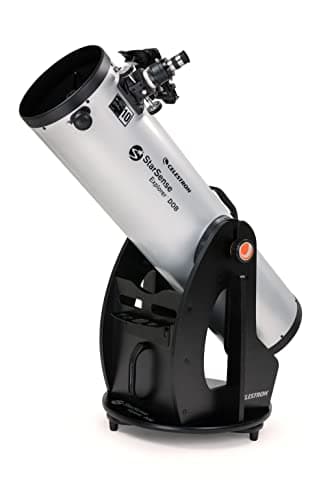 Celestron StarSense Explorer 10" DobsonianTop pick254mm of Newtonian on a Dobsonian base, with phone plate solving to find things. More light than anything else here, and heavier than anything else here. | The most light on this site | 254mm (10")508x useful |
Top pick · The most light on this site
Celestron StarSense Explorer 10" Dobsonian
254mm of Newtonian on a Dobsonian base, with phone plate solving to find things. More light than anything else here, and heavier than anything else here.
What the aperture allows
- Maximum useful magnification
- 508x
- 2 × 254mm of aperture
- Resolving limit (Dawes)
- 0.46 arcseconds
- 116 ÷ 254mm
- Cassini division (0.7″)
- Within reach
- on a steady night, at high magnification
Celestron publishes 600x as this telescope’s highest useful magnification. Our figure is 508x, from two times the aperture in millimeters. The gap of 92x comes from the slightly more generous per-inch constant makers use. Neither number describes a typical night: the atmosphere usually settles the question well below both.
Worked example: a 25mm eyepiece in this telescope gives 1200mm ÷ 25mm = 48x.
Two times 254mm gives 508x of useful magnification and Dawes' limit is 0.46 arcseconds, the finest resolving limit of any telescope on this site. Celestron publishes 1317 times the light-gathering of the eye and a limiting stellar magnitude of 14.7.
Against the 8-inch version of the same telescope the ratio is (254 / 203) squared = 1.57, so this collects 57 percent more light. That is the difference between a faint smudge and a smudge with structure in it on the brighter galaxies.
At f/4.7 and 1200mm the supplied 25mm eyepiece gives 48x, the same as the 8-inch, because both share the 1200mm focal length. The 10-inch simply delivers that magnification with more light behind it.
54.8 lb is the honest headline. The tube and base separate, but neither half is light, and a fast f/4.7 mirror also has to be collimated more carefully than a slower one. This is a telescope for somebody who already knows they want it.
What it does well
- The finest resolving limit and the most light of anything on this site
- Phone plate solving finds targets without an alignment routine or batteries in the mount
- Shares the 1200mm focal length with the 8-inch, so eyepiece choices carry across
What it costs you
- 54.8 lb total, and awkward to move even in two pieces
- f/4.7 is demanding about collimation and about eyepiece quality at the edge
- Needs a supported smartphone that fits the dock, and a level surface for the base
Skip this one if: Skip it if you will have to carry it down stairs. Aperture you do not set up is worth nothing, and the 8-inch is 11 lb lighter for 64 percent of the light.
#ad · how this is funded · price as of September 21, 2026
The weight, in two numbers rather than one
Celestron publishes 54.8 lb in total: a 29.2 lb optical tube and a 25.6 lb base. That is the honest description, and stating it as two numbers is more useful than the total, because the total is not what you carry.
Two trips, each with something heavy and awkward in both hands. The tube is the difficult one: it is long as well as heavy, so it does not tuck under an arm. None of that is a problem if the telescope lives in a garage and goes out onto a driveway. All of it is a problem if it lives upstairs, or if setting up has to happen quietly, or if the observing site is a walk from the car.
This is the single most common reason a large Dobsonian stops being used, and it is entirely predictable before purchase. An 8-inch is 11.4 lb lighter for 64 percent of the light, and a telescope that goes outside twice a week sees vastly more sky than one that goes out monthly. Why Dobsonians win on aperture per dollar makes the case for the format; this is the point where the format pushes back.
The app: what it does, and what it needs
A phone clamps into a dock with a mirror beneath it. The app photographs the sky through that mirror, matches the star pattern to work out where the telescope is pointing, and draws arrows telling you which way to push. There is no alignment routine and no power in the telescope at all.
- It finds. It does not follow. There are no motors here. At 250x an object crosses the field in well under a minute and you nudge it back by hand. StarSense against manual finding covers what the system replaces.
- It needs a fairly current phone. Celestron publishes compatibility with Android 12 and later, or iOS 18 and later including iPhone XR and newer. That is worth checking against the phone in your pocket before ordering, not after.
- The dock takes the phone, not the case. A large phone in a thick case is a real fitting problem rather than a theoretical one.
- It works under a light-polluted sky. Plate solving needs enough stars to match a pattern, not a dark site, so it functions in exactly the places where recognizing constellations is hardest.
Against the telescopes buyers weigh it against
| StarSense 10" | StarSense 8" | Classic 200P | NexStar 8SE | |
|---|---|---|---|---|
| Aperture | 254mm | 203mm | 203mm | 203.2mm |
| Focal length | 1200mm | 1200mm | Not published | 2032mm |
| Focal ratio | f/4.7 | f/5.9 | Not published | f/10 |
| Max useful magnification | 508x | 406x | 406x | 406x |
| Resolving limit | 0.46 arcsec | 0.57 arcsec | 0.57 arcsec | 0.57 arcsec |
| Limiting magnitude (published) | 14.7 | 14.2 | Not published | 14 |
| Relative light gathering | 1.57x | Baseline | Same | Same |
| Finds objects | Phone | Phone | You do | Motorized GoTo |
| Tracks | No | No | No | Yes |
| Total weight | 54.8 lb | 43.4 lb | Not published | 32 lb |
The comparison that actually matters is the first two columns, because they are the same telescope in two sizes with the same focal length and the same 2-inch Crayford focuser, which means eyepieces carry straight across between them. The 8-inch review covers that model in full. Everything you gain by going up is in two rows: half a magnitude of light and a finer resolving limit. Everything you give up is in the last row.
Against the NexStar 8SE the trade is different in kind rather than degree: the 8SE tracks and this does not, the 8SE weighs 22.8 lb less, and this collects 57 percent more light and shows a far wider field. GoTo against manual is the page on that decision.
Who should buy it, and who should not
Buy it if you already know you want aperture, you have somewhere to keep it at ground level, and faint objects are what you are chasing. It is the most capable telescope on this site by the only measure that decides what you can see, and the phone-guided finding means the aperture is usable by somebody who does not yet know the sky. For a determined observer with a garage and a driveway, this is close to the most telescope per dollar that exists.
Do not buy it as a first telescope, and do not buy it if it has to come down stairs. Do not buy it if wide star fields are what you enjoy, because the exit pupil arithmetic caps that at around 36x. Do not buy it if you want the telescope to follow objects for you. And check your phone against Celestron's published compatibility list before ordering, because the finding system is most of what you are paying extra for over a plain Dobsonian.
Questions people actually ask
Is the Celestron StarSense Explorer 10" Dobsonian worth it?
It is worth it for an observer chasing faint objects who can handle the weight. 254mm computes to 508x of useful magnification and a 0.46-arcsecond resolving limit, the finest on this site, and it collects 57 percent more light than an 8-inch. It is not worth it as a first telescope, and the 11.4 lb it adds over the 8-inch stops more people using it than the extra light rewards.
How much better is a 10-inch than an 8-inch Dobsonian?
About half a magnitude. The light ratio is (254 / 203) squared, which is 1.57, and that works out to roughly 0.5 magnitudes. Celestron's own published limiting magnitudes agree: 14.7 for the 10-inch against 14.2 for the 8-inch. It also resolves finer, at 0.46 arcseconds against 0.57.
How heavy is the StarSense Explorer 10-inch Dobsonian?
Celestron publishes 54.8 lb in total, as a 29.2 lb optical tube and a 25.6 lb base. It separates into those two pieces and no further, so it is a two-trip telescope and neither trip is light. The tube is long as well as heavy.
Does the StarSense Explorer 10" track objects?
No. There are no motors in it. The app works out where the telescope is pointing and shows arrows telling you which way to push, but once an object is centered it drifts across the field as the Earth turns and you nudge it back by hand.
What phone do you need for StarSense Explorer?
Celestron publishes compatibility with Android 12 and later, or iOS 18 and later including iPhone XR and newer models. Check your phone against the maker's current list before ordering, since the plate-solving finder is the main thing you are paying extra for over a plain Dobsonian.
Is f/4.7 too fast for a beginner telescope?
It is not unusable, but it is less forgiving. A fast mirror needs collimation checked more often, shows budget eyepieces softening toward the edge of the field, and caps the lowest useful magnification at about 36x because below that the exit pupil exceeds what a dark-adapted eye can take in.
Read next
Celestron StarSense Explorer 8" Dobsonian
203mm on a Dobsonian base, with phone plate solving to find targets. The largest aperture on this site that a beginner can genuinely aim.
Top pick: Celestron StarSense Explorer 8-inch Dobsonian
Currently unavailable at Amazon
Checked September 21, 2026. We are not linking to it while there is nothing to buy.
Best step up
Your Second Telescope
What a second telescope actually changes, computed from aperture, and the picks that are worth the step from a 130mm first telescope.
Top pick: Celestron StarSense Explorer 8-inch Dobsonian
Currently unavailable at Amazon
Checked September 21, 2026. We are not linking to it while there is nothing to buy.
Best aperture per dollar
Dobsonian Telescopes, and Why Experienced Observers Recommend Them
Why a Dobsonian gives the most aperture per dollar, what the design costs you, and which size to buy.
Top pick: Sky-Watcher Classic 200P Dobsonian (8-inch)
#ad · how this is funded · price as of September 21, 2026
Found something wrong here? Tell us and we will correct it and date the correction, per our editorial policy.