Reviews
Sky-Watcher Heritage 150 Tabletop Dobsonian
Six inches of aperture that stores next to the vacuum cleaner. This is the telescope our under-$300 bracket names when light is what you want, and this is what it costs you.
By Scooter M. · Published · How we pick
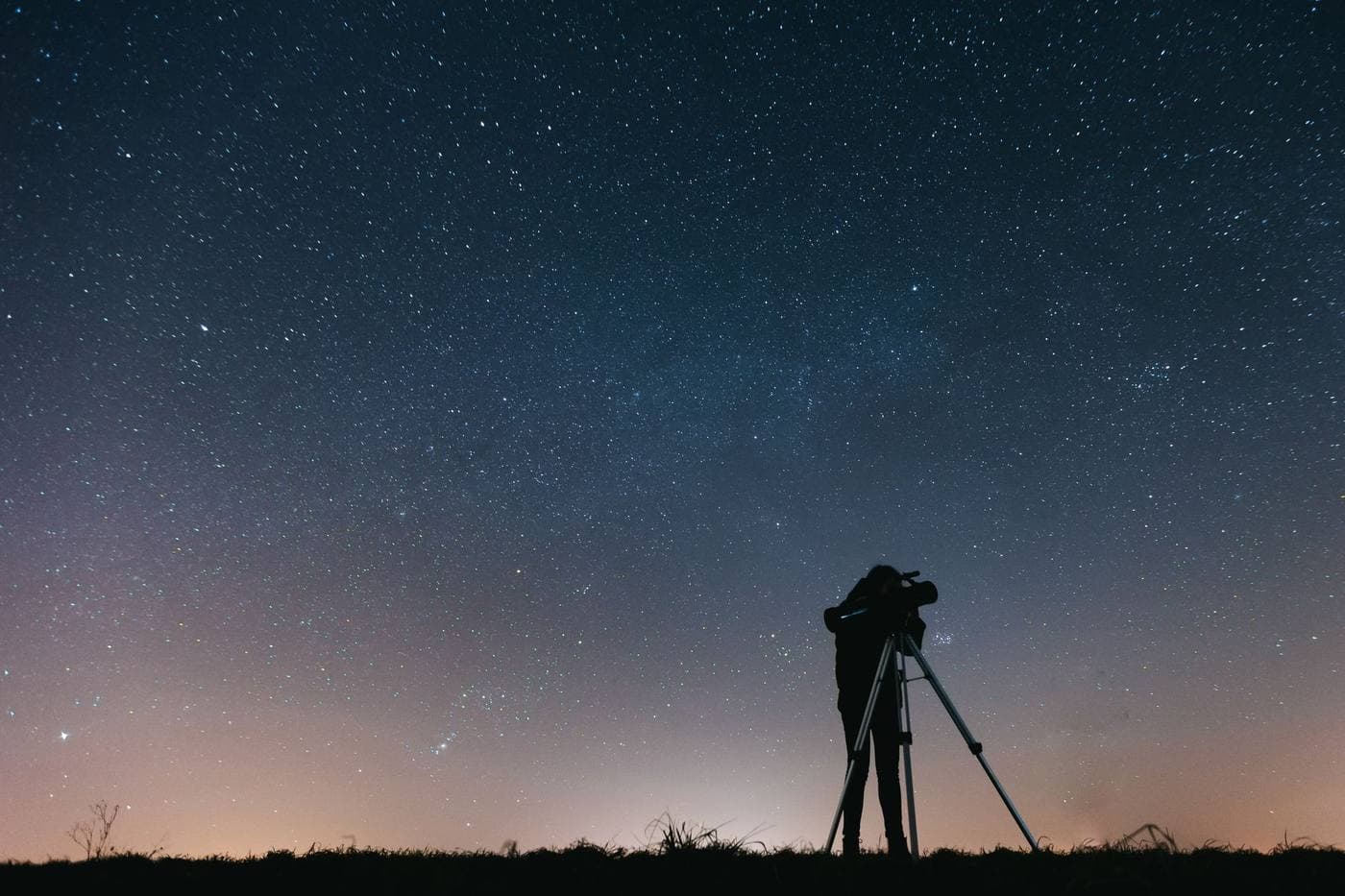
Most beginner telescopes ask you to choose between aperture and convenience. The Heritage 150 is on this site because it declines the question: 150mm of parabolic mirror, in a tube that shortens for storage, on a base with no tripod anywhere in it. The under-$300 bracket names it as one of two right answers, and this is the page behind that recommendation.
The arithmetic first
max useful magnification = 2 x aperture. Dawes limit = 116 / aperture.
150 x 2 = 300x. 116 / 150 = 0.77 arcseconds.
Sky-Watcher publishes neither figure for this telescope, so both are computed here from its published 150mm aperture using the formulas on our methodology page. The focal ratio checks out against the maker: 750 / 150 = f/5.
0.77 arcseconds is the number that matters. The Cassini division in Saturn's rings spans roughly 0.7 arcseconds at its widest, which puts it inside this telescope's reach on a genuinely steady night rather than permanently outside it. That is the line a 130mm telescope, at 0.89 arcseconds, sits on the wrong side of. What size telescope shows Saturn's rings works that threshold through properly.
300x is a ceiling and not a target. On an average night atmospheric seeing will stop you well below 200x, and the useful working range for this telescope is far lower than either number suggests.
Where Sky-Watcher's own figures do not agree with the arithmetic
Sky-Watcher publishes two light-gathering claims for this telescope: 363 percent more light than the human eye, and 44 percent more light than the 130mm model. The first is the maker's own number and we have no way to check it. The second we can check, because it is a ratio of two apertures the maker also publishes.
light ratio = (aperture 1 / aperture 2) squared
(150 / 130)squared = 1.33, so 33 percent more light
Sky-Watcher publishes 44 percent. The aperture ratio gives 33 percent. We cannot reconcile the difference from anything the maker publishes, so this site uses the computed figure and names the maker's beside it rather than quietly picking one.
This is not an accusation of anything. Light-gathering comparisons can legitimately account for things an aperture ratio ignores, and Sky-Watcher does not publish the numbers that would let a reader check which. What we can say is that the honest, verifiable gap between the two Heritage models is a third more light, and that a third more light is a real and visible difference on faint objects.
The collapsible tube is the whole product
A conventional 150mm f/5 Newtonian tube is a meter-long object that lives in a garage. Sky-Watcher's own description is that the optical tube uses a system that allows it to be collapsed for easy portability and storage while retaining collimation, and that second clause is the one that matters.
A telescope that loses its alignment every time it is put away is a telescope that needs collimating before every session, and in practice that means it gets used less. Holding collimation through the collapse is what makes a cupboard-stored 6-inch a realistic proposition rather than a compromise you regret.
The mirror, and why f/5 makes it worth checking
Sky-Watcher publishes a parabolic primary in borosilicate glass with a Radiant Aluminum Quartz coating. Parabolic is the word to look for, and it is worth understanding why it is worth paying for at this focal ratio specifically.
A spherical mirror does not bring parallel light to one point, and the error grows as the focal ratio falls. At f/9 it is small enough to ignore. At f/5 it is not, which is exactly why the Celestron AstroMaster 130EQ, also f/5 but spherical by its maker's own specification, is the harder telescope to recommend at a similar price. Same focal ratio, different mirror, and the difference is stated on both boxes.
The condition that decides whether to buy it
If the honest answer is that you have no suitable surface, there are two ways out. Buy a cheap sturdy side table, which costs a fraction of the telescope. Or buy the floor-standing version instead: the Classic 150P has the same aperture, a better focuser and no furniture requirement, at the cost of no longer fitting in a cupboard.
How this is funded: the buy buttons below are Amazon Associates links, and a qualifying purchase earns us a commission at no extra cost to you. It cannot move the ranking, because the order here is set by aperture per dollar, and no commission rate changes how much light a mirror collects. Full disclosure.
| # | Telescope | Best for | Aperture | Price |
|---|---|---|---|---|
| 1 | 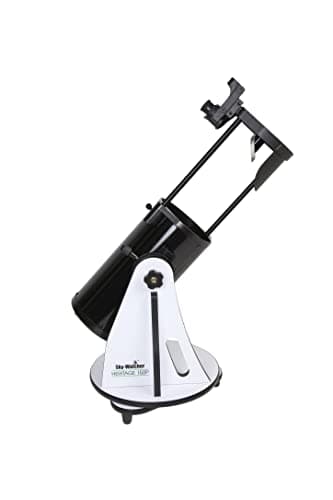 Sky-Watcher Heritage 150 Tabletop DobsonianTop pick150mm at f/5 in a collapsible tube on a tabletop base. Deep-sky aperture that still stores next to the vacuum cleaner. | Maximum aperture in a cupboard | 150mm300x useful |
Top pick · Maximum aperture in a cupboard
Sky-Watcher Heritage 150 Tabletop Dobsonian
150mm at f/5 in a collapsible tube on a tabletop base. Deep-sky aperture that still stores next to the vacuum cleaner.
What the aperture allows
- Maximum useful magnification
- 300x
- 2 × 150mm of aperture
- Resolving limit (Dawes)
- 0.77 arcseconds
- 116 ÷ 150mm
- Cassini division (0.7″)
- Out of reach
- this aperture cannot resolve it
Worked example: a 25mm eyepiece in this telescope gives 750mm ÷ 25mm = 30x.
This is the Heritage 130's argument with 33 percent more mirror. Light gathering scales as the square of the aperture ratio, so 150 over 130, squared, is 1.33 times the light of its smaller sibling.
Two times 150mm is 300x of useful magnification and Dawes' limit is 0.77 arcseconds, which puts the Cassini division inside its reach on a good night.
At f/5 the 750mm focal length keeps the tube short enough to collapse, which is the entire reason this design exists. A conventional 150mm Newtonian tube is over a meter long and lives in a garage.
The same tabletop caveat applies as with the 130: it needs a stable surface at seated chest height. Check you have one before you buy, not after.
What it does well
- Deep-sky aperture in a package that genuinely stores in a cupboard
- Collapsible tube holds collimation between setups
- No tripod means no tripod wobble, the most common cause of a shaky first view
What it costs you
- The tabletop requirement is a real constraint, not a footnote
- The helical focuser is the weakest component
- An open tube collects dust and needs the occasional clean
Skip this one if: Skip it if you have the floor space for the Classic 150P. The floor-standing version has a better focuser and needs no furniture.
$355.00 · 13% off
#ad · how this is funded · price as of October 24, 2026
What the eyepieces do with 750mm
magnification = telescope focal length / eyepiece focal length
750 / 25 = 30x. 750 / 10 = 75x. 750 / 6 = 125x.
Exit pupil is aperture divided by magnification, so 150 / 30 = 5mm and 150 / 75 = 2mm. Sky-Watcher does not publish which eyepieces ship with this telescope, so these are worked examples from common focal lengths rather than a description of what is in the box.
The weakest published component is the focuser: a 1.25-inch helical, which you turn like a lens barrel rather than a knob. It works, and it is fiddlier than a rack-and-pinion at high magnification, where a small nudge moves the whole telescope. It is the first thing owners of this model tend to want to change.
Against the two telescopes it sits between
| Heritage 150 | Heritage 130 | Classic 150P | |
|---|---|---|---|
| Aperture | 150mm | 130mm | 150mm |
| Focal length | 750mm | 650mm | 750mm |
| Focal ratio | f/5 | f/5 | f/5 |
| Primary mirror | Parabolic | Parabolic | Parabolic |
| Max useful magnification | 300x | 260x | 300x |
| Resolving limit | 0.77 arcsec | 0.89 arcsec | 0.77 arcsec |
| Relative light gathering | 1.33x the 130 | Baseline | 1.33x the 130 |
| Tube | Collapsible | Collapsible | Solid |
| Needs a table | Yes | Yes | No |
| Focuser | 1.25-inch helical | 1.25-inch helical | Rack and pinion |
Read across, the choice is unusually clean. Against the Heritage 130 you are buying a third more light and the Cassini division for more money and more bulk. Against the Classic 150P you are buying storage, and paying for it with a worse focuser and a table you have to own.
Who should buy it, and who should not
Buy it if you have the surface, you want the most aperture that will genuinely live indoors, and you would rather spend on the mirror than on a mount. On those terms this is close to the best value in beginner astronomy, and the tabletop page explains why that keeps being true of the design.
Do not buy it if you have no table and no intention of buying one, if you are buying for a child who cannot comfortably reach a seated-height eyepiece, or if the telescope will live in a garage anyway — in which case the floor-standing version is simply better. The beginner ranking puts all of these in order.
Sky-Watcher sells a floor-standing telescope with the same mirror in it. The Heritage 150P against the Classic 150P sets the two side by side.
Questions people actually ask
Is the Sky-Watcher Heritage 150 worth it?
If you have a stable surface at seated chest height, it is one of the best aperture-per-dollar buys in beginner astronomy. 150mm gives a computed 0.77-arcsecond resolving limit, which brings the Cassini division into reach, and the tube collapses so it stores indoors. Without a suitable surface it is the wrong telescope.
Heritage 150 or Heritage 130?
The 150 collects 33 percent more light from the aperture ratio, and drops the resolving limit from 0.89 to 0.77 arcseconds, which is what brings the Cassini division into reach. Sky-Watcher itself publishes 44 percent rather than 33; we cannot reconcile that from its published figures and use the computed one. Both have the same tabletop requirement.
Heritage 150 or Classic 150P?
The same aperture and the same focal ratio, so optically they see the same sky. The Heritage collapses and needs a table; the Classic stands on the floor and has a better focuser. If you have the storage space, the Classic is the easier telescope to live with. If you do not, the Heritage is the one that actually gets used.
Does the Heritage 150 hold its collimation when collapsed?
Sky-Watcher states that the tube collapses for storage while retaining collimation. That is the maker's claim rather than something we have measured, and it is the claim the whole design rests on, because a telescope that needs realigning before every session gets used less.
What can you see with a Heritage 150?
Lunar detail down to the resolving limit, Saturn's rings clearly separated with the Cassini division borderline on a steady night, Jupiter's cloud belts, the Orion Nebula with real structure, and the brighter globular clusters starting to resolve at the edges. Galaxies show as faint gray shapes and need a dark sky.
What magnification does the Heritage 150 support?
The computed ceiling is 300x, from two times the 150mm aperture. In practice atmospheric seeing usually stops a telescope this size well below 200x, and most observing happens between 30x and 150x. A 25mm eyepiece on its 750mm focal length gives 30x.
Read next

Sky-Watcher Heritage 130 Tabletop Dobsonian
The aperture-per-dollar champion: 130mm parabolic in a collapsible tube, with one condition to check first.
Top pick: Sky-Watcher Heritage 130 Tabletop Dobsonian
$305.00 · 12% off
#ad · how this is funded · price as of October 24, 2026
Best tabletop
Tabletop Telescopes, and the One Thing to Check First
The best value design in beginner astronomy, and the surface requirement that decides whether it works for you.
Top pick: Sky-Watcher Heritage 130 Tabletop Dobsonian
$305.00 · 12% off
#ad · how this is funded · price as of October 24, 2026
Best under $300
The Best Telescopes Under $300
The bracket where the choice becomes aperture against finding assistance, with both sides of the trade computed.
Top pick: Celestron StarSense Explorer LT 114AZ
$259.95 · 8% off
#ad · how this is funded · price as of October 24, 2026
Found something wrong here? Tell us and we will correct it and date the correction, per our editorial policy.