Reviews
Sky-Watcher Classic 150P Dobsonian (6-inch)
The telescope for somebody who wants real aperture and has looked honestly at where an 8-inch Dobsonian would have to live.
By Scooter M. · Published · How we pick

The Classic 150P exists for a specific buyer: somebody who has read that an 8-inch Dobsonian is the right answer, looked at where it would actually live, and concluded that it would not get carried outside. That is a good reason to buy this instead, and it is a better reason than most telescope purchases have.
What 150mm allows
max useful magnification = 2 x aperture. Dawes limit = 116 / aperture.
150 x 2 = 300x. 116 / 150 = 0.77 arcseconds.
The Cassini division in Saturn's rings spans roughly 0.7 arcseconds at its widest, so 0.77 puts it right at the threshold: visible on a genuinely steady night, absent on an average one. More on Saturn.
Sky-Watcher publishes a comparison of its own that is more useful than most marketing figures: this telescope is 232 percent brighter than a 100mm refractor. That is the aperture argument stated by the manufacturer rather than by us, and it is why a 6-inch reflector costs less than a 4-inch refractor while showing considerably more.
Sky-Watcher does not publish a focal length or a maximum useful magnification for this model where we could read it, so neither figure appears in the spec table below. The computed limits above need only the aperture, which is published, and that is the whole point of computing them rather than quoting them.
Where it sits against the 8-inch
This is the only comparison that matters for this telescope, and Sky-Watcher supplies the number for it: the 200mm Classic is 78 percent brighter than this one, which is again their figure rather than ours.
| Classic 150P (6-inch) | Classic 200P (8-inch) | |
|---|---|---|
| Aperture | 150mm | 200mm |
| Max useful magnification | 300x | 400x |
| Resolving limit | 0.77 arcsec | 0.58 arcsec |
| Cassini division | Threshold, best nights | Comfortable |
| Relative brightness | Baseline | 78 percent brighter |
| Focuser | 2-inch rack-and-pinion | 2-inch Crayford |
| Trips to carry it out | One | Two |
| Fits across a back seat | Yes | Awkwardly |
The floor-standing advantage nobody mentions
Both tabletop Dobsonians on this site need a stable surface at seated chest height, and that requirement quietly rules them out for a lot of buyers. The Classic 150P does not: it stands on the ground and puts the eyepiece at a comfortable height for somebody sitting on a low stool.
That is the most comfortable way to observe there is, and it removes an entire category of purchase regret. If you have been weighing a 150mm tabletop against this, the furniture question is the tiebreaker more often than the optics are: the Heritage 150 is the same aperture in a tube that collapses, and the tabletop page sets out that condition in full.
The 2-inch focuser
Sky-Watcher fits a 2-inch rack-and-pinion focuser with a 1.25-inch adapter. That matters for one specific reason: a 2-inch eyepiece can deliver a genuinely wide low-power field that a 1.25-inch barrel physically cannot pass, and a wide field is what a fast Dobsonian is best at.
It also means the telescope has an upgrade path rather than a ceiling. The eyepieces it ships with are not the eyepieces you will own in three years, and this focuser will accept the better ones. Which focal lengths suit it.
How this is funded: the buy buttons below are Amazon Associates links, and a qualifying purchase earns us a commission at no extra cost to you. It cannot move the ranking, because the order here is set by aperture per dollar, and no commission rate changes how much light a mirror collects. Full disclosure.
| # | Telescope | Best for | Aperture | Price |
|---|---|---|---|---|
| 1 | 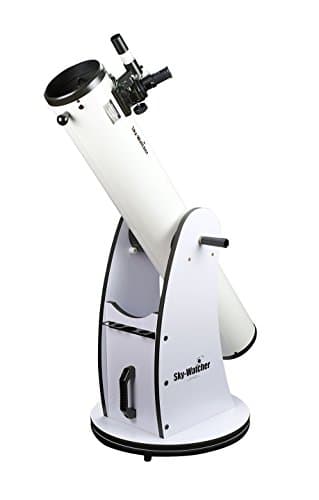 Sky-Watcher Classic 150P Dobsonian (6-inch)Top pickSix inches of parabolic mirror on a floor-standing Dobsonian base. The compromise between the 8-inch and a life with less lifting. | Serious aperture that still fits in a car | 150mm (6 in)300x useful |
Top pick · Serious aperture that still fits in a car
Sky-Watcher Classic 150P Dobsonian (6-inch)
Six inches of parabolic mirror on a floor-standing Dobsonian base. The compromise between the 8-inch and a life with less lifting.
What the aperture allows
- Maximum useful magnification
- 300x
- 2 × 150mm of aperture
- Resolving limit (Dawes)
- 0.77 arcseconds
- 116 ÷ 150mm
- Cassini division (0.7″)
- Out of reach
- this aperture cannot resolve it
150mm sits in a genuinely useful place. Two times the aperture gives 300x of useful magnification and Dawes' limit works out to 0.77 arcseconds, so the Cassini division is within reach on a steady night.
Against the 8-inch it collects about 56 percent of the light. Sky-Watcher publishes the 8-inch as 78 percent brighter, which is the same comparison seen from the other side. Against a 100mm refractor it gains 232 percent, also their figure. Those two numbers together are the whole argument for buying by aperture.
The practical case for the 6-inch over the 8-inch is transport. It fits across a back seat, one person can move it in a single trip, and a telescope that gets used beats one that is technically better and stays in the garage.
This is a floor-standing Dobsonian, so unlike the tabletop models it needs no furniture. You sit on a low stool beside it, which is the most comfortable way to observe there is.
What it does well
- Real aperture without the 8-inch's transport problem
- Floor-standing, so no table required
- The 2-inch focuser is a genuine upgrade path rather than a dead end
- Simple enough that nothing about it can fail on a cold night
What it costs you
- Still a long tube; it is not a cupboard telescope
- No tracking or GoTo, so you find things yourself
- Collimation and cool-down apply to every Newtonian, this one included
Skip this one if: Skip it if you were choosing between this and the 8-inch and storage is not actually a problem. In that case the extra aperture is worth having.
| Optical design | Newtonian reflector, parabolic primary with Radiant Aluminum Quartz coatingsSource: Classic 150P Dobsonian — manufacturer specifications (retrieved September 1, 2026) |
|---|---|
| Aperture | 150mm (6 in)Source: Classic 150P Dobsonian — manufacturer specifications (retrieved September 1, 2026) |
| Mount | Dobsonian rocker box with Teflon bearings and a tension control handleSource: Classic 150P Dobsonian — manufacturer specifications (retrieved September 1, 2026) |
| Versus a 100mm refractor | 232 percent brighterSky-Watcher's own published comparison.Source: Classic 150P Dobsonian — manufacturer specifications (retrieved September 1, 2026) |
| Focuser | 2-inch rack-and-pinion with a 1.25-inch adapterSource: Classic 150P Dobsonian — manufacturer specifications (retrieved September 1, 2026) |
$515.00 · 13% off
#ad · how this is funded · price as of October 20, 2026
What owning it actually involves
- Carry it out in one trip and set it on level ground. There is no assembly.
- Leave it thirty minutes before you expect the best of it. A 150mm mirror warmer than the air makes its own turbulence inside the tube.
- Find things with the longest eyepiece you own. The widest field is the finding field, always.
- Nudge the tube to track. At 150x an object crosses the field in well under a minute, and the motion becomes automatic within about two sessions.
- Check collimation occasionally, not routinely. A telescope kept indoors and carried gently can go months. How.
Who should not buy it
Anybody whose storage and stairs would comfortably take the 8-inch, because 78 percent more light is worth the second trip. Anybody who needs the telescope to fit in a cupboard, where a collapsible tabletop is the right design. And anybody buying for a child, because a floor-standing 6-inch is a large object for a small person to aim.
There is a collapsible tabletop version of this aperture. The Heritage 150P against the Classic 150P compares them on what Sky-Watcher publishes for each.
Questions people actually ask
Is a 6-inch Dobsonian enough for a beginner?
More than enough. At 150mm the computed resolving limit is 0.77 arcseconds and the useful magnification ceiling is 300x, which covers the Cassini division on a steady night, Jupiter's belt structure, globular clusters starting to resolve, and the brighter galaxies from a dark site.
Sky-Watcher Classic 150P or 200P?
The 200P if your storage and your route outside will take it, because Sky-Watcher's own figure is that it is 78 percent brighter. The 150P if they will not, because it fits across a back seat and one person carries it in a single trip.
Does the Classic 150P need a table?
No, and that is one of its main advantages over the tabletop Dobsonians. It stands on the ground and the eyepiece falls at a comfortable height for somebody on a low stool.
What can you see with a 6-inch Dobsonian?
Lunar detail down to its 0.77-arcsecond limit, Saturn's rings with the Cassini division on the best nights, Jupiter's belts and moons, the Orion Nebula with real structure, globular clusters beginning to resolve into stars, and the brighter Messier galaxies as shapes from a dark site.
Why does the spec table have blank rows?
Because Sky-Watcher does not publish a focal length or a maximum useful magnification for this model anywhere we could read it, and this site publishes only figures it retrieved from a named source. The computed limits need only the aperture, which is published.
Read next
Best aperture per dollar
Dobsonian Telescopes, and Why Experienced Observers Recommend Them
Why a Dobsonian gives the most aperture per dollar, what the design costs you, and which size to buy.
Top pick: Sky-Watcher Heritage 130 Tabletop Dobsonian
$305.00 · 12% off
#ad · how this is funded · price as of October 20, 2026
Sky-Watcher Classic 200P Dobsonian (8-inch)
Eight inches of aperture, 0.58 arcseconds of resolution, and the honest cost: it is a two-trip telescope.
Top pick: Sky-Watcher Classic 200P Dobsonian (8-inch)
Currently unavailable at Amazon
Checked October 20, 2026. We are not linking to it while there is nothing to buy.
Best under $500
The Best Telescopes Under $500
The bracket where 150mm arrives, resolving 0.77 arcseconds and bringing the Cassini division into reach on a steady night.
Top pick: Sky-Watcher Heritage 150 Tabletop Dobsonian
$355.00 · 13% off
#ad · how this is funded · price as of October 20, 2026
Found something wrong here? Tell us and we will correct it and date the correction, per our editorial policy.