Telescope Types & Comparisons
Sky-Watcher Heritage 150P vs Classic 150P
Same 150mm parabolic mirror, same resolving limit, same light grasp. Everything that separates these two happens outside the optical tube.
By Scooter M. · Published · How we pick
Most comparisons on this site come down to aperture, because aperture is what decides what a telescope can show you. This one cannot, because both of these telescopes have exactly the same aperture, the same kind of mirror and the same coatings. Sky-Watcher publishes a 150mm parabolic primary with Radiant Aluminum Quartz coatings for both.
So every optical number this site computes comes out identical, and the decision has to be made on everything else.
Optically, these are the same telescope
max useful magnification = 2 x aperture. Dawes limit = 116 / aperture.
150 x 2 = 300x. 116 / 150 = 0.77 arcseconds.
At 0.77 arcseconds the Cassini division, at roughly 0.7, is just out of reach in both. Both show Saturn's rings clearly as rings, Jupiter's belts, and the brighter deep-sky objects from a reasonable sky.
There is no optical advantage hiding anywhere in this comparison. Two 150mm parabolic mirrors collect the same light and resolve the same detail. If somebody tells you one of these shows more than the other, the thing they are describing is the mount, the focuser or the eyepiece.
What Sky-Watcher publishes, and what it does not
One asymmetry in the sourcing is worth stating plainly, because it affects what this page can tell you. Sky-Watcher publishes a 750mm focal length and f/5 for the Heritage 150P. For the Classic 150P it publishes the aperture, the mirror type and the focuser, but no focal length and no focal ratio anywhere this site could read.
The comparison that actually decides it
| Heritage 150P | Classic 150P | |
|---|---|---|
| Aperture | 150mm | 150mm (6 in) |
| Primary mirror | Parabolic, RAQ coatings | Parabolic, RAQ coatings |
| Max useful magnification (computed) | 300x | 300x |
| Resolving limit (computed) | 0.77 arcsec | 0.77 arcsec |
| Focal length | 750mm | Not published |
| Focal ratio | f/5 | Not published |
| Tube | Collapsible | Solid |
| Base | Tabletop Dobsonian | Floor-standing rocker box |
| Focuser | 1.25-inch helical | 2-inch rack and pinion, 1.25-inch adapter |
| Needs a table | Yes | No |
Three rows carry the whole decision: the base, the focuser and the tube.
The table problem is not a small one
A tabletop Dobsonian sits on something. That something has to be stable enough not to wobble at 150x, high enough that you are not crouching, and outdoors. A patio table works. A camping table works. A garden wall works. A kitchen chair does not, and neither does the ground.
This is the single most common regret with tabletop telescopes, and it is entirely predictable before purchase: people who have somewhere to put it love them, and people who do not end up observing from an awkward crouch. The Classic 150P stands on its own base at eyepiece height and removes the question. The tabletop telescopes page covers the format in general.
In exchange, the Heritage collapses. The tube shortens for transport, which is why it fits in a car trunk and a closet in a way the solid-tube telescope does not. If the telescope has to travel or be stored somewhere small, that is decisive in the other direction.
The focuser is the quiet upgrade path
The Classic 150P has a 2-inch rack-and-pinion focuser with a 1.25-inch adapter. The Heritage 150P has a 1.25-inch helical focuser. That sounds like a detail and it decides what the telescope can become.
A 1.25-inch focuser caps the widest field you can ever reach, because the barrel physically limits the field stop. A 2-inch focuser removes that ceiling, so the Classic can take a wide-field 2-inch eyepiece later and the Heritage cannot. Which eyepieces to buy explains what that ceiling is and where it bites.
How this is funded: the buy buttons below are Amazon Associates links, and a qualifying purchase earns us a commission at no extra cost to you. It cannot move the ranking, because the order here is set by aperture per dollar, and no commission rate changes how much light a mirror collects. Full disclosure.
| # | Telescope | Best for | Aperture | Price |
|---|---|---|---|---|
| 1 | 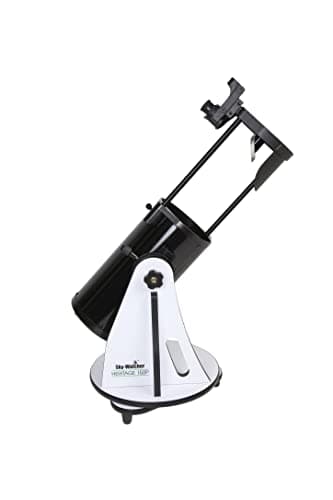 Sky-Watcher Heritage 150 Tabletop DobsonianTop pick150mm at f/5 in a collapsible tube on a tabletop base. Deep-sky aperture that still stores next to the vacuum cleaner. | Maximum aperture in a cupboard | 150mm300x useful | |
| 2 | 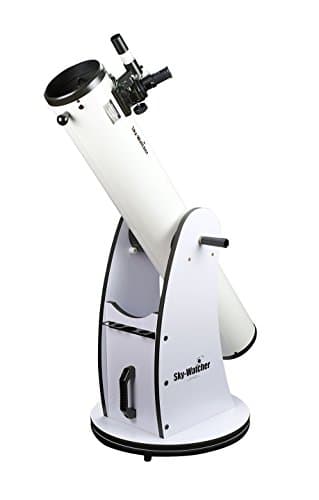 Sky-Watcher Classic 150P Dobsonian (6-inch)Six inches of parabolic mirror on a floor-standing Dobsonian base. The compromise between the 8-inch and a life with less lifting. | Serious aperture that still fits in a car | 150mm (6 in)300x useful |
Top pick · Maximum aperture in a cupboard
Sky-Watcher Heritage 150 Tabletop Dobsonian
150mm at f/5 in a collapsible tube on a tabletop base. Deep-sky aperture that still stores next to the vacuum cleaner.
What the aperture allows
- Maximum useful magnification
- 300x
- 2 × 150mm of aperture
- Resolving limit (Dawes)
- 0.77 arcseconds
- 116 ÷ 150mm
- Cassini division (0.7″)
- Out of reach
- this aperture cannot resolve it
Worked example: a 25mm eyepiece in this telescope gives 750mm ÷ 25mm = 30x.
This is the Heritage 130's argument with 33 percent more mirror. Light gathering scales as the square of the aperture ratio, so 150 over 130, squared, is 1.33 times the light of its smaller sibling.
Two times 150mm is 300x of useful magnification and Dawes' limit is 0.77 arcseconds, which puts the Cassini division inside its reach on a good night.
At f/5 the 750mm focal length keeps the tube short enough to collapse, which is the entire reason this design exists. A conventional 150mm Newtonian tube is over a meter long and lives in a garage.
The same tabletop caveat applies as with the 130: it needs a stable surface at seated chest height. Check you have one before you buy, not after.
What it does well
- Deep-sky aperture in a package that genuinely stores in a cupboard
- Collapsible tube holds collimation between setups
- No tripod means no tripod wobble, the most common cause of a shaky first view
What it costs you
- The tabletop requirement is a real constraint, not a footnote
- The helical focuser is the weakest component
- An open tube collects dust and needs the occasional clean
Skip this one if: Skip it if you have the floor space for the Classic 150P. The floor-standing version has a better focuser and needs no furniture.
#ad · how this is funded · price as of September 21, 2026
Pick 2 · Serious aperture that still fits in a car
Sky-Watcher Classic 150P Dobsonian (6-inch)
Six inches of parabolic mirror on a floor-standing Dobsonian base. The compromise between the 8-inch and a life with less lifting.
What the aperture allows
- Maximum useful magnification
- 300x
- 2 × 150mm of aperture
- Resolving limit (Dawes)
- 0.77 arcseconds
- 116 ÷ 150mm
- Cassini division (0.7″)
- Out of reach
- this aperture cannot resolve it
150mm sits in a genuinely useful place. Two times the aperture gives 300x of useful magnification and Dawes' limit works out to 0.77 arcseconds, so the Cassini division is within reach on a steady night.
Against the 8-inch it collects about 56 percent of the light. Sky-Watcher publishes the 8-inch as 78 percent brighter, which is the same comparison seen from the other side. Against a 100mm refractor it gains 232 percent, also their figure. Those two numbers together are the whole argument for buying by aperture.
The practical case for the 6-inch over the 8-inch is transport. It fits across a back seat, one person can move it in a single trip, and a telescope that gets used beats one that is technically better and stays in the garage.
This is a floor-standing Dobsonian, so unlike the tabletop models it needs no furniture. You sit on a low stool beside it, which is the most comfortable way to observe there is.
What it does well
- Real aperture without the 8-inch's transport problem
- Floor-standing, so no table required
- The 2-inch focuser is a genuine upgrade path rather than a dead end
- Simple enough that nothing about it can fail on a cold night
What it costs you
- Still a long tube; it is not a cupboard telescope
- No tracking or GoTo, so you find things yourself
- Collimation and cool-down apply to every Newtonian, this one included
Skip this one if: Skip it if you were choosing between this and the 8-inch and storage is not actually a problem. In that case the extra aperture is worth having.
| Optical design | Newtonian reflector, parabolic primary with Radiant Aluminum Quartz coatingsSource: Classic 150P Dobsonian — manufacturer specifications (retrieved September 1, 2026) |
|---|---|
| Aperture | 150mm (6 in)Source: Classic 150P Dobsonian — manufacturer specifications (retrieved September 1, 2026) |
| Mount | Dobsonian rocker box with Teflon bearings and a tension control handleSource: Classic 150P Dobsonian — manufacturer specifications (retrieved September 1, 2026) |
| Versus a 100mm refractor | 232 percent brighterSky-Watcher's own published comparison.Source: Classic 150P Dobsonian — manufacturer specifications (retrieved September 1, 2026) |
| Focuser | 2-inch rack-and-pinion with a 1.25-inch adapterSource: Classic 150P Dobsonian — manufacturer specifications (retrieved September 1, 2026) |
#ad · how this is funded · price as of September 21, 2026
Which to buy
- Buy the Heritage 150P if storage or transport is tight, if you have a solid outdoor surface at a sensible height, or if the telescope will spend time in a car. It is the same optics in a package that goes places. The full Heritage 150P review.
- Buy the Classic 150P if it will live in one place and go out into a garden. It stands at its own height, its 2-inch focuser gives it somewhere to grow, and you never have to solve the table problem. The full Classic 150P review.
- Consider the Heritage 130P if the budget is the constraint rather than the format, since it is the same design one size down. The 130 against the 150 is that comparison.
What you should not do is agonize over image quality. These two telescopes show the same sky. Pick the one that fits the place you will actually use it, because the telescope that gets carried outside is the one that shows you anything at all.
Questions people actually ask
Is the Heritage 150P or the Classic 150P optically better?
Neither. Sky-Watcher publishes a 150mm parabolic primary with the same Radiant Aluminum Quartz coatings for both, so they collect the same light and resolve to the same computed 0.77 arcseconds. Any difference you notice in use comes from the mount, the focuser or the eyepieces rather than the mirror.
What is the focal length of the Sky-Watcher Classic 150P?
Sky-Watcher does not publish one on its product page, so this site does not state a figure. That is why the magnification rows for the Classic 150P are blank here: magnification is focal length divided by eyepiece focal length, and we publish only numbers we can attribute to a named source.
Does the Heritage 150P really need a table?
Yes. It is a tabletop Dobsonian and its base is a few inches tall, so it needs a stable outdoor surface at roughly seated eyepiece height. A patio or camping table works well. Using it on the ground means observing from a crouch, which is the most common complaint about the format.
Can you put a 2-inch eyepiece in the Heritage 150P?
No. Sky-Watcher publishes a 1.25-inch helical focuser on the Heritage 150P, while the Classic 150P has a 2-inch rack-and-pinion focuser with a 1.25-inch adapter. That limits the widest field the Heritage can ever reach, because a 1.25-inch barrel caps the field stop.
Which is better for a beginner, the Heritage 150P or the Classic 150P?
Both are good beginner telescopes with identical optics. The Classic 150P is slightly more forgiving because it stands at its own height and needs no surface to sit on. The Heritage 150P is better if the telescope must be stored in a small space or travel by car.
Read next
Sky-Watcher Heritage 150 Tabletop Dobsonian
150mm parabolic at f/5 in a collapsible tube on a tabletop base. Deep-sky aperture with one furniture condition attached.
Top pick: Sky-Watcher Heritage 150 Tabletop Dobsonian
#ad · how this is funded · price as of September 21, 2026

Sky-Watcher Classic 150P Dobsonian (6-inch)
Six inches of parabolic mirror, floor-standing, and it fits across a back seat. The compromise that gets used.
Top pick: Sky-Watcher Classic 150P Dobsonian (6-inch)
#ad · how this is funded · price as of September 21, 2026
Best tabletop
Tabletop Telescopes, and the One Thing to Check First
The best value design in beginner astronomy, and the surface requirement that decides whether it works for you.
Top pick: Sky-Watcher Heritage 130 Tabletop Dobsonian
#ad · how this is funded · price as of September 21, 2026
Found something wrong here? Tell us and we will correct it and date the correction, per our editorial policy.