Telescope Types & Comparisons
Sky-Watcher Heritage 130 vs Heritage 150
Two telescopes that differ in exactly one specification. That makes this an unusually clean decision, and there is one number that decides it.
By Scooter M. · Published · How we pick
Most telescope comparisons involve trading one quality for another: aperture against portability, or optics against a mount. This one does not. The Heritage 130 and the Heritage 150 are the same design at the same focal ratio with the same kind of mirror in the same kind of collapsible tube on the same kind of base. One of them is bigger.
That makes the decision unusually clean, and it means a single number carries it.
The number that decides it
Dawes limit = 116 / aperture
116 / 130 = 0.89 arcseconds. 116 / 150 = 0.77 arcseconds.
The Cassini division in Saturn's rings spans roughly 0.7 arcseconds at its widest. 0.77 puts it inside reach on a genuinely steady night; 0.89 puts it outside. That is the threshold the extra aperture crosses.
Everything else about this comparison is a matter of degree. That one is a matter of kind: there is a specific, famous thing the larger telescope can show you and the smaller one cannot. What size telescope shows Saturn's rings works the threshold through properly.
What it collects, and where the maker's figures disagree
light ratio = (aperture 1 / aperture 2) squared
(150 / 130)squared = 1.33, so 33 percent more light
Sky-Watcher publishes 44 percent more light than its own 130mm model. The aperture ratio gives 33 percent. We cannot reconcile the difference from anything the maker publishes, so this site uses the computed figure and names the maker's beside it.
Thirty-three percent is a real and visible difference on faint objects, and an invisible one on the Moon. In practice it moves the fainter globular clusters from a soft glow toward a granular edge, and it makes the difference between a galaxy being suspected and being seen.
Everything the two share
- The same focal ratio, f/5, so the same eyepiece behaves comparably in both and neither is more demanding on eyepiece quality than the other.
- A parabolic primary in borosilicate glass on both, which is the specification that matters most at f/5 and the one cheaper telescopes at this ratio do not have.
- A collapsible tube on both, which shortens for storage while retaining collimation, and is the reason a six-inch telescope can live in a cupboard.
- A 1.25-inch helical focuser on both, which is the weakest published component on either telescope and the first thing owners want to change.
- The same tabletop requirement, which is the real constraint on both and is not a footnote.
How this is funded: the buy buttons below are Amazon Associates links, and a qualifying purchase earns us a commission at no extra cost to you. It cannot move the ranking, because the order here is set by aperture per dollar, and no commission rate changes how much light a mirror collects. Full disclosure.
| # | Telescope | Best for | Aperture | Price |
|---|---|---|---|---|
| 1 | 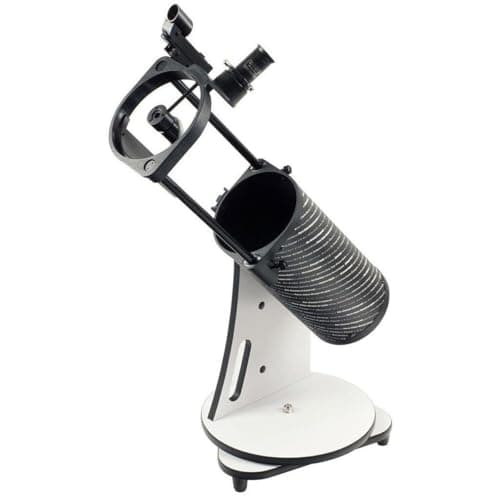 Sky-Watcher Heritage 130 Tabletop DobsonianTop pickThe same 130mm parabolic mirror as scopes costing far more, on a base with no tripod to wobble and nothing to set up. | Most aperture per dollar | 130mm260x useful | |
| 2 | 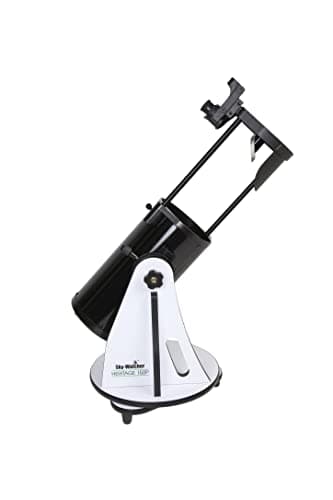 Sky-Watcher Heritage 150 Tabletop Dobsonian150mm at f/5 in a collapsible tube on a tabletop base. Deep-sky aperture that still stores next to the vacuum cleaner. | Maximum aperture in a cupboard | 150mm300x useful |
Top pick · Most aperture per dollar
Sky-Watcher Heritage 130 Tabletop Dobsonian
The same 130mm parabolic mirror as scopes costing far more, on a base with no tripod to wobble and nothing to set up.
What the aperture allows
- Maximum useful magnification
- 260x
- 2 × 130mm of aperture
- Resolving limit (Dawes)
- 0.89 arcseconds
- 116 ÷ 130mm
- Cassini division (0.7″)
- Out of reach
- this aperture cannot resolve it
Worked example: a 25mm eyepiece in this telescope gives 650mm ÷ 25mm = 26x.
This is the aperture-per-dollar champion of the beginner shelf and it is not close. You get the same 130mm parabolic mirror found in telescopes at twice the price, and you get it without paying for a tripod, a slow-motion assembly or a hand controller.
Two times 130mm is 260x of useful magnification. Dawes' limit at 130mm works out to 116 divided by 130, which is 0.89 arcseconds. The Cassini division in Saturn's rings spans roughly 0.7 arcseconds at its widest, so this telescope sits right at the edge of showing it on a still night and will show the rings themselves easily.
The catch is the word tabletop. It needs a surface at roughly chest height when you are seated. A garden table works, a plastic patio chair does not, and buying one without thinking about where it will stand is the single most common regret with this design.
The tube collapses, which is what makes it live in a cupboard rather than a garage. That matters more than it sounds: the telescope you can carry outside in one trip is the telescope you use.
What it does well
- The most aperture you can buy at this price, by a clear margin
- Nothing to assemble, no tripod to wobble, ready in the time it takes to carry it outside
- Collapsible tube stores in a cupboard and keeps its collimation
- The Dobsonian motion is intuitive: you push the tube where you want to look
What it costs you
- Needs a solid table or stool at the right height, which is a real constraint
- The helical focuser is coarser than a rack-and-pinion or a Crayford
- Open tube design collects dust and needs the odd mirror clean
Skip this one if: Skip it if you have nowhere to stand it. On the ground it points at treetops, and on a wobbly plastic table every view shakes.
#ad · how this is funded · price as of September 13, 2026
Pick 2 · Maximum aperture in a cupboard
Sky-Watcher Heritage 150 Tabletop Dobsonian
150mm at f/5 in a collapsible tube on a tabletop base. Deep-sky aperture that still stores next to the vacuum cleaner.
What the aperture allows
- Maximum useful magnification
- 300x
- 2 × 150mm of aperture
- Resolving limit (Dawes)
- 0.77 arcseconds
- 116 ÷ 150mm
- Cassini division (0.7″)
- Out of reach
- this aperture cannot resolve it
Worked example: a 25mm eyepiece in this telescope gives 750mm ÷ 25mm = 30x.
This is the Heritage 130's argument with 33 percent more mirror. Light gathering scales as the square of the aperture ratio, so 150 over 130, squared, is 1.33 times the light of its smaller sibling.
Two times 150mm is 300x of useful magnification and Dawes' limit is 0.77 arcseconds, which puts the Cassini division inside its reach on a good night.
At f/5 the 750mm focal length keeps the tube short enough to collapse, which is the entire reason this design exists. A conventional 150mm Newtonian tube is over a meter long and lives in a garage.
The same tabletop caveat applies as with the 130: it needs a stable surface at seated chest height. Check you have one before you buy, not after.
What it does well
- Deep-sky aperture in a package that genuinely stores in a cupboard
- Collapsible tube holds collimation between setups
- No tripod means no tripod wobble, the most common cause of a shaky first view
What it costs you
- The tabletop requirement is a real constraint, not a footnote
- The helical focuser is the weakest component
- An open tube collects dust and needs the occasional clean
Skip this one if: Skip it if you have the floor space for the Classic 150P. The floor-standing version has a better focuser and needs no furniture.
#ad · how this is funded · price as of September 13, 2026
Side by side
| Heritage 130 | Heritage 150 | |
|---|---|---|
| Aperture | 130mm | 150mm |
| Focal length | 650mm | 750mm |
| Focal ratio | f/5 | f/5 |
| Primary mirror | Parabolic, borosilicate | Parabolic, borosilicate |
| Max useful magnification | 260x | 300x |
| Resolving limit | 0.89 arcsec | 0.77 arcsec |
| Cassini division | Out of reach | In reach on a steady night |
| Relative light gathering | Baseline | 1.33x |
| Published light vs the eye | 319 percent more | 363 percent more |
| Tube | Collapsible | Collapsible |
| Needs a table | Yes | Yes |
Which one to buy
Buy the Heritage 150 if the budget reaches it and the planets are part of why you are buying. Crossing the Cassini threshold is the kind of thing you remember, and 33 percent more light is not a rounding error on a faint target. This is the telescope the under-$300 bracket names when light is the priority.
Buy the Heritage 130 if the budget does not reach, if the telescope has to be genuinely easy to carry, or if it is for a child. It is smaller, lighter and lower, and it remains the best aperture-per-dollar purchase in beginner astronomy. Nothing about the 150 makes the 130 a bad telescope.
Buy neither if there is no suitable surface in the house and no intention of buying one. That is the only condition on this page that disqualifies both, and it disqualifies them completely.
The honest cons, on both
- The helical focuser is fiddly at high magnification on either telescope, because you turn the barrel rather than a knob and a small movement shifts the whole tube.
- The open tube collects dust over time and lets stray light in from a porch lamp more easily than a closed tube would. A simple shroud fixes the second problem.
- Neither tracks. At 150x an object drifts out of the field in well under a minute on both and you nudge it back.
- The 150 is meaningfully bigger. It is heavier to lift onto a table and takes more cupboard, which is the practical price of the aperture.
- The 130 will leave you wanting the 150 if the planets turn out to be your thing, which is worth knowing before you buy rather than a year later.
Questions people actually ask
Heritage 130 or Heritage 150?
The 150 if the budget reaches it and planets matter to you: it collects 33 percent more light and its 0.77-arcsecond resolving limit brings the Cassini division into reach, where the 130's 0.89 does not. The 130 if budget, weight or a child's use is the constraint — it is still the best aperture per dollar on the beginner shelf.
Is the Heritage 150 worth the extra over the 130?
If planets are part of the reason you are buying, yes, because it crosses a specific threshold rather than just being incrementally better. If you mostly want the Moon and bright clusters, the difference is much smaller and the 130 is easier to live with.
Do the Heritage 130 and 150 use the same mirror type?
Both use a parabolic primary in borosilicate glass, which is the specification that matters at f/5. Neither uses a spherical mirror, which is the compromise found in cheaper telescopes at this focal ratio.
Do both need a table?
Yes, and it is a real requirement on both rather than a footnote. Each needs a stable surface at roughly seated chest height. On the ground either one points at treetops, which is the most common regret with the design.
Why does Sky-Watcher say 44 percent more light when the aperture ratio gives 33?
We do not know, and we will not guess. The aperture ratio of 150 to 130, squared, is 1.33. Sky-Watcher publishes 44 percent for the same comparison and does not publish the figures that would let a reader check which is which, so this site prints both and uses the computed one.
Read next
Best tabletop
Tabletop Telescopes, and the One Thing to Check First
The best value design in beginner astronomy, and the surface requirement that decides whether it works for you.
Top pick: Sky-Watcher Heritage 130 Tabletop Dobsonian
#ad · how this is funded · price as of September 13, 2026

Sky-Watcher Heritage 130 Tabletop Dobsonian
The aperture-per-dollar champion: 130mm parabolic in a collapsible tube, with one condition to check first.
Top pick: Sky-Watcher Heritage 130 Tabletop Dobsonian
#ad · how this is funded · price as of September 13, 2026
Sky-Watcher Heritage 150 Tabletop Dobsonian
150mm parabolic at f/5 in a collapsible tube on a tabletop base. Deep-sky aperture with one furniture condition attached.
Top pick: Sky-Watcher Heritage 150 Tabletop Dobsonian
#ad · how this is funded · price as of September 13, 2026
Found something wrong here? Tell us and we will correct it and date the correction, per our editorial policy.