Reviews
Celestron StarSense Explorer DX 130AZ
The telescope this site recommends most often, and the reasoning is two numbers: 130mm of parabolic aperture, and a finder that removes the reason most first telescopes stop being used.
By Scooter M. · Published · How we pick

The StarSense Explorer DX 130AZ is the telescope this site points first-time buyers at more often than any other. The case for it is not subtle: 130mm of parabolic mirror, a mount that stays where you put it, and the one piece of software that genuinely solves the find-it problem.
What the published numbers say
Celestron publishes an unusually complete specification sheet for this telescope, and the figures below are all its own. The computed limits beside them are ours, derived from the published aperture.
max useful magnification = 2 x aperture. Dawes limit = 116 / aperture.
130 x 2 = 260x. 116 / 130 = 0.89 arcseconds.
Celestron publishes 307x and 0.89 arcseconds for the same telescope. The resolution figures agree exactly; the magnification figures differ, and that difference is worth a paragraph.
The gap between 260x and Celestron's 307x is not a disagreement about physics. Manufacturers commonly compute the ceiling per inch of aperture with a slightly more generous constant than the 2x-per-millimeter rule of thumb. Neither figure describes a typical night: astronomical seeing usually settles the question somewhere between 130x and 180x.
The StarSense system, described accurately
Your phone sits in a dock over a small mirror aimed at the sky. The app photographs the star field, matches the pattern against a catalog, and works out exactly where the telescope is pointing. That is plate solving, and it is the same technique research telescopes use.
It then shows an on-screen arrow and a bullseye. There is no alignment routine, no named stars to identify, no power supply and no hand controller.
What the eyepieces give you
magnification = telescope focal length / eyepiece focal length
650 / 25 = 26x. 650 / 10 = 65x.
Celestron publishes exactly these two figures, 26x and 65x, on its own product page. The 25mm is the one you will use most; the 10mm is the weakest component in the box and the first thing worth upgrading. Which eyepieces to buy.
Where it sits against the alternatives
| StarSense DX 130AZ | Sky-Watcher Heritage 130 | StarSense LT 114AZ | |
|---|---|---|---|
| Aperture | 130mm | 130mm | 114mm |
| Primary mirror | Parabolic | Parabolic | Spherical |
| Max useful magnification | 260x | 260x | 228x |
| Resolving limit | 0.89 arcsec | 0.89 arcsec | 1.02 arcsec |
| Mount | Alt-az tripod | Tabletop Dobsonian | Alt-az tripod |
| Phone finding | Yes | No | Yes |
| Needs a table | No | Yes | No |
Against the Heritage 130 it is the same optic on a full-height tripod with the app, for more money. Against the LT 114AZ it is a parabolic mirror instead of a spherical one and 30 percent more light, also for more money. Both comparisons come out in its favor for a first buyer, which is why it leads the beginner ranking.
How this is funded: the buy buttons below are Amazon Associates links, and a qualifying purchase earns us a commission at no extra cost to you. It cannot move the ranking, because the order here is set by aperture per dollar, and no commission rate changes how much light a mirror collects. Full disclosure.
| # | Telescope | Best for | Aperture | Price |
|---|---|---|---|---|
| 1 | 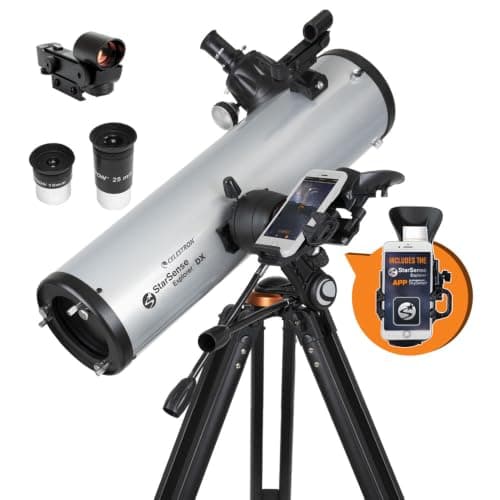 Celestron StarSense Explorer DX 130AZTop pick130mm of parabolic aperture on a mount that stays still, plus the one piece of software that genuinely solves the find-it problem. | Most first buyers | 130mm (5.11 in)260x useful |
Top pick · Most first buyers
Celestron StarSense Explorer DX 130AZ
130mm of parabolic aperture on a mount that stays still, plus the one piece of software that genuinely solves the find-it problem.
What the aperture allows
- Maximum useful magnification
- 260x
- 2 × 130mm of aperture
- Resolving limit (Dawes)
- 0.89 arcseconds
- 116 ÷ 130mm
- Cassini division (0.7″)
- Out of reach
- this aperture cannot resolve it
Celestron publishes 307x as this telescope’s highest useful magnification. Our figure is 260x, from two times the aperture in millimeters. The gap of 47x comes from the slightly more generous per-inch constant makers use. Neither number describes a typical night: the atmosphere usually settles the question well below both.
Worked example: a 25mm eyepiece in this telescope gives 650mm ÷ 25mm = 26x.
130mm is the aperture where the sky stops being a list of bright dots. Two times that aperture is 260x of useful magnification, which is more than the atmosphere will usually give you on any given night, so nothing in this telescope's optical budget is wasted on a number you cannot use.
Celestron's own published ceiling for it is 307x, which sits above the 2x-aperture rule of thumb. The gap is worth knowing about: manufacturers compute that figure per inch of aperture with a slightly more generous constant. Neither number describes a night you will actually have. Plan around 130x to 180x and treat anything higher as a rare-night bonus.
At f/5 the focal length is short, so the supplied 25mm eyepiece gives a wide, forgiving 26x that makes finding things possible in the first place. That is not a compromise; it is the eyepiece you will use most.
The StarSense part is the honest reason this sits at the top. It uses your phone's camera to plate-solve the actual sky and then walks you to a target with an on-screen arrow. It is not a motor and it does not track. It solves the problem that really kills first telescopes, which is not being able to find anything.
What it does well
- 130mm parabolic mirror rather than the cheaper spherical mirror used at this price by several competitors
- The phone-based finder works and needs no alignment stars, no power and no hand controller
- Full-height tripod, so an adult uses it standing up rather than kneeling on wet grass
- Manual mount means nothing to charge, nothing to fail and nothing to re-align next time
What it costs you
- The bundled 10mm eyepiece is the weakest part of the package
- A Newtonian needs collimation checks; not hard, but it is a task a refractor does not have
- No tracking, so at high magnification you are nudging the tube every 30 seconds
Skip this one if: Skip it if the person receiving it is under about ten and will be using it alone. The tripod is full height and the finding workflow assumes a phone.
#ad · how this is funded · price as of October 18, 2026
Who should not buy it
Anyone buying for a child under about ten, because the tripod is full height and the workflow assumes a phone. Anyone who would rather learn to star-hop, because the same money buys noticeably more aperture without the dock. And anyone whose observing spot is a table rather than open ground, where a tabletop Dobsonian is the better fit.
Where this telescope sits in the maker's own range is covered in the best Celestron telescopes.
Questions people actually ask
Is the Celestron StarSense Explorer DX 130AZ worth it?
For a first-time buyer, usually yes. It combines a 130mm parabolic mirror with phone-based plate solving that removes the most common reason first telescopes stop being used. The same money buys more aperture without the app, if finding things is not your bottleneck.
What magnification does the DX 130AZ give?
26x with the supplied 25mm eyepiece and 65x with the 10mm, both of which are Celestron's own published figures. The useful ceiling is 260x from two times the 130mm aperture, and Celestron publishes 307x.
Does StarSense move the telescope for you?
No. It shows you which way to push the tube and tells you when you have arrived. Nothing is motorized and nothing tracks, so objects still drift out of the field as the Earth turns.
Can you see Saturn's rings with the DX 130AZ?
Yes, easily. The rings span far more than this telescope's 0.89-arcsecond resolving limit, and 65x with the supplied 10mm eyepiece is already above the roughly 70x at which the ring separation becomes obvious.
Does it need collimation?
Occasionally, like any Newtonian reflector. A telescope kept indoors and carried gently can go months between adjustments. The collimation guide covers the star test and the procedure.
Read next

StarSense Phone Finding vs Finding Things Yourself
Phone-guided finding against learning to star-hop: what each costs in aperture, and which suits which buyer.
Top pick: Celestron StarSense Explorer DX 130AZ
#ad · how this is funded · price as of October 18, 2026
Best under $300
The Best Telescopes Under $300
The bracket where the choice becomes aperture against finding assistance, with both sides of the trade computed.
Top pick: Celestron StarSense Explorer LT 114AZ
$259.95 · 8% off
#ad · how this is funded · price as of October 18, 2026
Sky-Watcher Heritage 130 Tabletop Dobsonian
The aperture-per-dollar champion: 130mm parabolic in a collapsible tube, with one condition to check first.
Top pick: Sky-Watcher Heritage 130 Tabletop Dobsonian
$305.00 · 12% off
#ad · how this is funded · price as of October 18, 2026
Found something wrong here? Tell us and we will correct it and date the correction, per our editorial policy.