Reviews
Celestron Ultima 20-60x80
A daytime instrument with enough aperture to be taken seriously after dark. The zoom is the appeal, and the reason it will never replace a telescope.
By Scooter M. · Published · How we pick

A spotting scope is a short refractor with a built-in diagonal and a zoom eyepiece, sold to people who watch birds and score targets. This one has an 80mm objective, which is the same aperture as the largest binoculars on this site and larger than several of the telescopes. That makes it a genuinely dual-purpose instrument rather than a daytime toy, and this review is mostly about where the dual purpose runs out.
What 80mm supports, after dark
max useful magnification = 2 x aperture. Dawes limit = 116 / aperture.
80 x 2 = 160x. 116 / 80 = 1.45 arcseconds.
Celestron publishes a limiting stellar magnitude of 12.02 under ideal skies, 11.02 moderate and 10.02 poor. The zoom tops out at 60x, well inside the 160x the aperture could support, so the top of the range is an honest number rather than a marketing one.
That last point separates this from most budget optics on the market. A great many telescopes are sold claiming magnifications far above two times their aperture; this scope's 60x maximum is only 38 percent of what 80mm can take. When you reach the top of the zoom you are running out of eyepiece, not out of glass.
At 1.45 arcseconds, though, the Cassini division in Saturn's rings — roughly 0.7 arcseconds — is out of reach, and so is genuine planetary surface detail. What you can see sets out what aperture each planetary feature needs.
The zoom, and what it costs
Celestron publishes a 480mm focal length and an 8mm to 24mm zoom eyepiece with an integrated T-adapter, which gives the stated 20x to 60x.
magnification = focal length / eyepiece focal length
480 / 24 = 20x. 480 / 8 = 60x.
The published zoom range and the published focal length agree exactly, which is a good sign that both numbers are real.
A zoom eyepiece is a convenience that costs you something at both ends. Celestron publishes an exit pupil of 4mm at 20x falling to 1.3mm at 60x, and a field of 105 ft at 1,000 yards at 20x falling to 53 ft at 60x. Converting those, the field is about 2.0 degrees at 20x and about 1.0 degrees at 60x.
- At 60x the exit pupil is 1.3mm, which is dim. That is fine on the Moon, which has light to spare, and limiting on anything faint.
- A zoom has more glass than a fixed eyepiece of the same focal length, so contrast and edge sharpness are slightly behind a good fixed eyepiece. Which eyepieces to buy covers what a fixed design gives you.
- 2.0 degrees at the wide end is narrow compared with binoculars, so this is not a sweeping instrument. It frames a target.
- 18mm of eye relief is published and generous, which makes it comfortable with glasses on.
The angled body is an astronomy advantage
Celestron publishes this as an angled spotting scope, meaning the eyepiece sits at 45 degrees to the tube. For birding that is a preference. For astronomy it is a clear advantage, because pointing a straight-through scope upward forces your head underneath it, which is the standard complaint about using large binoculars at the zenith.
With an angled body you look down into an instrument pointed up, which is exactly how an astronomical refractor with a star diagonal works. That is the single feature that makes this scope usable for real observing sessions rather than occasional glances.
How this is funded: the buy buttons below are Amazon Associates links, and a qualifying purchase earns us a commission at no extra cost to you. It cannot move the ranking, because the order here is set by aperture per dollar, and no commission rate changes how much light a mirror collects. Full disclosure.
| # | Telescope | Best for | Aperture | Price |
|---|---|---|---|---|
| 1 | 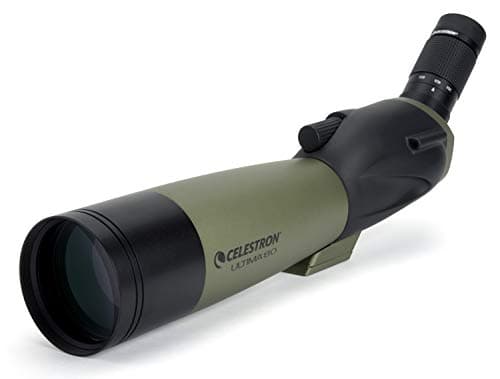 Celestron Ultima 20-60x80 Angled Spotting ScopeTop pick80mm of aperture with a built-in 20-60x zoom and an upright image. More objective than most beginner telescopes, and a magnification ceiling set by its eyepiece rather than its optics. | Daytime first, sky second | 80mm objective (3.15 in)160x useful |
Top pick · Daytime first, sky second
Celestron Ultima 20-60x80 Angled Spotting Scope
80mm of aperture with a built-in 20-60x zoom and an upright image. More objective than most beginner telescopes, and a magnification ceiling set by its eyepiece rather than its optics.
What the aperture allows
- Maximum useful magnification
- 160x
- 2 × 80mm of aperture
- Resolving limit (Dawes)
- 1.45 arcseconds
- 116 ÷ 80mm
- Cassini division (0.7″)
- Out of reach
- this aperture cannot resolve it
Worked example: a 25mm eyepiece in this telescope gives 480mm ÷ 25mm = 19x.
80mm is more aperture than most beginner telescopes carry, and it is the number that decides what this instrument can resolve: 116 divided by 80 gives a 1.45-arcsecond limit, which is finer than the 70mm refractors on this site manage.
Then the zoom caps it. Two times 80mm of aperture would support 160x, and the built-in eyepiece stops at 60x. That is the exact inverse of the problem this site was built to explain: a telescope box advertises magnification its optics cannot deliver, while a spotting scope quietly delivers less magnification than its optics could support. The 60x ceiling is a design decision about daylight use, not an optical limit.
For the sky that ceiling matters most on the planets. Saturn's ring separation becomes obvious at around 70x, so at this scope's maximum of 60x you are just short of the view that makes people remember the night. You will see an oval that is clearly not a star, and on a steady night the rings will separate at the edge of perception.
Celestron's published limiting stellar magnitude of 12.02 under ideal skies is the honest figure for deep sky: real, and about a magnitude short of what a 130mm telescope reaches. The upright, correctly-oriented image is the trade you are buying it for, and it costs light at every extra glass surface.
What it does well
- 80mm of objective, more than most beginner telescopes at a comparable price
- Upright, right-way-round image that works for landscapes, wildlife and boats
- Sealed and weather-resistant in a way an open-tube reflector is not
- Zoom eyepiece with an integrated T-adapter, so no eyepiece shopping to do
- Celestron publishes a limiting stellar magnitude for it, which most spotting-scope makers do not
What it costs you
- 60x ceiling from the fixed zoom, against the 160x its 80mm aperture could support
- The zoom eyepiece does not come out, so no wide-field low-power eyepiece for deep sky
- No tripod supplied, and it needs a sturdier one than its weight suggests
- Angled body is right for the sky and awkward for tracking a moving animal
- The erecting prisms that make the image upright cost light and a little sharpness
Skip this one if: Skip it if the sky is the whole reason you are buying. At this price a 130mm tabletop Dobsonian collects 2.6 times the light and takes eyepieces that reach genuinely useful magnifications.
#ad · how this is funded · price as of September 27, 2026
What it will not do that a telescope will
| Ultima 80 | TrailSeeker 65 | SkyMaster 20x80 | AstroMaster 102AZ | |
|---|---|---|---|---|
| Aperture | 80mm | 65mm | 80mm | 102mm |
| Magnification | 20-60x zoom | 16-48x zoom | 20x fixed | Eyepiece dependent |
| Max useful magnification | 160x | 130x | 160x | 204x |
| Resolving limit | 1.45 arcsec | 1.78 arcsec | 1.45 arcsec | 1.14 arcsec |
| Limiting magnitude, ideal | 12.02 | 11.56 | 12.02 | Not published |
| Eyepieces interchangeable | No | No | No | Yes |
| Both eyes | No | No | Yes | No |
| Daytime use | Excellent | Excellent | Good | With a diagonal |
| Weight | 57 oz | 48 oz | 75 oz | Not published |
The row that matters most is eyepieces interchangeable. A spotting scope's eyepiece is part of the instrument, so 60x is a permanent ceiling and you cannot buy your way past it. A telescope of the same aperture takes any eyepiece you like and can be pushed to 160x, and its owner can upgrade the view without replacing the scope. That is the structural reason a spotting scope is not a telescope substitute, and it has nothing to do with optical quality. Telescope against spotting scope works the comparison through properly.
The honest drawbacks
- No tripod or mount is supplied, and at 57 oz it needs a real one. Budget for it.
- The eyepiece is fixed, capping magnification at 60x forever.
- 1.3mm exit pupil at full zoom makes the top of the range dim on anything but the Moon and bright planets.
- 1.45 arcseconds rules out the Cassini division and planetary surface detail permanently.
- One eye, not two. For star fields the binocular view is more restful and arguably more beautiful; this trades that for magnification and a diagonal.
- It costs more than several telescopes on this site that will show more of the night sky. If astronomy is the only purpose, this is the wrong purchase.
The T-adapter, which is easy to overlook
Celestron publishes the zoom eyepiece as having an integrated T-adapter. That is a small detail with a real consequence: it means a camera can be threaded directly onto the scope through a T-ring matched to your camera body, without holding a phone to the eyepiece or buying a separate adapter.
For daytime photography of wildlife that is the main appeal, and the practice has its own name, digiscoping. For astronomy it makes the Moon straightforwardly photographable, and at 480mm of focal length the whole disc fits comfortably in a frame. Planets are possible and small, as they are through any instrument of this aperture.
A phone works too, with a bracket, and for most owners that is the easier route. The NexYZ review covers what a phone can honestly capture through an eyepiece and what it cannot. The advantage of the threaded T-adapter is rigidity: a camera bolted to the scope does not need aligning every time the way a phone in a bracket does.
Who should buy it, and who should not
Buy it if daytime use is at least half the reason. For wildlife, landscapes, or watching something a long way off, an 80mm spotting scope with a zoom is the right tool and the astronomy is a real bonus — the Moon at 60x through this is a genuinely good view, Jupiter's moons are easy, and Saturn shows as an oval with rings you can tell are there.
Buy it also if portability and a single instrument matter more than capability, since one 57 oz scope covering both jobs beats two separate purchases for some people.
Do not buy it as an astronomy instrument. At this price a 130mm or 150mm telescope collects far more light, resolves finer detail, and accepts any eyepiece you want to put in it. The zoom and the daylight performance are what you are paying for, and if you do not need them the money is better spent elsewhere.
Questions people actually ask
Can you use the Celestron Ultima 80 for astronomy?
Yes, genuinely. 80mm is a real aperture and Celestron publishes a limiting stellar magnitude of 12.02 under ideal skies. The angled body makes looking up comfortable, and 60x is well within what the aperture supports. At 1.45 arcseconds it cannot resolve the Cassini division or show planetary surface detail.
Is a spotting scope as good as a telescope?
No, for one structural reason: the eyepiece is not interchangeable. The Ultima 80 stops at 60x permanently, while a telescope of the same 80mm aperture accepts any eyepiece and can be worked up to about 160x. A spotting scope also shows a narrower field than binoculars and uses one eye.
What magnification does the Celestron Ultima 80 have?
Celestron publishes 20x to 60x from an 8mm to 24mm zoom eyepiece on a 480mm focal length, and the arithmetic agrees exactly: 480 divided by 24 is 20x and 480 divided by 8 is 60x. Exit pupil falls from 4mm at 20x to 1.3mm at 60x, so the top of the zoom is noticeably dimmer.
Does the Ultima 80 come with a tripod?
No. Celestron publishes it as tripod adaptable with no mount or tripod supplied, and at 57 oz it needs a sturdy one. The tripod is a required part of the purchase rather than an optional extra.
Angled or straight spotting scope for stargazing?
Angled, clearly. With the eyepiece at 45 degrees you look down into a scope that is pointed up, the way an astronomical refractor with a star diagonal works. A straight scope pointed near the zenith forces your head underneath it, which is uncomfortable for any sustained observing.
Read next
Telescope vs Spotting Scope: Which One Do You Actually Want?
A spotting scope caps at its zoom's top magnification; a telescope takes any eyepiece. The decision, with both makers' published numbers.
Top pick: Celestron Ultima 20-60x80 Angled Spotting Scope
#ad · how this is funded · price as of September 27, 2026

Celestron TrailSeeker 16-48x65
65mm angled spotting scope, 16-48x zoom, with phase-coated BaK-4 prisms and XLT coatings. Nine ounces lighter than the 80mm.
Top pick: Celestron TrailSeeker 16-48x65 Spotting Scope
$299.95 · 15% off
#ad · how this is funded · price as of September 27, 2026
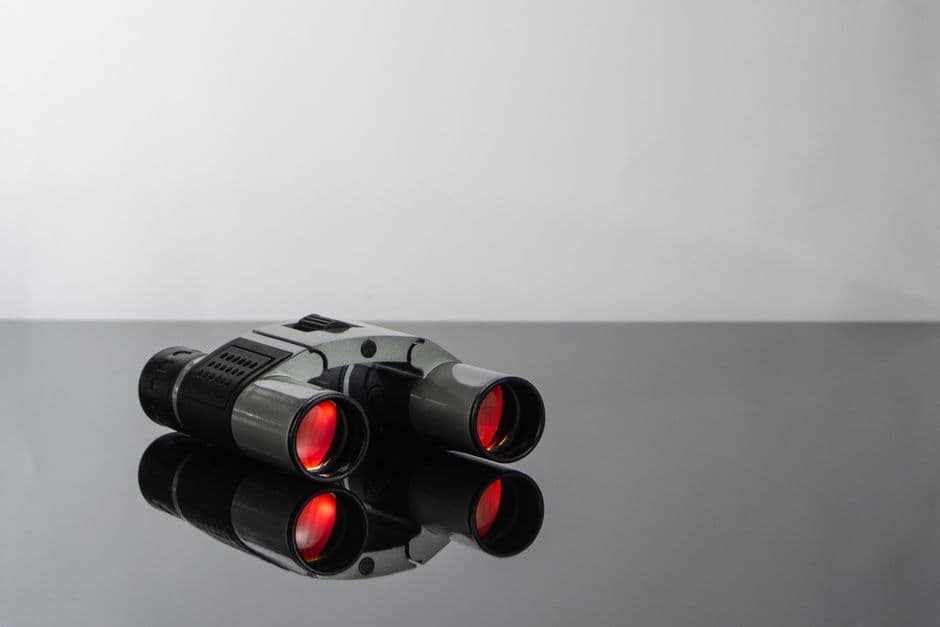
Celestron SkyMaster 20x80
20x80 Porro binoculars with a published 12.02 limiting magnitude and BaK-4 prisms. More light than any other pair here, at 75 oz.
Top pick: Celestron SkyMaster 20x80 Binoculars
#ad · how this is funded · price as of September 27, 2026
Found something wrong here? Tell us and we will correct it and date the correction, per our editorial policy.