Reviews
Celestron TrailSeeker 16-48x65
Higher optical specification than the larger scope beside it, on a smaller objective. An unusual trade, and the right one for anybody who carries their optics.
By Scooter M. · Published · How we pick

Most product ranges get better as they get bigger. This one does not, quite. The TrailSeeker 65 has a smaller objective than the Ultima 80 on this site and a higher optical specification: Celestron publishes phase-coated BaK-4 prisms and XLT fully multi-coated optics here, against fully multi-coated BaK-4 without the phase coating on the larger scope. That is an interesting trade and it points at a specific buyer.
What phase coating actually does
In a roof-prism or phase-sensitive prism system, light taking different paths through the glass can emerge slightly out of phase, which softens fine detail and reduces contrast. A phase coating corrects that. It is not a marketing word: it is a measurable improvement in resolution of fine, low-contrast detail, which in daylight means feather edges and in astronomy means the difference between a smudge and a smudge with texture.
The honest caveat is that no coating creates photons. A better-corrected 65mm still collects less light than a less-corrected 80mm, and for faint astronomical objects aperture wins that argument every time.
The arithmetic, against the larger scope
light ratio = (aperture 1 / aperture 2) squared. Dawes limit = 116 / aperture.
(65 / 80)squared = 0.66. 116 / 65 = 1.78 arcseconds.
This collects about 66 percent of the Ultima 80's light. Celestron publishes limiting stellar magnitudes of 11.56 here against 12.02 for the 80mm — a difference of 0.46 magnitudes, and a 0.66 light ratio works out to 0.45. The maker's figures and the arithmetic agree.
So the cost of the smaller objective is just under half a magnitude of depth and a coarser resolving limit, 1.78 arcseconds against 1.45. Neither scope reaches the roughly 0.7 arcseconds the Cassini division needs, so that particular target is lost to both.
magnification = focal length / eyepiece focal length
382 / 24 = 16x. 382 / 8 = 48x.
Celestron publishes a 382mm focal length, an 8mm to 24mm zoom and a 16x to 48x range. The three figures agree, and 48x is well inside the 130x that two times 65mm would allow.
Where the smaller scope wins
- 48 oz against 57 oz. Nine ounces sounds trivial and is not, because a spotting scope is usually carried with its tripod. Celestron also publishes 382mm of length against the 80mm scope's 480mm, so it packs shorter.
- A wider view at the bottom of the zoom. 136 ft at 1,000 yards at 16x, against 105 ft at 20x on the larger scope. Converting, that is about 2.6 degrees against 2.0.
- Better eye relief where it matters. Celestron publishes 18mm at 16x falling to 15mm at 48x, so even at full zoom it stays at the comfortable threshold for spectacle wearers.
- Phase-coated prisms and XLT coatings, which is the higher optical specification of the two.
- A less demanding tripod. 48 oz is within reach of mounts that would struggle with 75 oz binoculars or a heavier scope.
What it gives up
- Half a magnitude of depth, per Celestron's own published figures. On faint objects the 80mm is simply better.
- A coarser resolving limit, 1.78 arcseconds against 1.45, so slightly less fine detail on the Moon and on double stars.
- 48x rather than 60x at the top, and as with any spotting scope the eyepiece is not interchangeable, so that ceiling is permanent.
- No tripod supplied, same as the larger scope.
- It costs nearly as much as the 80mm. You are paying for coatings and portability, not for capability, and if neither matters to you the larger scope is the better value.
How this is funded: the buy buttons below are Amazon Associates links, and a qualifying purchase earns us a commission at no extra cost to you. It cannot move the ranking, because the order here is set by aperture per dollar, and no commission rate changes how much light a mirror collects. Full disclosure.
| # | Telescope | Best for | Aperture | Price |
|---|---|---|---|---|
| 1 | 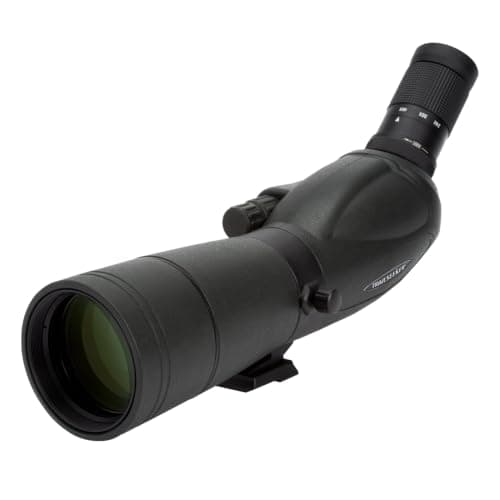 Celestron TrailSeeker 16-48x65 Spotting ScopeTop pick65mm and 48 oz, with phase-coated prisms and Celestron's XLT coatings. The one you actually walk with, at a real cost in aperture. | Carrying it all day | 65mm objective (2.56 in)130x useful |
Top pick · Carrying it all day
Celestron TrailSeeker 16-48x65 Spotting Scope
65mm and 48 oz, with phase-coated prisms and Celestron's XLT coatings. The one you actually walk with, at a real cost in aperture.
What the aperture allows
- Maximum useful magnification
- 130x
- 2 × 65mm of aperture
- Resolving limit (Dawes)
- 1.78 arcseconds
- 116 ÷ 65mm
- Cassini division (0.7″)
- Out of reach
- this aperture cannot resolve it
Worked example: a 25mm eyepiece in this telescope gives 382mm ÷ 25mm = 15x.
65mm collects 34 percent less light than the 80mm Ultima, from the ratio 65 over 80 squared, and it saves 9 oz. Whether that is a good trade depends entirely on whether the instrument gets carried, which is the same argument this site makes about large Dobsonians.
Its 116-divided-by-65 resolving limit is 1.78 arcseconds, which is coarser than every telescope on this site except nothing at all. The Cassini division is far out of reach and so are tight double stars.
The 16x bottom end is the interesting number for the sky. A wide, bright, low-power view of the Pleiades or the Milky Way is the one astronomical thing a spotting scope does genuinely well, and 16x with a 4mm exit pupil is a good place to do it from.
Phase-coated prisms and XLT coatings are real optical upgrades over the budget end of this category, and they are why this one costs what it does. They improve contrast; they do not add aperture.
What it does well
- 48 oz, which is the difference between an instrument you carry and one you drive to a spot
- Phase-coated prisms and XLT coatings, a genuine step up from budget spotting scopes
- 16x low end gives a wide, bright field that suits star clusters and the Milky Way
- Weather-sealed and upright, so it works as a daytime instrument without compromise
What it costs you
- 65mm is below the 70mm floor this site sets for a worthwhile astronomical instrument
- 48x ceiling, against the 130x its aperture could support
- 1.78-arcsecond resolving limit rules out the Cassini division and tight doubles
- No tripod supplied, and a light tripod undoes the optics
Skip this one if: Skip it if you want one instrument to do both jobs properly. It is a good daytime scope that can look up, not a telescope that also works in daylight.
$299.95 · 15% off
#ad · how this is funded · price as of September 27, 2026
What it shows after dark
At 16x to 48x on 65mm, expect the Moon in real detail — craters, mountain shadows and the terminator at its best — Jupiter's four bright moons as clear points, Saturn as an oval whose rings you can tell are there, the phases of Venus, and the brighter open clusters. Celestron publishes a limiting stellar magnitude of 11.56 under ideal skies, dropping to 9.56 under poor ones, which is a useful reminder of how much your sky matters. Light pollution has the numbers.
What it will not show is planetary surface detail, the Cassini division, or structure inside a galaxy. For those, aperture and interchangeable eyepieces are the answer, which means a telescope.
What the coatings claim actually means
Celestron publishes XLT fully multi-coated optics on this scope, and both halves of that phrase carry information worth unpacking, because coating language is where optical marketing is least disciplined.
- Coated means at least one surface has at least one layer. Fully coated means every air-to-glass surface has one. Multi-coated means some surfaces have several layers. Fully multi-coated, which is what is published here, means every air-to-glass surface carries multiple layers. That is the top of the standard ladder and it is a meaningful specification rather than a slogan.
- Why it matters: every uncoated glass surface reflects roughly four percent of the light that hits it. A scope like this has many such surfaces, and those reflections are lost twice over — the light does not reach your eye, and it bounces around inside the tube reducing contrast. Good multi-coating cuts each reflection to a fraction of a percent.
- XLT is Celestron's own name for its coating formulation. Treat it as a brand for a good multi-layer stack rather than as an independently verifiable figure, because the company publishes no transmission percentage for it that this site could cite.
Combined with the phase-coated prisms, this is a genuinely well-specified optical train for the price. None of it changes the aperture, which is still 65mm and still the figure that decides how faint an object you can see, but it does mean the light the scope collects arrives at your eye with less of it thrown away.
Who should buy it, and who should not
Buy it if you carry your optics. That is the whole case: on a hike, in hand luggage, or anywhere the difference between 48 oz and 57 oz plus four inches of length gets noticed, this is the scope that comes with you and therefore the one that gets used. The phase coating means you are not giving up optical quality to get that, only aperture.
Buy it also if you wear glasses, since 15mm of eye relief at full zoom is better than most zoom eyepieces manage.
Do not buy it if the scope will live on a tripod in one place, because the Ultima 80 collects half a magnitude more for a similar outlay. And do not buy either scope primarily for astronomy — at this price a telescope shows considerably more of the night sky, as telescope against spotting scope sets out.
Questions people actually ask
Is the Celestron TrailSeeker 65 good for astronomy?
It is capable rather than ideal. Celestron publishes a limiting stellar magnitude of 11.56 under ideal skies and a 16x to 48x zoom, which shows lunar detail well, Jupiter's moons, Saturn as an oval and the brighter clusters. At 1.78 arcseconds it cannot resolve the Cassini division or planetary surface detail.
TrailSeeker 65 or Ultima 80?
The Ultima 80 for capability, the TrailSeeker 65 for carrying. The 80mm collects about half a magnitude more light, per Celestron's published 12.02 against 11.56, and reaches 60x rather than 48x. The 65mm is 9 oz lighter, 4 inches shorter, and has the higher optical specification with phase-coated prisms and XLT coatings.
What does phase coating do on a spotting scope?
It corrects a phase shift that occurs as light takes different paths through the prism, which would otherwise soften fine low-contrast detail. It is a genuine improvement in resolution and contrast, but it does not gather light, so a phase-coated smaller scope still sees fainter objects less well than a larger one.
Does the TrailSeeker 65 come with a tripod?
No. Celestron publishes it as tripod adaptable with no mount or tripod supplied. At 48 oz it is less demanding than heavier optics, so a mid-range photo tripod will usually cope, but it is still a required purchase.
What magnification is the TrailSeeker 16-48x65?
16x to 48x, from an 8mm to 24mm zoom eyepiece on a published 382mm focal length. The arithmetic checks out: 382 divided by 24 is 16x and 382 divided by 8 is 48x. That top end is well within the roughly 130x that a 65mm aperture could support.
Read next

Celestron Ultima 20-60x80
80mm angled spotting scope with a 20-60x zoom eyepiece and BaK-4 prisms. Terrestrial first, astronomy a genuine second.
Top pick: Celestron Ultima 20-60x80 Angled Spotting Scope
#ad · how this is funded · price as of September 27, 2026
Telescope vs Spotting Scope: Which One Do You Actually Want?
A spotting scope caps at its zoom's top magnification; a telescope takes any eyepiece. The decision, with both makers' published numbers.
Top pick: Celestron Ultima 20-60x80 Angled Spotting Scope
#ad · how this is funded · price as of September 27, 2026

Best portable
The Best Portable Telescopes
Travel and hiking telescopes ranked by what their portability costs in aperture, with published weights throughout.
Top pick: Celestron Travel Scope 70
$119.95 · 25% off
#ad · how this is funded · price as of September 27, 2026
Found something wrong here? Tell us and we will correct it and date the correction, per our editorial policy.