Aperture, Magnification & First Light
Your Telescope Won't Focus
Correct focus is a much narrower position than people expect, and six things stop a telescope reaching it. Only one of them is a fault.
By Scooter M. · Published · How we pick
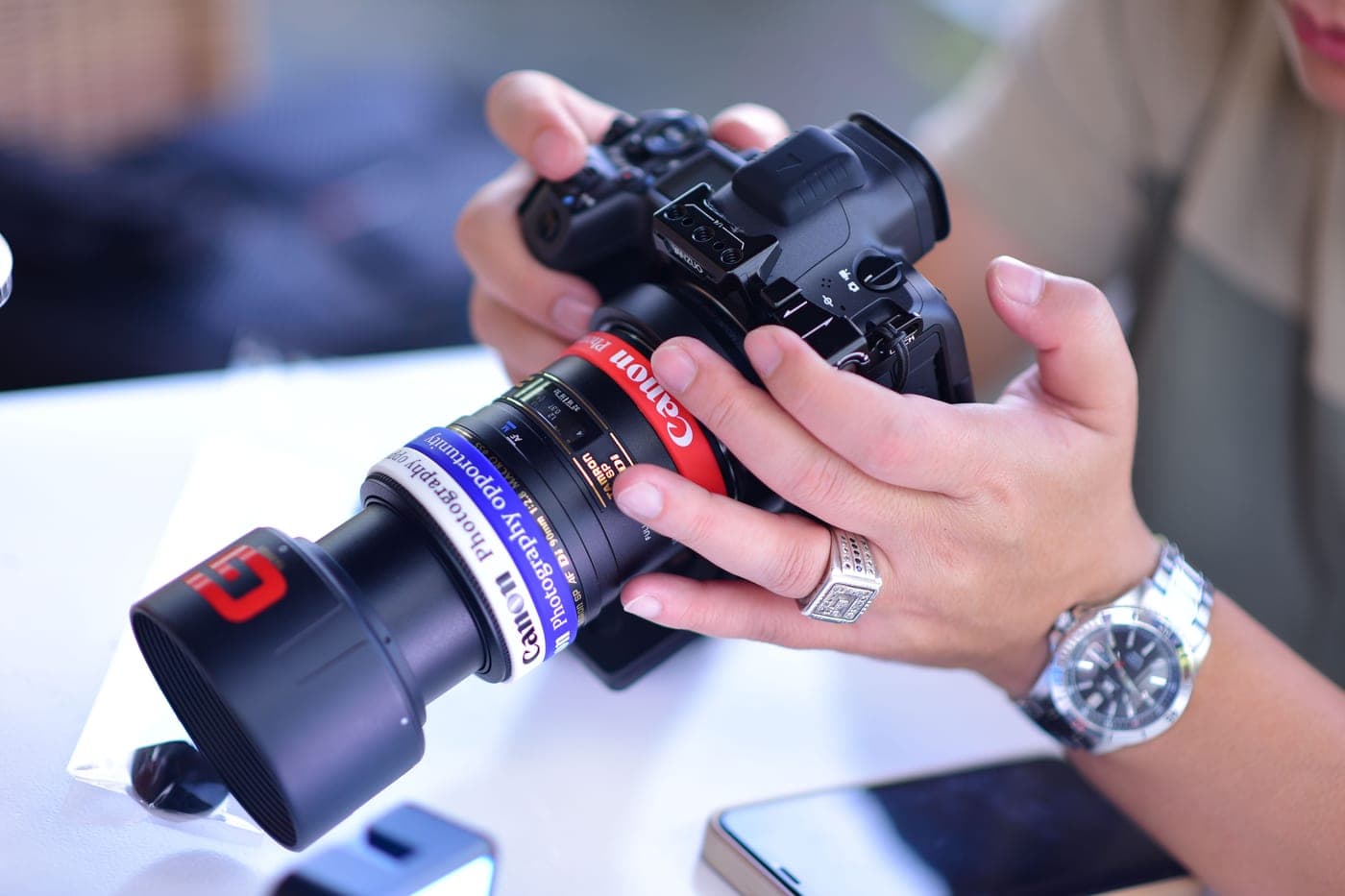
Correct focus is a much narrower position than most people expect. Before assuming anything is wrong, turn the focuser slowly through its entire travel in one direction and then back. Most of the time the sharp point was simply passed through too quickly to notice.
1. You are moving too fast
On a fast telescope the range within which a star looks sharp is a fraction of a turn of the knob. Go slowly enough that you can see the image tighten and then loosen again, and come back to the middle of that.
A useful trick: defocus deliberately until a bright star becomes a small disc, then focus in until that disc collapses to the smallest point you can achieve. Working toward focus from a known defocused state is easier than hunting either side of it, and it is far easier to practice in daylight on a distant chimney than on a cold first night.
2. Too much magnification
The shorter the eyepiece, the harder focus is to find and the more the atmosphere interferes. If focus is fighting you, fit a longer eyepiece: not as a workaround, but because the magnification was probably above what the aperture supports anyway.
maximum useful magnification = 2 x aperture in millimeters
A 70mm telescope: 140x. A 130mm telescope: 260x.
Above the ceiling the image genuinely cannot be made sharp, because the detail was never collected. That is not a focus problem and no amount of turning will fix it. Full explanation.
3. The telescope has not cooled down
A mirror warmer than the surrounding air creates its own convection currents inside the tube, and those currents blur the image in a way that looks exactly like a focus problem: the image shimmers and never quite settles no matter how you turn the knob.
A 130mm mirror needs 20 to 30 minutes outside and a 200mm mirror 30 to 45. Refractors are much less affected. Put the telescope out when you start getting ready.
4. The atmosphere
Astronomical seeing is turbulence in the air above you, and on a poor night it limits detail to 2 or 3 arcseconds regardless of the telescope. The symptom is a star that boils rather than one that is soft.
Nothing fixes this on the night. It is worst when the target is low in the sky, worst over a warm roof or paving, and worst on the evening of a warm day. Try again on a different night; the difference between a good night and a poor one is larger than most people expect.
5. The diagonal or Barlow is missing or doubled
A refractor's star diagonal adds a fixed amount of optical path length, and many refractors cannot reach focus without one fitted. Conversely a reflector usually cannot reach focus with a diagonal in place.
If the focuser has run to one end of its travel and the image is still not sharp, the answer is almost always to add or remove the diagonal, or to remove a Barlow that was left in the train.
6. Collimation, on a reflector
If a Newtonian is soft at every magnification, in every eyepiece, and stars focus to a small comet-like flare rather than a point, its mirrors are out of alignment. That is collimation, it is a normal maintenance task rather than a fault, and it takes a few minutes.
The collimation guide walks through it. This is the only item on this page that requires you to adjust anything.
No products on this page. A page for somebody whose telescope seems broken should diagnose the problem, not sell them a replacement.
Questions people actually ask
Why won't my telescope focus?
Usually because focus is a narrower position than expected and the sharp point was passed through. Otherwise: too much magnification, a mirror still cooling, poor seeing, or a diagonal that needs adding or removing to reach the focus point at all.
Why is my telescope image blurry at high magnification?
Most often because the magnification is above what the aperture supports, which is roughly two times the aperture in millimeters. Above that ceiling the image cannot be made sharp, because the detail was never collected in the first place.
Why do stars look like small discs rather than points?
Either the telescope is slightly out of focus, or the magnification is high enough that you are seeing the diffraction disc, which is a real optical effect rather than a fault. A comet-shaped disc instead of a round one means the telescope needs collimation.
Does temperature affect telescope focus?
Yes, in two ways. A mirror warmer than the air creates convection inside the tube that no amount of focusing corrects, and as a metal tube cools it contracts slightly, so the focus point drifts and needs a small adjustment during a session.
Read next
Collimation: Aligning a Reflector's Mirrors
What collimation is, how to tell when a reflector needs it, and why it matters far less than beginners fear.
The Magnification Myth: Why 525x Means Nothing
Why the magnification number on the box is meaningless, what the real ceiling is, and a calculator for your own telescope.
Top pick: Celestron Eyepiece, Barlow and Filter Kit (1.25")
$239.95 · 8% off
#ad · how this is funded · price as of October 19, 2026

Telescope Troubleshooting: It Is Probably Not Broken
The four problems that make a new telescope seem broken, and why none of them usually is.
Found something wrong here? Tell us and we will correct it and date the correction, per our editorial policy.