Aperture, Magnification & First Light
You Can't See Anything Through Your Telescope
Your telescope is almost certainly working. Five things cause this, they are listed here in order of how often they turn out to be the answer, and the first one is a dust cap.
By Scooter M. · Published · How we pick
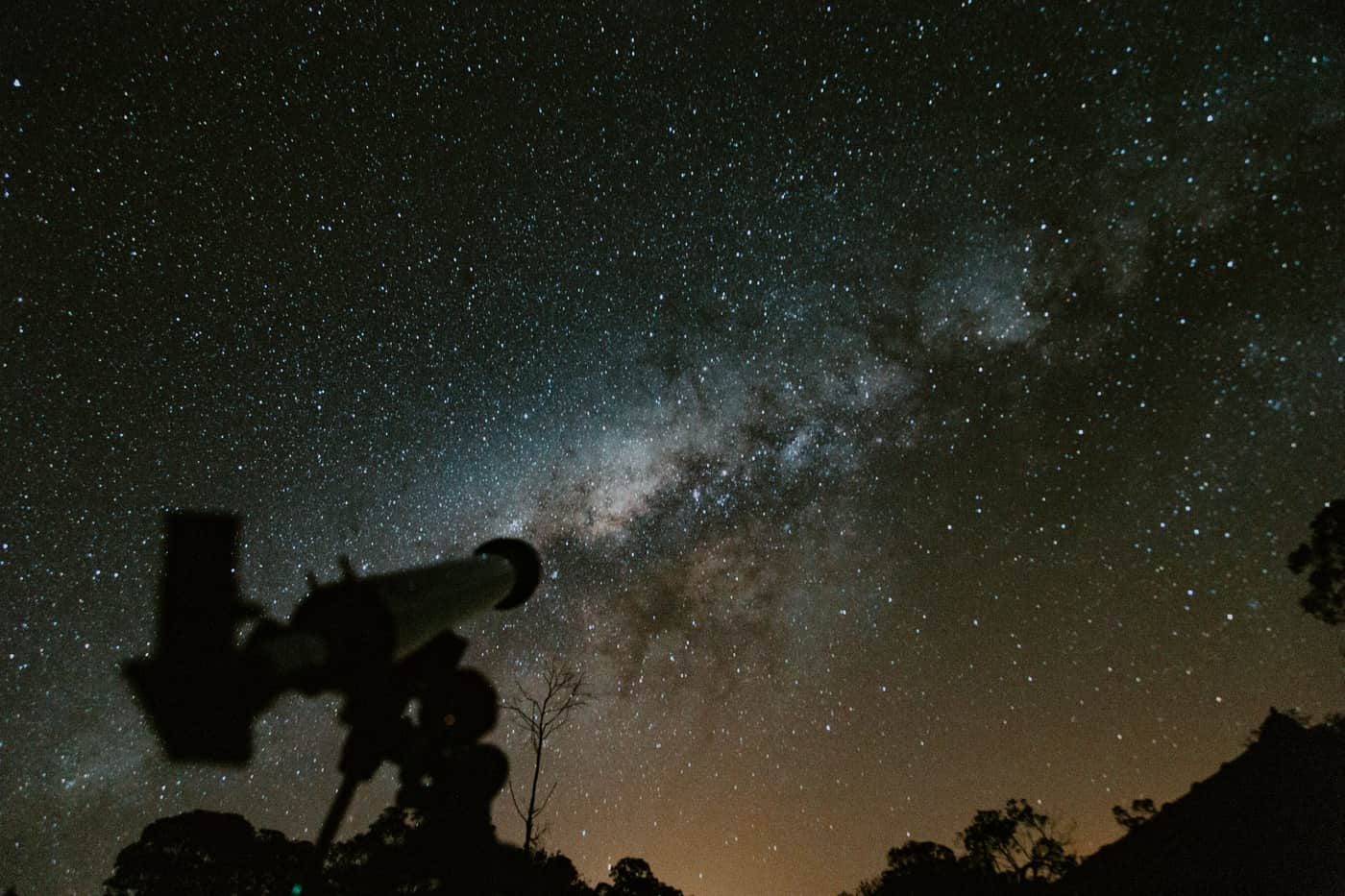
Your telescope is almost certainly working. Seeing nothing is nearly always one of five things, and none of them is a fault.
1. A dust cap is still on
This is genuinely the most common cause and it is not a joke. Many telescopes have a large front cap with a smaller removable disc set into it, so that removing the small disc reveals a reduced aperture for daytime use. Take the whole cap off.
Check the eyepiece end too. Eyepieces and diagonals ship with their own caps, and a capped eyepiece looks exactly like a telescope pointed at nothing.
2. The finderscope does not agree with the telescope
This is the cause that ends most first evenings, and it is invisible until you test for it. The finder and the main tube are separately mounted, and out of the box they are rarely pointing at the same place.
true field of view is roughly the eyepiece's apparent field / magnification
A 52-degree eyepiece at 26x: 52 / 26 = 2 degrees. The same eyepiece at 108x: 52 / 108 = 0.5 degrees.
Two degrees is four full-Moon widths. Half a degree is one. If your finder points half a degree off, an object dead-center in the finder is completely outside the eyepiece view at high power.
The fix, in daylight: point the main telescope at a distant fixed object, a chimney or a pylon a few hundred meters away, and center it in the eyepiece. Now look through the finder and adjust its screws until the same object is centered there too. Five minutes, once, and the problem is gone for good.
3. Too much magnification
The shortest eyepiece gives the narrowest field, the dimmest image and the most difficult focus. It is the worst possible tool for finding something, and it is the one people reach for first because the box advertised a big number.
Fit the longest eyepiece you own. The widest field is the finding field. Why the box claim is misleading.
4. You have not found focus
A star far out of focus is not a blurry star: it is a large, dim, featureless disc spread over so much of the field that it is easy to see as nothing at all.
Turn the focuser slowly all the way in one direction and then all the way back, watching for the point where anything sharpens. More on focus.
5. There is nothing where you are pointing
A telescope aimed at empty sky shows empty sky. That sounds obvious and it accounts for a genuine share of failed first evenings, because most of the sky is empty at 26x.
Start with the Moon. It is enormous, unmistakable, needs no dark adaptation, and confirms the whole optical path works in about ten seconds. The first night guide sets out a sequence that works.
The daylight test that settles it
- In daylight, point the telescope at something distant on the ground: a chimney, a pylon, a treeline. Never at or near the Sun.
- Fit the longest eyepiece you own.
- Turn the focuser slowly through its full travel.
- If you see a sharp image, the telescope is optically fine and the problem was aiming, magnification or focus at night.
- If you see nothing at all in daylight, check the caps again. If both are off and there is still nothing, that is a genuine fault and a warranty matter.
No products on this page. This page exists to tell somebody their telescope is fine at eleven at night. Selling them something would be the wrong response to that.
Questions people actually ask
Why can't I see anything through my telescope?
In order of likelihood: a dust cap still fitted, a finderscope that does not agree with the main telescope, too much magnification, focus not yet found, or nothing being where you are pointed. All five are configuration rather than fault.
How do I align a finderscope?
In daylight, center a distant fixed object such as a chimney in the main telescope's eyepiece, then adjust the finder's screws until the same object is centered in the finder. It takes five minutes and it is the single most valuable setup step.
How do I know if my telescope is faulty?
Test it in daylight on a distant object with the longest eyepiece. If it produces a sharp image, the optics are fine. If it shows nothing with both caps removed and the focuser run through its full travel, that is a genuine fault.
Why can I see the Moon but nothing else?
Because everything else is far fainter and far smaller. That is normal for a first session and means the telescope is working. Jupiter and Saturn are the next targets; both are bright and both look like stars until you magnify them.
Read next
How to Use a Telescope: Your First Night, Step by Step
The first evening with a telescope, in the order things actually happen, with the daylight steps that decide it.
Top pick: Celestron Night Vision Red LED Flashlight
$20.95 · 19% off
#ad · how this is funded · price as of October 19, 2026
Your Telescope Won't Focus
Six reasons a telescope will not come to focus, in order of likelihood, and what to do about each.

Telescope Troubleshooting: It Is Probably Not Broken
The four problems that make a new telescope seem broken, and why none of them usually is.
Found something wrong here? Tell us and we will correct it and date the correction, per our editorial policy.