What You Can Actually See
Can You See the ISS With a Telescope?
The International Space Station presents a larger disc than Saturn does. Aperture has never been the obstacle here: the obstacle is that it is moving about seventy times faster than the sky.
By Scooter M. · Published · How we pick
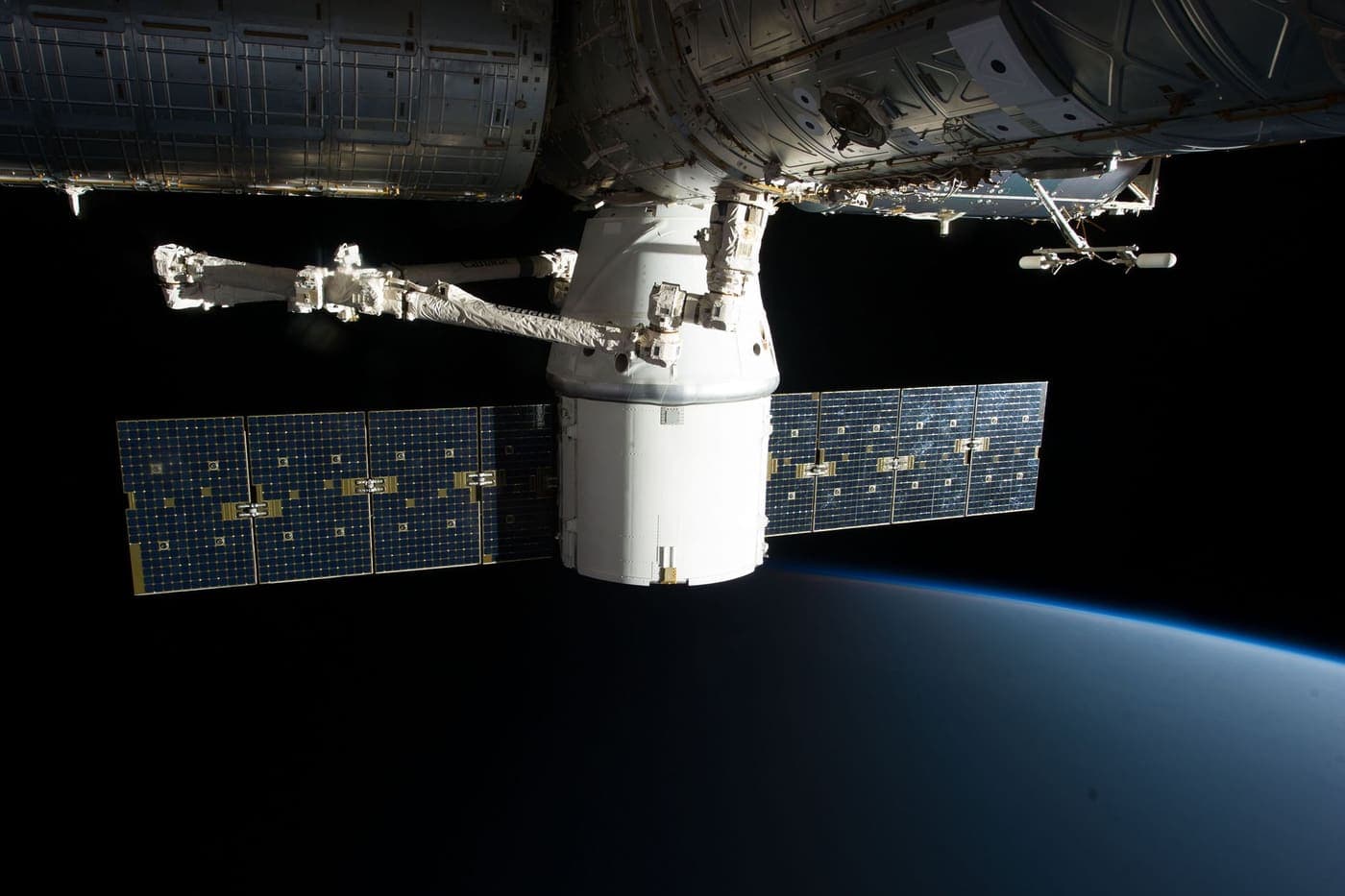
Yes, and the right instrument for it is a wide-field binocular such as the Celestron Cometron 7x50, not a telescope. The station reaches magnitude -4, as bright as Venus, and presents a disc of roughly 56 arcseconds, which is larger than Saturn's globe and comparable to Jupiter. Resolution is not the problem. The problem is that it crosses a high-power eyepiece field in about two seconds.
If you want to see shape rather than a moving dot, the honest answer is a low-power wide field and a steady pair of hands. If you want it magnified, the only telescope mount that can realistically follow it is one you push by hand, which rules out exactly the expensive mounts people assume would help.
The arithmetic that reframes the whole question
angular size in arcsec = (size / distance) x 206,265
The station is 109 m (358 ft) long including its solar arrays, orbiting at about 400 km: (109 / 400,000) x 206,265 = 56 arcsec.
Saturn's globe is 16 to 20 arcseconds and Jupiter is 35 to 45. So directly overhead, the ISS presents a larger target than either planet. At 100x it is as big in the field as the Moon is to the naked eye.
the sky's own motion = 15 arcsec per second. a fast ISS pass = around 1,000 arcsec per second.
A sidereal day is 23 h 56 min 4.0905 s, so the sky turns 15 arcsec/sec. A horizon-to-horizon pass takes as little as a few minutes, which is roughly 70 times that rate.
A GoTo mount's drive is built to match the sky, not something seventy times faster. This is why a $1,700 tracking telescope is worse at this target than $40 of binoculars: it physically cannot be commanded to follow the pass.
What you will actually see
| Instrument | What appears | Time in the field |
|---|---|---|
| Naked eye | A bright white dot moving steadily, no flashing | Whole pass |
| 7x50 binoculars | A bright elongated spark; shape hinted on a good pass | Tens of seconds |
| 10x50 binoculars | Elongation clearer, still no structure | Tens of seconds |
| 15x70 binoculars | A short bright bar rather than a point | Around ten seconds |
| Telescope at 50x | A definite shape: a bar with wings | A few seconds |
| Telescope at 150x | Solar arrays separable from the truss, briefly | About two seconds |
The right-hand column is the honest heart of this page. Everything in the second column is achievable; the question is whether you can keep the station inside the field long enough to look at it, and that gets exponentially harder as magnification rises.
One detail worth expecting: the brightness is not constant through a pass. The station is at its brightest when it is high and fully sunlit, and it dims as it drops toward the horizon or rotates its arrays away from the Sun. A pass can also end mid-sky, fading out over a few seconds as the station crosses into Earth's shadow, which is a startling thing to watch the first time and not a fault of anything.
Why a manual mount beats a motorized one here
A simple alt-azimuth or Dobsonian mount moves freely in both axes when you push it. That is normally described as a limitation, and on this one target it is the decisive advantage: you can swing it along the station's path by hand at whatever rate the pass demands.
A GoTo mount, by contrast, is driven. It will slew to a catalog object and then track at a sky rate, and neither behavior helps with something crossing the sky seventy times faster. GoTo against manual covers what the motors do and do not buy in general; this page is the clearest case where they buy nothing.
How these picks were judged
- Field of view first, by a wide margin. The target is bright and large; the only scarce resource is time in the field, and field width is what buys it.
- Then how fast you can aim it. Hand-held or hand-pushed beats driven here, which inverts the usual ranking on this site.
- Then magnification, last. More power shows more structure and shortens your look. Every pick is placed on that trade-off rather than on raw aperture.
- Motorized tracking was treated as a negative, because a mount that insists on a sky rate cannot be swung along a pass.
- Aperture barely entered it. At magnitude -4 there is no shortage of light, so a 50mm binocular is not handicapped against a 203mm telescope on this target.
Which of these is for you
| Pick | Best for | The catch |
|---|---|---|
| Celestron Cometron 7x50 | Best for the ISS: the widest field and the easiest aiming here, which is exactly what a fast pass needs | 7x will never show structure, only a bright elongated spark |
| Celestron UpClose G2 10x50 | Best compromise: more magnification than the 7x50 with a field still wide enough to hold a pass | 10x hand-held shakes enough to blur the elongation you are trying to see |
| Celestron SkyMaster 15x70 | Best for actually seeing it as a bar rather than a point, while still being hand-aimable | 70mm at 15x is heavy to hold steady overhead, and a tripod makes a fast pass harder to follow |
| Sky-Watcher Heritage 130P | Best telescope route: a free-moving mount you can push along the path, which no driven mount can do | Needs practice and a wide eyepiece, and most attempts end with the station leaving the field |
How this is funded: the buy buttons below are Amazon Associates links, and a qualifying purchase earns us a commission at no extra cost to you. It cannot move the ranking, because the order here is set by aperture per dollar, and no commission rate changes how much light a mirror collects. Full disclosure.
| # | Telescope | Best for | Aperture | Price |
|---|---|---|---|---|
| 1 | 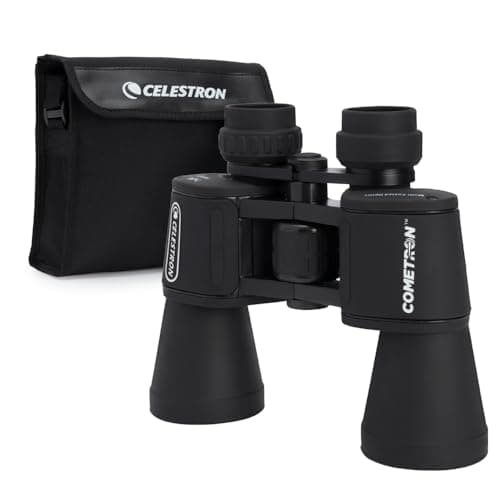 Celestron Cometron 7x50 BinocularsTop pick7x on 50mm objectives gives the widest field and the steadiest handheld view of anything here, at the price of the least light. | Handheld sweeping, on the smallest budget | 50mm objective lenses (1.97 in)100x useful | |
| 2 | 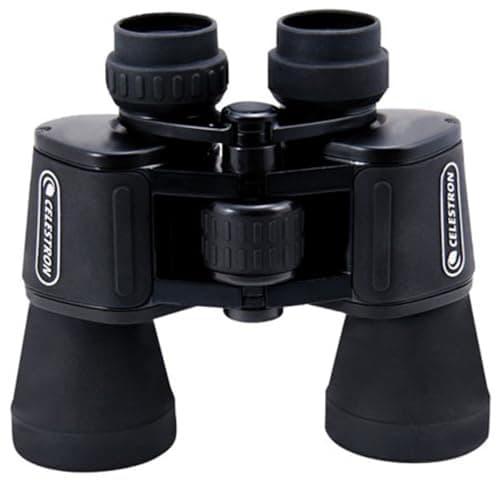 Celestron UpClose G2 10x50 BinocularsThe classic 10x50 format: about the most magnification most people can hand-hold, in a pair that is just as useful for birds as for stars. | One pair for the sky and for daylight | 50mm objective lenses (1.96 in)100x useful | |
| 3 | 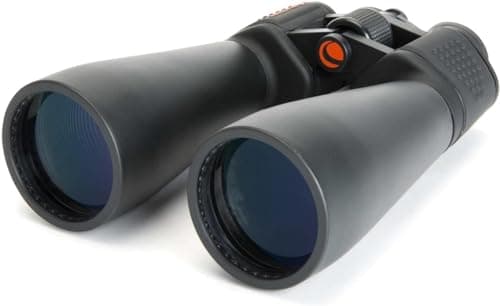 Celestron SkyMaster 15x70 Binoculars70mm of aperture in each barrel at a fixed 15x. For the money spent on a toy telescope, these show more and get used more. | The honest alternative to a cheap telescope | 70mm objective lenses (2.75 in)140x useful | |
| 4 | 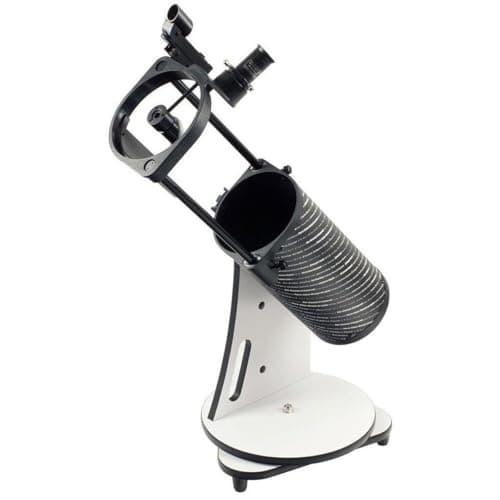 Sky-Watcher Heritage 130 Tabletop DobsonianThe same 130mm parabolic mirror as scopes costing far more, on a base with no tripod to wobble and nothing to set up. | Most aperture per dollar | 130mm260x useful |
Top pick · Handheld sweeping, on the smallest budget
Celestron Cometron 7x50 Binoculars
7x on 50mm objectives gives the widest field and the steadiest handheld view of anything here, at the price of the least light.
What the aperture allows
- Maximum useful magnification
- 100x
- 2 × 50mm of aperture
- Resolving limit (Dawes)
- 2.32 arcseconds
- 116 ÷ 50mm
- Cassini division (0.7″)
- Out of reach
- this aperture cannot resolve it
At 7x the image moves seven times as much as your hands do, which is slow enough to hold steady for as long as you like. That is the entire case for this magnification, and for a first astronomy instrument it is a strong one.
Celestron publishes a 6.6-degree field, wide enough to take in the whole of the Pleiades with room around it, and a 7.1mm exit pupil. That exit pupil is larger than most adult eyes open to, so some of the collected light is simply not used — the trade-off of a wide, bright, forgiving view.
The prisms are BK7 rather than BaK-4, which Celestron states plainly. BK7 is the cheaper glass and tends to vignette the edge of the exit pupil slightly; for a sweeping instrument at this price it is a reasonable compromise rather than a flaw.
What it does well
- The steadiest handheld magnification in this roundup
- A 6.6-degree field frames large clusters and the Milky Way whole
- The lightest pair here at a published 27.3 oz
- Tripod adaptable if you later want to mount them
What it costs you
- The smallest objectives here, so the faintest limiting magnitude Celestron publishes: 10.99 under ideal skies
- BK7 prisms rather than the better BaK-4
- A 7.1mm exit pupil wastes light on eyes that no longer dilate that far, which becomes more common with age
- Water resistant but not nitrogen filled, so they can fog internally
Skip this one if: Skip them if you will always use a tripod. Once they are mounted, more magnification and more aperture both become usable, and the reasons to choose 7x disappear.
$47.95 · 17% off
#ad · how this is funded · price as of October 19, 2026
Pick 2 · One pair for the sky and for daylight
Celestron UpClose G2 10x50 Binoculars
The classic 10x50 format: about the most magnification most people can hand-hold, in a pair that is just as useful for birds as for stars.
What the aperture allows
- Maximum useful magnification
- 100x
- 2 × 50mm of aperture
- Resolving limit (Dawes)
- 2.32 arcseconds
- 116 ÷ 50mm
- Cassini division (0.7″)
- Out of reach
- this aperture cannot resolve it
10x50 is the format astronomy guides have recommended for decades, and the reason is arithmetic rather than tradition. 10x is close to the most magnification most people can hold steady for any length of time, and 50mm objectives give a 5mm exit pupil that suits most adult eyes without wasting light.
Celestron publishes the same limiting magnitudes for this pair as for the 7x50, 10.99 under ideal skies. The extra magnification does not collect more light; it spreads the same light over a larger image, which makes small clusters and double stars easier while making the widest targets harder to frame.
It is also the most genuinely dual-use instrument here. At 27 oz it is light enough to carry on a walk, which is the difference between binoculars that live by the back door and binoculars that live in a drawer.
What it does well
- 10x is close to the limit most people can hand-hold for sustained looking
- A 5mm exit pupil suits most adult eyes without wasting light
- Equally useful in daylight, so it gets used far more often
- A published 27 oz, among the lightest here
What it costs you
- The same 50mm light grasp as the cheaper 7x50, so no gain in faint objects
- BK7 prisms rather than BaK-4
- Celestron's own store listed this pair as out of stock when checked; the live price layer on this page tracks the retailer it links to
- A published 12mm eye relief is short for glasses wearers
Skip this one if: Skip them if you wear glasses while observing. A published 12mm of eye relief is short, and you will not see the whole field.
#ad · how this is funded · price as of October 19, 2026
Pick 3 · The honest alternative to a cheap telescope
Celestron SkyMaster 15x70 Binoculars
70mm of aperture in each barrel at a fixed 15x. For the money spent on a toy telescope, these show more and get used more.
What the aperture allows
- Maximum useful magnification
- 140x
- 2 × 70mm of aperture
- Resolving limit (Dawes)
- 1.66 arcseconds
- 116 ÷ 70mm
- Cassini division (0.7″)
- Out of reach
- this aperture cannot resolve it
Worked example: a 25mm eyepiece in this telescope gives 279.63mm ÷ 25mm = 11x.
Each barrel has the same 70mm aperture as the entry-level refractors on this site, and because you use both eyes the perceived brightness is higher than a single 70mm tube.
The fixed 15x is well below the 140x that 70mm could support, and that is deliberate. Binoculars are a wide-field instrument: the Pleiades, the Andromeda galaxy, the Milky Way star clouds and the whole Moon at once.
Celestron publishing three limiting magnitudes, 11.73 for ideal skies down to 9.73 for poor ones, is the single most useful number on this page. It says out loud what most listings hide: your sky matters as much as your optics.
At 15x these are heavy to hold steady. The included tripod adapter is not an accessory, it is a requirement for any sustained looking.
What it does well
- 70mm per barrel is real aperture, not a novelty
- Instantly usable: no assembly, no alignment, no learning curve
- Wide field shows large objects a telescope cannot fit in view
- Doubles as daytime and wildlife optics, so it gets used year-round
What it costs you
- Too heavy to hold steady at 15x for long; a tripod is effectively required
- Fixed magnification, so the planets stay small
- No detail on Saturn: at 15x the rings are a suggestion, not a shape
Skip this one if: Skip them if the goal is specifically to see Saturn's rings as rings. 15x will not do it; a 70mm telescope at 70x will.
$129.95 · 32% off
#ad · how this is funded · price as of October 19, 2026
Pick 4 · Most aperture per dollar
Sky-Watcher Heritage 130 Tabletop Dobsonian
The same 130mm parabolic mirror as scopes costing far more, on a base with no tripod to wobble and nothing to set up.
What the aperture allows
- Maximum useful magnification
- 260x
- 2 × 130mm of aperture
- Resolving limit (Dawes)
- 0.89 arcseconds
- 116 ÷ 130mm
- Cassini division (0.7″)
- Out of reach
- this aperture cannot resolve it
Worked example: a 25mm eyepiece in this telescope gives 650mm ÷ 25mm = 26x.
This is the aperture-per-dollar champion of the beginner shelf and it is not close. You get the same 130mm parabolic mirror found in telescopes at twice the price, and you get it without paying for a tripod, a slow-motion assembly or a hand controller.
Two times 130mm is 260x of useful magnification. Dawes' limit at 130mm works out to 116 divided by 130, which is 0.89 arcseconds. The Cassini division in Saturn's rings spans roughly 0.7 arcseconds at its widest, so this telescope sits right at the edge of showing it on a still night and will show the rings themselves easily.
The catch is the word tabletop. It needs a surface at roughly chest height when you are seated. A garden table works, a plastic patio chair does not, and buying one without thinking about where it will stand is the single most common regret with this design.
The tube collapses, which is what makes it live in a cupboard rather than a garage. That matters more than it sounds: the telescope you can carry outside in one trip is the telescope you use.
What it does well
- The most aperture you can buy at this price, by a clear margin
- Nothing to assemble, no tripod to wobble, ready in the time it takes to carry it outside
- Collapsible tube stores in a cupboard and keeps its collimation
- The Dobsonian motion is intuitive: you push the tube where you want to look
What it costs you
- Needs a solid table or stool at the right height, which is a real constraint
- The helical focuser is coarser than a rack-and-pinion or a Crayford
- Open tube design collects dust and needs the odd mirror clean
Skip this one if: Skip it if you have nowhere to stand it. On the ground it points at treetops, and on a wobbly plastic table every view shakes.
$305.00 · 12% off
#ad · how this is funded · price as of October 19, 2026
How to catch a pass
- Get the prediction first. NASA's Spot the Station sends alerts for passes over your location. Hunting for the ISS without a prediction does not work.
- Choose a bright, high pass. A pass that goes nearly overhead is both larger and brighter than one that skims the horizon, and the magnitude -4 figure applies when it is sunlit and overhead.
- Observe in twilight. The station needs to be in sunlight while your sky is dark, which is why passes cluster in the hours after sunset and before sunrise.
- Be set up early and aimed along the path, not at it. You want to be waiting ahead of the station, then matching its motion as it arrives.
- Use your lowest magnification for the first attempts. Learn to hold the pass in a wide field before trying to see structure in a narrow one.
- Expect the pass to end abruptly. It may vanish mid-sky as it enters Earth's shadow, and a horizon-to-horizon crossing lasts up to about ten minutes at most.
Solar and lunar transits, which are the expert version
Occasionally the station's path crosses the face of the Sun or the Moon from a specific location on the ground. Amateur astronomers find those transits particularly interesting, and for good reason: for a second or less you get the station silhouetted against a disc, which is the only way to see its shape against a bright background rather than as a spark against the dark.
It is also the hardest thing on this page by a wide margin. The transit lasts about a second, the ground track is narrow enough that a few miles puts you outside it, and you have to be set up, focused and recording before it happens because there is no time to react.
A pass is also a good reminder of what binoculars are genuinely for. If this is the kind of observing that appeals, the astronomy binoculars roundup is the page to read next.
Questions people actually ask
Can you see the ISS with a telescope?
Yes. It reaches magnitude -4, as bright as Venus, and presents about 56 arcseconds when overhead, which is larger than Saturn's globe. The difficulty is motion, not light or resolution: at 150x it crosses the eyepiece field in roughly two seconds.
What does the ISS look like through a telescope?
At 50x, a definite shape: a central bar with wings either side. At 150x the solar arrays can be separated from the truss for a moment or two. To the naked eye it is a steadily moving bright white dot that does not flash, which is how you tell it from an aircraft.
Can a GoTo telescope track the ISS?
Not usefully. A GoTo mount drives at sky rates, around 15 arcseconds per second, while a fast ISS pass moves roughly seventy times that. A free-moving manual alt-azimuth or Dobsonian mount you push by hand is the only telescope arrangement that can realistically follow a pass.
What magnification should you use on the ISS?
Start as low as you can, 7x to 15x in binoculars, and only raise it once you can reliably keep a pass in the field. Magnification trades structure against time: 50x shows a shape for a few seconds, 150x shows the arrays for about two.
Can you see the ISS during the day?
Not with the naked eye in full daylight, but a telescope or binoculars allows viewing of the ISS during daylight hours. You need a predicted pass and accurate pointing, since there are no stars to orient against.
How do I know when the ISS will pass over?
Use NASA's Spot the Station, which sends alerts for your location. The station orbits at about 400 km with a period of 92.9 minutes, so roughly 15.5 orbits a day, but only passes that are sunlit while your sky is dark are visible.
Read next
Best for astronomy
The Best Binoculars for Astronomy
Astronomy binoculars ranked on aperture, holdability and exit pupil, with the maker's limiting magnitudes for every pair.
Top pick: Celestron SkyMaster 15x70 Binoculars
$129.95 · 32% off
#ad · how this is funded · price as of October 19, 2026
GoTo vs Manual: What the Motors Actually Cost You
What a GoTo mount costs in aperture, when it earns that back, and the phone-guided middle option most buyers miss.
Top pick: Celestron NexStar 130SLT
#ad · how this is funded · price as of October 19, 2026
The Moon Through a Telescope, and the Magnification to Use
The magnification that suits the Moon, why full Moon is the worst night to look, and what a moon filter actually fixes.
Top pick: Celestron Moon Filter (1.25")
$12.95 · 12% off
#ad · how this is funded · price as of October 19, 2026
Found something wrong here? Tell us and we will correct it and date the correction, per our editorial policy.