Reviews
Celestron NexStar 130SLT
The optics on this telescope are not the reason to buy it, and they are not the reason to avoid it either. Everything that matters here is the mount underneath them.
By Scooter M. · Published · How we pick
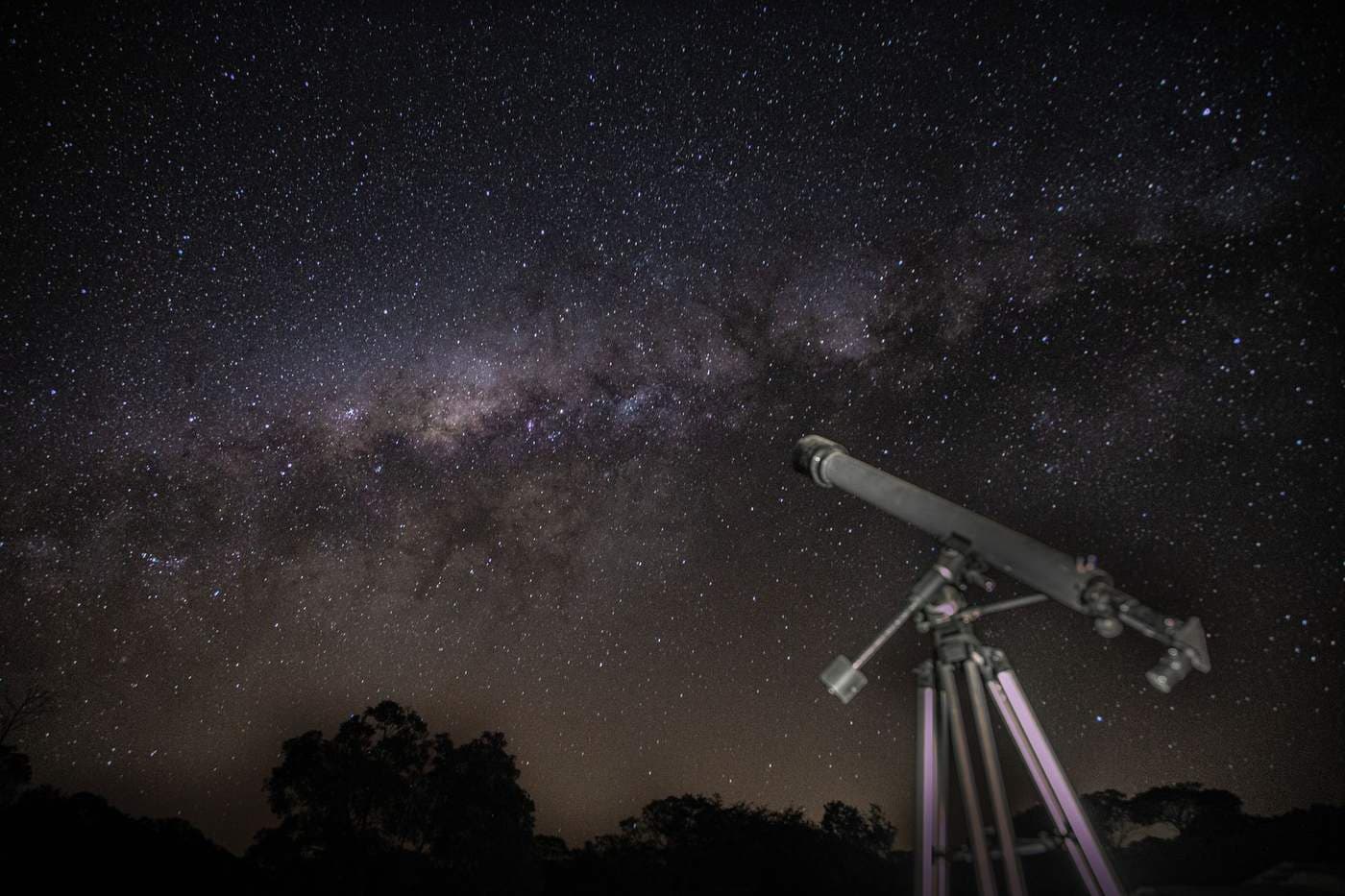
This is the telescope this site keeps citing whenever GoTo comes up, and it has never had a page of its own. It deserves one, because the decision it represents is the most expensive one a beginner makes: whether to spend the budget on mirror or on motors.
The arithmetic first
max useful magnification = 2 x aperture. Dawes limit = 116 / aperture.
130 x 2 = 260x. 116 / 130 = 0.89 arcseconds.
Celestron publishes 307x and .89 arcseconds. The resolution figures agree exactly; the magnification figures differ because makers compute per inch with a more generous constant. Celestron also publishes a lowest useful magnification of 19x, which is the aperture divided by a 7mm dark-adapted pupil.
Celestron publishes 345 times the light-gathering of the human eye and a limiting stellar magnitude of 13.1. At 0.89 arcseconds the Cassini division, at roughly 0.7, stays out of reach. Saturn's rings separate cleanly, Jupiter's two main belts are comfortable, and the brighter Messier objects are available from a reasonable sky.
The optics are not what you are buying
This is the single most useful fact about this telescope. Celestron publishes identical optical figures for the NexStar 130SLT and the StarSense Explorer DX 130AZ: the same 130mm parabolic mirror, the same 650mm focal length, the same f/5, the same 307x, the same 0.89 arcseconds, the same 345x light gathering.
Two telescopes with the same mirror see exactly the same sky. Everything you are paying extra for sits below the tube. The DX 130AZ review covers the same optic on a manual mount with phone-based finding instead of motors.
light ratio = (aperture 1 / aperture 2) squared
(150 / 130)squared = 1.33. (200 / 130)squared = 2.37.
A manual 150mm telescope collects 33 percent more light than this one, and a 200mm Dobsonian collects 2.4 times more. Motors never add detail; they only make what the mirror already collected easier to find and hold. What each budget bracket buys sets the sizes against the brackets.
What the motors genuinely give you
- Tracking. Once Jupiter is centered at 150x it stays centered. On a manual telescope at that magnification it leaves the field in well under a minute, and the difference between nudging and watching is larger than it sounds.
- Sharing. Handing a tracked eyepiece to somebody else works. Handing over a manual telescope at high power usually means finding the object again afterwards.
- A database. Celestron publishes over 40,000 objects in the NexStar+ hand control, with nine slew speeds and a maximum of 3 degrees per second. No phone is involved, which matters if yours is old or the battery is flat.
- Phone photography becomes possible. A tracked target holds still long enough for a phone to take a usable frame of the Moon or a bright planet. Telescopes and phones covers what a phone can actually capture.
The alignment routine is the real barrier
A computerized fork mount does not know where it is pointing when you switch it on. Before it will drive anywhere it wants you to center two or three named stars in the eyepiece, which requires you to recognize named stars.
It is also a per-session cost. The alignment happens every time the telescope comes out, which on a clear night with twenty minutes to spare is a meaningful share of the session. GoTo against manual works the whole trade through.
Power, which nobody mentions until it fails
Celestron publishes a 12 VDC requirement and eight AA batteries, not included. A motorized mount draws current continuously, and alkaline cells lose capacity in the cold, so the failure mode is a telescope that slews slowly, loses its alignment, or stops mid-session on exactly the sort of clear winter night you bought it for.
The fix is a mains adapter or a rechargeable power pack, and it is worth budgeting for one at the same time as the telescope rather than after the first ruined evening. A Dobsonian never has this problem, which is part of what its simplicity is worth.
How this is funded: the buy buttons below are Amazon Associates links, and a qualifying purchase earns us a commission at no extra cost to you. It cannot move the ranking, because the order here is set by aperture per dollar, and no commission rate changes how much light a mirror collects. Full disclosure.
| # | Telescope | Best for | Aperture | Price |
|---|---|---|---|---|
| 1 | 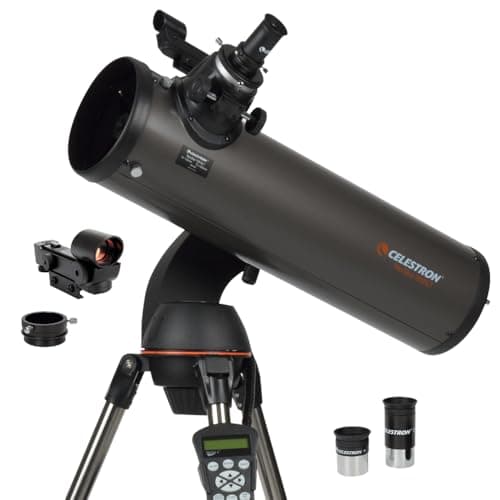 Celestron NexStar 130SLTTop pick130mm parabolic optics on a computerized fork mount and a full-height tripod, with a hand controller instead of a phone. | Tripod-mounted GoTo | 130mm (5.12 in)260x useful |
Top pick · Tripod-mounted GoTo
Celestron NexStar 130SLT
130mm parabolic optics on a computerized fork mount and a full-height tripod, with a hand controller instead of a phone.
What the aperture allows
- Maximum useful magnification
- 260x
- 2 × 130mm of aperture
- Resolving limit (Dawes)
- 0.89 arcseconds
- 116 ÷ 130mm
- Cassini division (0.7″)
- Out of reach
- this aperture cannot resolve it
Celestron publishes 307x as this telescope’s highest useful magnification. Our figure is 260x, from two times the aperture in millimeters. The gap of 47x comes from the slightly more generous per-inch constant makers use. Neither number describes a typical night: the atmosphere usually settles the question well below both.
Worked example: a 25mm eyepiece in this telescope gives 650mm ÷ 25mm = 26x.
Optically this is the same 130mm f/5 parabolic mirror as the StarSense DX 130AZ. Celestron publishes identical figures for both: 307x maximum useful magnification, 0.89 arcseconds of resolution, 345 times the light of the eye. The difference you are paying for is entirely in the mount.
What the motors buy is tracking. Once a planet is centered at 150x it stays centered, which changes the experience of looking at Jupiter from a series of nudges into an actual observation.
What they cost is alignment. Every session starts by pointing the telescope at two or three named stars, which means you need to recognize a few stars before the computer will find things for you. That is a real barrier for a complete beginner and it is the reason the phone-based StarSense approach usually suits a first buyer better.
The tripod is full height, so this is a stand-up telescope for an adult. That is a genuine advantage over every tabletop model here.
What it does well
- Tracking, which is the single biggest quality-of-life upgrade at high magnification
- Full-height tripod: no table, no kneeling
- A large object database in the hand controller, no phone required
What it costs you
- Star alignment every session, and it assumes you can identify alignment stars
- The single fork arm is the least steady part of the package at high power
- Needs power; batteries in the cold are a false economy
Skip this one if: Skip it if nobody in the house can point at two named stars yet. Start with a manual scope or the phone-guided StarSense and come back to GoTo later.
$699.95 · 14% off
#ad · how this is funded · price as of September 19, 2026
What the supplied eyepieces give you
magnification = telescope focal length / eyepiece focal length
650 / 25 = 26x. 650 / 9 = 72x.
Exit pupil is aperture divided by magnification: 130 / 26 = 5mm, and 130 / 72 = 1.8mm. Both are comfortable, and neither is close to the 260x ceiling, so there is real headroom above what the box contains. Which eyepieces to buy.
The other published component worth knowing about is the mount itself. It is a single fork arm, which carries the tube on one side rather than two, and Celestron publishes an 8.8 lb optical tube hanging off it. That is the least steady part of the package: at high magnification on a planet, a touch on the focuser takes a moment to settle. Why mounts decide everything.
Against the two telescopes buyers weigh it against
| NexStar 130SLT | StarSense DX 130AZ | Heritage 150 | |
|---|---|---|---|
| Aperture | 130mm | 130mm | 150mm |
| Focal ratio | f/5 | f/5 | f/5 |
| Max useful magnification | 260x | 260x | 300x |
| Resolving limit | 0.89 arcsec | 0.89 arcsec | 0.77 arcsec |
| Relative light gathering | Baseline | Same | 1.33x |
| Finds objects | Motorized GoTo | Phone plate solving | You do |
| Tracks | Yes | No | No |
| Setup each session | Align on named stars | None | None |
| Needs power | Yes, 8 AA | Your phone | No |
| Stands at full height | Yes | Yes | Needs a table |
Read across, the middle column is the awkward one: identical optics, no alignment routine, no batteries, and it finds things with a phone instead. Read to the right and the Heritage 150 is the aperture argument — a third more light, and nothing at all to set up, in exchange for finding everything yourself and needing a table.
Who should buy it, and who should not
Buy it if following is your problem rather than finding: if you want to sit on Jupiter at 150x without touching the telescope, share the eyepiece around, or take phone images of the Moon. Buy it also if you would rather not depend on a phone at all, because the hand control carries its own database.
Do not buy it as a first telescope for somebody who cannot yet name two bright stars, because that is what the alignment asks for. Do not buy it for deep sky on a budget, because the same money spent on mirror rather than motors buys a noticeably larger one. And do not buy it without also buying a power supply.
Questions people actually ask
Is the Celestron NexStar 130SLT worth it?
It is worth it if you specifically want tracking. Optically it is identical to the cheaper StarSense Explorer DX 130AZ — Celestron publishes the same 130mm, 650mm, f/5, 307x and 0.89 arcseconds for both — so every extra dollar buys the motorized mount rather than a better view.
What can you see with a NexStar 130SLT?
Lunar detail down to its 0.89-arcsecond limit, Saturn's rings clearly separated, Jupiter's two main belts and four bright moons, the phases of Venus, and the brighter Messier objects from a reasonable sky. Celestron publishes a limiting stellar magnitude of 13.1. The Cassini division needs about 150mm and is out of reach.
Do you have to align the NexStar 130SLT every time?
Yes. The mount does not know where it is pointing at switch-on, so each session starts by centering two or three named stars. That is quick once you know the stars, and it is the main reason a complete beginner is often better served by phone-based plate solving, which needs no alignment at all.
What batteries does the NexStar 130SLT use?
Celestron publishes 12 VDC and eight AA batteries, not included. A motorized mount draws current continuously and alkaline cells fade in the cold, so a mains adapter or a rechargeable power pack is worth buying at the same time as the telescope.
NexStar 130SLT or StarSense Explorer DX 130AZ?
Same mirror, different help. The 130SLT tracks and drives itself but must be aligned on named stars and needs power. The DX 130AZ finds things with your phone, needs no alignment and no batteries, costs less, and does not track. If following objects matters more than finding them, take the 130SLT.
Is GoTo better than a bigger telescope?
Not for what you can see. Motors do not collect light: a 150mm manual telescope gathers 33 percent more than this 130mm one, and a 200mm Dobsonian gathers 2.4 times more. GoTo buys convenience, which is a real thing to buy, but it is never detail.
Read next

GoTo vs Manual: What the Motors Actually Cost You
What a GoTo mount costs in aperture, when it earns that back, and the phone-guided middle option most buyers miss.
Top pick: Celestron NexStar 130SLT
$699.95 · 14% off
#ad · how this is funded · price as of September 19, 2026

Celestron StarSense Explorer DX 130AZ
130mm parabolic mirror plus phone-based plate solving. The specs compiled and the 307x claim checked against the arithmetic.
Top pick: Celestron StarSense Explorer DX 130AZ
#ad · how this is funded · price as of September 19, 2026
Telescope Mounts, and Why They Decide Everything
The four mount types compared, why the mount matters as much as the optics, and whether they are interchangeable.
Top pick: Sky-Watcher Classic 200P Dobsonian (8-inch)
#ad · how this is funded · price as of September 19, 2026
Found something wrong here? Tell us and we will correct it and date the correction, per our editorial policy.