What You Can Actually See
What Jupiter Looks Like Through a Telescope
Jupiter is the best value target in the sky for a small telescope: bright, large, and different every single night because its four big moons move visibly between sessions.
By Scooter M. · Published · How we pick
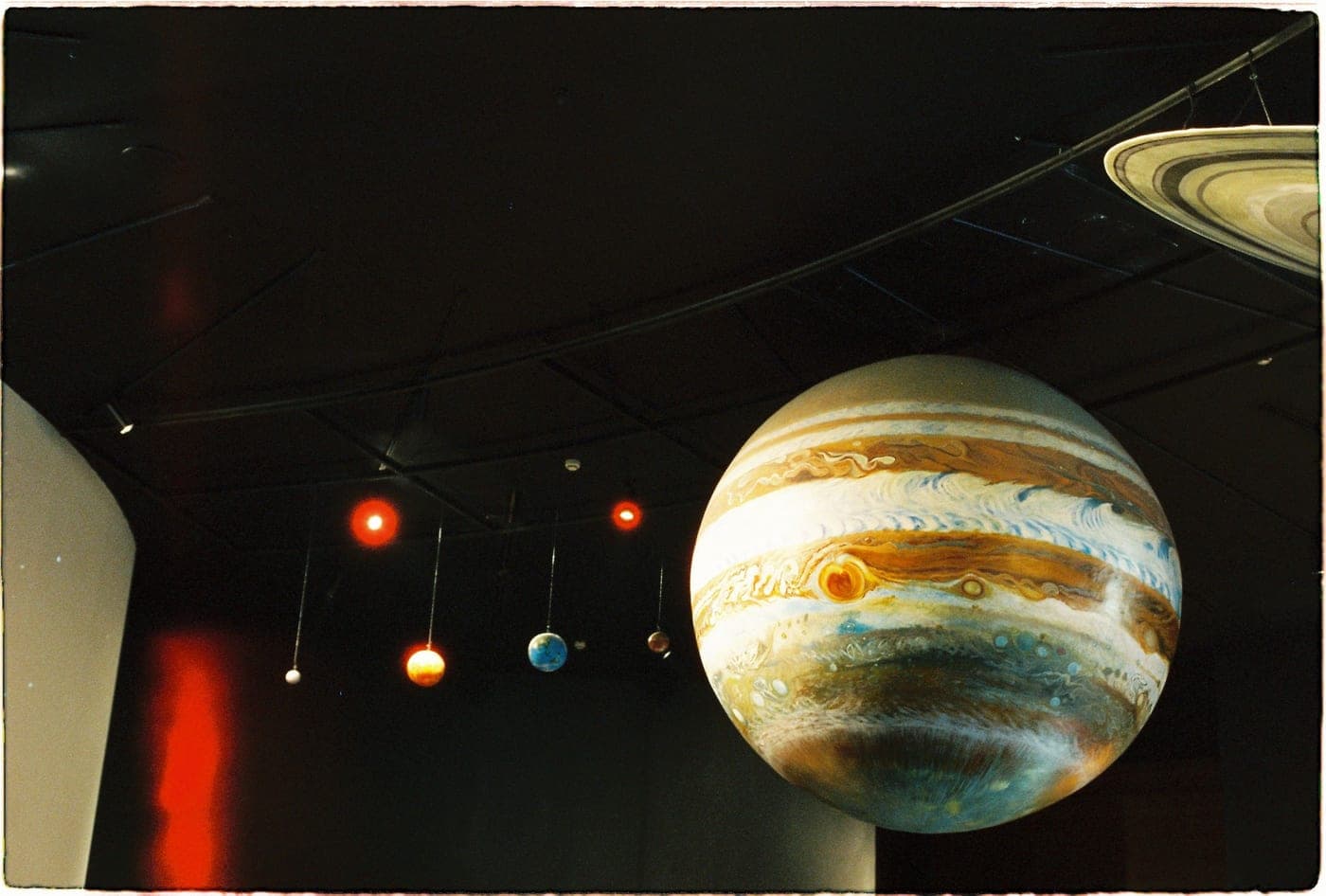
A 70mm telescope at 70x shows Jupiter as a small cream-colored disc with two dark bands across it and four bright moons strung out on either side. That is a real telescopic view of another world, and it is available at the smallest aperture on this site.
The four moons are the best part
Io, Europa, Ganymede and Callisto are visible in anything, including binoculars, as star-like points in a line through the planet. What makes them special is that they move. Their positions change over hours and are completely rearranged from one night to the next.
This is genuinely the most rewarding thing a beginner can observe, because it turns Jupiter from a picture into a system. Sketch the positions one evening, look again two nights later, and the change is unmistakable.
What each aperture adds
| Aperture | What appears |
|---|---|
| 70mm | Disc, two main belts, four moons |
| 102mm | Belts with visible edge structure, moon shadow transits |
| 130mm | More belts, the Great Red Spot on a good night |
| 150mm | Belt detail, festoons, the Red Spot readily |
| 200mm | Fine belt structure, color differences between belts |
Shadow transits: the thing to plan for
When one of the moons passes between Jupiter and the Sun it casts a shadow on the cloud tops, which appears as a small, perfectly round, jet-black dot crossing the disc over a couple of hours.
This is visible in a 102mm telescope and obvious in a 150mm, and it is one of the few things in amateur astronomy where you can watch something change in real time. Planetarium apps list transit times; it is worth building an evening around one.
Getting the most out of it
- Observe when Jupiter is high, ideally near its highest point for the night. Low down, atmospheric turbulence dominates.
- Use moderate magnification. 100x to 150x usually shows more belt detail than 200x, because the higher power amplifies the atmosphere as well as the planet.
- Look for several minutes. Belt structure appears in brief steady moments and is invisible in a quick glance.
- Try a light blue filter for the belts. It raises contrast on the cloud structure. A moon filter also helps simply by cutting the glare.
- Note where the moons are, and check again in two nights. It is the observation that makes the system real.
Jupiter at 35 to 45 arcseconds is the easiest of the planets, which makes it a misleading benchmark for the rest. Mars shrinks to 3.5 arcseconds away from opposition, about a tenth of Jupiter's width, and Uranus and Neptune never exceed 4.1 and 2.4. None of them behaves the way this page might lead you to expect.
How this is funded: the buy buttons below are Amazon Associates links, and a qualifying purchase earns us a commission at no extra cost to you. It cannot move the ranking, because the order here is set by aperture per dollar, and no commission rate changes how much light a mirror collects. Full disclosure.
| # | Telescope | Best for | Aperture | Price |
|---|---|---|---|---|
| 1 | 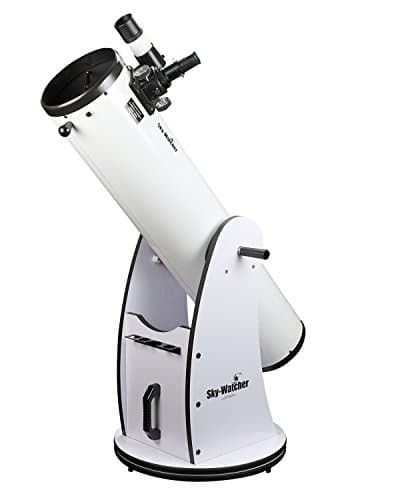 Sky-Watcher Classic 200P Dobsonian (8-inch)Top pickEight inches of aperture on the simplest mount ever designed. This is the telescope experienced observers tell beginners to buy. | The one you will not outgrow | 200mm (8 in)400x useful | Unavailable |
| 2 | 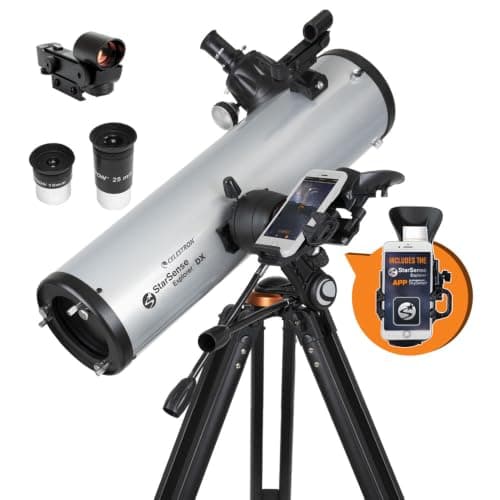 Celestron StarSense Explorer DX 130AZ130mm of parabolic aperture on a mount that stays still, plus the one piece of software that genuinely solves the find-it problem. | Most first buyers | 130mm (5.11 in)260x useful | |
| 3 | 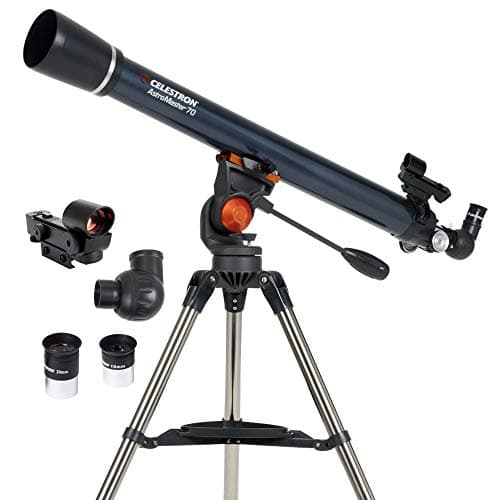 Celestron AstroMaster 70AZ70mm of refractor optics at f/13, on a steel tripod. A long, slow tube that trades field of view and weight for cleaner views of the Moon and planets. | The smallest scope worth owning | 70mm (2.76 in)140x useful |
Top pick · The one you will not outgrow
Sky-Watcher Classic 200P Dobsonian (8-inch)
Eight inches of aperture on the simplest mount ever designed. This is the telescope experienced observers tell beginners to buy.
What the aperture allows
- Maximum useful magnification
- 400x
- 2 × 200mm of aperture
- Resolving limit (Dawes)
- 0.58 arcseconds
- 116 ÷ 200mm
- Cassini division (0.7″)
- Within reach
- on a steady night, at high magnification
200mm is a different category of instrument, not an incremental upgrade. Against the 70mm refractor at the other end of this list the light-gathering ratio is 200 divided by 70, squared: 8.2 times more light reaching your eye.
Two times 200mm gives 400x of useful magnification, which is more than the atmosphere delivers on all but a handful of nights a year. In practice this telescope is limited by the sky rather than by its optics, which is exactly the position you want to be in.
Dawes' limit at 200mm is 116 divided by 200, which is 0.58 arcseconds. The Cassini division, at roughly 0.7 arcseconds, is comfortably inside that. So is the Great Red Spot, and so are hundreds of Messier objects a 70mm scope simply cannot reach.
The honest cost is bulk. The tube is long and the base is wide, and this is a telescope you carry outside in two trips. Everyone who owns one tells the same story: they used it far more once they stopped storing it somewhere awkward.
What it does well
- The aperture-per-dollar figure that no other design at this price approaches
- A mount that cannot be wobbly, because there is almost nothing to it
- The 2-inch focuser takes wide-field eyepieces the cheaper models cannot
- Genuinely a lifetime telescope; nobody outgrows eight inches of aperture in a hurry
What it costs you
- Big and heavy: two trips outside, and it needs real storage space
- No tracking, so at 200x objects drift out of view in well under a minute
- Needs collimation checks, and the mirror takes 30 to 45 minutes to reach outside temperature
Skip this one if: Skip it if you live upstairs with no lift, or if the observing spot is a fire escape. The best telescope in this list is the wrong one if carrying it is a chore.
| Optical design | Newtonian reflector, borosilicate parabolic primary with 94 percent reflective coatingsSource: Classic 200P Dobsonian — manufacturer specifications (retrieved September 1, 2026) |
|---|---|
| Aperture | 200mm (8 in)Source: Classic 200P Dobsonian — manufacturer specifications (retrieved September 1, 2026) |
| Mount | Dobsonian rocker box with Teflon bearings and a patented tension control handleSource: Classic 200P Dobsonian — manufacturer specifications (retrieved September 1, 2026) |
| Light gathering vs the eye | 816xSky-Watcher's own published figure.Source: Classic 200P Dobsonian — manufacturer specifications (retrieved September 1, 2026) |
| Focuser | 2-inch Crayford with a 1.25-inch adapterSource: Classic 200P Dobsonian — manufacturer specifications (retrieved September 1, 2026) |
| Versus the 6-inch model | 78 percent brighter than the 150mm versionSky-Watcher's own published comparison.Source: Classic 200P Dobsonian — manufacturer specifications (retrieved September 1, 2026) |
Currently unavailable at Amazon
Checked October 18, 2026. We are not linking to it while there is nothing to buy.
Pick 2 · Most first buyers
Celestron StarSense Explorer DX 130AZ
130mm of parabolic aperture on a mount that stays still, plus the one piece of software that genuinely solves the find-it problem.
What the aperture allows
- Maximum useful magnification
- 260x
- 2 × 130mm of aperture
- Resolving limit (Dawes)
- 0.89 arcseconds
- 116 ÷ 130mm
- Cassini division (0.7″)
- Out of reach
- this aperture cannot resolve it
Celestron publishes 307x as this telescope’s highest useful magnification. Our figure is 260x, from two times the aperture in millimeters. The gap of 47x comes from the slightly more generous per-inch constant makers use. Neither number describes a typical night: the atmosphere usually settles the question well below both.
Worked example: a 25mm eyepiece in this telescope gives 650mm ÷ 25mm = 26x.
130mm is the aperture where the sky stops being a list of bright dots. Two times that aperture is 260x of useful magnification, which is more than the atmosphere will usually give you on any given night, so nothing in this telescope's optical budget is wasted on a number you cannot use.
Celestron's own published ceiling for it is 307x, which sits above the 2x-aperture rule of thumb. The gap is worth knowing about: manufacturers compute that figure per inch of aperture with a slightly more generous constant. Neither number describes a night you will actually have. Plan around 130x to 180x and treat anything higher as a rare-night bonus.
At f/5 the focal length is short, so the supplied 25mm eyepiece gives a wide, forgiving 26x that makes finding things possible in the first place. That is not a compromise; it is the eyepiece you will use most.
The StarSense part is the honest reason this sits at the top. It uses your phone's camera to plate-solve the actual sky and then walks you to a target with an on-screen arrow. It is not a motor and it does not track. It solves the problem that really kills first telescopes, which is not being able to find anything.
What it does well
- 130mm parabolic mirror rather than the cheaper spherical mirror used at this price by several competitors
- The phone-based finder works and needs no alignment stars, no power and no hand controller
- Full-height tripod, so an adult uses it standing up rather than kneeling on wet grass
- Manual mount means nothing to charge, nothing to fail and nothing to re-align next time
What it costs you
- The bundled 10mm eyepiece is the weakest part of the package
- A Newtonian needs collimation checks; not hard, but it is a task a refractor does not have
- No tracking, so at high magnification you are nudging the tube every 30 seconds
Skip this one if: Skip it if the person receiving it is under about ten and will be using it alone. The tripod is full height and the finding workflow assumes a phone.
#ad · how this is funded · price as of October 18, 2026
Pick 3 · The smallest scope worth owning
Celestron AstroMaster 70AZ
70mm of refractor optics at f/13, on a steel tripod. A long, slow tube that trades field of view and weight for cleaner views of the Moon and planets.
What the aperture allows
- Maximum useful magnification
- 140x
- 2 × 70mm of aperture
- Resolving limit (Dawes)
- 1.66 arcseconds
- 116 ÷ 70mm
- Cassini division (0.7″)
- Out of reach
- this aperture cannot resolve it
Celestron publishes 165x as this telescope’s highest useful magnification. Our figure is 140x, from two times the aperture in millimeters. The gap of 25x comes from the slightly more generous per-inch constant makers use. Neither number describes a typical night: the atmosphere usually settles the question well below both.
Worked example: a 25mm eyepiece in this telescope gives 900mm ÷ 25mm = 36x.
70mm is the floor. Below it a telescope struggles to beat a decent pair of binoculars, and that is a real comparison rather than a rhetorical one. Two times 70mm gives 140x of useful magnification; Celestron publishes 165x.
The defining number is the focal length. Celestron publishes 900mm, which at 70mm is f/13, an unusually slow ratio for a beginner refractor. A slow achromat brings the colors closer to a common focus, so the violet fringe on the Moon and on Jupiter is smaller than on a faster tube of the same aperture.
The same slow ratio narrows the field. At 45x with the supplied 20mm eyepiece, large star clusters that fit comfortably in a short refractor will not fit here, and finding things takes a steadier hand on the red dot finder.
It is also a large, heavy package for 70mm of aperture: a 685mm tube and a published 10.8 lb kit. That buys a steadier steel tripod than the lightest travel telescopes carry, and it costs portability.
What it does well
- Sealed tube: no collimation, no mirror cleaning, essentially no maintenance
- At f/13, less false color on the Moon and bright planets than a faster 70mm tube
- A steel tripod that is steadier than the lightweight tripods on travel telescopes
- The supplied eyepieces give 45x and 90x, a useful planetary range with no extra purchase
What it costs you
- 70mm collects too little light for galaxies and most nebulae
- The f/13 focal ratio narrows the field, so large clusters and finding things are harder
- A published 10.8 lb and a 685mm tube is a lot to carry for 70mm of aperture
- Chromatic aberration is reduced at f/13, not eliminated
Skip this one if: Skip it if what you actually want is deep sky, or a telescope you can carry easily. No eyepiece will make 70mm show you a spiral arm, and a travel refractor does the carrying better.
$199.95 · 10% off
#ad · how this is funded · price as of October 18, 2026
Questions people actually ask
What does Jupiter look like through a beginner telescope?
A small cream-colored disc with two dark cloud belts across it and four bright moons in a line beside it. At 70mm and 70x all of that is clearly visible; larger apertures add more belts, finer structure and the Great Red Spot.
Can you see Jupiter's Great Red Spot with a small telescope?
It becomes visible at around 130mm on a night of good seeing, and readily at 150mm. It is also only facing Earth for about half of each ten-hour Jupiter rotation, so timing matters as much as aperture.
How many of Jupiter's moons can I see?
The four Galilean moons, Io, Europa, Ganymede and Callisto, are visible in any telescope and in binoculars. Occasionally fewer, when one is behind the planet or in its shadow. Jupiter's other moons are far beyond amateur reach.
What magnification should I use on Jupiter?
Between 100x and 150x for most telescopes and most nights. Higher magnification amplifies atmospheric turbulence along with the planet, so the sharpest view is usually not the largest one.
Read next
Best for the planets
The Best Telescopes for Seeing the Planets
Telescopes ranked for planetary detail, where resolving limit and mount steadiness matter more than raw light-gathering.
Top pick: Celestron NexStar 6SE
#ad · how this is funded · price as of October 18, 2026
What Size Telescope Do You Need to See Saturn's Rings?
70mm shows the rings; 150mm shows the Cassini division. Both computed, with what the ring tilt is doing this season.
Top pick: Celestron AstroMaster 70AZ
$199.95 · 10% off
#ad · how this is funded · price as of October 18, 2026
Best accessory upgrade
Telescope Eyepieces: Which Ones You Actually Need
Which eyepiece focal lengths suit your telescope, what exit pupil means, and the cheapest real upgrade available.
Top pick: Celestron Eyepiece, Barlow and Filter Kit (1.25")
$239.95 · 8% off
#ad · how this is funded · price as of October 18, 2026
Found something wrong here? Tell us and we will correct it and date the correction, per our editorial policy.