Telescope Types & Comparisons
Smart Telescopes: What They Actually Are
A smart telescope has no eyepiece. It is a small camera on a motorized mount that stacks exposures and shows the result on your phone, which makes it a different instrument from everything else on this site.
By Scooter M. · Published · How we pick

A smart telescope is a camera, not a telescope you look through. There is no eyepiece. A small sensor takes a stream of short exposures, software stacks them, and a processed image appears on your phone in a minute or two. Knowing that up front is the whole thing, because it decides whether one is right for you.
What that changes
Everything this site says about aperture, resolving limits and what the eye can detect applies to visual observing. A stacked long exposure is not limited the way an eye is: it accumulates light over minutes, and it sees color where the eye sees gray.
So a small smart telescope will show you a colorful nebula that a 200mm Dobsonian shows as a gray smudge. That is not the smart telescope being optically better. It is a camera doing something an eye physically cannot.
What smart telescopes are genuinely good at
- Faint deep-sky objects from a light-polluted garden. Stacking plus filtering pulls out nebulae that visual observing simply cannot reach from a bright sky.
- Color. The eye sees deep sky in gray. A sensor does not.
- Sharing in the moment. Everybody can look at the phone at once, which beats queuing at an eyepiece.
- Setup speed. Most are genuinely a few minutes from the box to a first image.
What they are not good at
- The Moon and the planets. These are bright, and the small apertures typical of the category resolve less detail than a mid-sized conventional telescope does.
- The experience of looking. Photons that left Saturn an hour and a half ago landing on your retina is the thing many people wanted, and a screen is not that.
- Learning the sky. The device does the finding and the seeing, so you learn very little of either.
- Value per millimeter. The aperture is small for the money, because you are paying for the mount, the sensor and the software.
Why this page publishes so few numbers
We publish specifications only where we have read them from a source we can name. The leading smart-telescope makers put their specification tables behind client-side rendering that a plain page fetch does not retrieve, so the aperture and focal length figures for those products are not in our hands.
Rather than fill the gap with numbers from memory, this page says so. That is the same rule applied everywhere on this site, and this is one of the places where it costs us a more detailed page. The methodology page sets the rule out in full.
The recommendation
If the goal is images of nebulae and galaxies from a suburban garden with almost no learning curve, a smart telescope does something no conventional beginner telescope can. If the goal is to look at Saturn's rings with your own eye, buy a conventional telescope; the picks below are the ones that get closest to a smart telescope's convenience without giving up the eyepiece.
How this is funded: the buy buttons below are Amazon Associates links, and a qualifying purchase earns us a commission at no extra cost to you. It cannot move the ranking, because the order here is set by aperture per dollar, and no commission rate changes how much light a mirror collects. Full disclosure.
| # | Telescope | Best for | Aperture | Price |
|---|---|---|---|---|
| 1 | 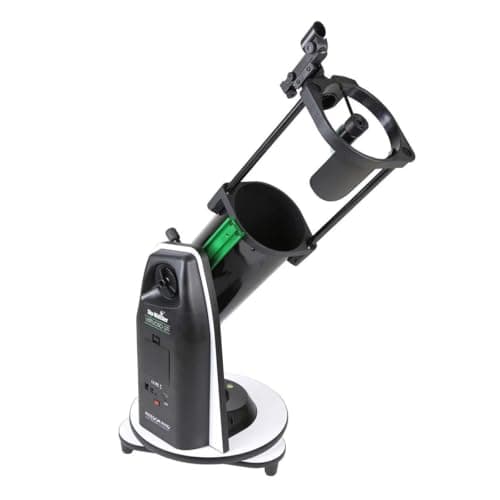 Sky-Watcher Virtuoso GTi 130PTop pickA 130mm collapsible Dobsonian with Wi-Fi GoTo built into the base, and it still lets you push the tube by hand. | GoTo without giving up aperture | 130mm260x useful | |
| 2 | 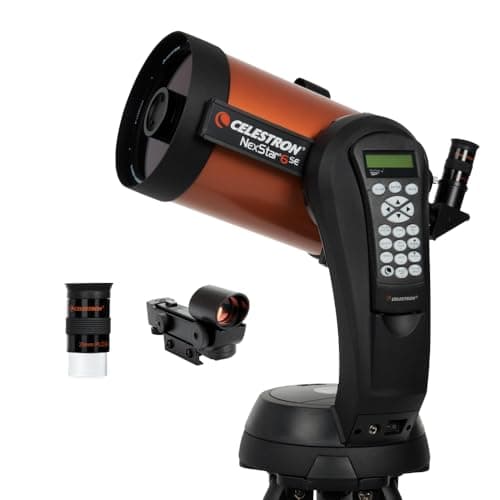 Celestron NexStar 6SE150mm of Schmidt-Cassegrain at f/10 on a computerized fork. Long focal length in a short tube, and the planetary views to match. | The serious step up | 150mm (5.91 in)300x useful | |
| 3 | 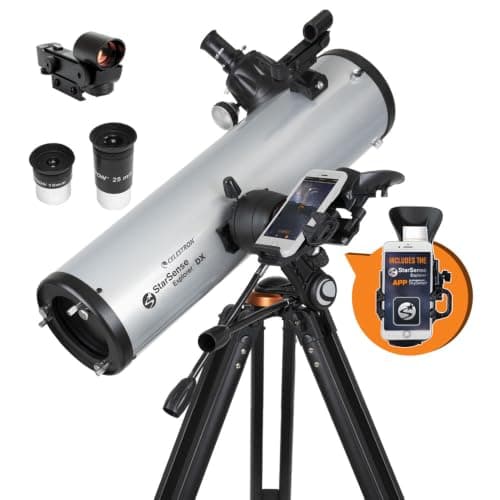 Celestron StarSense Explorer DX 130AZ130mm of parabolic aperture on a mount that stays still, plus the one piece of software that genuinely solves the find-it problem. | Most first buyers | 130mm (5.11 in)260x useful |
Top pick · GoTo without giving up aperture
Sky-Watcher Virtuoso GTi 130P
A 130mm collapsible Dobsonian with Wi-Fi GoTo built into the base, and it still lets you push the tube by hand.
What the aperture allows
- Maximum useful magnification
- 260x
- 2 × 130mm of aperture
- Resolving limit (Dawes)
- 0.89 arcseconds
- 116 ÷ 130mm
- Cassini division (0.7″)
- Out of reach
- this aperture cannot resolve it
Worked example: a 25mm eyepiece in this telescope gives 650mm ÷ 25mm = 26x.
The usual GoTo trade is that you pay for motors instead of glass and end up with a smaller mirror. This one avoids that: it is the same 130mm f/5 optic as the manual Heritage, with the electronics in the base rather than in a tripod.
Two times 130mm is 260x of useful magnification and the published Dawes limit for that aperture is 0.89 arcseconds. The motors change nothing about what the optics can resolve, which is the point worth holding onto: GoTo buys you finding and tracking, never detail.
Freedom Find is the feature that matters in practice. Most GoTo mounts lose their alignment the moment somebody shoves the tube. This one uses encoders on both axes, so a curious nine-year-old grabbing it does not end the session.
Budget for power. Eight AA cells run down faster than you expect in the cold, and a cheap 12V supply is the difference between an evening and forty minutes.
What it does well
- Full aperture and full GoTo in the same package, which is unusual at this size
- Tracking keeps a planet centered at high magnification, which is what makes it worth looking at
- Manual override via dual encoders survives being grabbed
- Collapsible tube on a tabletop base, so it still stores easily
What it costs you
- Eats AA batteries; an external 12V supply is effectively mandatory and is not included
- Alignment is a step every session, however quick
- Tabletop base, so it still needs a surface
Skip this one if: Skip it if you would rather learn the sky than be driven around it. The manual Heritage 130 has the same optics for less.
$495.00 · 13% off
#ad · how this is funded · price as of October 18, 2026
Pick 2 · The serious step up
Celestron NexStar 6SE
150mm of Schmidt-Cassegrain at f/10 on a computerized fork. Long focal length in a short tube, and the planetary views to match.
What the aperture allows
- Maximum useful magnification
- 300x
- 2 × 150mm of aperture
- Resolving limit (Dawes)
- 0.77 arcseconds
- 116 ÷ 150mm
- Cassini division (0.7″)
- Out of reach
- this aperture cannot resolve it
Celestron publishes 354x as this telescope’s highest useful magnification. Our figure is 300x, from two times the aperture in millimeters. The gap of 54x comes from the slightly more generous per-inch constant makers use. Neither number describes a typical night: the atmosphere usually settles the question well below both.
Worked example: a 25mm eyepiece in this telescope gives 1500mm ÷ 25mm = 60x.
The Schmidt-Cassegrain folds a 1500mm light path into a tube about a foot long. That is what you are paying for: 150mm of aperture and a long focal length in something you can pick up with one hand.
Two times 150mm gives 300x of useful magnification. Celestron publishes 354x. Dawes' limit is 0.77 arcseconds, so the Cassini division and the Great Red Spot are both genuinely within reach.
At f/10 a 25mm eyepiece gives 60x rather than the 26x it would give on an f/5 Newtonian, so the widest view this telescope offers is narrower than a Dobsonian's. It is a planetary and double-star instrument first and a deep-sky one second.
This is the point on the list where the price stops being a beginner price. It earns that if the buyer already knows they are staying with the hobby; it is a lot of telescope to gamble on somebody who has never looked through one.
What it does well
- 150mm of aperture in a genuinely portable tube
- Long focal length suits the Moon, the planets and double stars extremely well
- Full GoTo and tracking on a mount that is properly steady for the tube
What it costs you
- Narrow widest field: large open clusters do not fit
- The corrector plate dews up and needs a dew shield or a heater
- Long cool-down before the optics settle
Skip this one if: Skip it if this would be the first telescope in the house. Buy a Dobsonian, find out whether the hobby sticks, and spend this money in a year with much better information.
#ad · how this is funded · price as of October 18, 2026
Pick 3 · Most first buyers
Celestron StarSense Explorer DX 130AZ
130mm of parabolic aperture on a mount that stays still, plus the one piece of software that genuinely solves the find-it problem.
What the aperture allows
- Maximum useful magnification
- 260x
- 2 × 130mm of aperture
- Resolving limit (Dawes)
- 0.89 arcseconds
- 116 ÷ 130mm
- Cassini division (0.7″)
- Out of reach
- this aperture cannot resolve it
Celestron publishes 307x as this telescope’s highest useful magnification. Our figure is 260x, from two times the aperture in millimeters. The gap of 47x comes from the slightly more generous per-inch constant makers use. Neither number describes a typical night: the atmosphere usually settles the question well below both.
Worked example: a 25mm eyepiece in this telescope gives 650mm ÷ 25mm = 26x.
130mm is the aperture where the sky stops being a list of bright dots. Two times that aperture is 260x of useful magnification, which is more than the atmosphere will usually give you on any given night, so nothing in this telescope's optical budget is wasted on a number you cannot use.
Celestron's own published ceiling for it is 307x, which sits above the 2x-aperture rule of thumb. The gap is worth knowing about: manufacturers compute that figure per inch of aperture with a slightly more generous constant. Neither number describes a night you will actually have. Plan around 130x to 180x and treat anything higher as a rare-night bonus.
At f/5 the focal length is short, so the supplied 25mm eyepiece gives a wide, forgiving 26x that makes finding things possible in the first place. That is not a compromise; it is the eyepiece you will use most.
The StarSense part is the honest reason this sits at the top. It uses your phone's camera to plate-solve the actual sky and then walks you to a target with an on-screen arrow. It is not a motor and it does not track. It solves the problem that really kills first telescopes, which is not being able to find anything.
What it does well
- 130mm parabolic mirror rather than the cheaper spherical mirror used at this price by several competitors
- The phone-based finder works and needs no alignment stars, no power and no hand controller
- Full-height tripod, so an adult uses it standing up rather than kneeling on wet grass
- Manual mount means nothing to charge, nothing to fail and nothing to re-align next time
What it costs you
- The bundled 10mm eyepiece is the weakest part of the package
- A Newtonian needs collimation checks; not hard, but it is a task a refractor does not have
- No tracking, so at high magnification you are nudging the tube every 30 seconds
Skip this one if: Skip it if the person receiving it is under about ten and will be using it alone. The tripod is full height and the finding workflow assumes a phone.
#ad · how this is funded · price as of October 18, 2026
Questions people actually ask
What is a smart telescope?
A motorized telescope with a camera instead of an eyepiece. It takes a stream of short exposures, stacks them in software, and shows a processed image on your phone. You never look through it directly.
Are smart telescopes good for beginners?
For imaging faint objects from a light-polluted garden with almost no learning curve, yes. For seeing Saturn's rings with your own eye, no, because there is no eyepiece and the apertures in this category are small for the money.
Can you look through a smart telescope?
No. There is no eyepiece and no way to fit one on most models. Everything you see is on a phone or tablet screen.
Is a smart telescope better than a Dobsonian?
They do different things. A smart telescope shows color and reaches faint objects a Dobsonian cannot show visually. A Dobsonian collects far more light for the money and lets you actually look at the sky. Neither replaces the other.
Read next

GoTo vs Manual: What the Motors Actually Cost You
What a GoTo mount costs in aperture, when it earns that back, and the phone-guided middle option most buyers miss.
Top pick: Celestron NexStar 130SLT
#ad · how this is funded · price as of October 18, 2026

Best for deep sky
Telescopes for Deep Space, and What Deep Sky Really Looks Like
What galaxies and nebulae genuinely look like at each aperture, and why sky darkness matters as much as the telescope.
Top pick: Celestron StarSense Explorer 8-inch Dobsonian
#ad · how this is funded · price as of October 18, 2026

What a City Sky Actually Allows
What survives a bright sky, what does not, and why light pollution changes what you should spend a telescope budget on.
Top pick: Celestron NexStar 6SE
#ad · how this is funded · price as of October 18, 2026
Found something wrong here? Tell us and we will correct it and date the correction, per our editorial policy.