Reviews
Sky-Watcher Virtuoso GTi 130P
The telescope that breaks the usual GoTo trade. You normally pay for motors with glass; here the electronics sit in the base and the mirror stays full size.
By Scooter M. · Published · How we pick

The standard objection to a GoTo telescope is that you pay for motors instead of aperture, and at a given price you end up with a smaller mirror. That objection is usually correct. This telescope is the clearest exception on this site.
Why the trade works here
The electronics live in the tabletop base rather than in a tripod and a fork arm. There is no full-height tripod to pay for, no counterweight, and no separate mount head. What that saves goes into keeping the optic at the full 130mm f/5 that the manual Heritage 130 uses.
max useful magnification = 2 x aperture. Dawes limit = 116 / aperture.
130 x 2 = 260x. 116 / 130 = 0.89 arcseconds.
Identical to the manual Heritage 130, because they are the same optic. This is the point worth holding onto: GoTo buys finding and tracking, never detail. No motor changes what a mirror resolves.
Freedom Find is the feature that matters
Most GoTo mounts lose their alignment the instant somebody grabs the tube and moves it by hand, which on a telescope in a household with children is a matter of when rather than whether.
Sky-Watcher fits dual encoders on both axes and calls the result Freedom Find. The mount reads its own position continuously, so you can push the tube wherever you like and the alignment survives. For a family telescope that single feature is worth more than the GoTo database.
What the GoTo actually gives you
Sky-Watcher publishes a database of over 10,000 objects through the free SynScan Pro app, connecting over the mount's built-in Wi-Fi rather than through a hand controller. Alignment options include one-star, brightest-star, north-level and three-star methods.
The north-level option matters more than it sounds for a beginner, because it does not require identifying a named star. That removes the barrier that makes conventional GoTo awkward as a first telescope. GoTo against manual works the wider trade through.
Tracking is the half people underrate. At 150x on a manual telescope an object crosses the field in under a minute and every look is a nudge. Tracked, 150x becomes somewhere you can settle and actually observe, which is a different experience of the same optic.
Against its own manual sibling
| Virtuoso GTi 130P | Heritage 130 | |
|---|---|---|
| Aperture | 130mm | 130mm |
| Focal length and ratio | 650mm, f/5 | 650mm, f/5 |
| Max useful magnification | 260x | 260x |
| Resolving limit | 0.89 arcsec | 0.89 arcsec |
| Finds objects | Automatically, 10,000+ database | You do |
| Tracks | Yes | No |
| Manual override | Yes, dual encoders | It is all manual |
| Needs power | 8 AA or external 12V | No |
| Setup each session | Alignment routine | Carry it out and look |
How this is funded: the buy buttons below are Amazon Associates links, and a qualifying purchase earns us a commission at no extra cost to you. It cannot move the ranking, because the order here is set by aperture per dollar, and no commission rate changes how much light a mirror collects. Full disclosure.
| # | Telescope | Best for | Aperture | Price |
|---|---|---|---|---|
| 1 | 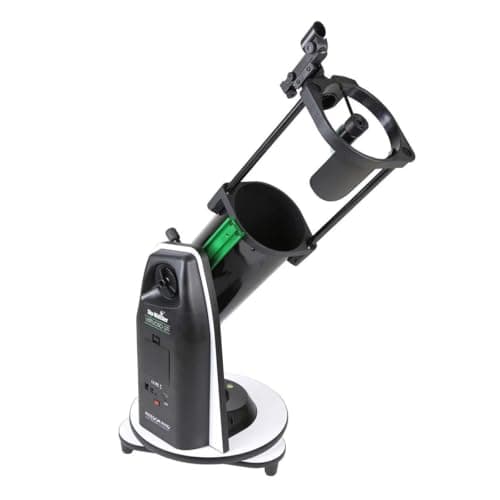 Sky-Watcher Virtuoso GTi 130PTop pickA 130mm collapsible Dobsonian with Wi-Fi GoTo built into the base, and it still lets you push the tube by hand. | GoTo without giving up aperture | 130mm260x useful |
Top pick · GoTo without giving up aperture
Sky-Watcher Virtuoso GTi 130P
A 130mm collapsible Dobsonian with Wi-Fi GoTo built into the base, and it still lets you push the tube by hand.
What the aperture allows
- Maximum useful magnification
- 260x
- 2 × 130mm of aperture
- Resolving limit (Dawes)
- 0.89 arcseconds
- 116 ÷ 130mm
- Cassini division (0.7″)
- Out of reach
- this aperture cannot resolve it
Worked example: a 25mm eyepiece in this telescope gives 650mm ÷ 25mm = 26x.
The usual GoTo trade is that you pay for motors instead of glass and end up with a smaller mirror. This one avoids that: it is the same 130mm f/5 optic as the manual Heritage, with the electronics in the base rather than in a tripod.
Two times 130mm is 260x of useful magnification and the published Dawes limit for that aperture is 0.89 arcseconds. The motors change nothing about what the optics can resolve, which is the point worth holding onto: GoTo buys you finding and tracking, never detail.
Freedom Find is the feature that matters in practice. Most GoTo mounts lose their alignment the moment somebody shoves the tube. This one uses encoders on both axes, so a curious nine-year-old grabbing it does not end the session.
Budget for power. Eight AA cells run down faster than you expect in the cold, and a cheap 12V supply is the difference between an evening and forty minutes.
What it does well
- Full aperture and full GoTo in the same package, which is unusual at this size
- Tracking keeps a planet centered at high magnification, which is what makes it worth looking at
- Manual override via dual encoders survives being grabbed
- Collapsible tube on a tabletop base, so it still stores easily
What it costs you
- Eats AA batteries; an external 12V supply is effectively mandatory and is not included
- Alignment is a step every session, however quick
- Tabletop base, so it still needs a surface
Skip this one if: Skip it if you would rather learn the sky than be driven around it. The manual Heritage 130 has the same optics for less.
$495.00 · 13% off
#ad · how this is funded · price as of October 20, 2026
The tabletop condition still applies
This is a tabletop Dobsonian with motors, and the surface requirement has not gone anywhere. It needs a stable surface at roughly chest height while you are seated. A wooden garden table works; a flexing camping table transmits every touch into the view, and a motorized mount on an unstable surface is worse than a manual one because the slew itself shakes it.
Who should not buy it
Anybody who wants to learn the sky, because being driven around it teaches you very little and the manual Heritage 130 has the same optics for less. Anybody without a suitable table. And anybody unwilling to deal with power, because this telescope is inert without it in a way a Dobsonian never is.
This is the telescope that heads the best GoTo telescopes, where it is ranked against the fork-mounted alternatives.
Questions people actually ask
Is the Sky-Watcher Virtuoso GTi 130P worth it?
It is unusually good value for a GoTo telescope, because the electronics sit in a tabletop base instead of a tripod, so the optic stays a full 130mm f/5 rather than shrinking to pay for motors. The cost is power and an alignment step each session.
Does GoTo let you see more?
No. Motors do not collect light. This telescope resolves 0.89 arcseconds and tops out at 260x of useful magnification, exactly like the manual Heritage 130 that shares its optics. GoTo buys finding and tracking.
What is Freedom Find?
Sky-Watcher's dual-encoder system. The mount reads its own position on both axes continuously, so you can move the tube by hand without losing the alignment. On most GoTo mounts that would end the session.
Does the Virtuoso GTi need batteries?
Yes. Sky-Watcher publishes eight AA batteries or an external 12V supply, and the supply is not included. AAs drain quickly in cold weather, so a 12V source is effectively part of the purchase.
Does it need a table?
Yes. It is a tabletop Dobsonian and needs a stable surface at seated chest height. An unstable surface is worse here than on a manual telescope, because the motor slew shakes it too.
Read next

GoTo vs Manual: What the Motors Actually Cost You
What a GoTo mount costs in aperture, when it earns that back, and the phone-guided middle option most buyers miss.
Top pick: Celestron NexStar 130SLT
#ad · how this is funded · price as of October 20, 2026

Sky-Watcher Heritage 130 Tabletop Dobsonian
The aperture-per-dollar champion: 130mm parabolic in a collapsible tube, with one condition to check first.
Top pick: Sky-Watcher Heritage 130 Tabletop Dobsonian
$305.00 · 12% off
#ad · how this is funded · price as of October 20, 2026
Best tabletop
Tabletop Telescopes, and the One Thing to Check First
The best value design in beginner astronomy, and the surface requirement that decides whether it works for you.
Top pick: Sky-Watcher Heritage 130 Tabletop Dobsonian
$305.00 · 12% off
#ad · how this is funded · price as of October 20, 2026
Found something wrong here? Tell us and we will correct it and date the correction, per our editorial policy.