Beginner Telescopes
Can You Do Astrophotography With a Beginner Telescope?
The answer splits cleanly in two, and which half you are in is decided by your mount rather than your optics. Almost nobody tells buyers that before they spend the money.
By Scooter M. · Published · How we pick
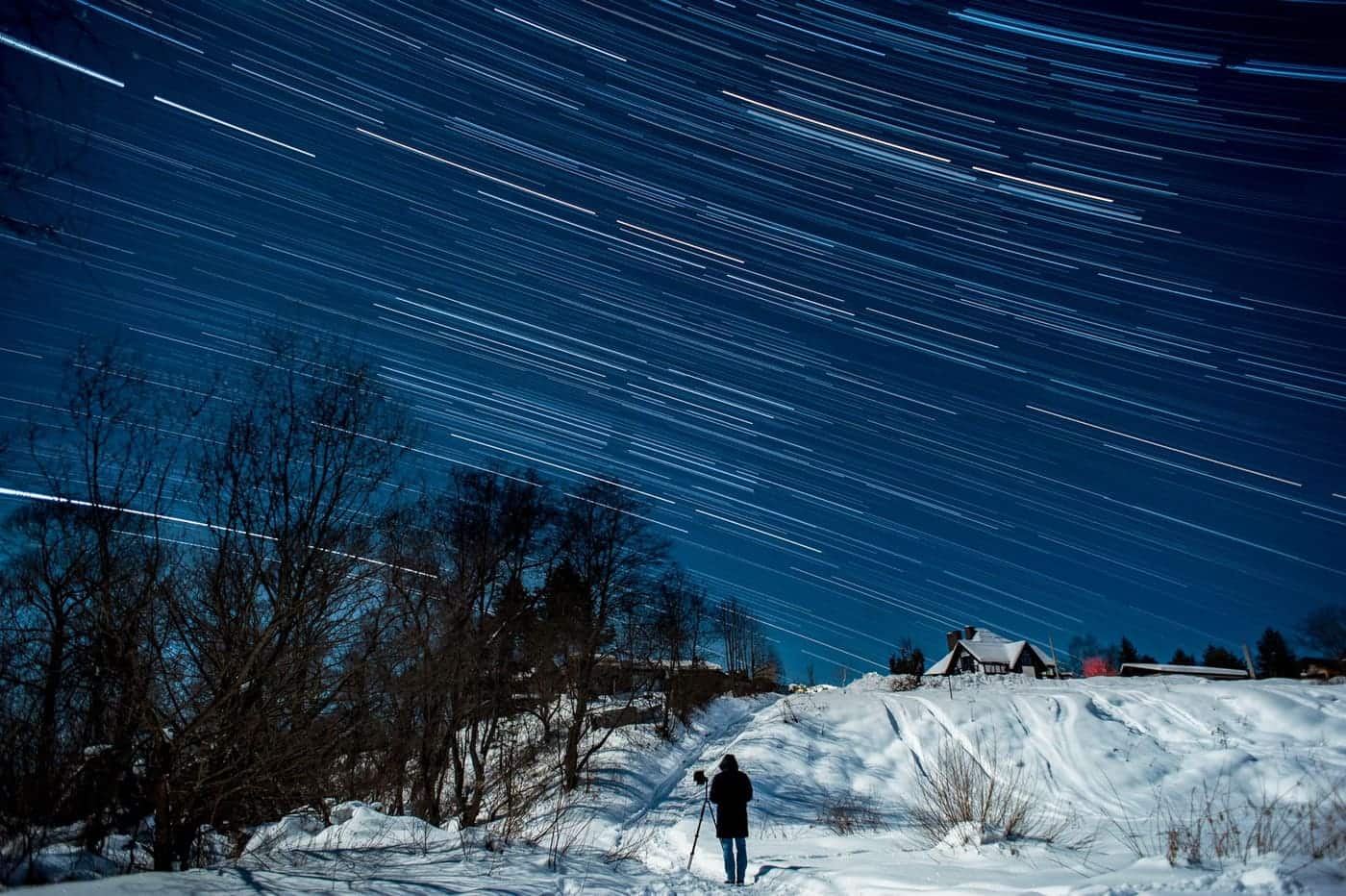
Yes for the Moon and the planets, and the cheapest honest route is a $62 phone adapter such as the Celestron NexYZ on whatever telescope you already own. No for galaxies and nebulae, unless the mount tracks — and for that the Sky-Watcher Virtuoso GTi 130P is the least expensive telescope on this site that genuinely qualifies. The dividing line is not optical quality or aperture. It is whether the mount can follow the sky.
This matters because the two halves cost about twenty times different amounts, and a buyer who does not know the line exists usually buys a Dobsonian for its aperture and then discovers it cannot do the thing they bought it for.
Why the mount decides it
The sky turns. A sidereal day is 23 hours 56 minutes 4.0905 seconds, so everything drifts across the eyepiece continuously, and a camera recording for more than a moment records that drift as a streak. Untracked exposures must stay under a minute to avoid having a star's point image become an elongated line, and through a telescope's long focal length the real limit is a small fraction of that.
bright target = short exposure. faint target = long exposure.
The Moon and the bright planets, the brightest objects in the night sky: fractions of a second. A galaxy or nebula, whose light is spread thinly across many arcminutes: seconds to minutes.
Fractions of a second do not care that the sky is moving. Minutes care enormously. That single difference is why lunar and planetary imaging works on any mount and deep-sky imaging does not.
What the easy half actually gets you
The Moon through a phone held to an eyepiece is the single most satisfying result in beginner astrophotography, and it is genuinely easy. The Moon is bright, large and tolerant: the exposure is short enough that drift is irrelevant, and the result looks like the Moon rather than like a smudge.
The planets are harder but still in the untracked half, because of a technique called lucky imaging: instead of one long exposure you record a video, and software selects and stacks the sharpest frames. That is typically used when observing planetary objects and helps to overcome atmospheric conditions, and it turns the atmosphere from a hard limit into a statistical one.
| Target | Exposure | Untracked mount | What you need |
|---|---|---|---|
| The Moon | 1/100 s to 1/500 s | Yes, easily | Phone and an adapter |
| Jupiter, Saturn, Mars | Video, then stacking | Yes, with patience | Phone or webcam, stacking software |
| Venus phases | Fractions of a second | Yes | Phone and an adapter |
| Bright star clusters | A few seconds | Marginal | Tracking strongly preferred |
| Orion Nebula | 15 s to minutes | No | A tracking mount |
| Andromeda, faint galaxies | Minutes, stacked | No | Tracking, and ideally guiding |
What "tracking" has to mean to count
Three things get called tracking and only one of them is. A mount that slews to an object has a catalog, which is a finding feature. A mount that plate-solves with a phone, as the StarSense system does, tells you where to push, which is also a finding feature. A mount that tracks drives continuously at the sky's rate once it is on target, which is the only one that lets a shutter stay open.
Single-axis trackers need accurate polar alignment; dual-axis mounts can also correct in declination with auto-guiding, which is what allows the longest exposures. For a beginner the practical distinction is simpler: does the mount keep the object centered by itself for several minutes without you touching it? If not, deep-sky imaging is out of reach whatever else the telescope does well.
How these picks were judged
- Tracking capability first, because it is the binary that decides which half of the hobby a buyer can enter.
- Then focal ratio and focal length against the target. A long f/10 suits planets; a shorter, faster tube is friendlier for extended deep-sky objects.
- Then what it costs to get a first usable image, not what it costs to reach the ceiling. The cheapest honest entry is ranked first for that reason.
- Aperture was deliberately demoted. A 203mm Dobsonian outperforms every pick here visually and cannot produce a deep-sky exposure, which is the whole argument of this page.
- Nothing here is sold as a serious imaging rig. Dedicated cooled cameras, guide scopes and equatorial mounts are a different budget, and pretending otherwise would be dishonest.
Which of these is for you
| Pick | Best for | The catch |
|---|---|---|
| Celestron NexYZ 3-Axis Phone Adapter | Best first purchase for anyone with any telescope: it unlocks the Moon and the planets for the price of an eyepiece | Does nothing for deep sky, because it cannot make an untracked mount hold still |
| Sky-Watcher Virtuoso GTi 130P | Best value entry to tracked imaging: it genuinely drives at sky rate, so a multi-second exposure is possible | 130mm and a tabletop base is the floor of deep-sky imaging, not a comfortable place to work from |
| Celestron NexStar 8SE | Best for planetary imaging: 203mm at f/10 gives the resolution and the magnification that lucky imaging rewards | Its long focal length and single-arm fork make it a poor deep-sky imaging platform despite the tracking |
| Celestron NexStar 6SE | Best balance of tracking, aperture and portability if planets are the main imaging target | Same focal-length problem as the 8SE, with less aperture, at a price well above the Virtuoso |
| Celestron StarSense Explorer DX 130AZ | Best if the real goal is observing and you want Moon and planet photos alongside it | Phone plate-solving is finding, not tracking. This mount cannot do deep-sky exposures at all |
How this is funded: the buy buttons below are Amazon Associates links, and a qualifying purchase earns us a commission at no extra cost to you. It cannot move the ranking, because the order here is set by aperture per dollar, and no commission rate changes how much light a mirror collects. Full disclosure.
| # | Telescope | Best for | Aperture | Price |
|---|---|---|---|---|
| 1 | 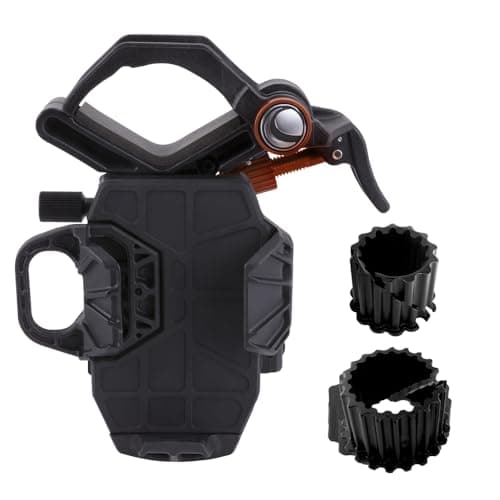 Celestron NexYZ 3-Axis Smartphone AdapterTop pickThree knob-driven axes that hold a phone camera over an eyepiece and let you align it precisely. The part that makes phone lunar photography work rather than frustrate. | Getting a phone photo of the Moon | Eyepiece clamp 35mm to 60mm70x useful | |
| 2 | 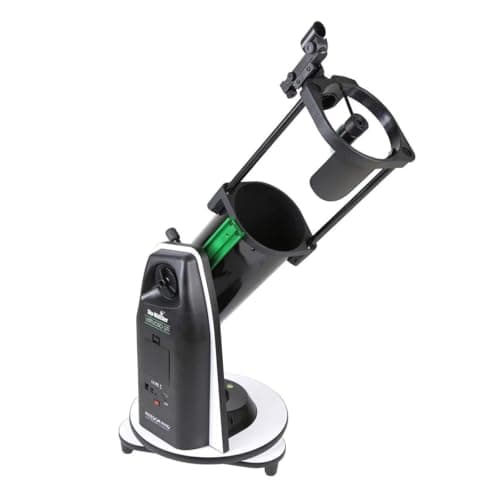 Sky-Watcher Virtuoso GTi 130PA 130mm collapsible Dobsonian with Wi-Fi GoTo built into the base, and it still lets you push the tube by hand. | GoTo without giving up aperture | 130mm260x useful | |
| 3 | 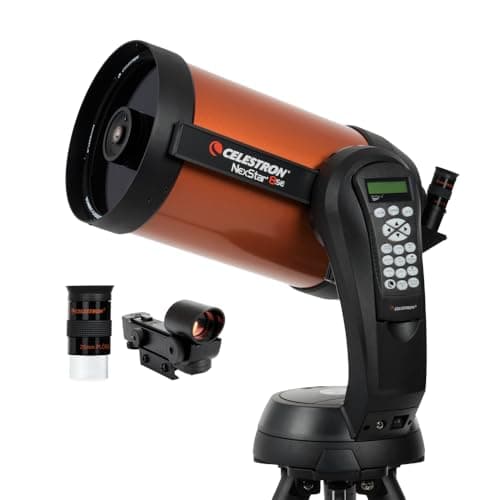 Celestron NexStar 8SE203mm of Schmidt-Cassegrain at f/10 on a computerized fork. The largest aperture on this site that still finds and follows objects by itself. | The most aperture that still tracks | 203.2mm (8")406x useful | |
| 4 | 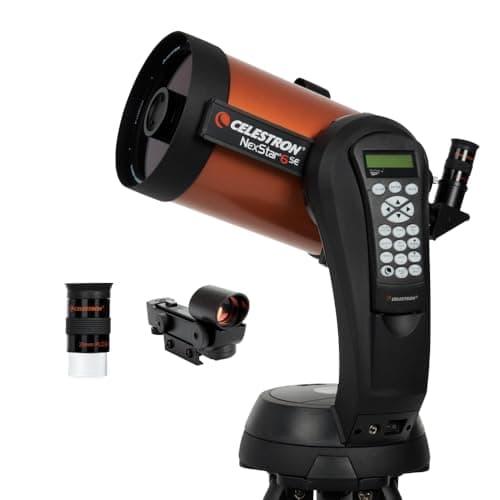 Celestron NexStar 6SE150mm of Schmidt-Cassegrain at f/10 on a computerized fork. Long focal length in a short tube, and the planetary views to match. | The serious step up | 150mm (5.91 in)300x useful | |
| 5 | 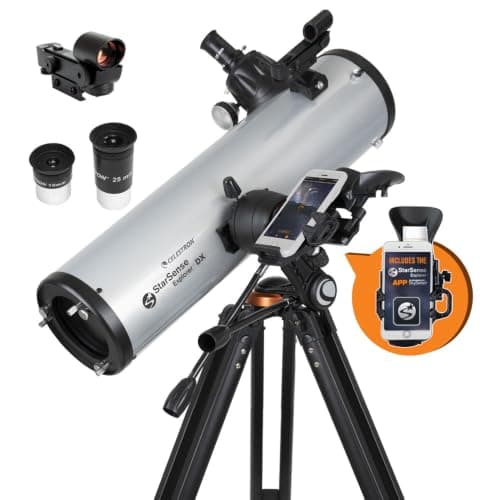 Celestron StarSense Explorer DX 130AZ130mm of parabolic aperture on a mount that stays still, plus the one piece of software that genuinely solves the find-it problem. | Most first buyers | 130mm (5.11 in)260x useful |
Top pick · Getting a phone photo of the Moon
Celestron NexYZ 3-Axis Smartphone Adapter
Three knob-driven axes that hold a phone camera over an eyepiece and let you align it precisely. The part that makes phone lunar photography work rather than frustrate.
What the aperture allows
- Maximum useful magnification
- 70x
- 2 × 35mm of aperture
- Resolving limit (Dawes)
- 3.31 arcseconds
- 116 ÷ 35mm
- Cassini division (0.7″)
- Out of reach
- this aperture cannot resolve it
The problem this solves is smaller than it sounds and more annoying than it looks. A phone camera has to sit centered over the eyepiece and at the right distance, within about a millimeter, or the image vignettes to a dark circle or vanishes. Holding a phone there by hand works for about four seconds.
Three axes with knobs is the difference between that and a repeatable setup. You clamp once, then dial the phone into position while watching the screen, and it stays there while you take a dozen frames.
The 10 oz weight is worth thinking about on a small telescope. On a light alt-azimuth mount, hanging 283 grams off the eyepiece shifts the balance and adds vibration, and on a tabletop Dobsonian it can be enough to make the tube drift.
What it does not do is turn a telescope into an astrophotography rig. The Moon works because it is bright enough for a short exposure. Anything fainter needs tracking and long exposures, which is a different hobby with a different budget.
What it does well
- Three knob-driven axes make phone alignment repeatable instead of a wrestling match
- Wide clamp range fits most eyepieces and most phones, with adapters down to 25mm
- Works on binoculars and spotting scopes as well as telescopes
- Cast metal rather than all plastic at the load-bearing points
What it costs you
- 283 grams hanging off the eyepiece unbalances a light mount and adds vibration
- Only really useful on the Moon and the brightest planets
- Fiddly the first few times, whatever the mechanism
- A phone in a case usually has to come out of the case
Skip this one if: Skip it if you want photographs of nebulae or galaxies. This is a lunar and bright-planet accessory, and no bracket changes what a short handheld exposure can capture.
$66.95 · 7% off
#ad · how this is funded · price as of October 18, 2026
Pick 2 · GoTo without giving up aperture
Sky-Watcher Virtuoso GTi 130P
A 130mm collapsible Dobsonian with Wi-Fi GoTo built into the base, and it still lets you push the tube by hand.
What the aperture allows
- Maximum useful magnification
- 260x
- 2 × 130mm of aperture
- Resolving limit (Dawes)
- 0.89 arcseconds
- 116 ÷ 130mm
- Cassini division (0.7″)
- Out of reach
- this aperture cannot resolve it
Worked example: a 25mm eyepiece in this telescope gives 650mm ÷ 25mm = 26x.
The usual GoTo trade is that you pay for motors instead of glass and end up with a smaller mirror. This one avoids that: it is the same 130mm f/5 optic as the manual Heritage, with the electronics in the base rather than in a tripod.
Two times 130mm is 260x of useful magnification and the published Dawes limit for that aperture is 0.89 arcseconds. The motors change nothing about what the optics can resolve, which is the point worth holding onto: GoTo buys you finding and tracking, never detail.
Freedom Find is the feature that matters in practice. Most GoTo mounts lose their alignment the moment somebody shoves the tube. This one uses encoders on both axes, so a curious nine-year-old grabbing it does not end the session.
Budget for power. Eight AA cells run down faster than you expect in the cold, and a cheap 12V supply is the difference between an evening and forty minutes.
What it does well
- Full aperture and full GoTo in the same package, which is unusual at this size
- Tracking keeps a planet centered at high magnification, which is what makes it worth looking at
- Manual override via dual encoders survives being grabbed
- Collapsible tube on a tabletop base, so it still stores easily
What it costs you
- Eats AA batteries; an external 12V supply is effectively mandatory and is not included
- Alignment is a step every session, however quick
- Tabletop base, so it still needs a surface
Skip this one if: Skip it if you would rather learn the sky than be driven around it. The manual Heritage 130 has the same optics for less.
$495.00 · 13% off
#ad · how this is funded · price as of October 18, 2026
Pick 3 · The most aperture that still tracks
Celestron NexStar 8SE
203mm of Schmidt-Cassegrain at f/10 on a computerized fork. The largest aperture on this site that still finds and follows objects by itself.
What the aperture allows
- Maximum useful magnification
- 406x
- 2 × 203.2mm of aperture
- Resolving limit (Dawes)
- 0.57 arcseconds
- 116 ÷ 203.2mm
- Cassini division (0.7″)
- Within reach
- on a steady night, at high magnification
Celestron publishes 480x as this telescope’s highest useful magnification. Our figure is 406x, from two times the aperture in millimeters. The gap of 74x comes from the slightly more generous per-inch constant makers use. Neither number describes a typical night: the atmosphere usually settles the question well below both.
Worked example: a 25mm eyepiece in this telescope gives 2032mm ÷ 25mm = 81x.
Two times 203.2mm gives 406x of useful magnification, and Dawes' limit is 0.57 arcseconds. That is comfortably inside the 0.7 arcseconds the Cassini division needs, so the gap in Saturn's rings is genuinely available on a steady night rather than theoretically available.
Celestron publishes 843 times the light-gathering of the eye and a limiting stellar magnitude of 14. Against the 150mm NexStar 6SE the collecting area ratio is (203.2 / 150) squared = 1.83, so this telescope collects 83 percent more light than the 6SE.
At f/10 the focal length is 2032mm, so the supplied 25mm eyepiece gives 81x. That is a high lowest power: the widest true field this telescope offers is narrow, and large open clusters and the Andromeda galaxy will not fit in it.
The number that decides most purchases is not on the spec sheet. The optical tube and the fork are one 32 lb assembly with a separate tripod, and it is carried in two hands, not one. A telescope that lives in a closet because it is awkward to move sees less sky than a smaller one by the door.
What it does well
- 203mm of aperture that finds and tracks objects on its own
- Resolves the Cassini division at 0.57 arcseconds on a steady night
- The long 2032mm focal length suits planets and double stars exceptionally well
What it costs you
- 32 lb of kit weight, in two pieces, every session
- The narrowest widest-field of any telescope on this site: 81x with the supplied eyepiece
- Needs mains power or a battery pack, and a dew shield for the corrector plate
Skip this one if: Skip it if this is a first telescope. It is a lot of money and a lot of weight to gamble on a hobby that has not stuck yet, and an 8-inch Dobsonian shows the same sky without the motors, the batteries or the fork.
#ad · how this is funded · price as of October 18, 2026
Pick 4 · The serious step up
Celestron NexStar 6SE
150mm of Schmidt-Cassegrain at f/10 on a computerized fork. Long focal length in a short tube, and the planetary views to match.
What the aperture allows
- Maximum useful magnification
- 300x
- 2 × 150mm of aperture
- Resolving limit (Dawes)
- 0.77 arcseconds
- 116 ÷ 150mm
- Cassini division (0.7″)
- Out of reach
- this aperture cannot resolve it
Celestron publishes 354x as this telescope’s highest useful magnification. Our figure is 300x, from two times the aperture in millimeters. The gap of 54x comes from the slightly more generous per-inch constant makers use. Neither number describes a typical night: the atmosphere usually settles the question well below both.
Worked example: a 25mm eyepiece in this telescope gives 1500mm ÷ 25mm = 60x.
The Schmidt-Cassegrain folds a 1500mm light path into a tube about a foot long. That is what you are paying for: 150mm of aperture and a long focal length in something you can pick up with one hand.
Two times 150mm gives 300x of useful magnification. Celestron publishes 354x. Dawes' limit is 0.77 arcseconds, so the Cassini division and the Great Red Spot are both genuinely within reach.
At f/10 a 25mm eyepiece gives 60x rather than the 26x it would give on an f/5 Newtonian, so the widest view this telescope offers is narrower than a Dobsonian's. It is a planetary and double-star instrument first and a deep-sky one second.
This is the point on the list where the price stops being a beginner price. It earns that if the buyer already knows they are staying with the hobby; it is a lot of telescope to gamble on somebody who has never looked through one.
What it does well
- 150mm of aperture in a genuinely portable tube
- Long focal length suits the Moon, the planets and double stars extremely well
- Full GoTo and tracking on a mount that is properly steady for the tube
What it costs you
- Narrow widest field: large open clusters do not fit
- The corrector plate dews up and needs a dew shield or a heater
- Long cool-down before the optics settle
Skip this one if: Skip it if this would be the first telescope in the house. Buy a Dobsonian, find out whether the hobby sticks, and spend this money in a year with much better information.
#ad · how this is funded · price as of October 18, 2026
Pick 5 · Most first buyers
Celestron StarSense Explorer DX 130AZ
130mm of parabolic aperture on a mount that stays still, plus the one piece of software that genuinely solves the find-it problem.
What the aperture allows
- Maximum useful magnification
- 260x
- 2 × 130mm of aperture
- Resolving limit (Dawes)
- 0.89 arcseconds
- 116 ÷ 130mm
- Cassini division (0.7″)
- Out of reach
- this aperture cannot resolve it
Celestron publishes 307x as this telescope’s highest useful magnification. Our figure is 260x, from two times the aperture in millimeters. The gap of 47x comes from the slightly more generous per-inch constant makers use. Neither number describes a typical night: the atmosphere usually settles the question well below both.
Worked example: a 25mm eyepiece in this telescope gives 650mm ÷ 25mm = 26x.
130mm is the aperture where the sky stops being a list of bright dots. Two times that aperture is 260x of useful magnification, which is more than the atmosphere will usually give you on any given night, so nothing in this telescope's optical budget is wasted on a number you cannot use.
Celestron's own published ceiling for it is 307x, which sits above the 2x-aperture rule of thumb. The gap is worth knowing about: manufacturers compute that figure per inch of aperture with a slightly more generous constant. Neither number describes a night you will actually have. Plan around 130x to 180x and treat anything higher as a rare-night bonus.
At f/5 the focal length is short, so the supplied 25mm eyepiece gives a wide, forgiving 26x that makes finding things possible in the first place. That is not a compromise; it is the eyepiece you will use most.
The StarSense part is the honest reason this sits at the top. It uses your phone's camera to plate-solve the actual sky and then walks you to a target with an on-screen arrow. It is not a motor and it does not track. It solves the problem that really kills first telescopes, which is not being able to find anything.
What it does well
- 130mm parabolic mirror rather than the cheaper spherical mirror used at this price by several competitors
- The phone-based finder works and needs no alignment stars, no power and no hand controller
- Full-height tripod, so an adult uses it standing up rather than kneeling on wet grass
- Manual mount means nothing to charge, nothing to fail and nothing to re-align next time
What it costs you
- The bundled 10mm eyepiece is the weakest part of the package
- A Newtonian needs collimation checks; not hard, but it is a task a refractor does not have
- No tracking, so at high magnification you are nudging the tube every 30 seconds
Skip this one if: Skip it if the person receiving it is under about ten and will be using it alone. The tripod is full height and the finding workflow assumes a phone.
#ad · how this is funded · price as of October 18, 2026
A realistic first session
- Start with the Moon, a few days either side of first quarter. The terminator throws long shadows and the result looks dramatic without any processing.
- Fit the phone adapter and find focus through the phone screen, not through your eye. The two focus points are not the same.
- Turn off the phone's flash and lower its exposure. The default setting will blow the Moon out to a white disc every time.
- Then try Jupiter or Saturn as video, 30 to 60 seconds of it, and stack the frames with free software afterwards.
- Expect the planets to be small. You are recording a 40-arcsecond target through a phone lens; the result is a recognizable Saturn, not a magazine cover.
- Only then decide whether deep sky is worth a tracking mount. You will know far more about what you actually enjoy, and the Moon and planets cost almost nothing to find out.
What the next step up actually costs
Worth knowing before you start, because the escalation is steeper than the first purchase suggests and nobody mentions it until you are in it.
- A phone adapter. Unlocks the Moon and planets on any telescope. This is where everyone should start.
- A mount that tracks. Opens deep sky at all. Single-axis trackers need accurate polar alignment to work; get this wrong and the drift comes back.
- Dual-axis tracking with auto-guiding. Corrects in declination as well as right ascension, which is what allows genuinely long exposures. A separate guide scope or an off-axis guider comes with it.
- A camera built for it. Dedicated astrophotography cameras cool their sensor to cut thermal noise in long exposures and give raw readout. Some DSLRs are made with extra hydrogen-alpha sensitivity for emission nebulae.
- Narrowband or light-pollution filters, if you are imaging from a suburb rather than driving somewhere dark.
Each of those steps costs more than the one before it, and the first step costs about as much as an eyepiece. That asymmetry is the practical argument for doing the Moon and the planets first: it is the cheapest possible way to find out whether you enjoy the process, and most of what you learn transfers.
If the phone side is what interests you, telescopes and phones goes further into which adapters fit what and where phone finding differs from phone photography. If tracking is the part that matters, the GoTo roundup ranks the driven mounts, and GoTo against manual is the honest cost comparison.
Questions people actually ask
Can you do astrophotography with a beginner telescope?
The Moon and the planets, yes, with almost any telescope and a smartphone adapter, because those exposures last fractions of a second. Galaxies and nebulae need exposures of seconds to minutes, which requires a mount that tracks the sky. The mount decides it, not the optics.
Can you do astrophotography with a Dobsonian?
Lunar and planetary, yes. Deep-sky, no. A Dobsonian has no drive, so you nudge it to keep up, and nothing you can add changes that. Untracked exposures have to stay under a minute to avoid turning stars into lines, and through a telescope the real limit is a small fraction of that.
What is the cheapest way to start astrophotography?
A phone adapter on a telescope you already own, around $62. It unlocks the Moon and the planets immediately. That is the honest entry point, and it tells you whether you enjoy imaging before you spend ten times as much on a tracking mount.
Do I need a tracking mount for astrophotography?
For deep sky, yes. For the Moon and planets, no. Tracking means the mount drives continuously at the sky's rate once centered, which is different from a GoTo catalog that slews to an object or a phone app that plate-solves and tells you where to push.
How do people photograph planets without long exposures?
By recording video instead of a single frame. Software then selects and stacks the sharpest frames, a technique called lucky imaging, which is typically used on planetary objects and helps overcome atmospheric turbulence. It works on an untracked mount because each frame is very short.
Will my phone photos look like the pictures online?
The Moon will look genuinely good. The planets will be small but recognizable. Galaxies and nebulae will not, because those images are long exposures stacked over hours with cooled cameras, guiding and filters, which is a different budget and a different hobby.
Read next
Best with a phone
Telescopes and Phones: Finding, Photographing, and Which You Actually Want
Phone finding and phone photography are different jobs needing different hardware. Which telescopes do which, and what a phone can honestly capture.
Top pick: Celestron StarSense Explorer DX 130AZ
#ad · how this is funded · price as of October 18, 2026
Best GoTo
The Best GoTo Telescopes
Computerized telescopes ranked on what the motors cost in aperture, whether they track as well as find, and what they need to run.
Top pick: Sky-Watcher Virtuoso GTi 130P
$495.00 · 13% off
#ad · how this is funded · price as of October 18, 2026
GoTo vs Manual: What the Motors Actually Cost You
What a GoTo mount costs in aperture, when it earns that back, and the phone-guided middle option most buyers miss.
Top pick: Celestron NexStar 130SLT
#ad · how this is funded · price as of October 18, 2026
Found something wrong here? Tell us and we will correct it and date the correction, per our editorial policy.